Share
That's What I Call Marketing
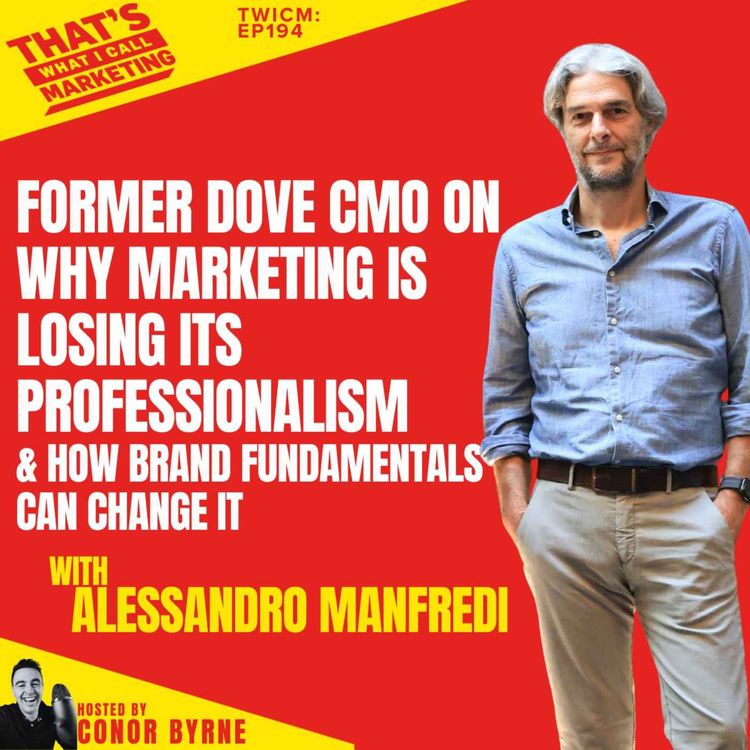
TWICM 194: Former Dove CMO Alessandro Manfredi on Why Marketing Is Losing It's Professionalism
Former Dove CMO Alessandro Manfredi joins That’s What I Call Marketing to discuss Dove Real Beauty, brand fundamentals, AI, creative effectiveness and why marketing may be losing some of its professionalism. Alessandro spent 28 years at Unilever and played a major role in the growth of Dove, one of the most famous examples of long-term brand building in modern marketing. In this conversation, he explains why Dove’s success was not built on purpose alone, but on product quality, emotional connection, research, innovation, communication architecture and strategic rigour. Thanks to the Marketing Society of Ireland for organising this event. Tracksuit cares deeply about marketing professionalism and have introduced Tracksuit University to close the gap between Marketing and the C Suite and you can get 20% Off with an exclusive TWICM Discout - use the code thatswhaticallmarketing at https://university.gotracksuit.com/
This episode is for marketers, CMOs, brand leaders, strategists and agency teams who want to understand what it really takes to build brands that last.
What you will learn:
- Why marketing is losing some of its professionalism and training
- How Dove Real Beauty moved the brand from product love to emotional connection
- Why “people don’t buy beautiful ideas” without strong products behind them
- What Alessandro means by brand fundamentals
- Why AI is powerful for execution, but not a replacement for strategy
- How CMOs can reclaim strategic influence without making it a power grab
- Why brands need to shape culture rather than chase trends
- How purpose can work when it is grounded in a real human tension
- What smaller marketing teams can learn from Dove’s approach to creativity, insight and rigour
Chapters:
03:35 From academia to Unilever and Dove
06:22 The origins of Dove Real Beauty
09:37 Why marketing is losing strategic discipline
12:03 How Dove grew over 20 years
14:23 Research, insight and emotional connection
19:30 Why people do not buy beautiful ideas alone
20:41 Brand fundamentals and communication architecture
22:54 Why AI is not strategy
24:32 Working with agencies and strategic planners
25:48 The three elements of bulletproof brand fundamentals
29:34 Purpose, North Star and shaping culture
33:09 Creative effectiveness: culture, talent and rigour
36:50 What smaller marketing teams can learn from Dove
37:26 Handling criticism of Real Beauty
39:04 Social media, mental health and marketers’ responsibility
41:23 Life after Dove and Unilever
44:37 Where to find Alessandro Manfredi
Guest: Alessandro Manfredi
Host: Conor Byrne
Podcast: That’s What I Call Marketing
Find out more about Alessandro Manfredi: aleikigai.com
Learn more about Tracksuit: gotracksuit.com
Subscribe for more conversations with leading marketers, CMOs, brand builders, strategists and creative leaders. https://www.thatswhaticallmarketing.com/
#Marketing #BrandBuilding #Dove #RealBeauty #CMO #BrandStrategy #CreativeEffectiveness #AIInMarketing #Unilever #MarketingLeadership #PurposeMarketing #BrandFundamentals #ThatsWhatICallMarketing
More episodes
View all episodes

The Cannes Sessions - TWICM X The Uncensored CMO
24:27|Jon Evans (Uncensored CMO) on Going Solo: Sponsorship, Podcasting as Networking & Cashflow RealityConor Byrne chats with Jon Evans (Uncensored CMO) about leaving the CMO track to run his podcast full time, using sponsorship to fund the work and turning “being good at talking” into a career. Jon explains why podcasting is a powerful networking tool—CMOs often decline coffee but say yes to being a guest—and how it accelerates learning by speaking to experts weekly. He also shares the less glamorous surprises of working for yourself: contracts, running a business properly, cashflow, and the difficulty of getting paid on time while supporting a team. Jon stresses that success is a long grind—“seven years to have an overnight success”—and that consistency and compounding effort are what make creator-led media businesses work in marketing.
The Cannes Sessions Day 4 - Daily Round Up 25/06/2026
28:38|In this episode of the Cannes Sessions, Conor Byrne takes us through another packed day on the Croisette, starting with the CMOs in the Spotlight session featuring Jill Kramer of Mastercard, Michelle Klein of Westpac, Manuel “Manolo” Arroyo of The Coca-Cola Company, and Suhayl Limbada CMO of KFC India. There were big themes running through the day: how legacy brands stay useful, why marketers need to understand the P&L, what happens when creativity meets commercial pressure, and why the best brands do not throw away their distinctive assets just because the world has changed. There is also a brilliant conversation with Maddy Cooper, Founder and CEO of Flourish, on how AI can help marketers in regulated sectors get work to market faster without creating a compliance nightmare. That matters because the future of marketing is not just more content, more formats and more channels. It is whether brands can still make sharp, responsible, commercially useful work at the speed the market now demands. The Digital Voice team were also out on the Croisette speaking to marketers including Langton McCombe from Particular Audience, Rory McDonald from Market Media at The Warehouse Group, and Alex Springer from OpenAttribution.org about retail media, incrementality, AI, ROAS, creativity, and what Cannes is really for and James Taylor CEO of Particular Audience.And, of course, there was a big moment for Ireland, with Heineken’s The Pub That Refused To Die winning a Grand Prix, plus a look ahead to the Cannes Young Lions results where Darragh Spain and Fardosa Flanagan from 123.ie represented Ireland in the Young Marketers category along with lots of amazing talent representing Ireland.01:18 – CMOs in the Spotlight: Mastercard, KFC India, Westpac and Coca-Cola02:01 – Why Mastercard is re-examining the Priceless platform03:14 – KFC, Gen Z, universal truths and the role of the Colonel04:19 – Westpac, jingles, legacy brands and speaking the language of the CFO05:14 – Coca-Cola, creativity, behaviour and why great teams matter more than big budgets11:28 – Spending time with Jonnie Cahill and the value of generous senior marketers15:03 – Maddy Cooper on Flourish, AI, compliance and regulated marketing18:29 – Inside the Cannes Lions work exhibition21:00 – Ireland’s Grand Prix moment for Heineken23:58 – Langton McCombe on retail media, commerce media and incrementality26:32 – Rory McDonald on creativity, ROAS and business outcomes29:54 – Alex Springer on attribution, AI, influence and the future of content34:26 – Final reflections from Cannes Sessions 2026Thanks to The Digital Voice for partnering on the Cannes Sessions.Find out more:The Digital Voice: thedigitalvoice.co.ukFlourish: flourishingworld.comThat’s What I Call Marketing: follow the podcast for more conversations with the people shaping modern marketing.
The Cannes Sessions Day 3 - Daily Round Up 24/06/2026
21:00|Cannes Lions Day 3: Moloco CMO Paul Darcy on AI Disruption, Brand vs Performance + Festival Voices & Award HighlightsOn day three of the Cannes Lions Festival of Creativity, host Conor Byrne records The Cannes Sessions in partnership with The Digital Voice and interviews Paul Darcy, CMO of Moloco, fresh off an Adweek panel on how AI and LLM-driven consumer behavior are disrupting digital brands and acquisition channels. Darcy discusses the growing importance of brand as a signal to LLMs, the rising opportunity cost and measurement challenges of brand media versus increasingly optimized performance marketing (including CTV and in-app video), and Moloco’s focus on expanding modern performance surfaces. He also summarizes Moloco and BCG’s report on AI disruption by industry, highlighting discovery and customer-relationship durability, and notes AI overviews reducing clicks. The episode also features Cannes attendee perspectives (Amir Rasekh of Nectar 360, Beatrice Bordel Grant, Pauline Yoo from Samsung Ads, and Max from Adnormally) and Conor’s press-room roundup of select Cannes Lions winners.00:00 Welcome to Cannes01:15 Meet Paul Darcy01:39 AI Disrupts Brands02:43 Brand vs Performance04:29 Performance as Brand05:19 Fixing Ad Inefficiency06:44 Moloco Growth Mission07:19 BCG Disruption Report10:33 Digital Voice Street Chats10:56 Nectar 360 Goals11:50 Amazon Port Surprise14:24 Samsung Ads Highlights16:12 Networking at Cannes17:34 Press Room Winners20:07 Wrap and Tomorrow
The Cannes Sessions Day 2- Daily Round Up 23/06/2026
24:27|Cannes Lions 2026 Day 2: Google’s Paul Limbey on AI Transformation, LinkedIn Creators & Heineken’s Bronze LionOn day two at Cannes Lions 2026 (Tuesday, 23 June), host Conor Byrne recaps a busy schedule at Brand Tech Beach, including an interview with Natasha Wallace to be released later in the summer with The Digital Voice. He doorstops Google’s Paul Limbey, who warns against the “double shift” of giving top performers both day jobs and transformation work, highlights the rise of forward-deployed roles backed by major programs from Google Cloud, Anthropic and OpenAI, and explains his upcoming leadership fable The Frog in a Sock (out early July) about organizational constraints like workflows, approvals and pilot obsession; he also argues for product-minded scaling, better performance metrics for transformation, and repeated communication. At the System1 party, Conor discusses talks from Andrew Tindall, Mark Ritson and Jon Evans, chats with creator Henry about high-effort LinkedIn video, and interviews Jon Evans on going full-time with Uncensored CMO. Fiona shares Heineken Ireland’s Bronze Lion wins for The Pub That Refused To Die, while Digital Voice street interviews cover AI, retail media, and creators seeking long-term brand partnerships.00:00 Day Two Kickoff01:02 Paul Limbey from google01:28 Ending The Double Shift05:00 Frog In A Sock05:50 Scaling Beyond Pilots06:45 Performance And People08:07 Repeat To Lead Change09:31 System1 Party Recap10:35 Henry Hayes On LinkedIn Comedy14:45 Jon Evans Goes Solo20:54 Heinekens Bronze Lion with Fiona Curtin23:19 Croisette Street Interviews
The Cannes Sessions - Daily Round Up 22/06/2026
22:03|Cannes Lions 2026 Day 1: Young Lions Kickoff, AI Takes Over the Croisette & Early WinnersOn day one of Cannes Lions 2026, host Conor Byrne covers the Young Lions competition as teams prepare for a 24-hour brief, and shares highlights from meetings and sessions across the festival. He recaps a coffee catch-up with Karen Nelson-Field and plans to feature her on the podcast, then reports recurring Cannes themes around AI, including agentic AI in ad tech and the importance of transparency and human-in-the-loop control discussed by Limelight leaders. From Adweek House, he notes talks on moving at “the speed of now,” AI enabling human connection (including Grindr and TD Bank), and sponsorship as a marketing lever. He also shares early Lions winners across Creative B2B and health categories, and summarizes research from WARC, Jellyfish, and Inseed on how creativity performs differently for humans versus LLMs.00:39 Young Lions Kickoff01:24 Coffee With Karen Nelson-Field02:19 Limelight on AI Transparency04:48 Adweek House Highlights06:31 Early Lions Winners Roundup07:59 Creativity in an LLM World12:21 Oshri on Limelight US Growth14:46 Ritson vs Sharp Debrief with Marc & V from the Sleeping Barber Podcast
TWICM 195: LinkedIn's Ty Heath on why she will defend brand to the death
49:34|“I will defend brand to the death.” Ty Heath, Global Director of Thought Leadership at LinkedIn and Jury President for the B2B Creative category at Cannes Lions 2026, joins Conor Byrne on That’s What I Call Marketing for a conversation about B2B marketing, brand building, AI search, thought leadership, creativity and the future of buying decisions.Ty has helped shape some of the most influential thinking in modern B2B marketing through The B2B Institute at LinkedIn, including work on the 95/5 rule, brand and demand, buying committees, B2B creativity and the emotional nature of business decision-making.In this episode, Ty shares her journey from high-performance athletics to Google, Nestlé, IBM and LinkedIn, and explains why the lessons of elite sport still shape how she thinks about leadership, resilience and long-term practice. The conversation then moves into some of the biggest questions facing marketers today. What changes when buyers use AI tools and LLMs to build their shortlists? How should brands think about visibility, authority and credibility in an AI-assisted search world? Does gated content still make sense? Why does brand still matter when algorithms and AI tools are influencing discovery? And what will Ty be looking for as Jury President of the B2B Creative Lions at Cannes Lions 2026?This episode is part of the Cannes Sessions, sponsored by The Digital Voice, the amplification agency working with leading ad tech and martech companies globally. The Digital Voice helps brands show up across the full mix, from global press and thought leadership to content, social, events and creative, including major moments like Cannes Lions.What you will learn:Why Ty Heath says she will “defend brand to the death”How B2B marketing moved beyond rational messaging into emotional decision-makingWhy The B2B Institute focused on what does not change, not just what is changingHow the 95/5 rule helped reframe long-term B2B growthWhy buying committees need to feel safe before they say yesWhat AI search and LLMs mean for B2B discoverabilityWhy authority, credibility and reputation now matter moreHow brands can be visible to buyers and surfaced by AI toolsWhy gated content can create a trade-off between lead capture and reachHow employee and executive voices can build trust at scaleWhat Ty will be looking for in B2B creative work at Cannes Lions 2026Why B2B creativity is finally getting the attention it deservesTimestamps:03:03 – From elite athletics to marketing leadership10:51 – Google, Nestlé, IBM and finding a path into marketing15:20 – Why words, language and communication carry responsibility17:52 – The emotional reality of B2B decision-making18:57 – Building The B2B Institute and changing B2B marketing21:55 – Brand and demand, the 95/5 rule and long-term growth23:18 – AI, LLMs and the changing future of discoverability27:42 – Buying committees, buyability and making decisions feel safer30:36 – The gated content debate35:14 – Why brand still matters in an AI-assisted world38:58 – Employee voices, executive presence and B2B credibility43:23 – Cannes Lions 2026 and the rise of B2B creativityListen to more episodes of That’s What I Call Marketing for conversations with leading marketers, CMOs, founders, strategists and creative thinkers on brand, effectiveness, creativity, marketing leadership and the future of the industry.#B2BMarketing #BrandBuilding #TyHeath #LinkedIn #TheB2BInstitute #CannesLions #B2BCreativity #MarketingEffectiveness #ThoughtLeadership #AIsearch #LLMSEO #GEO #BrandAndDemand #MarketingLeadership #ThatsWhatICallMarketing
TWICM 193: How Tourism Australia Became One of the World’s Strongest Brands
49:11|Tourism marketing often gets reduced to beautiful beaches, drone shots and generic aspiration. Susan Coghill has spent years proving that isn’t enough.In this episode of That’s What I Call Marketing, Conor sits down with the CMO of Tourism Australia to explore how one of the world’s most recognisable destination brands thinks about salience, creativity, distinctive assets and long-term brand building in an increasingly competitive global market.Susan shares the story behind Tourism Australia’s hugely successful “Come and Say G’Day” platform, why Ruby the Kangaroo became such a powerful brand asset, and how the organisation balances consistency with freshness across markets including the US, UK and China.The conversation also explores Susan’s fascinating career journey from working at Apple during the “Think Different” era, including delivering creative work directly to Steve Jobs in Hawaii, through to leading one of the most admired tourism brands in the world.Along the way, they discuss:Why Australian marketers consistently punch above their weight globallyThe role of salience and mental availability in destination marketingWhy tourism brands often fall into category samenessThe importance of distinctive assets like Ruby the KangarooHow Tourism Australia approaches talent partnerships with figures like Nigella Lawson and Robert IrwinWhat modern tourism marketing can learn from entertainment and social mediaHow AI discoverability is changing brand strategy and search behaviourWhy consistency compounds in marketingThis is a conversation about much more than tourism. It is really about how brands stay memorable in a crowded world.07:40 – Working during Apple’s “Think Different” era & meeting Steve Jobs14:05 – Moving from agency life to brand side16:20 – Why Tourism Australia is “the best job in the world”18:00 – Why Australian marketers punch above their weight20:15 – Escaping tourism marketing clichés22:10 – Building the “Come and Say G’Day” platform24:45 – Talent strategy, Robert Irwin and Nigella Lawson29:30 – How Tourism Australia thinks about salience and consideration32:10 – Competing without the biggest budget35:00 – Social media, TikTok and destination storytelling38:20 – The creation of Ruby the Kangaroo42:40 – AI discoverability and the future of search45:20 – Why tourism marketing matters economically and culturallyA huge thank you to our partners at Tracksuit for supporting the podcast.You can listen to more episodes of That’s What I Call Marketing here:That’s What I Call Marketing
16. TWICM 192: LinkedIn’s CMO on why Marketers Need a GM Mindset with Jessica Jensen
41:17||Season 5, Ep. 16Jessica Jensen is the CMO of LinkedIn, but this conversation goes far beyond platform strategy or social media trends.In this episode of That’s What I Call Marketing, Jessica joins Conor Byrne for a deep conversation about what modern marketing leadership actually looks like inside one of the world’s biggest technology companies.From studying Japanese and living in Tokyo, to starting a business during the 2008 financial crisis, to leading global marketing teams across Silicon Valley, Jessica shares the experiences that shaped her approach to marketing, creativity, leadership and growth.They explore why marketers need a GM mindset, how LinkedIn thinks about trust and brand building, why AI is changing career development, and what separates marketers who stay relevant from those who get left behind.Jessica also explains:– Why most marketing messaging is forgettable– Why marketers should learn finance, product and sales– How LinkedIn manages global marketing across multiple business units– Why human networks matter even more in the AI era– The real tension between global scale and local market needs– What CMOs actually measure internally– Why humour and humanity matter in B2B marketingIf you’re a CMO, marketing leader, brand strategist, or someone trying to build a long-term marketing career in the age of AI, this episode is packed with practical insight.Timestamps00:00 Intro02:25 How Jessica accidentally inspired the podcast03:40 Learning Japanese & living in Tokyo05:45 Startup failure & “Mama had to go get a job”07:00 Discovering marketing at Facebook08:40 Bringing humour into LinkedIn marketing10:55 The difference between LinkedIn & Indeed12:30 Why personal brands matter more in AI13:40 Is organic reach on LinkedIn getting harder?15:05 Managing complexity as LinkedIn’s CMO18:00 Running global marketing across 20+ markets22:05 Breaking down silos inside large organisations26:20 What Jessica actually measures as a CMO28:15 Why marketers need a GM mindset30:20 Why marketers should “wear lots of sweaters”32:00 Jessica’s warning for marketers ignoring AI35:20 The skills marketers need in 202637:45 What prepared Jessica to become LinkedIn’s CMO39:00 Final reflections on leadership & humanitySubscribe for more conversations with the world’s leading CMOs, founders, strategists and creative leaders.Listen to the podcast:Spotify: https://open.spotify.com/show/7MXhujDpTzbSRRbyQFgdWpAcast: https://shows.acast.com/thats-what-i-call-marketingFollow Conor Byrne on LinkedIn for more marketing analysis and commentary.Brought to you by TracksuitTracksuit is the always-on brand tracking platform helping marketers understand brand health, measure impact, and make better decisions over time.👉 https://gotracksuit.com#Marketing #CMO #LinkedIn #ArtificialIntelligence #BrandStrategy #B2BMarketing #MarketingLeadership #PersonalBrand #FutureOfWork #DigitalMarketing