Share
That's What I Call Marketing
The Singles Ep8: Cannes, Controversy, Telstra, UberEats, AI & more.....
Welcome back Dan and Jasper from Tracksuit to dive into some of the most impactful stories and trends in the marketing industry.
Our discussion kicks off with a recap of the Cannes Lions International Festival of Creativity. We highlight some standout campaigns, starting with Dove’s 'Real Beauty' campaign developed by Ogilvy New York with Pinterest. This campaign won the Grand Prix in Media for its bold stance against AI-generated beauty ideals and its reaffirmation of Dove’s long-term commitment to showcasing real, untouched women. We dive deep into how this campaign has driven trust and relatability among consumers, backed by Tracksuit's data.
We then shift our focus to Telstra, Australia’s leading telecommunications company, and its 'Better on a Better Network' campaign. This campaign, which won the Film Craft Grand Prix at Cannes, features unique Australian storytelling through 26 stop-motion films. Despite challenges around service quality and pricing, Telstra’s strong brand funnel metrics showcase its resilience and category leadership.
Next, we discuss the controversy surrounding the Brazilian campaign by Consul, which won the Creative Data Lions Grand Prix but later faced scrutiny for using AI to falsify results. We explore the implications of this incident and discuss Cannes’ response with new Global Integrity Standards set to ensure accountability in future submissions.
Moving to the US market, we analyze the competitive landscape of online food delivery services, focusing on Uber Eats and DoorDash. We examine how Uber Eats is striving to close the gap with DoorDash by building emotional connections and trust with consumers through creative campaigns like 'Football is for Food.'
Lastly, we dive into the role of AI in marketing, including AI-driven influencer strategies. We explore how AI is transforming influencer marketing from predictive analytics to performance optimization, while also stressing the importance of maintaining authenticity and human connection.
Whether you’re a marketing professional or a brand enthusiast, this episode offers valuable insights backed by data to help you stay ahead of the curve. Don’t forget to check out Tracksuit at gotracksuit.com and see how you can transform your brand tracking efforts. If you enjoyed this episode, please rate, review, and share it to help us reach more marketing professionals like you.
01:32 Episode Overview: Cannes, Delivery Market, and AI
03:30 Cannes Highlights: Dove's Real Beauty Campaign
09:52 Telstra's Award-Winning Campaign
14:46 Cannes Controversy: The Console Campaign
19:56 Uber Eats and DoorDash in the US Market
20:58 Uber Eats' Market Challenges
21:58 Building Emotional Connections
24:36 Successful Campaigns and Trust
27:31 AI in Marketing and Influencers
32:38 The Future of AI and Consumer Trust
38:02 Conclusion and Final Thoughts
Don’t forget to visit gotracksuit.com to check out their amazing always on brand tracking dashboard.
Jasper: https://www.linkedin.com/in/jasperskinner/
- Dan:https://www.linkedin.com/in/dan-fleming-a15854118/
- Conor: https://www.linkedin.com/in/conorbyrne/
More episodes
View all episodes

8. S5 Ep8: Synthetic Research Explained
33:02||Season 5, Ep. 8Synthetic Research Explained, Understanding AI-Powered Audience Testing for MarketersWhat is synthetic research and how accurate is it really?In this episode of That’s What I Call Marketing, Conor Byrne sits down with Dr. Ben Warner, former Chief Data Adviser to the UK Prime Minister and co-founder of Electric Twin, to unpack one of the most talked-about developments in modern market research: synthetic audiences.This is not ChatGPT pretending to be a consumer. Synthetic research uses real-world survey data, behavioural modelling and large language models to create AI-driven audience simulations that allow organisations to test messaging, product ideas and strategy at speed before committing real budgets. If you work in marketing, insight, product, strategy or leadership, this episode will challenge how you think about research, risk and decision-making.⏱️ Timestamps00:00 – Introduction to synthetic research02:00 – From quantum physics to behavioural modelling03:35 – Why human behaviour is harder to predict than we think05:17 – The problem with traditional decision-making tools09:02 – What Electric Twin actually does10:00 – What a “synthetic audience” really means13:59 – Testing creative, messaging and propositions in real time15:06 – Accuracy vs traditional survey research17:00 – Real-world use cases across marketing and product19:02 – The danger of asking the “wrong” question23:06 – Democratising customer insight inside organisations25:00 – Where synthetic research fits (and where it doesn’t)27:00 – Innovation vs risk-averse organisations29:09 – The story behind the name “Electric Twin”In this episode, we cover:How synthetic audiences are built from real-world dataWhy traditional surveys can be slow, expensive and restrictiveHow AI allows teams to iterate research questions instantlyThe difference between testing ideas safely and making bold decisions blindlyWhy trust and validation matter in emerging AI toolsWhere synthetic research complements (not replaces) conventional methodsWhy this mattersEvery organisation says it wants to be “customer-centric”.But insight is often expensive, delayed, siloed or underused.Synthetic research introduces a new tool into the decision-making toolkit — one that allows teams to explore, iterate and pressure-test ideas before they go live.Whether you are a CMO defending budget, a product lead developing a proposition, or a strategy team modelling future scenarios, this conversation explores how AI-driven research could reshape how decisions are made.If you found this useful, share it with a colleague and subscribe for more conversations with marketing leaders shaping the future of the industry.🎧 Listen to more episodes of That’s What I Call Marketing 📌 Connect with Conor Byrne for more marketing insight🔗 Learn more about Electric Twin and synthetic audiences
7. S5Ep7: What your CFO actually wants to hear from you
35:28||Season 5, Ep. 7What does your CFO actually want to hear from you?In this episode of That’s What I Call Marketing, Conor Byrne sits down with Michael Kaminsky former analytics leader at Harry’s and Founder & CEO of Recast to unpack the real tension between marketing and finance. After Michael’s Harvard Business Review article on the CMO–CFO relationship circulated widely (and resonated strongly with CFOs and CMOs), this conversation goes deep on:Why marketing forecasts keep missingWhy finance doesn’t trust marketing numbersHow to talk about ROI and risk crediblyThe problem with last-click attributionHow to structure experiments properlyWhat “expected value” really means for marketersWhy brand investment must be framed as capital allocationIf you’re a CMO, Marketing Director, Head of Performance or brand leader trying to build a stronger relationship with your CFO — this episode is essential.⏱️ Chapters 01:02 – Michael’s time at Harry’s: analytics, growth & experimentation 05:00 – The early days of podcast advertising & growth bets 06:15 – False precision in marketing measurement 07:23 – Brand tracking, survey data & real signal 08:42 – The Harvard Business Review article 09:07 – Why CMOs and CFOs feel tension 10:13 – Speaking the language of finance 14:21 – Discounted cash flow & thinking in timelines 15:00 – The credibility killer: marketing marketing 15:32 – Why being willing to be wrong builds trust 18:20 – Talking about risk & expected value 22:18 – Incrementality & structured experimentation 25:05 – Recast: forecasting & bridging marketing and finance 28:28 – The forecasting trap: last-touch attribution 30:19 – Compounding learning & agency transparency 32:00 – Final reflections: marketing as growth co-pilot🔎 Topics CoveredCMO CFO relationshipMarketing finance alignmentMarketing ROIForecasting marketing investmentIncrementality in marketingLast click attribution problemsMedia mix modelling (MMM)Brand investment vs short-term performanceCapital allocation in marketingBuilding trust with financeIf you found this valuable:✔️ Share it with a fellow marketer ✔️ Subscribe for more conversations with leading marketing thinkers ✔️ Leave a review — it helps the show reach more senior marketersCheck out Recast here https://getrecast.com/
6. S5 Ep6: Marketing Masterclass with Marketing Leader Orla Mitchell
48:29||Season 5, Ep. 6What does it really take to move from brand marketer to global growth leader?In this episode Conor Byrne sits down with Orla Mitchell for a candid, commercially grounded conversation about leadership, long-term brand building and earning marketing’s seat at the growth table.Orla’s career spans senior roles at Nestlé, Kerry Foods, and Mars, where she led global food and confectionery portfolios including the transformation of the gum category and the return of Extra to the #1 position in the US. She later returned to Ireland to join WaterWipes, ultimately becoming CEO and helping scale the brand internationally with sharper strategic focus and disciplined portfolio choices.This episode goes far beyond career highlights. It’s about how marketing thinking matures from creative execution to enterprise-level value creation.3:00 – Winning the Marketing Champion Award & what recognition really means4:40 – From accountancy to marketing: finding the discipline that fit6:00 – Cutting her teeth in FMCG at Nestlé9:50 – Being headhunted to Mars & stepping into bigger challenges13:00 – Dealing with disappointment & knowing when to leave15:20 – Long vs short term thinking before it was fashionable17:30 – Entering Mars: business model transformation over “just advertising”19:15 – Business marketer vs creative marketer21:00 – The Ehrenberg-Bass moment: science over opinion24:30 – Creative effectiveness, star systems & why great ads last27:00 – Test & learn done properly (with action standards)31:30 – Global roles & navigating “we’re different” market objections35:30 – Leading the gum category transformation38:20 – Extra’s growth in the US & penetration focus41:00 – Leaving Mars & the WaterWipes opportunity43:00 – Scaling a challenger brand & making tough market choices46:00 – Marketing as growth co-pilot, not support functionIf you lead brands, sit at an executive table, or aspire to do either, this episode is a masterclass in commercially credible marketing leadership.Thanks to Tracksuit for their support of this episode.
5. System, Sizzle & Sales Impact of Super Bowl 2026 with CMO Nataly Kelly
43:11||Season 5, Ep. 5Zappi CMO Nataly Kelly joins to talk about the Sizzle, Systems & Sales Impact of The Super Bowl.The Super Bowl is advertising’s biggest stage. $8 million for 30 seconds. Cultural noise at maximum volume. Celebrities everywhere. Music in almost every ad.But once the spectacle fades, one question remains: which ads actually drove impact?In this episode, we unpack the Zappi Super Bowl 2026 report (check it out here) built from testing every ad live with 20,000 American category buyers and benchmarking them against the top 100 performing TV ads in the US.We explore:– Why emotional response alone isn’t enough – The role of purchase likelihood in predicting sales impact – How celebrities can amplify an ad — or bury the brand – Why distinctive brand assets (Budweiser’s Clydesdales, Nerds’ characters) still matter – The Pepsi polar bear debate and what it says about brand memory – How health brands like Wegovy, Hims & Hers and Ro cut through – Why the best Super Bowl ads are part of a system, not a one-night stuntThis conversation goes beyond ranking ads. It looks at what actually moves the needle — and what marketers without Super Bowl budgets can learn from the world’s most expensive media moment. Zappi’s full report is available at zappi.io here.Chapters2:25 – What Zappi Measures 4:07 – How the Super Bowl Ads Were Tested Live 5:00 – Celebrity Usage: Amplifier or Distraction? 8:54 – Brand Recall vs Entertainment 10:15 – Super Bowl Ads as Part of a System 12:38 – Music, Multi-Screening & Attention 13:54 – Health Brands, Outrage & Cultural Relevance 16:12 – Why Budweiser Still Wins with Distinctive Assets 18:34 – Pepsi, Polar Bears & the Coke Asset Debate 20:41 – System Over Sizzle: Campaign vs One Night 23:40 – The Emotional Power of Lays 24:35 – Nerds, Product Demonstration & Penetration 27:00 – What Marketers Without Super Bowl Budgets Should Learn 31:56 – Are Super Bowl Trends Changing? 36:50 – Favourite Ad 38:00 – Why Sales Impact Still Matters Most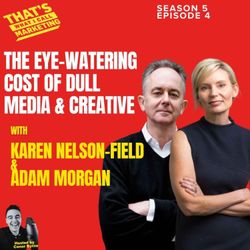
4. S5 Ep4: The Eye-Watering Cost of Dull Media & Creative with Karen Nelson-Field & Adam Morgan
48:00||Season 5, Ep. 4Most advertising doesn’t fail because it’s wrong. It fails because it’s dull and dull is expensive.In this episode of That’s What I Call Marketing, Conor Byrne sits down with Adam Morgan and Karen Nelson-Field to unpack the real cost of dull creative and dull media using hard evidence from IPA effectiveness data, System1 testing, and large-scale attention measurement.The conversation moves beyond taste or opinion and into economics: why rational, low-emotion advertising can still “work” but only by wasting millions; why some media environments structurally suppress attention; and why optimisation, procurement pressure, and performance thinking have quietly normalised mediocrity.If you work in brand, media, B2B, finance-led marketing, or any category that tells itself it has to be boring, this episode is a wake-up call.What you’ll learnWhy 50% of ads struggle to beat a cow chewing grass on attention and emotionHow dull creative drives up required spend by millions to achieve the same outcomesWhy CPM is often a cost per meaningless thousandHow attention volume predicts ROI, memory, and effectivenessWhy great creative fails when media doesn’t give it a stageHow risk, responsibility, and “sensible” decisions slowly drain impact from workWhere AI may actually help creativity rather than flatten itThis episode draws directly on the “Cost of Dull” research programme and explains what it means for marketers trying to balance effectiveness, efficiency, and real-world constraints. 02:27 – What do we actually mean by “dull” advertising?03:55 – The cow-chewing-grass test and why half of ads lose06:00 – Attention vs emotion: two ways to measure dullness08:00 – The Cannes “Ennui” experiment and burning money as a signal11:10 – What “dull media” really means (and why it’s misunderstood)13:55 – When great creative is wasted by low-attention environments16:20 – Is dull creative ever the better option?17:24 – Trust, facts, and why rational messaging costs more19:00 – Campaigns vs single ads: where attention is really lost20:00 – Why mix matters more than hero-only thinking21:00 – Global differences: creative vs media effects23:00 – Why B2B marketing is structurally duller and the cost of that26:00 – The “dull eclipse”: performance mindset, optimisation, benchmarks28:20 – Procurement, pricing pressure, and creative erosion31:00 – CPM, wastage, and the illusion of efficiency34:20 – AI, challenger brands, and testing creativity at speed37:55 – Risk vs responsibility: how sensible decisions kill ideas41:00 – What marketers can actually do differently43:45 – Final reflections and where the research goes nextAbout the guestsAdam Morgan is co-founder of Eatbigfish and a leading voice on challenger brands, effectiveness, and commercial creativity.Karen Nelson-Field is Professor of Media Science and one of the world’s foremost researchers on attention, media value, and advertising effectiveness.If you’re trying to explain to a CFO, procurement team, or board why “safe” work keeps underperforming, this episode gives you the language and the evidence to do it properly.Content Mentioned in the Episode: Risk & Responsibility https://www.youtube.com/watch?v=MuJx2IJjaFwCost of Dull Media Report https://21467338.fs1.hubspotusercontent-ap1.net/hubfs/21467338/COMPANY%20MATERIALS/Cost%20of%20Dull%20Final.pdfCost of Dull Eat Big Fish https://www.eatbigfish.com/thinking/challengers-and-cost-of-dull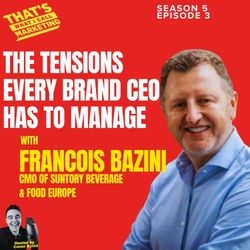
3. S5 Ep3: The Tensions Every Brand CEO Has to Manage with CMO Francois Bazini
49:49||Season 5, Ep. 3François Bazini, CMO of Suntory Beverage & Food Europe is one of the most thoughtful brand CMOs in global FMCGFrançois shares a rare, inside view of what it really means to be a brand steward in organisations like Danone, BCG, PepsiCo and Suntory. From resisting short-term zig-zagging, to building brands that can withstand private label pressure, this conversation goes deep on the realities of modern brand leadership. We explore why marketers must act as brand CEOs, how tension with CFOs can be productive rather than problematic, and why targeting older audiences is one of the most under-exploited growth opportunities in marketing today. François also unpacks the Ribena turnaround, Schweppes’ response to Fever-Tree, and why most advertising testing is misunderstood. This is a wide-ranging, honest discussion about judgment, evidence, culture, and the long game in brand building.Topics include: Brand stewardship vs short-termism, marketing ROI, working with finance, global vs local marketing roles, age targeting myths, private label competition, creative testing, and why some brands endure while others drift.03:25 – Career path: from Danone to consulting and global brand roles04:55 – What BCG teaches marketers about being fact-based07:00 – Brand stewardship and avoiding strategic zig-zagging09:30 – Timeless vs timely brand decisions11:00 – Marketing ROI beyond short-term sales12:30 – Marketers as brand CEOs13:45 – Working with CFOs and productive tension16:00 – Global vs local marketing roles20:00 – Ribena: brand decline and recovery22:30 – Going back to a brand’s peak moment26:00 – The myth of always targeting youth29:00 – Schweppes, Fever-Tree and category disruption31:45 – Targeting over-45s unapologetically34:00 – Media thresholds and focus over fragmentation35:45 – Moving beyond marketing mix modelling38:15 – The limits of advertising testing41:00 – When great ads fail tests but succeed commercially42:20 – Competing with private label43:00 – DAQV: desirability, affordability, quality, visibility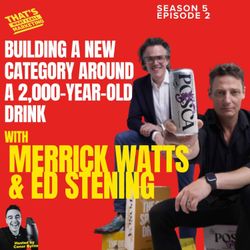
2. S5 Ep2: Building a New Category Around a 2,000-Year-Old Drink
47:12||Season 5, Ep. 2What happens when a radio comedian, a senior drinks marketer, and a 2,000-year-old Roman hydration recipe collide?In this episode of That’s What I Call Marketing, Conor Byrne sits down with Merrick Watts and Ed Stening, co-founders of Posca Hydrate — a sugar-free, hypertonic hydration drink inspired by ancient Roman Posca.Posca isn’t a nostalgia play. It’s a sugar-free, hypertonic drink inspired by a Roman solution to unsafe water — rebuilt for modern life, modern habits, and modern expectations. That means confronting everything from flavour and formulation to packaging, positioning, and retail resistance.Along the way, Merrick and Ed unpack a set of ideas that matter far beyond drinks:Why liquid still matters more than marketing.Why category creation is harder than brand building.Why refusing “me-too” formats can slow growth — but protect belief.And why brands should aim for humour, not jokes.Merrick explains why jokes age quickly, but a sense of humour travels across audiences, occasions, and time and how that thinking shapes Posca’s tone, creative decisions, and internal culture. It’s not about being funny. It’s about not taking yourself seriously while taking the product seriously.They also discuss building brand in-house rather than outsourcing belief, measuring brand as a startup using Tracksuit, balancing mental and physical availability, and what it really takes to scale a challenger brand globally without losing the story that made it matter in the first place.This is a conversation about founders, flavour, brand discipline, and the uncomfortable decisions that come with doing something genuinely different.3:50 – From radio comedy to drinks founder5:50 – Why the liquid comes first7:50 – The Roman origin of Posca10:50 – Turning history into a brand story14:50 – Ancient wisdom meets modern science16:20 – Building brand from the inside out19:50 – Tone, humour, and taking the product seriously23:50 – Building a category, not fitting one29:50 – Brand vs physical availability32:50 – Measuring34:50 – Global expansion strategy38:50 – The hypertonic breakthrough moment44:50 – Risk and belief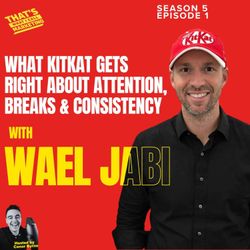
1. S5 Ep1: What KitKat Gets Right About Attention, Breaks & Consistency with Wael Jabi
45:50||Season 5, Ep. 1Kit Kats Global Head of Marketing Shares what it really takes to build and protect an iconic global brand?In this season opener for Season 5 of That’s What I Call Marketing, Conor Byrne is joined by Wael Jabi, KitKats Global Head of Marketing at Nestlé, for a deep conversation about brand judgement, consistency, partnerships, and the decisions that quietly shape long-term growth.Wael’s career spans Leo Burnett, Procter & Gamble, and Nestlé, and the discussion moves well beyond surface-level case studies. Together, they explore what KitKat teaches us about resisting reinvention, diagnosing the right marketing problems under pressure, and how major cultural platforms like Formula 1 can be used to express brand meaning rather than dilute it.This is a practical, reflective conversation for CMOs, brand leaders, and senior marketers who care about building brands that last not just chasing short-term performance.Topics covered include:Why most brands don’t need reinvention they need restraintThe marketing failure that taught Wael when price becomes the wrong answerWhat KitKat gets right about consistency and memory structuresHow to think about F1 and major sponsorships without losing brand meaningBrand vs performance decisions under pressureWhy judgement matters more than tactics at senior levels01:55 – Wael’s career path: agency to P&G05:50 – Why advertising isn’t the most important thing09:40 – A pricing decision that went wrong14:20 – Diagnosing the wrong marketing problem18:40 – KitKat and brand consistency23:15 – “Breaks are broken” insight26:50 – Making iconic work at global scale30:20 – Formula 1 and partnerships34:50 – Showing up in your world vs theirs38:20 – Judgement under pressure41:00 – What’s next for KitKatThanks to Tracksuit for their partnership with this episode, check out https://www.gotracksuit.com to find out more about the always on brand tracking platform
The Singles: Don't Look Back In Anger 2025
34:11|Don't Look Back In Anger - the episode where we look back at the biggest stories we covered on The Singles and see how those brands have gotten on this year. So What happens after the marketing headlines fade? Let's we revisit some of the biggest brand stories of 2025 — and test them against what actually changed over time. Using always-on brand health data from Tracksuit, Conor Byrne is joined by Dan and Jasper to look back at Tesla, American Eagle, Rhode, and Deliveroo, six to nine months after the noise. Not opinions. Not predictions. Just evidence of where attention turned into demand — and where it didn’t.Across very different categories, a consistent pattern emerges: “The campaign didn’t hurt sales — but the brand is weaker than it was.”In this episode, we explore:Why Tesla still dominates innovation perception but is leaking trust and preference in both the US and UKHow American Eagle’s controversial campaign held short-term revenue while brand fundamentals quietly erodedWhat Rhode’s acquisition by e.l.f. gets right — and the brand risks that come with scaling distributionWhy Deliveroo, post-DoorDash acquisition, faces a preference problem in a category defined by low loyalty and easy switchingThis is a conversation is about thinking about long-term demand, pricing power, and resilience not just quarterly performance. If you care about the gap between being noticed and being chosen, this episode is for you.02:40 – Tesla: innovation without reassurance11:40 – American Eagle: sales hold, brand weakens17:45 – Rhode: scaling without dilution23:05 – Deliveroo: preference in a default-driven category