Share
That's What I Call Marketing
S1. Ep16: Loretta Dignam "Marketing & Menopause"
With Loretta Dignam, Founder of the Menopause Hub. Loretta has a marketing career that you can only marvel at working with Mars, Diageo, Kerry Foods and Jacobs Fruitfield (Valeo Foods). She launched categories, like premium Sheba catfood and Dolmios pasta sauces and then went on to shut off brands that weren't perforning to focus on building the ones that were in her time at Diageo before rejuvenating some of the countries best loved biscuits (cookies). Loretta set up the Menopause Hub to break the stigma attached to menopause and help organisations think about creating menopause friendly workplaces. Today's episode is brought to you in partnership with Marketing Magazine. If you want to get in touch email thatswhaticallmarketing@gmail.com or find us on twitter @thats_marketing
That’s What I Call Marketing is where marketers come for real conversations about brand, B2B, creativity, effectiveness and the future of the profession.
Hosted by Conor Byrne, the show features conversations with CMOs, marketing leaders, agency leaders, authors, thinkers and practitioners about what good marketing looks like in practice.
- Listen, follow and find more episodes at: https://www.thatswhaticallmarketing.com
- Connect with Conor on LinkedIn: https://www.linkedin.com/in/conorbyrneirl/
- If you enjoy the show, please follow, subscribe and leave a review. It helps more marketers find the conversations.
More episodes
View all episodes
TWICM 219: Make Your Mark Ep 1 with John Kelly of Musgraves
31:59|Make Your Mark is a three-part series exploring how marketers build their careers and make a difference to their businesses, their customers and the people around them, in partnership with the Marketing Institute of Ireland.In this opening conversation, John Kelly, Retail Marketing Manager at Musgrave, joins That’s What I Call Marketing to discuss his 20-year career working predominantly with SuperValu, and what it takes to turn customer understanding into commercial results. John’s experience shows how much you can learn by taking on different challenges within one organisation. From checking promotional prices as a marketing assistant to delivering campaigns across a network of independent retailers, he explains how attention to detail, curiosity and doing what you said you would do build the credibility to take your next step.We also get into the work behind SuperValu’s “Yes You Scan” campaign. Getting TV, radio, social and in-store communications working together is one challenge; getting the entire business, right down to the checkout, moving towards the same outcome is another.In this episode, we cover:– How John deliberately built experience across value, local marketing, loyalty, sponsorship and retail marketing.– The commercial thinking and business-wide coordination behind Real Rewards prices and “Yes You Scan”.– What independent retailers know about their communities, and how that knowledge complements customer research and sales data.– Keeping SuperValu distinctive while competing on value and delivering short-term sales.– What John learned from micromanaging, and how he now uses trust, accountability and regular feedback to develop his team.– Why the time AI saves should help marketers get closer to customers, alongside the continuing need for creativity and storytelling.A useful listen for marketers interested in career development, retail marketing, brand building, customer insight, marketing effectiveness and leadership.TIMESTAMPS00:00 Consumer understanding and storytelling00:23 Introducing the Make Your Mark series03:08 John Kelly’s route into marketing04:00 Musgrave and SuperValu’s retailer model05:00 Different roles, new challenges and career development06:23 Commercial outcomes and attention to detail08:19 Why John’s team hears “never assume”10:21 Building credibility by following through11:00 Real Rewards prices and “Yes You Scan”12:12 Getting the whole business behind a campaign13:11 Competition, pace and brand differentiation15:34 Customer insight and the say-do gap16:47 Short-term sales and long-term brand building18:21 Learning to lead without micromanaging20:10 Mentoring and finding answers as a leader22:19 The attitude and skills John looks for when hiring25:37 Using AI to get closer to customers27:00 Demonstrating marketing’s business impact28:12 Recognising marketing talent through awards30:24 Make Your Mark and continuous learningThat’s What I Call Marketing is the podcast for marketers who care about brand, B2B, creativity, effectiveness and the future of the profession.Follow the show for more conversations with CMOs, marketing leaders, agency leaders, professors, authors, thinkers and practitioners.Find more episodes at: https://www.thatswhaticallmarketing.comOUR SERIES PARTNERThank you to the Marketing Institute of Ireland for partnering with us on this series as part of their Make Your Mark campaign. The campaign recognises that making your mark happens throughout your career: as you develop your skills, grow in confidence, take responsibility and help others progress. Across three conversations with marketers working in different organisations and at different career stages, we explore what that means in practice. The Marketing Institute of Ireland helps marketers build their expertise and professional credibility through its competency framework, professional assessment, certification and ongoing CPD.
TWICM 218: The Singles: Grindr IRL with Madonna, ON taking On Nike, Walkers Little Moments of Joy
28:06|Bella Harrison and Ed Parkin from Tracksuit join That’s What I Call Marketing to discuss Grindr’s push into real-world experiences, On’s entry into football and Walkers’ growing brand preference, exploring what each story tells marketers about building brands and measuring progress.Three brands, three different challenges: giving people more reasons to use an app, taking a specialist sports brand to a wider audience, and keeping an established favourite relevant. Conor Byrne, Bella and Ed examine the strategies alongside Tracksuit’s brand health data, discussing what is moving, what remains uncertain and which measures matter.In this episode, we cover:– Grindr’s “Global Gayborhood” ambition: how a surprise Madonna performance, events and broader services support its move beyond a hook-up app, and why its younger audience deserves closer attention.– On’s move into football with Kylian Mbappé and Thierry Henry: building on its running and tennis credentials, competing with Nike and adidas, and the questions facing a premium brand entering the boot market.– The difference between recognising a brand and thinking of it first, and how expanding into another sport could give On more opportunities to come to mind.– Walkers’ brand refresh, new flavours and football partnerships with Lionel Messi, David Beckham and Thierry Henry, alongside a rise in preference from 29% to 36%.– Why flat awareness or usage figures do not tell the whole story, and how audience differences, category context and preference can help marketers make a stronger case for their work.– “What the Actual?”: the discussion around Sydney Sweeney’s Novig campaign, PNC Bank using the Titanic in its advertising, and why the Laughing Cow has stopped laughing.A useful listen for marketers interested in brand strategy, customer insight, experiential marketing, sports marketing, brand building, marketing effectiveness and commercial impact.That’s What I Call Marketing is the podcast for marketers who care about brand, B2B, creativity, effectiveness and the future of the profession.Follow the show for more conversations with CMOs, marketing leaders, agency leaders, professors, authors, thinkers and practitioners.Find more episodes at: https://www.thatswhaticallmarketing.comTHE SINGLES — IN PARTNERSHIP WITH TRACKSUITThe Singles is our monthly look at the marketing stories getting people talking, using Tracksuit’s brand tracking data to bring evidence and context to the conversation.A huge thanks to Tracksuit for supporting the series, and to Bella Harrison and Ed Parkin for helping us understand the brand performance behind the headlines.Explore Tracksuit’s always-on, affordable brand tracking platform: https://www.gotracksuit.comTIMESTAMPS01:50 Grindr: real-world events and the “Global Gayborhood”02:58 Madonna, community and experiences people share04:08 What the brand data shows for Grindr05:33 Reaching younger audiences in a changing dating category06:41 Putting audience and category data into context07:37 Giving people reasons to use Grindr beyond dating09:14 On enters football with Kylian Mbappé10:08 Building on running and tennis10:53 Premium positioning and the realities of buying football boots13:06 On’s brand growth and the opportunity to come to mind more often14:36 Thierry Henry joins On as Director of Football15:16 Thierry Henry and Ireland’s long football memory16:10 Walkers: refreshing an iconic brand17:45 Why Walkers’ seven-point preference gain matters19:46 Competing across the wider snacking category21:25 Familiarity, trust and choosing a brand22:05 Using brand metrics in budget conversations23:27 What the Actual? Sydney Sweeney and Novig25:10 PNC Bank’s Titanic advertising26:08 The Laughing Cow stops laughing: one to watch
TWICM 217: Rich Silverstein Co-Founder of Goodby Silverstein & Partners on 40 Years in Advertising
52:45|On the day he retires from Goodby Silverstein & Partners, co-founder Rich Silverstein joins That’s What I Call Marketing to reflect on 40 years in advertising, the making of ‘Got Milk?’ and what makes an idea last. Rich takes us back to the early days of the agency, when a project for Electronic Arts helped turn a group of creatives who wanted to do things their own way into a business. We get into the thinking behind ‘Got Milk?’, the E*TRADE monkey ad and the lizards, and ask whether work made for a different media era could be even more powerful today. Rich is candid about the role of craft, humour and client confidence, as well as his concern that AI could make it easier to settle for work that is merely good enough.In this episode, we cover:– How Rich, Jeff Goodby and Andy Berlin started the agency, and what they took from their time with Hal Riney– The simple truth behind ‘Got Milk?’ and how its words and distinctive look came together– Why the best campaigns build a brand over time, rather than end with one commercial– What it takes to sell an unusual idea when more people want a say in the work– Rich’s mixed feelings about AI, and how he is using it to develop a musical– Why he tells young creatives to study the world and the people in itA useful listen for marketers interested in brand building, creative effectiveness, advertising craft, agency relationships and AI in marketing.That’s What I Call Marketing is the podcast for marketers who care about brand, B2B, creativity, effectiveness and the future of the profession.Follow the show for more conversations with CMOs, marketing leaders, agency leaders, professors, authors, thinkers and practitioners.Find more episodes at: https://www.thatswhaticallmarketing.comTimestamps00:00 – Rich Silverstein and 40 years in advertising10:01 – Hal Riney, Electronic Arts and starting Goodby Silverstein & Partners14:28 – Bringing design, journalism and craft together15:25 – Why Rich skips most advertising16:31 – AI and the danger of “good enough”21:46 – What editorial design and Rolling Stone taught him24:05 – Why great work should still hold up years later24:26 – The story behind ‘Got Milk?’26:00 – The E*TRADE monkey ad28:37 – Creative constraints and the need for confident clients30:36 – The lizards and building a brand over time33:15 – Using humour to make an idea last36:32 – Selling ambitious work and working with clients37:39 – Research, planning and creative collaboration40:37 – The ideas Rich loved but could not sell41:59 – 13 Days, his musical project, and using AI to make it46:47 – Advice for creatives starting an agency today49:19 – Why the ideas come faster, but selling them remains hard51:51 – The advertising Rich still admires52:46 – Mentors, observation and studying the worldThanks to Tracksuit for partnering with That’s What I Call Marketing. Find out more about its always-on brand tracking platform at https://www.gotracksuit.com.
TWICM 216: Scribd CMO Gemma Craven on the Path to becoming CMO, Building Range, Reputation & Impact
44:16|Gemma Craven, Chief Marketing Officer at Scribd, Inc., joins That’s What I Call Marketing to discuss her path to becoming a CMO, the value of building experience across different areas of marketing and what it takes to reshape brands, teams and reputations.This episode explores how a varied career across PR, social media, technology, agencies, consultancy and in-house leadership gave Gemma the range required to lead marketing across Scribd, Everand, Fable and SlideShare. It is an honest conversation about career choices that did not always make immediate sense to other people.In this episode, we cover:– How moving between countries, disciplines and organisations shaped Gemma’s approach to marketing leadership– Building Social@Ogilvy New York when many people still believed social media would not last– Why Gemma deliberately moved beyond being known solely as a social media specialist– How working with CMOs at McCann helped her see CMO leadership as a possible destination– Why becoming a fractional CMO was initially viewed as a failure by some people– Restructuring Scribd’s marketing organisation around its products, audiences and areas of expertise– Managing a portfolio that includes Scribd, Everand, Fable and SlideShare– Why brands must actively manage their reputations rather than leave customers, reviews and online communities to define them– Connecting brand strategy more closely with product, engineering, design and customer experience– The thinking behind Scribd’s “Connect the Docs” campaign and the enduring human satisfaction of figuring something out for yourselfGemma Craven has more than 25 years of experience building and positioning global brands. Before joining Scribd, Inc., she led marketing at Melissa & Doug, advised senior leaders at companies including Spotify, Nike, Fiverr and Ford, and led digital brand strategy at McCann New York, where she helped make Fearless Girl a global phenomenon. She also built Social@Ogilvy New York into an award-winning, multi-practice division. A useful listen for marketers interested in marketing leadership, career development, brand strategy, organisational design, reputation management, customer experience and the path to becoming a CMO.That’s What I Call Marketing is the podcast for marketers who care about brand, B2B, creativity, effectiveness and the future of the profession.Follow the show for more conversations with CMOs, marketing leaders, agency leaders, professors, authors, thinkers and practitioners.Find more episodes at: https://www.thatswhaticallmarketing.comThis episode is brought to you in partnership with Tracksuit, the always-on brand-tracking platform that helps marketers monitor brand health and bring a clear, shared view of brand performance into the boardroom. Tracksuit tracks brands across more than 25 markets, making ongoing brand measurement more accessible, visible and useful for marketing teams and senior leaders. Find out more at: https://www.gotracksuit.comThe Big Marketing MeetUp Belfast, takes place at ICC Belfast on 5 November 2026, book tickets at: https://www.tickettailor.com/events/bmmubelfast/1935249Chapters04:15 – A career shaped by curiosity and working across cultures06:30 – Moving from London to New York and experiencing culture shock09:41 – Building Social@Ogilvy New York16:42 – Why Gemma moved from agency life into technology19:24 – When becoming a CMO started to feel possible20:49 – Why varied experience creates better marketing leaders23:13 – Too ambitious to work for Mick Jagger24:01 – Choosing the fractional CMO path28:11 – Restructuring marketing around products and audiences29:17 – What happens when a brand leaves its story untold29:48 – Leading teams through organisational change32:16 – Refreshing the Scribd and SlideShare brands32:24 – The strategy behind “Connect the Dots”36:26 – Resisting the pressure to launch a campaign too quickly38:06 – How brand discovery and reputation are changing
TWICM 215: The Singles: Monzo’s Get Busy Living, Heinz x Heineken & is Meta X Ray‑Ban creepy?
30:56|Conor Byrne hosts another “Singles” episode with Bella and Ed from Tracksuit, using brand tracking data to unpack the biggest marketing stories of the moment—what’s genuinely driving brand growth, what’s just noise, and where brands are taking real risks. From Monzo’s bold “Get Busy Living” brand campaign in a fiercely competitive banking market, to the clever Heinz x Heineken collaboration built for summer BBQ culture, they explore how creativity and brand equity show up in the metrics. They also break down quick-fire eclipse “culture-jacking” wins from brands like Starbucks, Netflix and Mastercard, before debating the backlash and brand danger around Meta-powered Ray-Ban smart glasses. Finally, they launch “What the Actual?”—spotlighting recent brand missteps from Target and a Callaway/Good Good promo—and invite listeners to submit their own.02:05 Monzo Brand Campaign13:02 Heinz Heineken Collab18:37 Solar Eclipse Marketing22:55 Meta Ray Ban Glasses27:28 What The Actual FailsCheck out tracksuit https://www.gotracksuit.com/That’s What I Call Marketing is where marketers come for real conversations about brand, B2B, creativity, effectiveness and the future of the profession.Hosted by Conor Byrne, the show features conversations with CMOs, marketing leaders, agency leaders, authors, thinkers and practitioners about what good marketing looks like in practice.Listen, follow and find more episodes at: https://www.thatswhaticallmarketing.comConnect with Conor on LinkedIn: https://www.linkedin.com/in/conorbyrneirl/If you enjoy the show, please follow, subscribe and leave a review. It helps more marketers find the conversations.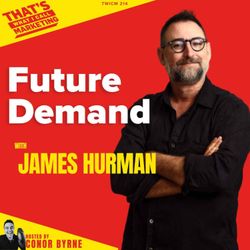
TWICM 214: James Hurman Future Demand, Making the Commercial Case for Brand Investment
46:49|James Hurman, author of Future Demand and co-founder of Tracksuit, joins That’s What I Call Marketing to explain how brand building creates future demand, how performance marketing converts current demand and why marketers need both to drive sustainable growth. This episode offers a practical way to understand how advertising really works, how to build the internal case for brand investment and how marketers can move an organisation beyond a performance-only mindset without betting everything on one dramatic change.In this episode, we cover:– Why James Hurman rewrote Future Demand specifically for marketers– The relationship between brand building, future demand and performance marketing– Why advertising rarely causes an immediate sale but can help a brand win a greater share of future sales– How Instacart CMO Laura Jones “marched up the funnel” from measurable performance activity to the Olympics and the Super Bowl– How Telstra tested a 50:50 brand and performance split in Adelaide and recorded a 14% improvement against the rest of Australia– How marketers can use experiments, geographic holdouts and better measurement to demonstrate incrementality– Why CEOs, CFOs and marketers often want the same commercial outcome but describe marketing investment in very different language– What AI, agentic shopping, AEO and GEO could change — and why the fundamentals of markets, brands and human decision-making still matterJames challenges the traditional idea that advertising works by persuading somebody to buy immediately. Instead, he describes a two-stage process: brand advertising creates familiarity and positive bias among people who are not yet in the market, while performance activity helps convert that existing bias when they are ready to buy.He also shares practical examples of how marketers can earn confidence gradually, measure brand investment more rigorously and communicate its commercial value to non-marketing stakeholders.That’s What I Call Marketing is the podcast for marketers who care about brand, B2B, creativity, effectiveness and the future of the profession.Follow the show for more conversations with CMOs, marketing leaders, agency leaders, professors, authors, thinkers and practitioners.Find more episodes at: https://www.thatswhaticallmarketing.comCHAPTERS03:47 Exploring what a marketing book can be05:40 Why James rewrote Future Demand07:39 Creating future demand and converting current demand08:29 Laura Jones and Instacart’s four-year brand journey11:03 How Instacart “marched up the funnel”12:00 Telstra’s geographic holdout test in Adelaide14:16 Making marketing science easier to understand16:11 The wrong mental model for advertising17:44 How advertising creates and converts demand19:06 Is advertising really a weak force?20:07 Why the evidence has not changed every organisation21:43 Winning support from non-marketing stakeholders23:38 Creating a shared language with CFOs25:18 Why James remains invested in solving this problem26:56 How marketing cultures differ across markets29:53 Better marketing measurement and experimentation31:27 Using AI to learn and improve marketing capability34:14 How AI is affecting businesses and marketing37:21 Will agentic shopping change consumer behaviour?39:58 Familiarity, emotion and why people choose brands40:58 What McDonald’s “brand love” metric predicts42:19 Tracksuit University and the language of the boardroom44:25 Where to find Future DemandABOUT JAMES HURMANJames Hurman is the author of Future Demand and The Case for Creativity. He is a co-founder of Tracksuit and founding partner of innovation studio Previously Unavailable. His work focuses on marketing effectiveness, creativity, brand building and helping businesses understand how marketing contributes to long-term commercial growth.Explore Future Demand: https://future-demand.comLearn more about Tracksuit: https://www.gotracksuit.comVisit Tracksuit University: https://university.gotracksuit.com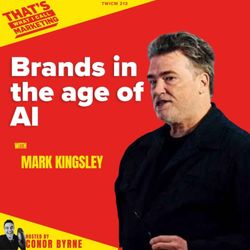
TWICM 213: Mark Kingsley on Brands in the Age of AI
36:39|Mark Kingsley, brand strategist, designer, author and founder of Malcontent, joins That’s What I Call Marketing to discuss his book "Brands in the Age of AI" and why marketers need to think much more deeply about artificial intelligence than prompts, productivity and tools.Mark’s central argument is that AI is not simply a tool, it is a condition, an environment that is already changing how we work, create, build brands and relate to one another. This conversation explores what that means for brand strategy, creativity, marketing careers and the relationship between companies and customers.Rather than offering another AI how-to guide that could be outdated within months, Mark draws on history, philosophy, psychology, design and technology to understand where AI fits into a much longer story of technological change.In this episode, we cover:– What the Jacquard loom, Charles Babbage, Ada Lovelace, Alan Turing and even *Frankenstein* can teach us about today’s AI debate– AI-driven job losses, automation and the continued commoditisation of creative and knowledge work– Why removing junior-level “donkey work” could create a serious skills and judgement problem for agencies, marketers and professional services– Brian Eno’s idea of “scenius” and why creativity is rarely the product of a lone genius– Agentic AI, B2A2C commerce and what happens when AI agents begin making purchasing decisions– Why brands could use AI to move beyond transactions towards deeper relationships with people– Why human discernment could become more valuable as AI becomes more capable– The danger of treating AI primarily as another system for extracting efficiency and profit– How AI might instead be used to support human flourishingOne of the most important questions running through the conversation is what happens to expertise when AI starts doing the work through which people traditionally learned their craft.We also explore what AI means for brands themselves. If brands genuinely want relationships rather than simply transactions, Mark argues AI could help companies recognise people as individuals and members of communities rather than merely customers to extract value from.A useful listen for marketers interested in AI in marketing, brand strategy, creativity, marketing leadership, agentic AI, synthetic research, the future of work, customer experience and the changing role of human judgement.02:32 Why this is not another AI how-to book04:36 “AI is not a tool, it’s a condition”05:43 Technology, Heidegger and what technology reveals07:38 Is AI already changing society at scale?08:01 Alan Turing and the history of machine intelligence09:02 Jacquard looms, the Luddites and automation11:04 AI layoffs and the economics of replacing people13:36 AI infrastructure and removing barriers19:13 Photography, creativity and resistance to new technology20:18 Why great photographers and creatives still matter21:24 Brian Eno’s Oblique Strategies25:18 Agentic AI and B2A2C commerce26:00 AI personas and purchasing agents27:02 Tokenisation and the “semiotic gap” between humans and agents30:48 Why Mark is disappointed by the adversarial AI debate34:13 What *Brands in the Age of AI* ultimately asks brands to reconsiderThis episode is brought to you by Tracksuit the always-on brand tracking platform for clients and agencies.Find out more: https://www.gotracksuit.comMore from That’s What I Call MarketingThat’s What I Call Marketing is the podcast for marketers who care about brand, B2B, creativity, effectiveness and the future of the profession.Follow the show for more conversations with CMOs, marketing leaders, agency leaders, professors, authors, thinkers and practitioners.Find more episodes at: https://www.thatswhaticallmarketing.com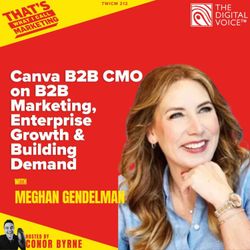
TWICM 212: Canva B2B CMO on B2B Marketing, Enterprise Growth and Building Demand
34:49|Meghan Gendelman, CMO, B2B at Canva, joins That’s What I Call Marketing to discuss B2B marketing, enterprise growth, building demand and how Canva is taking a hugely successful product-led business further into the enterprise. This conversation gets into what building a B2B growth engine actually requires: understanding customers, combining product-led and sales-led growth, building brand before buyers enter the market, using data properly and working out where AI genuinely adds value.In this episode, we cover:– Why Meghan believes B2B marketing is anything but boring, particularly when you are dealing with complex buying committees, long consideration periods and multiple decision-makers– Why customer insight still matters more than tools, including Meghan’s experience of using AI to scale content for GEO and discovering that faster content without anything new or useful simply didn’t work– How brand, customer entry points and buying signals help marketers influence customers long before they reach a website or speak to sales– Why Meghan believes every good marketer needs to become comfortable with data, pipeline and the commercial numbers behind the business– How Canva is thinking about AI, LLMs, design, brand governance and integrations with platforms including ChatGPT, Claude and Gemini– What Meghan learned from more than a decade at Salesforce, her time at DocuSign and the process that led her to become Canva’s first B2B CMO– How she leads global marketing teams through clear values, trust, vulnerability and knowing the difference between “smoke” and “fire”We also discuss the changing B2B buying journey, why much of the decision can happen before a buyer identifies themselves, the role of brand in demand generation and why B2B and B2C marketing are becoming less distinct than marketers sometimes assume.A useful listen for marketers interested in B2B marketing, enterprise marketing, product-led growth, demand generation, brand building, AI in marketing, customer insight, sales and marketing, marketing leadership and commercial growth.02:12 Meghan’s career across Salesforce, DocuSign and Canva03:03 Why everything starts with the customer05:44 The AI and GEO content experiment that failed07:18 Why B2B marketing is not boring10:30 Leading global marketing teams through values and trust11:41 Smoke, fire and knowing when leaders need to get involved12:47 Why Meghan joined Canva14:46 Canva’s 30–40 hour B2B marketing interview challenge16:15 Taking Canva from product-led growth into enterprise17:04 Product-led growth versus sales-led growth19:47 How B2B buying decisions are changing22:08 Why every marketer needs to understand data23:13 Meghan’s Monday morning pipeline ritual24:21 Learning from other marketing leaders25:00 Remote work, offices and building global teams27:39 Why EMEA is not one market28:40 Keeping Canva simple as the platform expands29:11 Canva as an AI-powered design platform30:27 Canva, ChatGPT, Claude, Gemini and the LLM ecosystem31:47 Building Canva’s B2B and enterprise brandAbout Meghan GendelmanB2B at Canva, leading its B2B marketing strategy as Canva continues to grow its enterprise business. Before Canva, Meghan held senior marketing roles at DocuSign and spent more than 12 years at Salesforce across areas including customer success, product marketing, growth marketing, field marketing, demand generation and regional marketing leadership.This episode was recorded as part of the That’s What I Call Marketing Cannes Sessions and produced in partnership with The Digital Voice.The Digital Voice: https://www.thedigitalvoice.co.uk/That’s What I Call Marketing is the podcast for marketers who care about brand, B2B, creativity, effectiveness and the future of the profession.Follow the show for more conversations with CMOs, marketing leaders, agency leaders, professors, authors, thinkers and practitioners.Find more episodes at:https://www.thatswhaticallmarketing.com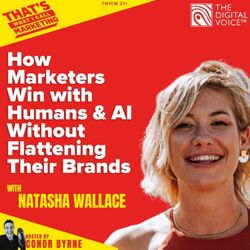
TWICM 211: Jellyfish's Natasha Wallace On How Marketers Win with Humans & AI Without Flattening Their Brands
35:07|Natasha Wallace, Chief Solutions Officer for Strategy, Planning and AI at Jellyfish, joins That’s What I Call Marketing to discuss how brands can become more visible and understandable to AI without sacrificing creativity, emotion or distinctiveness.This episode explains how marketers should approach the growing challenge of serving two audiences at once: humans, who respond to stories, feelings and ideas, and AI models, which rely on clear signals, context, trust and specificity.In this episode, we cover:– Why Jellyfish’s research found almost no correlation between how humans and AI models judge creative work– What “brand flattening” means and why marketers should resist making everything rational and functional– How to make a brand legible to large language models without weakening its creativity– Why brand trust, distinctive assets and consumer consensus still influence AI recommendations– The role of YouTube, Reddit, creators, ecommerce and digital PR in shaping model perception– Why paid, owned and earned media need to work together in an AI-led discovery environmentNatasha also explains Jellyfish’s concept of the “brand echo”: the conversation, reaction and community created around a brand, even when the original activity is not directly visible to an AI model.The practical message is not that marketers need to abandon the fundamentals. It is that audience strategy, brand positioning, content, media and measurement need to work together more closely. The brands most likely to succeed will be clear enough for machines to understand and interesting enough for people to care about.A useful listen for marketers interested in AI in marketing, GEO, brand strategy, creativity, content strategy, advertising effectiveness and the future of search and discovery.That’s What I Call Marketing is the podcast for marketers who care about brand, B2B, creativity, effectiveness and the future of the profession.Follow the show for more conversations with CMOs, marketing leaders, agency leaders, professors, authors, thinkers and practitioners.Find more episodes at: https://www.thatswhaticallmarketing.com**Timestamps**00:00 Why marketers must not flatten their brands for AI00:39 Introducing Natasha Wallace of Jellyfish02:04 Natasha’s career across digital, media and emerging technology03:35 Why AI feels different from previous industry shifts05:23 Working globally with Heineken and major sports properties07:05 Why Natasha joined Jellyfish09:00 Bringing media, content, creative and AI strategy together12:32 What humans and AI models see in award-winning advertising15:31 The danger of brand flattening16:36 How the “brand echo” influences AI models17:35 Why brand trust and distinctive assets still matter20:21 Why YouTube is frequently cited by large language models22:28 How marketers should prioritise their AI and GEO activity24:46 Leading and lagging indicators for AI visibility26:01 The platforms and voices that shape model perception27:27 Borrowed credibility, belonging and long-term brand associations30:05 Testing creative work without making it formulaic32:25 Why AI should strengthen human thinking, not replace itThat’s What I Call Marketing is the podcast for marketers who care about brand, B2B, creativity, effectiveness and the future of the profession.Follow the show for more conversations with CMOs, marketing leaders, agency leaders, professors, authors, thinkers and practitioners.Find more episodes at: https://www.thatswhaticallmarketing.comThis Cannes Sessions episode is produced in partnership with The Digital Voice.