Share

Sweat Your Assets Podcast
Financial Redundancy. Why Central Banks Want You to Keep Cash at Home
Norway's central bank has asked every household to keep some cash at home — in one of the most cashless economies on Earth. In this episode, we unpack why the people who run the world's most advanced payment systems are quietly telling you not to rely on them entirely. From the blackout that froze payments across Spain and Portugal, to the engineering principle of redundancy, to what savers in high-inflation economies have always known instinctively — this is the case for holding more than one card, more than one account, and more than one way to pay. Small, deliberate inefficiencies that buy resilience on the bad day, and peace of mind on all the others.
Welcome to a new episode of Sweat Your Assets — enjoy!
Read the full article: https://sweatyourassets.biz/financial-redundancykeep-cash-at-home/
Sweat Your Assets is a financial education platform built on one idea: anyone can learn to manage money wisely, build wealth steadily, and make decisions that hold up over time.
The podcast is one piece of a larger sandbox — alongside a blog, YouTube channel, and monthly newsletter. Everything comes from what I read, test, and apply about money, investing, and financial freedom.
No sponsorships. No shortcuts. Just honest, evidence-based thinking.
Each episode covers what actually matters: financial mindset, money psychology, investing principles, building income, and avoiding the traps that keep people broke.
The conversations the mainstream media rarely has, because they don't sell.
If you want to think more clearly about money, you're in the right place.
Sweat Your Assets — Alessandro Baroni 🌐 sweatyourassets.biz ▶️ youtube.com/c/SweatYourAssets 📩 Newsletter: sweatyourassets.aweb.page/financial-growth-newsletter
More episodes
View all episodes
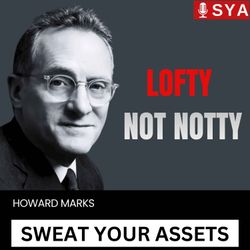
59. This is the hardest thing I have ever seen - Howard Marks on the AI Frenzy
33:26||Season 3, Ep. 59Every boom arrives with a story good enough to justify the price. The railroads. The Nifty Fifty. The internet. And now artificial intelligence.In this episode, Howard Marks — co-chairman of Oaktree Capital and one of the most careful thinkers on risk in the business — works through the question everyone is circling: are markets excessively exuberant, or is this simply what optimism looks like before it's proven right?Marks makes a distinction most commentary misses. A bubble isn't a price level; it's a state of mind. It's what happens when investors stop asking whether an asset is worth what it costs and start believing that no price is too high. The technology can be genuinely transformative and the stocks can still be a bad investment. Both things have been true before.We look at where today's valuations sit against the historical record — what buying into elevated multiples has meant for returns over the following decade, and why the answer has been remarkably consistent even when the underlying story was sound. High prices don't predict crashes. They predict lower future returns. That's a less dramatic claim and a far more useful one.Then the practical part: how do you actually invest here? Not by going to cash and waiting for a signal that never comes with a bell attached. Marks's answer is about posture — where you sit on the aggressive-to-defensive dial, what you're being paid to take risk, and the discipline of calibration over prediction.If you've been wondering whether to trim, add, or simply hold your nerve, this is the conversation to sit with.In this episode:What separates a bubble from an expensive marketWhy "great company" and "good investment" are different questionsWhat historical valuation levels have meant for forward returnsThe case against trying to time the topCalibrating risk instead of forecasting outcomesOriginal speech/interview by Howard Marks, interviewed on the Prof G Podcast (2026). Sweat Your Assets re-edited the interview. A YouTube version with visual support is available at: https://youtu.be/P3joXUHoArABlog → sweatyourassets.bizMonthly Newsletter: https://sweatyourassets.aweb.page/financial-growth-newsletter
57. Climbing the Wall of Worry - Market Barometer, Aug-2026
12:12||Season 3, Ep. 57Climbing the Wall of Worry | Market Barometer | August 2026Record highs everywhere — while the Fed talks rate hikes, Iran sits under the toughest sanctions ever written, and a trade spat brews with Canada. Bull markets climb a wall of worry, and August's wall was steep.In this Market Barometer episode: what moved stocks, bonds, oil, gold, and Bitcoin in August 2026, what Fed chair Kevin Warsh's first Jackson Hole speech means for your wallet, and why the best advice remains boring — stay invested, stay diversified, keep some dry powder.Plus: three quotes of the month, and two investing giants from the blog — Peter Lynch and David Swensen.📊 Market heatmaps, tables, and links to the full articles and videos are in the written newsletter: https://sweatyourassets.optin.com/newsletter/awlist6442749/MzA1MTM5MzM=/climbing-the-wall-of-worry-digest-68-aug-26.htm📫 Free monthly newsletter — no sponsors, no noise: https://sweatyourassets.optin.com/newsletter/awlist6442749/MzA1MTM5MzM=/climbing-the-wall-of-worry-digest-68-aug-26.htmKeep it real, Sweat Your Assets.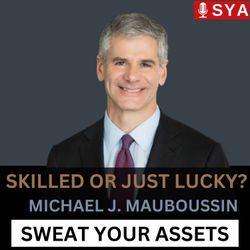
56. How to Manage Luck and Skill in Business, Sport and Investing. Michael J. Mauboussin
23:37||Season 3, Ep. 56Could you lose on purpose? In chess, yes. At the roulette table, never. And in investing... the answer reveals something most investors get wrong their entire lives.In this special episode, I hand the microphone to Michael J. Mauboussin — Head of Research at Counterpoint Global (Morgan Stanley), adjunct professor of finance at Columbia Business School, and author of The Success Equation. What you'll hear is an abridged audio version of a lecture he delivered at the Santa Fe Institute, curated and annotated by Sweat Your Assets.Mauboussin untangles the roles of skill and luck in business, sports, and investing — and shows why we systematically confuse the two. You'll learn where investing sits on the skill–luck continuum, why more skill paradoxically makes luck matter more, why decisions should be judged by process rather than outcome, and why your own brain quietly manufactures stories to explain results that were never in your control.If you can't tell skill from luck, you'll copy the wrong investors, fire the right managers, and misread your own results. This episode is one of the highest-leverage upgrades you can make to your investment philosophy.Prefer the full experience? The complete video lecture, with all slides and charts, is available on the Sweat Your Assets YouTube channel.YouTube: https://www.youtube.com/watch?v=5hFuwL1d_Wo&t=0s🌐 https://sweatyourassets.bizKeep it real. Sweat Your Assets.
55. Don't Fight the Bond Market - Market Barometer, Jul-26
14:09||Season 3, Ep. 55For the first time, I'm bringing my Monthly Market Barometer—previously available only through the Sweat Your Assets newsletter—to the podcast.Every month I step back from the daily market noise to explain what really moved markets, why it matters, and what long-term investors should pay attention to. The goal isn't to predict the future, but to help you understand the forces shaping today's investment landscape.📩 Subscribe to the free Sweat Your Assets Newsletter to receive the complete Market Barometer, charts, commentary, and curated resources delivered every month.In this episode:Why the bond market, not the stock market, was the real story of July.What the new Federal Reserve Chairman's communication means for investors.Why rising government bond yields affect mortgages, businesses, and stock valuations.The latest inflation developments in the United States, Europe, the United Kingdom, and Japan.How renewed tensions in the Middle East pushed oil prices more than 20% higher.What happened to Big Tech, the S&P 500, Bitcoin, Gold, and the VIX.A walkthrough of my Monthly Market Barometer and the key indicators I monitor.Three timeless quotes from James Carville, Warren Buffett, and Mary Pickford that perfectly capture this month's lessons.My recommended Video of the Month: Michael Mauboussin's brilliant presentation on Luck vs. Skill in investing and decision-making.Key takeaway: A flat stock market doesn't necessarily mean a quiet month. Beneath the surface, July reminded investors that the bond market often tells the real story—and that diversification remains one of the most powerful investing tools we have.📬 Subscribe to the Sweat Your Assets Newsletter: https://sweatyourassets.aweb.page/financial-growth-newsletter📺 YouTube: https://www.youtube.com/@SweatYourAssets🌍 Website: https://sweatyourassets.biz
54. What Sting Gets Right About Kids Financial Independence
10:31||Season 3, Ep. 54Kids financial independence is built at the kitchen table, not in a will. Today´s article uses Sting’s much-discussed stance on inheritance to explore what parents actually pass on to their children, and why the most valuable financial gift has nothing to do with money.Reading a recent interview with Sting, I came across a line that stopped me. Asked again whether his six children would inherit his fortune, the 74-year-old singer laughed, then said something worth sitting with: telling your children they do not have to work is “a form of abuse that I hope I’m never guilty of.”This article is about what he means, why I believe he is right, and what it actually looks like in practice.Enjoy the episode, Sweat Your Assets.
53. The Pale Blue Dot: A Compass for Chaotic Times
17:43||Season 3, Ep. 53In 1990, a spacecraft four billion miles from Earth turned its camera back toward home. What it captured was almost nothing — a pale blue crescent, less than a pixel, adrift in darkness. Carl Sagan spent years fighting to make that photograph happen. He knew it would change something about how we see ourselves.In chaotic times, that image remains one of the most useful things any of us can look at. Not for comfort — for proportion. For the kind of clarity that only comes when you zoom out far enough to see where you actually are.In this episode, we explore what the pale blue dot really asks of us: from Ptolemy to Copernicus, from Pascal's terror to Marcus Aurelius's view from above, from Camus's absurd to Sagan's quiet, unambiguous conclusion — this is the only world we have, and it is where we make our stand.A conversation about ego, perspective, stewardship, and what it means to care about the right things, in the right proportion, with the right degree of urgency.Enjoy the episode. Alessandro BARONI - Sweat Your Assets
52. The Bull, the Bear and the Dance of Shiva
13:46||Season 3, Ep. 52Walk through Bowling Green at the southern tip of Manhattan and you will find the Charging Bull — 3.5 tonnes of bronze installed in the dark of night in December 1989 by Sicilian sculptor Arturo Di Modica, without permission, as a personal gift to a city shaken by the 1987 crash. It was removed by police within hours and returned by public demand within days. It has stood there ever since on a temporary permit that has now lasted more than thirty years.The bull and the bear are the two dominant symbols of capital markets. They describe direction: prices rising, prices falling. They are useful shorthand. But they are also incomplete, because what they do not capture is the underlying rhythm that connects them — the pattern beneath the price chart.That pattern has an unlikely visual expression: a two-metre bronze statue of the Hindu deity Shiva, in his form as Nataraja, the Lord of the Dance, standing on the campus of CERN in Geneva. Gifted by the Indian government in 2004, it was placed there because CERN's physicists recognised in it a metaphor for what they study: the continuous creation, transformation, and destruction of matter at the subatomic level. The physicist Fritjof Capra first drew this parallel in 1972, and the plaque beside the statue quotes him directly.In this episode, we explore what happens when you bring these three images together. The bull and the bear show you the visible motion of markets. The Nataraja shows you the deeper structure: a cycle without a final destination, in which creation and destruction are not opposites but the same dance. And understanding that rhythm — rather than projecting current conditions forward in a straight line — is arguably the most practical skill available to a long-term investor.Topics covered include the story behind Di Modica's guerrilla installation, the iconography of the Nataraja and why it ended up at CERN, the cognitive error of linear thinking in markets, Howard Marks on cycles, and what composure actually looks like as an investment practice.Alessandro BARONI
51. Practice Makes Perfect. Reps First. Mastery Follows
11:40||Season 3, Ep. 51What separates people who build real skills — in life, business, and investing — from those who only ever plan to? A pottery class parable, a filmmaker who posted a video every day for 534 days, and a personal finance writer who turned creative discipline into an investment philosophy all point to the same answer: reps come first, and mastery follows.In this episode, we look at the pottery experiment from Art and Fear, Nick Maggiulli's lessons from 500 blog posts and his book Just Keep Buying, Casey Neistat's legendary daily vlog streak, and what Arnold Schwarzenegger, Anders Ericsson, and Seth Godin all have to say about how mastery is actually built. We also explore what this means for your financial independence journey — because the reps-first principle applies just as powerfully to saving, investing, and building wealth as it does to throwing clay.The cost of inactivity compounds just as surely as the returns on consistent action. The only question is how many pots you're willing to make before you start worrying about perfection.Read the full article and explore more episodes at sweatyourassets.biz.Alessandro BARONI