Share
Steve Pretty On The Origin of the Pieces
Sound balancers, Bowie's favourite studio and Debussy
Episode Summary
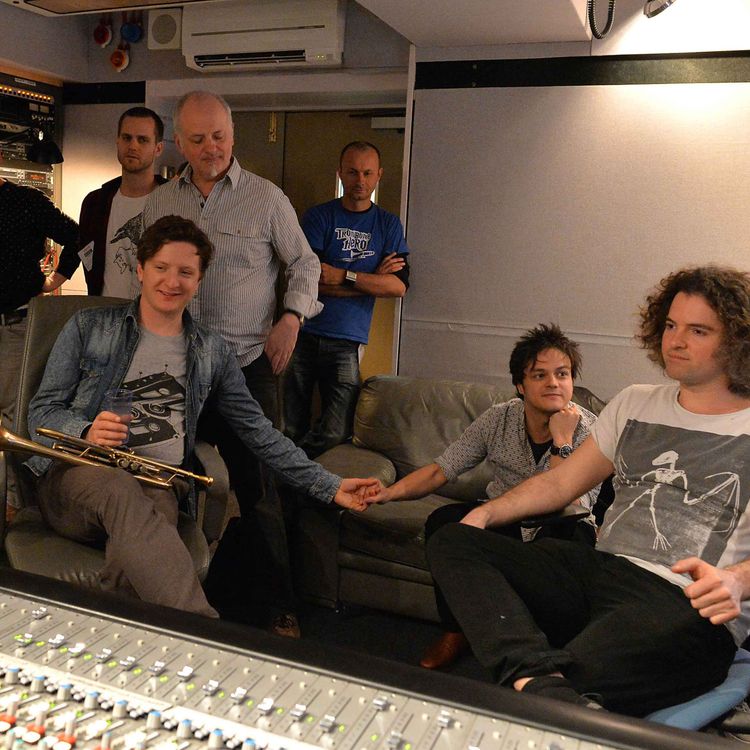
In this episode, Steve Pretty embarks on a sonic journey with Martin Appleby, a seasoned sound engineer with over nearly four decades of experience at BBC's Maida Vale studios. They delve into Martin's illustrious career, exploring his role in capturing live music for prestigious BBC programs and his the challenges and opportunities of live recording. The episode further explores the philosophical dimensions of recording live ensembles and the unique challenges of live studio recording.
Key Topics Discussed
Introduction to Martin Appleby
- Overview of Martin's 40-year career at the BBC.
- Martin's background as a musician and sound engineer.
- His studies on the Appalachian dulcimer and its connections to West African music traditions.
- The rich history and significance of Maida Vale studios.
Live Studio Recording
- The art and pressure of recording live music in a studio setting.
- The benefits of musicians performing together in the same room without headphones.
- Highlighting a memorable session with singer Jamie Cullum.
- The role of sound engineers in capturing authentic, dynamic performances.
Technical Aspects of Recording
- Use of omni and stereo cardioid microphones.
- Shaping the sound with artistic precision, akin to photography.
- The importance of perspective in music recording.
Exploration of Arabesque Music and Debussy
- The influence of Islamic art on Debussy's compositions.
- Debussy's revolutionary approach to music, seeking to establish a distinct French identity.
- Insights from pianist Benjamin Steinhardt on Debussy's inspirations.
Debussy's Musical Legacy
- Debussy's use of older modes and Eastern pentatonic scales.
- The impact of his relationship with his patron Nadja and admiration for Chopin.
- Steve's own attempts at composing in Debussy's style and its analysis.
Evolving Music Industry
- Discussion on AI-generated music and its potential limitations.
- Updates on the music industry landscape, including genre explorations and the transformation of the Jazz Bar in Edinburgh into a community-owned arts hub.
- The closure of the Towersley Festival and the challenges faced by live music events today.
Notable Quotes
- "Capturing the performance is the one thing you really can't fake." - Martin Appleby
- "The great thing we can do that nobody else can is we've got the space. The musicians can all come in, be in one place, do their thing, go away, and we just mix it." - Martin Appleby
Additional Information
- **Patreon:** Listeners can support the show and access exclusive content on Steve Pretty's Patreon page.
- **Previous Episode:** Exploration of the double bass with Charlie Pine.
Next Episode Teasers
- Upcoming explorations of genres like Tona and Corrido.
- Further discussions on the evolving landscape of the music industry.
Listeners are encouraged to tune in for a deep dive into the world of sound engineering, the legacy of Debussy, and the vibrant history of Maida Vale studios.
More episodes
View all episodes
40. Voice, Power and the Big Machine: Opera Special
01:21:18||Ep. 40This week, I’m joined by bass Barnaby Rea for a longer-than-usual opera special I mean if we're doing opera, we've gotta go long, right?!), recorded backstage at the Royal Opera House, London.Barnaby is a British/Irish bass who trained at the Guildhall School of Music & Drama and the National Opera Studio. He was a Harewood Artist at English National Opera and a member of the Oper Frankfurt solo ensemble. He has also appeared with companies including the Royal Opera House, Deutsche Oper Berlin, Zurich Opera, Teatro Real, Opéra de Lyon, Scottish Opera and Opera North.We recorded this while Barnaby was performing Doctor Grenvil in Verdi’s La traviata, in Richard Eyre’s long-running Royal Opera production.This episode was also partly inspired by a recent visit to Milan and the extraordinary Teatro alla Scala, which got me thinking about opera not just as music, but as architecture, social ritual, commerce, class, spectacle and power.So this is partly a conversation about opera singing, partly a look at the machinery of a major opera house, and partly an attempt to understand why opera can feel both thrillingly immediate and socially intimidating.We talk about opera vs musical theatre, why singers train for so long, how a voice can fill a huge theatre without amplification, what “placement” and resonance mean, and why vibrato is not just decorative wobbling.We also get into opera’s social context: boxes, gods, stalls, ticket prices, access, prestige, and whether opera’s elitist reputation is entirely fair.There’s also a wider reflection on live music now: why huge arena shows can dominate the public story of the music industry while smaller venues, grassroots promoters, festivals and independent musicians are struggling.This is a longer episode than usual, but that feels fitting for opera: there is a lot of voice, history, scale and backstage machinery to get into.In this episode00:00 – Steve introduces the opera special, Barnaby Rea, the Royal Opera House and the Milan / La Scala inspiration01:35 – Barnaby’s route into opera: school swing band, musical theatre, Sweeney Todd, Guys and Dolls and early training07:30 – Guildhall, opera school, learning the craft, and why opera takes so long to train for properly12:30 – Singing in different languages and understanding what you are actually saying15:40 – Opera vs musical theatre: amplification, stamina, acting, dancing and vocal demands20:45 – Inside the Royal Opera House: backstage scale, sets, docks, ballet and multiple productions24:45 – La Scala, opera boxes, social hierarchy, standing tickets and opera as mass entertainment30:05 – Arena economics, struggling grassroots venues, festivals and why smaller gigs matter36:50 – Is opera elitist? Ticket prices, access, class, prestige and opera culture in Europe42:35 – Entertaining Noises: Barnaby demonstrates the bass voice43:00 – Breath, resonance, placement, formant, range and preparing different roles50:15 – Show days, double casting, vocal recovery, travel, jump-ins and the pressure of saying yes55:00 – Berg, volume, singing without microphones, working with the room, and breathing with the orchestra01:00:30 – Vibrato: what it is, why it exists, and why it is not just decorative wobbling01:03:10 – Steve attempts a brief opera lesson01:07:40 – Learning roles, memory, punctuality, preparation and what performers can control01:12:45 – What is music for? Barnaby on release, escape, connection and performance01:15:50 – Music as personal soundtrack, film scoring, galleries, headphones and emotional recontextualising01:16:40 – Barnaby’s links, La traviata and walking into productions with decades of history01:18:35 – Outro: Peter Grimes, Wilton’s Music Hall, Ocean Songs, the website and what’s coming nextGuestFind Barnaby Rea at barnabyrea.com and on Instagram at @barnabyrea_bass.Support the show on Patreon: patreon.com/StevePrettyOnTheOriginofthePiecesStay musically curious!
39. A Cave, A Conch, An Algorithm
01:22:32||Ep. 39A collaboration with What We Did Before on the deep history of music, from prehistoric instruments and ritual to place, technology and AI. A slightly different episode this time. Instead of the usual format, I’m sharing an interview I did for the excellent podcast What We Did Before. This particular episode, Before Music: Cave Rituals and Ancient Instruments | Steve Pretty explores where music may have come from, what it might have looked and sounded like before recorded history, and what those origins can still tell us now. We get into prehistoric conch shells and bone flutes, the role of ritual, why location and environment matter to how music develops, and how some of those ancient questions suddenly loop back round when you start thinking about AI-generated music. In other words: caves, culture, creativity, and the usual big weird human questions. I also mention a couple of live dates at the top of the episode. Ocean Songs is at East Point Pavilion in Lowestoft on Saturday 21st March, and the album launch is at Theatreship in London on Tuesday 24th March. My next live edition of Steve Pretty On the Origin of the Pieces is at Wilton’s Music Hall on Tuesday 19th May, featuring Jim Bob. In this episodea collaboration with What We Did Beforewhere music may have come fromprehistoric instruments, including conch shells and bone flutesmusic, ritual and early human culturewhy place and environment shape musical traditionssome thoughts on AI and what it means for music now Also mentionedOcean Songs at East Point Pavilion, 21st MarchOcean Songs album launch at Theatreship, 24th MarchSteve Pretty On the Origin of the Pieces live at Wilton’s Music Hall, 19th May
38. Nathaniel Dye: Public Service Announcement
55:13||Ep. 38In this episode, I’m dedicating the show to Nathaniel Dye — musician, music teacher, brass band obsessive, ultramarathon runner, and one of the most quietly extraordinary people I’ve met. We begin with Nat performing his song “Public Service Announcement” (recorded live at my Wilton’s Music Hall show in November 2024) — a funny, furious, razor-sharp call to take bowel cancer symptoms seriously.Nat sadly died recently from complications related to bowel cancer. This episode is part tribute, part replay, part attempt to hold onto the actual substance of what he stood for: making things, teaching people, and choosing music — not as escapism, but as a meaningful way to use the time you’ve got.You’ll also hear excerpts from my “Listen like a musician” series, and then a replay of my earlier interview with Nat (from Episode 10), where he talks about his diagnosis, his fundraising, his trombone marathon plans, and what music became for him after everything changed.In this episodeNat’s live performance of “Public Service Announcement” Why he threw himself back into teaching and music-making after treatment The story behind Bowel Cancer Bucket List and the fundraising workA replay of our earlier chat: music, mortality, and doing the thing anywayThe episode outro: Nat’s music, accompanied by bass/tuba greats Guy Pratt and Theon Cross Links & referencesBowel Cancer Bucket List (Nat’s site + donation links): bowelcancerbucketlist.comMatters of Life and Death (album page): Bowel Cancer Bucket List – album page Matters of Life and Death (Spotify): Spotify album link“Public Service Announcement” (Spotify track): Spotify track linkDonate to Macmillan Cancer Support: Macmillan donation page Guy Pratt: guypratt.comTheon Cross who appears in Nat's closing song too: theoncross.com Stay musically curious.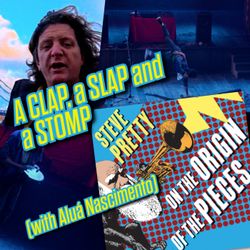
37. A Clap, a Slap and a Stomp (with Aluá Nascimento)
38:29||Ep. 37Episode 37 - A clap, a Slap and a StompWhat actually is musical time? In this episode, Steve kicks off 2026 with the first four days of his “12 Days of Listening” mini-series — all about pulse, groove, and how our brains latch onto patterns (sometimes to our advantage, sometimes not).Then we jump to Wilton’s Music Hall (January 2025) for a live guest spot from Aluá Nascimento — Brazilian percussionist, multi-instrumentalist, and former STOMP cast member — starting with a trumpet + pandeiro duet on “Brazil” and expanding into body percussion, Afro-Brazilian rhythm traditions, and the wonderfully low-tech joy of making music out of whatever’s around.Along the way, Aluá talks about growing up around capoeira, how culture and history shaped these sounds, and demonstrates instruments including berimbau (musical bow), caxixi (shaker), and pandeiro — with a bit of audience participation thrown in too.In this episodeA practical listening upgrade: pulse vs rhythm (try it while walking)“The pocket”: groove as micro-timing, not just the patternWhy your brain is basically a pattern-hunting drummerShared time / entrainment: why humans sync up (and why it matters in music)Live at Wilton’s: trumpet + pandeiro on “Brazil”Aluá’s story: capoeira roots, Afro-Brazilian traditions, and the STOMP yearsInstruments you’ll hear: body percussion, pandeiro, berimbau, caxixi (and more)Find AluáInstagramBeat Goes On (bio + workshops)Watch: Aluá Nascimento & Helene Jank – Body Music (YouTube)Also in this episodeSteve mentions Episode 36 (breaking down how the My Friend Maisy theme was made)Wilton’s Music Hall shows: 24th January — kids/family show at 2pm, evening show at 7pmSupport the showExplore episodes, transcripts, and more: originofthepieces.comJoin the Patreon: patreon.com/StevePrettyOnTheOriginofthePiecesIf you enjoyed this one, share it with a musically curious human (it helps more than you’d think)Stay musically curious!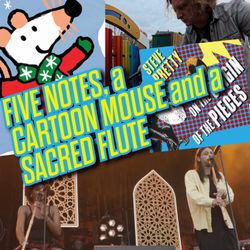
36. Five Notes, Maisy Mouse and a Sacred Flute
40:03||Ep. 36From a Colombian ritual flute heard backstage at Oslo Mela to a children’s TV theme tune played on a London school playground, this episode explores why pentatonic scales turn up everywhere — and why they feel so immediately playable, memorable, and emotionally direct. Along the way, Steve unpacks the thinking behind the theme tune he wrote for My Friend Maisy (also available on NOW), based on the books by Lucy Cousins, and how five carefully chosen notes can shape an entire musical world.The episode takes a gentle detour into Colombian traditional music with a backstage conversation recorded in 2024 with El León Pardo of Mestizo Collective, exploring the gaita — a ritual wind instrument built around paired male and female voices, deep cultural symbolism, and tightly limited pitch material. That sound becomes a useful reference point for the episode’s main thread: how scales function less like theory and more like palettes of identity.Back in TV land, Steve breaks down the Maisy theme in detail, showing how pentatonic scales sit at the heart of children’s musical toys, playground instruments, and early musical experiences — and why avoiding semitone clashes makes music feel instantly safe, inclusive, and playable. Using live demonstrations, playground recordings, and some creative repitching in Melodyne, the episode shows how tiny changes to a scale can completely transform a melody’s emotional character.In this episode:• A backstage conversation with León Pardo about the Colombian gaita, its ritual use, construction, and sound-world.• How male and female gaita flutes are paired, and what that reveals about musical identity.• Why pentatonic scales appear in folk traditions, playground instruments, and children’s musical toys worldwide.• A breakdown of the theme tune Steve wrote for My Friend Maisy, based on the books by Lucy Cousins.• Why playground bells and boomwhackers are almost always pentatonic — and why that matters.• A live experiment repitching the Maisy theme into an Ethiopian-inflected pentatonic.• Why thinking of scales as identities or colour palettes can make musical listening feel less intimidating.Also in this episode, Steve reflects on why many people drift away from music when theory becomes detached from sound — and why listening itself is a learnable, creative skill, whether or not you play an instrument.Plus details of the upcoming Steve Pretty On the Origin of the Pieces live shows at Wilton’s Music Hall on 24th January, including the first ever Origin KIDS matinee at 2pm and the evening show at 7pm. Full details and tickets at originofthepieces.com/live.🎧 Listen, rate and share to help more musically curious ears find the show.💻 More episodes, transcripts, and extras atoriginofthepieces.com🪶 Patreon:patreon.com/StevePrettyOnTheOriginofthePiecesStay musically curious.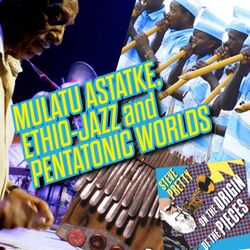
35. Mulatu Astatke, Ethio-jazz and Pentatonic Worlds
48:39||Ep. 35From Addis to the Barbican and back again, this episode dives into the sound-world shaped by Mulatu Astatke — the father of Ethio jazz. With Mulatu having recently completed his farewell tour, Steve goes back to a long, previously-unreleased interview he recorded with him during the making of Hackney Colliery Band’s Collaborations: Volume One. What emerges is a portrait of a true pioneer: a composer trained in London and at Berklee, a collaborator with Duke Ellington, and the architect of a style heard across film soundtracks, samples and stages worldwide.Expect discussions of Ethio jazz’s roots in traditional modes and tribal instruments; a journey through pentatonic and diminished scales; and Mulatu’s deep reflections on African musical heritage and collaboration. There’s even a live extract of Derashe from HCB’s Barbican show — the tune he discusses in the interview.In this episode:• How Mulatu fused Ethiopian pentatonic traditions with jazz harmony and improvisation.• Why some Ethiopian tribes use diminished (whole–half) scales, and how that changes the emotional palette.• The story of Duke Ellington’s Jazz Ambassadors tour — and how Ellington ended up performing one of Mulatu’s arrangements in Addis.• The embilta, washint and other Ethiopian wind instruments that parallel trumpets, trombones and baritone sax.• The link between African “bush” instruments, mbira/“African piano” traditions, and Western harmonic thinking.• A rare 2018 interview captured at Livingston Studios during the HCB/Mulatu recording sessions.• A live performance of Derashe from the Barbican, featuring Hackney Colliery Band and Mulatu Astatke.Also in this episode, Steve welcomes listeners from the New Scientist Podcast and explores the science–music crossover behind shell acoustics, underwater sound, and the physics of musical evolution. Plus a reminder that the new Origin of the Pieces website now includes full transcripts, an interactive world-map archive of every episode, and a growing library of extras.And don’t miss the upcoming Wilton’s Music Hall shows on 24th January 2026, including the first ever Origin KIDS matinee at 2pm and the evening performance at 7pm. TICKETS.🎧 Listen, rate and share to help more musically curious ears find the show.💻 More episodes and extras at originofthepieces.com🪶 Patreon: https://patreon.com/StevePrettyOnTheOriginofthePieces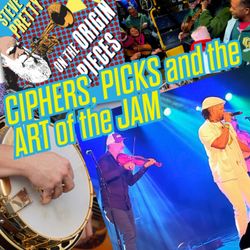
34. Ciphers, Picks and the Art of the Jam
53:52||Ep. 34From the high lonesome sound of Appalachia to the flow of a Bronx cipher, this episode explores what happens when two traditions of storytelling and rhythm collide. Recorded at the WOMEX 2024 world-music gathering in Finland, Steve talks with Gangstagrass — the trailblazing American group fusing bluegrass instrumentation with hip-hop lyricism and beats.Expect fiddles, banjo and beats; live sessions that blur the line between folk jam and freestyle; and a conversation about community, curiosity and the shared language of groove. There’s even a spontaneous rap about Origin of the Pieces and a bus-ride performance that somehow turned into a cipher on wheels.In this episode:How Gangstagrass blend banjo, fiddle and MCs without losing the soul of either style.Why hip-hop ciphers and bluegrass picks are closer than you might think.The jam session as a universal language — connecting folk musicians, rappers and improvisers worldwide.How genre boundaries were drawn by history, and how artists can redraw them.A stripped-back version of Do Better plus a freestyle that plugs their UK tour entirely in rhyme.Gangstagrass UK Tour — November 2025Also in this episode, Steve launches the new Origin of the Pieces website — featuring full transcripts, an interactive world-map archive, the Darwin-trumpet T-shirt shop, and exclusive extras via Patreon.And don’t miss the upcoming Wilton’s Music Hall shows on 24 January 2026, including the first ever Origin KIDS matinee and an evening performance featuring new guests and experiments in sound.🎧 Listen, rate and share to help more musically curious ears find the show.💻 More episodes and extras at originofthepieces.com🪶 Patreon: patreon.com/StevePrettyOnTheOriginofthePieces
33. Malawian Madalitso, Vampire Vamps & Sofa Songs
31:06||Ep. 33From living-room experiments to Malawian street stages — and a brief stop-off in Transylvania.This week, Steve explores what it means to sing what you see: making music that’s spontaneous, handmade and gloriously human. There’s a Halloween detour into his live Nosferatu score, a new Clip n Mix, and a look at the brilliant Madalitso Band from Malawi — two musicians whose home-built instruments and hypnotic grooves turn simplicity into joy.Plus: the mystery of a slightly windy theme tune proves that accidents can be the best kind of inspiration.👇 Full timestamps + links below!⏱️ Chapters00:00 – A suspiciously familiar theme02:30 – Living-room experiments & musical accidents06:40 – Clip n Mix – turning everyday sounds into music10:45 – Vampire Vamps: Nosferatu score (watch)16:30 – Introducing Madalitso Band (Malawi)22:00 – Homemade instruments & street recordings32:00 – Singing what you see44:30 – Finding beauty in simple sounds55:20 – Wilton’s shows, Patreon & Universe of Music tour🔗 Links & Extras🎧 Listen / WatchYouTube | Apple Podcasts | More platforms🎬 Nosferatu live score → Full video🎛 Support / Extras → Patreon🪐 Universe of Music Tour (with Chris Lintott)Corsham (20 Nov) | Cambridge (27 Nov) | Shoreham-by-Sea (15 Jan)🎟 Full info → universeofmusic.co.uk🎟️ Live at Wilton’s Music Hall – 24 Jan 2026👨👩👧👦 KIDS matinee (2 pm) – interactive family show🌙 Evening show (7 pm) – live podcast with guests & musical surprises💸 Code SPRETTY15 = £15 best available seatsBook Kids | Book Evening💬 Got a weird sound you’d like Steve to turn into music? Email podcast@stevepretty.com or comment with #ClipnMix.🙌 Like, subscribe & stay musically curious.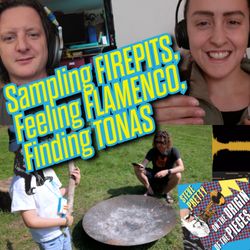
32. RE-UPLOAD: Sampling Firepits, Feeling Flamenco, Finding Tonás
52:43||Ep. 32⚠️ Note: This is a re-uploadThe original episode was taken down due to a copyright strike on the theme tune — even though I wrote and produced it myself. While I sort that out, you’re treated to a gloriously bad placeholder version.Also, I’ve trimmed down the Clip n Mix segment — I was clearly having too much fun with firepits last time, and it got a bit… indulgent. This one gets to the good stuff faster.🔥 Can you make music from a campsite firepit?And what is Tonás — the raw, unaccompanied flamenco style with roots in secrecy, survival, and soul?In this episode, I launch a new segment called Clip n Mix, where I turn everyday sounds into music. This time? A campsite firepit. My son and I hit it with sticks, sample it using Ableton Note, and turn it into a crunchy little beat — which you’ll hear later in the episode.Then we dive into one of flamenco’s most haunting styles: Tonás. My guest is the brilliant Josie Sinnadurai, a flamenco dancer based in Seville, who helps unpack the history, sound, and emotional depth of this unaccompanied vocal tradition.👇 Full chapters and links below!⏱️ Chapters00:00 – Intro + why the theme tune sounds different02:20 – Clip n Mix: sampling a firepit in Dorset09:45 – What is Tonás?10:20 – Interview with Josie Sinnadurai34:50 – Why I didn’t make a Tonás track35:20 – Turning firepit samples into music49:15 – Sound, play, and curiosity54:25 – Live shows + Patreon + sign-off🔗 Links🎬 Watch the Tonás video:https://www.youtube.com/watch?v=X7vpU5zLl-A👣 Follow Josie Sinnadurai:Website: https://www.josielaurelflamenco.com/Instagram: @josie_sinna📱 Try Ableton Note (free app):iOS: https://apps.apple.com/app/ableton-note/id1611814758Android: https://play.google.com/store/apps/details?id=com.ableton.note🎧 Download the firepit samples + Ableton Note session:https://www.patreon.com/StevePrettyOnTheOriginofthePieces🎟️ Live at Wilton’s Music Hall – 24th Jan 2026👨👩👧👦 Kids show (2pm):https://wiltons.org.uk/whats-on/steve-pretty-and-friends-on-the-origin-of-the-pieces-kids/🌙 Evening show (7pm):https://wiltons.org.uk/whats-on/steve-pretty-and-friends-on-the-origin-of-the-pieces-2/💬 Got a weird sound you’d like me to turn into music?Drop it in the comments or email podcast@stevepretty.com