Share
Space, Defence, & Security podcast
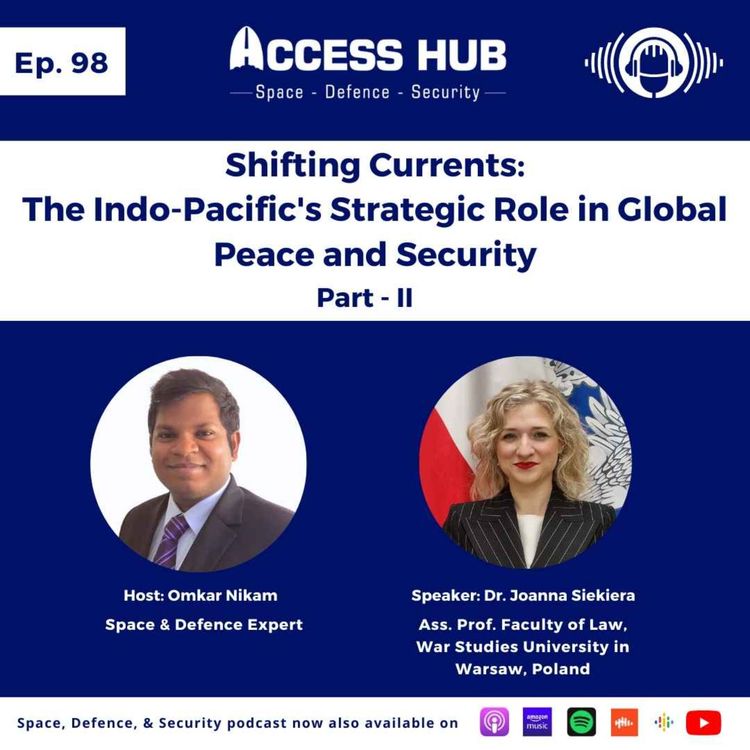
Ep.98 Shifting Currents: The Indo-Pacific's Strategic Role in Global Peace and Security - Part-II | Dr. Joanna Siekiera
NOTE: Episode 98 is a follow-up of episode 97, so I kindly request you to first listen to episode 97 to connect with our discussion in episode 98.
In this episode, we discuss one of the most critical regions shaping the future of global stability. As the Indo-Pacific emerges as a central hub for international trade, military alliances, and geopolitical maneuvering, we explore how nations within the region are influencing global peace and security. From maritime security and freedom of navigation to the strategic interests of major powers like the US, China, India, and Japan, we analyze the complex dynamics at play. Join us as we unpack the region's evolving role in fostering cooperation, mitigating conflicts, and addressing pressing challenges such as territorial disputes and power competition.
About the guest speaker:
Dr. Joanna Siekiera is an international lawyer and works as an Assistant Professor at the Faculty of Law, War Studies University in Warsaw, Poland. She is also a fellow at the US Marine Corps University in Quantico and supports various military institutions, primarily NATO, as a legal advisor.
Dr. Siekiera did her postdoctoral research at the Faculty of Law, University of Bergen, Norway, and Ph.D. studies in New Zealand at the Faculty of Law, Victoria University of Wellington. She worked in Polish diplomatic missions in Canada and Estonia.
She is the author of over 100 scientific publications in several languages, legal opinions for the Polish Ministry of Justice, the book “Regional Policy in the South Pacific”, and the editor of 9 monographs on international law, international relations, and security. Her areas of expertise are the law of armed conflict (lawfare, legal culture in armed conflict, NATO legal framework) and the Indo-Pacific region, Pacific law, and maritime security.
Dr. Siekiera took part in over 80 interviews and podcasts promoting science, interdisciplinary, and multidimensional research. She speaks 8 languages and currently is learning Chinese.
- “Europe's Role in Indo-Pacific Security with Dr. Joanna Siekiera” Center for International Maritime Security (CIMSEC) 18.07.2024 [USA]
- “21st Century as the Pacific Century” New Books Network 18.06.2024 [USA]
- “Decoding Crisis in the Indo-Pacific | Dr. Joanna Siekiera | Exclusive Interview” The Prode 24.05.2024 [United Kingdom]
- “Joanna Siekiera on China” Cognitive Crucible Podcast 18.03.2024 [USA]
- “Dragons in the West: Chinese Communist Party Threats in Europe and the Imperative of a Strategic Pivot” Irregular Warfare Initiative 27.02.2024 [USA].
If you find our podcast insightful, please like, share, and subscribe on www.accesshub.space and www.oknikam.eu.
About Access Hub
Access Hub is a global B2B market leader at the intersection of strategy, media, and technology, driving innovation across Space, Defense, Maritime, Aerospace, Energy, and Media-Tech.
Built on three pillars, Advertising & Marketing, Consulting, and Supply Chain Management, Access Hub delivers high-impact campaigns, actionable insights, and trusted supplier-buyer connections.
With a footprint in 120+ countries, 50,000+ monthly readers, and 250+ clients, we consistently deliver results: 75% average sales uplift and 4.85/5 client satisfaction rating.
Whether you’re looking to expand market reach, unlock strategic intelligence, or connect with industry leaders, Access Hub is where industries converge, innovation thrives, and growth accelerates.
More episodes
View all episodes
152. Ep.152 From Terror Funding to Statecraft: Weaponized Finance in the Age of AI - Part-II | Adam Rousselle
18:25||Season 1, Ep. 152Illicit finance is no longer a side issue, it is a core enabler of modern conflict, coercion, and gray-zone warfare.In this episode, we speak with Adam Rousselle, Intelligence and Security Expert, on how illicit financial networks power terror financing, sanctions evasion, organized crime, and state-driven hybrid operations worldwide.Moving beyond regional case studies, the discussion frames illicit finance as a global security architecture problem, shaped by fragmented regulation, data silos, and slow institutional response. Adam outlines a three-tier framework to explain how these networks are built, how money flows through them, and why they remain resilient.We also examine where AI is genuinely changing the game in counter-illicit finance, network analysis, anomaly detection, pattern recognition, and where its limits remain without strong data, governance, and human judgment.This isn’t about compliance. It’s about financial systems as battlefields, and why counter-illicit finance is now inseparable from national security and geopolitics.For deeper insights on illicit finance and global security, subscribe to BTL Research by Adam Rousselle.
151. Ep.151 From Terror Funding to Statecraft: Weaponized Finance in the Age of AI - Part-I | Adam Rousselle
27:42||Season 1, Ep. 151Illicit finance is no longer a side issue, it is a core enabler of modern conflict, coercion, and gray-zone warfare.In this episode, we speak with Adam Rousselle, Intelligence and Security Expert, on how illicit financial networks power terror financing, sanctions evasion, organized crime, and state-driven hybrid operations worldwide.Moving beyond regional case studies, the discussion frames illicit finance as a global security architecture problem, shaped by fragmented regulation, data silos, and slow institutional response. Adam outlines a three-tier framework to explain how these networks are built, how money flows through them, and why they remain resilient.We also examine where AI is genuinely changing the game in counter-illicit finance, network analysis, anomaly detection, pattern recognition, and where its limits remain without strong data, governance, and human judgment.This isn’t about compliance. It’s about financial systems as battlefields, and why counter-illicit finance is now inseparable from national security and geopolitics.For deeper insights on illicit finance and global security, subscribe to BTL Research by Adam Rousselle.
150. Ep.150 Joint Warfare Reality: How Weapons Are Selected for Air-Land-Sea Integration - Part-II | Sqn Ldr Shailesh Pol
57:37||Season 1, Ep. 150Joint warfare is not about individual platforms. It’s about who owns the mission, who controls the air, and who controls the kill chain.As India moves toward integrated theatre commands, the logic of warfare is undergoing a fundamental shift. Weapons that perform exceptionally within a single service often struggle when exposed to the realities of Air-Land-Sea joint operations. The difference between success and failure is no longer defined by firepower alone, but by sensors, data links, interoperability, and decision-making timelines.In this two-part episode, Sqn Ldr Shailesh Pol, a specialist in Air Defence, Counter-UAS, and aerial weapons, breaks down the realities of modern joint warfare from an operational perspective. This is not a doctrinal discussion. It is a candid examination of how weapons are actually evaluated, selected, integrated, and employed when multiple services fight as one.The conversation explores:How weapon selection fundamentally changes when the Air Force supports an Army-led campaign or a Naval task forceWhose requirement truly drives decisions in joint operations, the platform owner or the mission ownerWhy some weapons that look ideal on paper become liabilities once joint integration beginsThe critical role of sensors, networks, and control of targeting in determining weapon effectivenessWhat is harder to align in real operations: doctrine, communications, or decision-making speedWho truly controls the air in an army-led battlefieldHow joint forces counter non-conventional and non-standard threatsWhich interoperable systems enable success across Army, Navy, and Air Force operationsWhat policymakers and industry continue to underestimate about joint weapon integrationThis is essential viewing for military professionals, defence industry leaders, policymakers, analysts, and anyone seeking to understand how future conflicts will be fought, not in theory, but in reality.
149. Ep.149 Joint Warfare Reality: How Weapons Are Selected for Air-Land-Sea Integration - Part-I | Sqn Ldr Shailesh Pol
36:08||Season 1, Ep. 149Joint warfare is not about individual platforms. It’s about who owns the mission, who controls the air, and who controls the kill chain.As India moves toward integrated theatre commands, the logic of warfare is undergoing a fundamental shift. Weapons that perform exceptionally within a single service often struggle when exposed to the realities of Air-Land-Sea joint operations. The difference between success and failure is no longer defined by firepower alone, but by sensors, data links, interoperability, and decision-making timelines.In this two-part episode, Sqn Ldr Shailesh Pol, a specialist in Air Defence, Counter-UAS, and aerial weapons, breaks down the realities of modern joint warfare from an operational perspective. This is not a doctrinal discussion. It is a candid examination of how weapons are actually evaluated, selected, integrated, and employed when multiple services fight as one.The conversation explores:How weapon selection fundamentally changes when the Air Force supports an Army-led campaign or a Naval task forceWhose requirement truly drives decisions in joint operations, the platform owner or the mission ownerWhy some weapons that look ideal on paper become liabilities once joint integration beginsThe critical role of sensors, networks, and control of targeting in determining weapon effectivenessWhat is harder to align in real operations: doctrine, communications, or decision-making speedWho truly controls the air in an army-led battlefieldHow joint forces counter non-conventional and non-standard threatsWhich interoperable systems enable success across Army, Navy, and Air Force operationsWhat policymakers and industry continue to underestimate about joint weapon integrationThis is essential viewing for military professionals, defence industry leaders, policymakers, analysts, and anyone seeking to understand how future conflicts will be fought, not in theory, but in reality.
148. Ep.148 The Transformation of Modern Warfare in the Context of the Russia-Ukraine War - Part-II | Olena Kryzhanivska
26:38||Season 1, Ep. 148The Russia-Ukraine war has stripped away long-held assumptions about military power, exposing what works, what fails, and what adapts under pressure.In these episodes, Olena Kryzhanivska examines the shifts that defined 2025: the growing dominance of low-cost, scalable weapons, the declining advantage of legacy platforms, and the speed at which warfare now evolves through constant battlefield feedback.We discuss Ukraine’s move to open arms exports, its implications for the global defense market, and how deterrence and escalation are being reshaped one step at a time.This is not theory, it’s the blueprint of how future wars will be fought.For more insights, follow Olena’s essential reporting at Ukraine’s Arms Monitor on this link.
147. Ep.147 The Transformation of Modern Warfare in the Context of the Russia-Ukraine War - Part-I | Olena Kryzhanivska
33:19||Season 1, Ep. 147The Russia-Ukraine war has stripped away long-held assumptions about military power, exposing what works, what fails, and what adapts under pressure.In these episodes, Olena Kryzhanivska examines the shifts that defined 2025: the growing dominance of low-cost, scalable weapons, the declining advantage of legacy platforms, and the speed at which warfare now evolves through constant battlefield feedback.We discuss Ukraine’s move to open arms exports, its implications for the global defense market, and how deterrence and escalation are being reshaped one step at a time.This is not theory, it’s the blueprint of how future wars will be fought.For more insights, follow Olena’s essential reporting at Ukraine’s Arms Monitor on this link.
146. Ep.146 The Real Spies Behind the Screen: Inside DHURANDHAR | Colonel (Veteran) Bhupinder Shahi
47:59||Season 1, Ep. 146Some conversations don’t stay confined to the moment they’re spoken.They linger. They unsettle. They reopen memories.This episode was one of those.As DHURANDHAR, one of the latest Indian films exploring the world of espionage, moves audiences with its depiction of intelligence operations. One particular sequence, the 26/11 Mumbai terror attack, hit closer to home than expected. For me, it triggered an emotional wave that went far beyond cinema. That moment shaped the tone of this conversation and turned it into something deeply personal.In this powerful episode, I sit down with Colonel (Rtd.) Bhupinder Shahi, a retired Indian Army officer and the military consultant behind DHURANDHAR. Together, we peel back the layers between what intelligence work looks like on screen, and what it truly demands in reality.This is not a glamorous spy story.It’s a grounded, human conversation about discipline, secrecy, emotional burden, and responsibility. Colonel Shahi speaks candidly about:How far cinematic espionage drifts from real intelligence operationsThe mindset and psychological rigor required to operate in India’s security ecosystemWhy secrecy is not a choice, but a cultureThe weight he carried while ensuring DHURANDHAR portrayed intelligence work responsiblyScenes that come closest to the real emotional pressure faced by intelligence professionalsAnd the single most misunderstood truth young viewers should know before romanticising the world of spiesAt its core, this episode explores a difficult balance:How do you tell national security stories honestly, without exposing what must remain unsaid?Listen closely. Some stories aren’t meant to entertain. They’re meant to be felt.
145. Ep.145 The Shadow Network of Spies: Intelligence Cooperation Against Hamas - Part-II | Dr. Ecaterina Matoi
09:53||Season 1, Ep. 145Spies don’t work alone. And neither does intelligence.In this two-part episode, The Shadow Network of Spies, Dr. Ecaterina Matoi takes us inside the hidden world of intelligence cooperation against Hamas, where satellites, intercepted messages, and human sources converge across borders.From why even the most powerful intelligence agencies can’t track Hamas alone, to how Israel, the U.S., and regional partners share secrets under extreme time pressure, this episode unpacks what intelligence cooperation really looks like beyond the movies. We explore missed warnings, hard moral decisions in urban warfare, and how evolving militant networks tied to Iran and Hezbollah are reshaping the intelligence game.This is a rare, clear-eyed look at how modern spy networks work, what they get right, where they fail, and what comes next as the shadow war continues.
144. Ep.144 The Shadow Network of Spies: Intelligence Cooperation Against Hamas - Part-I | Dr. Ecaterina Matoi
21:18||Season 1, Ep. 144Spies don’t work alone. And neither does intelligence.In this two-part episode, The Shadow Network of Spies, Dr. Ecaterina Matoi takes us inside the hidden world of intelligence cooperation against Hamas, where satellites, intercepted messages, and human sources converge across borders.From why even the most powerful intelligence agencies can’t track Hamas alone, to how Israel, the U.S., and regional partners share secrets under extreme time pressure, this episode unpacks what intelligence cooperation really looks like beyond the movies. We explore missed warnings, hard moral decisions in urban warfare, and how evolving militant networks tied to Iran and Hezbollah are reshaping the intelligence game.This is a rare, clear-eyed look at how modern spy networks work, what they get right, where they fail, and what comes next as the shadow war continues.