Share
Space, Defence, & Security podcast
Powered by Access Hub
Latest episode
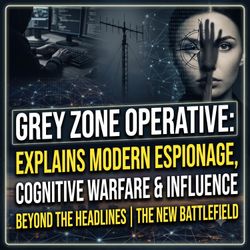
157. Ep.157 Former Grey Zone Operative Explains Modern Espionage, Influence & Cognitive Warfare | Oriane Cohen
42:52||Season 1, Ep. 157What really happens in the Grey Zone, the invisible space between peace and war where influence, espionage, perception, and plausible deniability shape global events?In this gripping episode of the Space, Defence, & Security Podcast powered by Access Hub, our host Omkar Nikam sits down with Oriane Cohen, a former Grey Zone Operative who transitioned from conflict journalism into covert intelligence operations before founding her strategic advisory practice.Drawing on first-hand operational experience, Oriane explains how modern intelligence works beyond Hollywood myths, why perception has become the new battlefield, and how governments, private operators, and influence networks shape events without ever appearing in the headlines.Whether you're interested in national security, intelligence, geopolitics, defence, military strategy, cyber influence, or cognitive warfare, this conversation provides a rare look into one of the least understood aspects of modern conflict.
More episodes
View all episodes

156. Ep.156 The Hidden War That Could Change Africa Forever | Aman Bezreh
37:09||Season 1, Ep. 156Why is one of the world's fastest-growing security crises receiving so little global attention?In this episode with Intelligence Analyst, Aman Bezreh, we explore the rapidly evolving conflict in Africa's Sahel region, where terrorist groups, rebel alliances, military coups, and foreign powers are reshaping the future of the continent. We discuss the rise of JNIM, the security situation in Mali, Niger, and Burkina Faso, the changing role of the United States and Europe, and how the recent Israel-Iran conflict could influence stability across Africa.If you're interested in geopolitics, international security, defense, military affairs, and global power competition, this episode provides an in-depth analysis of one of today's most overlooked conflicts.Topics Covered:• The Sahel crisis explained• Why JNIM is expanding• Terrorist and rebel alliances• Military coups in West Africa• Niger, Mali & Burkina Faso• US, Europe, Russia & China's role• The impact of the Israel-Iran conflict on Africa• What the future holds for the region
155. Ep.155 SpaceX's Starlink Expansion in Asia: Opportunity, Threat, or Both? | Blaine Curcio
40:39||Season 1, Ep. 155Will SpaceX and Starlink dominate Asia's future in space?A new space race is unfolding across Asia. Nations are rapidly investing in military satellites, sovereign communication networks, Earth observation capabilities, and indigenous space industries to secure their strategic interests.In this episode, Asian space industry expert and the founder of Orbital Gateway Consulting (OGC), Blaine Curcio, joins us to break down the biggest trends shaping the future of space in Asia.In this episode, we discuss:The impact of SpaceX and Starlink across AsiaThe future of military satellites and defense space programsChina's expanding influence through space diplomacyIndia's growing role in the global space economyThe rise of sovereign satellite infrastructureThe future of commercial satellite markets and LEO constellationsWhy Asia could become the world's most important space battlegroundWhether you work in the space industry, defense sector, satellite communications, or simply follow geopolitics and emerging technologies, this conversation offers deep insights into the next phase of the global space economy.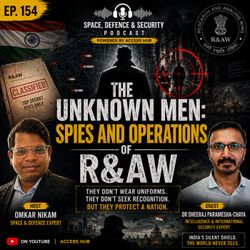
154. Ep.154 THE UNKNOWN MEN: Spies and Operations of R&AW | Dr Dheeraj Paramesha-Chaya
01:00:05||Season 1, Ep. 154India’s wars are not always fought on the battlefield.Behind the headlines, beyond diplomacy, exists a silent world of intelligence, covert operations, and strategic action. In this episode of the Space, Defence & Security Podcast, we explore the reality of Spies, India, and R&AW, the agency at the center of India’s external intelligence operations.Who are the “unknown men” often spoken about in connection with covert missions?How do intelligence operations actually work?And how has India’s approach to national security evolved in an increasingly complex geopolitical environment?This conversation moves beyond cinema and speculation to examine the strategic, operational, and psychological dimensions of intelligence work.🎙 Featuring Dr Dheeraj Paramesha-Chaya, Lecturer in intelligence and international security at the School of Criminology, Politics, and Law, University of Hull in UK, this episode provides a serious and informed perspective on one of the most discussed, yet least understood, aspects of national security.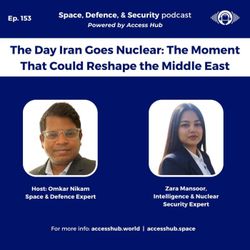
153. Ep.153 The Day Iran Goes Nuclear: The Moment That Could Reshape the Middle East - Zara Mansoor
44:00||Season 1, Ep. 153For decades, the world has tried to prevent Iran from developing nuclear weapons through sanctions, diplomacy, covert operations, and military pressure. But many analysts now believe Iran could reach nuclear weapons capability in the near future.If that happens, it will not just change Iran.It will change the Middle East.And it could reshape the global balance of power.In this episode, we speak with Zara Mansoor to explore the geopolitical, military, and strategic consequences of a nuclear Iran. We discuss Israel’s security doctrine, the possibility of a Middle East nuclear arms race, the role of the United States, China, and Russia, and what this means for the future of the global non-proliferation system.This is not a conversation about whether Iran will go nuclear.This is a conversation about what happens if it does.Link to Zara's newsletter.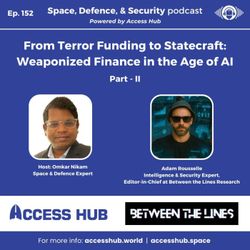
152. Ep.152 From Terror Funding to Statecraft: Weaponized Finance in the Age of AI - Part-II | Adam Rousselle
18:25||Season 1, Ep. 152Illicit finance is no longer a side issue, it is a core enabler of modern conflict, coercion, and gray-zone warfare.In this episode, we speak with Adam Rousselle, Intelligence and Security Expert, on how illicit financial networks power terror financing, sanctions evasion, organized crime, and state-driven hybrid operations worldwide.Moving beyond regional case studies, the discussion frames illicit finance as a global security architecture problem, shaped by fragmented regulation, data silos, and slow institutional response. Adam outlines a three-tier framework to explain how these networks are built, how money flows through them, and why they remain resilient.We also examine where AI is genuinely changing the game in counter-illicit finance, network analysis, anomaly detection, pattern recognition, and where its limits remain without strong data, governance, and human judgment.This isn’t about compliance. It’s about financial systems as battlefields, and why counter-illicit finance is now inseparable from national security and geopolitics.For deeper insights on illicit finance and global security, subscribe to BTL Research by Adam Rousselle.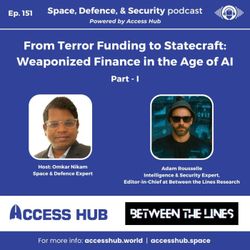
151. Ep.151 From Terror Funding to Statecraft: Weaponized Finance in the Age of AI - Part-I | Adam Rousselle
27:42||Season 1, Ep. 151Illicit finance is no longer a side issue, it is a core enabler of modern conflict, coercion, and gray-zone warfare.In this episode, we speak with Adam Rousselle, Intelligence and Security Expert, on how illicit financial networks power terror financing, sanctions evasion, organized crime, and state-driven hybrid operations worldwide.Moving beyond regional case studies, the discussion frames illicit finance as a global security architecture problem, shaped by fragmented regulation, data silos, and slow institutional response. Adam outlines a three-tier framework to explain how these networks are built, how money flows through them, and why they remain resilient.We also examine where AI is genuinely changing the game in counter-illicit finance, network analysis, anomaly detection, pattern recognition, and where its limits remain without strong data, governance, and human judgment.This isn’t about compliance. It’s about financial systems as battlefields, and why counter-illicit finance is now inseparable from national security and geopolitics.For deeper insights on illicit finance and global security, subscribe to BTL Research by Adam Rousselle.