Latest episode
10. Conclusion
15:48||Ep. 10The COST Action Slow Memory (2021–2025), led by Jenny Wüstenberg and Joanna Wawrzyniak, brought together 323 scholars from 44 countries to reframe memory studies. Emerging from a critique of event-focused, fast-paced approaches, the project emphasized slow-moving, dispersed, and structural temporalities of memory. Organized into five working groups, it explored industrial decline, welfare transformations, right-wing memory politics, conflict transformation, and environmental memory. The Action produced publications, teaching resources, policy briefs, and a virtual exhibition, while fostering collaborations across disciplines. As it concludes, Slow Memory endures as a conceptual and methodological framework shaping future scholarship and collective practice. In this episode, hosts Annemarie Majlund Jensen, Vjollca Krasniqi and Hanna Teichler look back and take stock. We would like to thank our colleagues:Natalie BraberVicky KaraiskouLibora Oates IndruchovaSara Dybris McQuaid Tea Sindbaek AndersenRose SmithChris Reynolds Yuliya Yurchuk Tanja PetrovicGruia Badescu Deniz Gündogan IbrisimJenny WüstenbergJoanna WawrzyniakAlice SemedoMariana Cerveira LimaMusic: Sleep comes, by Oleksii Kalyna from Pixabay
More episodes
View all episodes
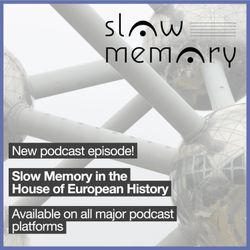
9. Slow Memory in the House of European History
16:43||Ep. 9In this episode of the Slow Memory Podcast, members of the COST action travel to Brussels to explore the House of European History’s Present Pasts exhibition through the lens of “slow witnessing.” Guided through powerful photographic projects that reimagine how Europe remembers, they focus on two striking case studies: Julien Sales’ Glacier, The Last Image, a haunting self-portrait of a disappearing glacier, and Hugo Passarello Luna’s Nostalgie de la Boue, which blurs the line between First World War history and reenactment. Reflecting on these works, the curators show how slowing down to notice details, connections, and emotions can deepen our understanding of memory as a living, complex presence.
8. Slow Ethnography: Heritage, Industry and Environmental Racism in the American Gulf States
16:31||Ep. 8This episode of The Slow Memory Podcast features Dr Lucy Bond and Dr Jessica Rapson, co‑chairs of Working Group 5 (Transformation of the Environment), in conversation about their British Academy and Leverhulme Trust–funded research on heritage, industry and environmental racism in the American Gulf States. They explore their approach to immersive, slow ethnography—spending extended time in the region, engaging with local communities, interviewing activists, and mapping tourist experiences. The discussion highlights the methodological, ethical, and wellbeing challenges of long‑term, place‑based research, and argues for the value of slowness in producing meaningful, critically engaged scholarship.
7. Solidarity: A Slow Memory Concept
16:03||Ep. 7The concept of solidarity occupies a central yet contested place in the history of Europe’s labour movements. Frequently invoked by trade unionists across ideological traditions, its meanings have never been singular or fixed. Drawing on life story interviews with retired union activists from several European countries, this podcast – hosted by Joanna Wawrzyniak and Natalie Braber – explores how solidarity is remembered as a lived, evolving practice shaped by the experience of industrial reorganisations. Both hosts bring insights from their collaboration in a broader oral history project on trade union memory in Europe, as part of Working Group 1, "Transformation of Work", of the Slow Memory COST Action.This podcast features the stories of David Amos, Francka Četković, Mick Chewings, Jan Rulewski, Jean-Claude Reding and Carles Vallejo. We warmly acknowledge the contributions of other interviewers: Nicolas Arendt, Zoé Konsbruck, Brian Rosa, Javier Tébar and Nina Voidopevic. For the full list of project participants, please visit our website. We are deeply grateful to everyone who generously shared their time and experience with us. We would also like thank the University of Warsaw IDUB New Ideas Excellence Initiative and Slow Memory COST Action for supporting this project.
6. Slow Memory and the Transformation of Conflicts
15:46||Ep. 6In this episode, members of working group four examine slow processes of remembering after the Yugoslav wars and the Troubles in Northern Ireland. Inspired by their COST Action meetings in Belgrade and Belfast during 2024, co-chairs of the working group, Orli Fridman (Associate Professor at the Faculty of Media and Communications and Professor of the School for International Training, Belgrade) and Chris Reynolds (Professor of European History and Memory Studies at Nottingham Trent University, UK) talk to Siobhan Kattago (Associate Professor of Political Philosophy, University of Tartu, Estonia) about their long-standing research on transformations of conflict in Belgrade and Belfast. In addition, Tamara Šmidling, a memory activist with the Centre for Public History, describes how ‘memory walks’ in the streets of Belgrade exemplify slow processes of memory. William Blair, Director of Collections with National Museums NI discusses how museum curators and oral historians work within long durations of time and slow memory. In comparing their experiences of slow memory in the areas of activism, peacebuilding, oral history, memory walks, and the curation of history exhibits, it becomes increasingly clear that transformations of conflict are slow processes that leave unpredictable traces in the present. While reconciliation may often seem elusive, the podcast outlines the different tempos and temporalities of working towards a lasting peace.
5. Slow Memory and the Art of Caring
10:35||Ep. 5In this episode, we introduce Slow Memory in arts-based practices of care. The episode features three pioneering arts-based practices from Argentina that generate significant, slow-moving transformations in mental health care. They promote the rights of people who experience mental suffering: the right to play, the right to dream, the right to be listened to, to be remembered. This is key, knowing that the memories of people with lived experiences of mental suffering are oftentimes the object of stigmatization and forgetting in society. The episode includes the voices and stories of people who are involved in this significant memory work, including Santiago Barugel (Hospital Infanto Juvenil Dra. Carolina Tobar García), Sonia Malva Basualdo (Colectivo Crisálida) and Daniel Degol (El cisne del arte). Read by: Marileen La HaijeMusic by Rasec Música Sin Copyrigth from Pixabay
4. 8 March as Slow Commemoration
17:05||Ep. 4In this episode, Members of Working Group 3 on the Transformation of Politics explore the history of International Women’s Day and how this date can be understood as a “slow commemoration”. Slow commemoration refers to dates in our calendar that appear to commemorate or celebrate something specific yet whose meaning is slippery. Slow commemorations attach themselves to multiple histories and multiple meanings: they can be filled with content to persuade you to fight for something, vote for something, or simply buy something. The 8 March is marked in many places in the world, but the meanings attached to it shift and slip according to time and location. Sometimes it is a day to celebrate women in traditional ways with gift-giving and flowers, sometimes it is a day to protest continued inequality, in some places it is viewed as nothing more than a Soviet hangover, and in others, it is a marketing opportunity.Narrated by Sara Jones and Maija SpurinaMusic by Rasec Música Sin Copyrigth from Pixabay