Share

SLOW ENGLISH PODCAST. YOUR ENGLISH TOOLBOX
Could You Give Me a Hand? 4 Natural Ways to Ask for Help
https://yourenglishtoolbox.com/episodes/153-could-you-give-me-a-hand-4-natural-ways-to-ask-for-help/
This podcast is created through a human-led editorial process. Every episode concept, educational strategy, narrative direction and final editorial decision is developed and reviewed by people committed to making English learning meaningful. Artificial intelligence supports script development and editing, while ElevenLabs provides the synthetic voices of our hosts. Human judgement leads the process; technology supports its production.
Learn with this episode on Your English Toolbox: follow the transcript, review the four audio expressions and practise five additional expressions on the web.
Martin is carrying four boxes and needs help, but his first attempt sounds more like a command than a polite request. Julia gives him four natural ways to ask for help without sounding abrupt.
This is episode eight of Everyday Useful Expressions, our series of ready-made English for real situations.
You will learn:
- Could you give me a hand? — a friendly request for practical help;
- Would you mind…? — a polite request followed by an ing form;
- I could use some help with… — a gentle, indirect way to signal that help would be useful;
- I’d appreciate it if you could… — a polite, slightly more formal request.
The episode explains the grammar after “Would you mind…?”, the potentially confusing reply “Not at all” and how to choose between a direct friendly request and a more formal professional one.
The episode page also includes five additional expressions for asking for help politely, with meanings, tone, examples and active practice.
Level: B1–B2 · Focus: polite requests · asking for help · natural spoken English · listening and speaking · Format: short conversational Slow English
Keywords: ask for help politely in English, could you give me a hand meaning, would you mind grammar, polite requests English, I would appreciate it if you could, everyday English expressions, B1 B2 speaking, slow English podcast, English listening practice, Your English Toolbox
#EverydayEnglish #PoliteRequests #SpeakEnglish #SlowEnglishPodcast #LearnEnglish #EnglishListeningPractice #YourEnglishToolbox
💬 We’d love to hear from you!
If you enjoyed this episode, leave a comment, share your thoughts, or tell us how you’re using these tips to improve your English. Your feedback helps us grow and create even better content for you.
More episodes
View all episodes

154. Short Stories with Peter: The Bet by Anton Chekhov (Abridged B1–B2 Level)
09:46||Ep. 154https://yourenglishtoolbox.com/episodes/154-short-stories-with-peter-the-bet-by-anton-chekhov/ This podcast is created through a human-led editorial process. Every episode concept, educational strategy, narrative direction and final editorial decision is developed and reviewed by people committed to making English learning meaningful. Artificial intelligence supports script development and editing, while ElevenLabs provides the synthetic voices of our hosts. Human judgement leads the process; technology supports its production. Learn with this episode on Your English Toolbox: follow the complete transcript, choose a translation in several languages, and explore the vocabulary guide with clear definitions, nuances and examples. What can fifteen years of silence do to the value of money, freedom and life itself? At a dinner party, a wealthy banker and a young lawyer begin an angry argument about whether death is worse than lifelong imprisonment. Their disagreement becomes a reckless bet: the lawyer will live completely alone for fifteen years, and the banker will pay him two million if he succeeds. Books become the prisoner’s only contact with the world. As the final night approaches, however, the banker discovers that keeping his promise may destroy him. In this new English abridgement of Anton Chekhov’s classic 1889 story, Peter guides you through a tense moral tale about pride, isolation, knowledge and the price people place on freedom. After the story, Peter explores four useful B1–B2 expressions: have something at stake — risk losing something important;stick something out — continue through a difficult situation until the end;be on the verge of — be extremely close to a new or serious situation;turn your back on something — deliberately reject or abandon it. You will also learn the pattern “would rather do one thing than do another” for expressing preference: “I would rather live in prison than die.” This is a slow, atmospheric listening experience for B1–B2 learners who want richer narrative English, distinct character voices and a classic ending that invites a genuine moral question. The Bet — a new English abridgement of Anton Chekhov’s 1889 Russian story. Adapted for B1–B2 English learners by Your English Toolbox from public-domain historical sources. This is not a reproduction of a modern English translation. The original work is in the public domain in Spain. Content note: discussion of capital punishment, prolonged isolation, financial ruin and an intended act of violence that is not carried out. Level: B1–B2 · Focus: listening comprehension · moral choices · money and freedom · preference with would rather · classic literature abridged for English learners Keywords: English short stories, learn English with stories, The Bet Anton Chekhov, B1 B2 English listening, moral suspense story, English vocabulary in context, would rather grammar, classic literature adapted, slow English podcast, Your English Toolbox #ShortStoriesWithPeter #LearnEnglishWithStories #B1B2English #EnglishListening #TheBet #AntonChekhov #ClassicLiterature #YourEnglishToolbox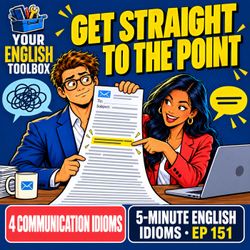
151. Get Straight to the Point: 4 Communication Idioms
05:52||Ep. 151https://yourenglishtoolbox.com/episodes/151-get-straight-to-the-point-4-communication-idioms/ This podcast is created through a human-led editorial process. Every episode concept, educational strategy, narrative direction and final editorial decision is developed and reviewed by people committed to making English learning meaningful. Artificial intelligence supports script development and editing, while ElevenLabs provides the synthetic voices of our hosts. Human judgement leads the process; technology supports its production. Learn with this episode on Your English Toolbox: follow the transcript, review the four idioms and practise at seven listening speeds. Martin has received a very long email from the workshop organisers, but the important information is surprisingly difficult to find. Julia helps him get straight to the point, notice when someone is beating around the bush, read between the lines and ask to be kept posted. This short conversational Slow English episode continues Lesson 10 — Communication — in the free Idiom Toolbox course. You will learn: get straight to the point — say the important thing immediately;beat around the bush — avoid saying something directly;read between the lines — understand a meaning that is suggested but not stated;keep someone posted — continue giving someone the latest information. The conversation compares direct and indirect communication, explains when a direct tone may sound helpful or rude and practises the patterns “keep someone posted about something” and “keep someone posted on something”. Finish with an active-recall challenge and a personal speaking prompt. Continue with Lesson 10 — Communication — in the free Idiom Toolbox course: https://yourenglishtoolbox.com/idioms/lesson-10-communication/ Level: B1–B2 · Focus: communication idioms · implied meaning · clear communication · listening and speaking · Format: short conversational Slow English Keywords: communication idioms in English, get straight to the point meaning, beat around the bush meaning, read between the lines meaning, keep me posted meaning, English idioms B1 B2, slow English podcast, English listening practice, Idiom Toolbox, Your English Toolbox #EnglishIdioms #CommunicationIdioms #SlowEnglishPodcast #LearnEnglish #EnglishListeningPractice #YourEnglishToolbox
152. How Bad Is the Problem? Minor, Serious or Urgent?
05:58||Ep. 152https://yourenglishtoolbox.com/episodes/152-how-bad-is-the-problem-minor-serious-or-urgent/ This podcast is created through a human-led editorial process. Every episode concept, educational strategy, narrative direction and final editorial decision is developed and reviewed by people committed to making English learning meaningful. Artificial intelligence supports script development and editing, while ElevenLabs provides the synthetic voices of our hosts. Human judgement leads the process; technology supports its production. Learn with this episode on Your English Toolbox: follow the transcript, compare the vocabulary in context and practise at seven listening speeds. A spelling mistake, a funding gap and water leaking beside electricity are all problems — but they are not the same kind of problem. In this short Precision English episode, Martin and Julia compare three useful words that learners often treat as simple levels of the same scale: minor, serious and urgent. You will learn: minor — small, with limited consequences;serious — important or severe, with significant consequences;urgent — requiring immediate attention or action. The conversation shows why serious describes severity while urgent describes time pressure. A problem can be serious without being urgent, urgent without being very serious, or both serious and urgent. You will also practise natural collocations including minor mistake, serious risk, urgent repair and urgent request, followed by a four-part active-recall challenge. On the episode page, choose from seven listening speeds, follow the transcript and review the vocabulary in context. Level: B1–B2 · Focus: precision vocabulary · describing problems · severity and urgency · listening and speaking · Format: short conversational Slow English Keywords: minor serious urgent difference, how to describe problems in English, precise English vocabulary, serious versus urgent, minor problem meaning, urgent problem meaning, B1 B2 vocabulary, slow English podcast, English listening practice, Your English Toolbox #EnglishVocabulary #PrecisionEnglish #SlowEnglishPodcast #LearnEnglish #EnglishListeningPractice #YourEnglishToolbox
150. 10 Habits of People Who Live to 100 | Part 2: Your Mind
15:12||Ep. 150https://yourenglishtoolbox.com/episodes/150-10-habits-of-people-who-live-to-100-part-2-your-mind/ This podcast is created through a human-led editorial process. Every episode concept, educational strategy, narrative direction and final editorial decision is developed and reviewed by people committed to making English learning meaningful. Artificial intelligence supports script development and editing, while ElevenLabs provides the synthetic voices of our hosts. Human judgement leads the process; technology supports its production. Learn with this episode on Your English Toolbox: listen and read without registering, or use a free student account to access the downloadable transcripts, vocabulary PDFs, flashcards and progress tools. Martin followed all five body habits from the previous episode: stairs, shopping bags, lentils and the same bedtime every night. It was a perfect week. Then, standing in the kitchen and feeling extremely healthy, a voice in his head asked: and all of this is for what, exactly? That question is habit number six. This is the second half of the bonus conversation that closes How to Live a Good Life: five habits connected with purpose, rest, learning, belonging and the people who matter. It is a warm, evidence-aware Slow English conversation about building a fuller life, not a promise that any habit can guarantee longevity. You will meet Dorothy, 88, from Bristol: choir on Tuesdays, stories at the library on Thursdays, her 91-year-old sister on Sundays, Italian class on Mondays — she started at 84 and says she is terrible — and one quiet hour in the garden every afternoon. Asked for her secret, she says: “I have things on Tuesdays.” What you will learn today: Why “What is my purpose?” may be too large a question, and the smaller question that can help.How to distinguish real rest from sitting down while absorbing somebody else’s stress.What cognitive reserve means, why challenging learning matters and what the evidence can — and cannot yet — say about learning a language later in life.Why belonging to something with a calendar can be more reliable than waiting to feel sociable.Three natural English sentences for purpose, learning and belonging, practised with pauses. English in context includes: a reason to get up, to look forward to something, to downshift, to unload stress, cognitive reserve, to take up something, to belong, to turn up and a ritual. Practice sentences: What are you looking forward to this week?I have taken up something new. I am terrible at it.Same time next week? Sentence of the day: A long life is not the goal. A full one is. All six conversations in How to Live a Good Life stand on their own. Start wherever you like, or listen to the complete series in order on Your English Toolbox. This episode provides general information, not medical advice. Evidence about healthy ageing describes population patterns and cannot predict an individual life. Every body and every situation is different; for anything that concerns you, speak to your doctor or another qualified health professional.
148. Short Stories with Peter: The Necklace by Guy de Maupassant (Abridged B1–B2 Level)
09:25||Ep. 148https://yourenglishtoolbox.com/episodes/148-short-stories-with-peter-the-necklace-by-guy-de-maupassant/ This podcast is created through a human-led editorial process. Every episode concept, educational strategy, narrative direction and final editorial decision is developed and reviewed by people committed to making English learning meaningful. Artificial intelligence supports script development and editing, while ElevenLabs provides the synthetic voices of our hosts. Human judgement leads the process; technology supports its production. Learn with this episode on Your English Toolbox: follow the complete transcript, choose a translation in several languages, and explore the vocabulary guide with clear definitions, nuances and examples. How much can one evening of elegance really cost? Mathilde Loisel dreams of beautiful rooms, fine clothes and a life filled with admiration. When her husband obtains an invitation to an important party, Mathilde borrows a magnificent diamond necklace from her wealthy friend Jeanne. For a few perfect hours, Mathilde becomes the woman she has always imagined herself to be. Then she returns home and discovers that the necklace has disappeared. In this new English abridgement of Guy de Maupassant’s classic 1884 story, Peter guides you through a tale of appearance, pride, debt and one decision with consequences that last for years. After the story, Peter explores four useful expressions: look the part — have the appearance expected in a particular situation;beyond your means — more expensive than you can reasonably afford;pay off a debt — finish returning all the money you owe;take something at face value — accept an appearance without questioning the truth behind it. You will also learn how the third conditional helps us imagine a different result in the past: “If Mathilde had told the truth, she would not have lost ten years of her life.” This is a slow, atmospheric listening experience for B1–B2 learners who want richer narrative English, distinct character voices and a classic ending that changes the meaning of everything before it. The Necklace — a new English abridgement of La Parure by Guy de Maupassant (1884). Originally written in French and adapted for B1–B2 English learners by Your English Toolbox. This is not a reproduction of a modern English translation. The original work is in the public domain in Spain. Content note: financial hardship, class inequality and prolonged poverty. Level: B1–B2 · Focus: listening comprehension · appearance and social pressure · money and debt · third conditional · classic literature abridged for English learners Keywords: English short stories, learn English with stories, The Necklace Guy de Maupassant, La Parure, B1 B2 English listening, twist ending story, English vocabulary in context, third conditional, classic literature adapted, slow English podcast, Your English Toolbox #ShortStoriesWithPeter #LearnEnglishWithStories #B1B2English #EnglishListening #TheNecklace #ClassicLiterature #YourEnglishToolbox
149. Weekly English Recap: 21 Shadowing Pairs
09:46||Ep. 149https://yourenglishtoolbox.com/episodes/149-weekly-english-recap-21-shadowing-pairs/ This podcast is created through a human-led editorial process. Every episode concept, educational strategy, narrative direction and final editorial decision is developed and reviewed by people committed to making English learning meaningful. Artificial intelligence supports script development and editing, while ElevenLabs provides the synthetic voices of our hosts. Human judgement leads the process; technology supports its production. Learn with this episode on Your English Toolbox: follow every pair on the transcript, review all twenty-one items and choose from seven listening speeds for a gentler or more challenging shadowing workout. Can you understand an expression, repeat it naturally and recognise the same idea in different words? In this weekly recap, Peter turns this week’s three short episodes into one focused vocabulary and shadowing workout. The two-sentence game is simple: Peter says a short, natural sentence containing one target expression.You get three seconds of silence to shadow it aloud and copy the pronunciation, rhythm and stress.Peter gives you a second sentence with the same meaning but different vocabulary, so you can confirm the meaning without translating. You will review all twenty-one learning items from this week: Decision idioms: on the fence;sleep on it;go with your gut;take the plunge. Better ways to describe and explain interesting things: fascinating;thought-provoking;engaging;hold your attention;encourage involvement;stay in your mind;reconsider an idea;strongly attract your curiosity. Natural ways to end a conversation from the audio lesson: I should let you go;I’d better get going;Let’s catch up soon;It was good talking to you. Extra closing expressions from the web lesson: I won’t keep you;I should get back to it;Let’s do this again soon;Take care;I’ll be in touch. Listen once for meaning. Then play the episode again and begin repeating as soon as Peter speaks, using the three-second silence to finish each sentence. The alternative sentence that follows gives you immediate feedback and strengthens active recall. Level: B1–B2 · Focus: weekly vocabulary review · shadowing · retrieval practice · paraphrasing · pronunciation and fluency Keywords: English shadowing practice, weekly English recap, English vocabulary review, decision idioms, ways to say interesting, end a conversation in English, paraphrasing practice, retrieval practice, improve English fluency, slow English podcast, Your English Toolbox #EnglishShadowing #VocabularyReview #EnglishIdioms #EverydayEnglish #SpeakEnglish #SlowEnglishPodcast #LearnEnglish #YourEnglishToolbox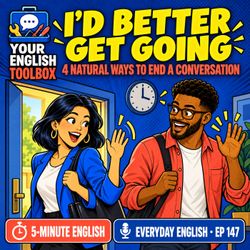
147. I’d Better Get Going: 4 Natural Ways to End a Conversation
06:06||Ep. 147https://yourenglishtoolbox.com/episodes/147-id-better-get-going-4-natural-ways-to-end-a-conversation/ This podcast is created through a human-led editorial process. Every episode concept, educational strategy, narrative direction and final editorial decision is developed and reviewed by people committed to making English learning meaningful. Artificial intelligence supports script development and editing, while ElevenLabs provides the synthetic voices of our hosts. Human judgement leads the process; technology supports its production. Have you ever said “well…” several times because you wanted to leave but did not know how to end the conversation politely? In episode seven of Everyday Useful Expressions, Martin and Julia practise four natural closing expressions you can use immediately in phone calls and face-to-face conversations. You will learn: I should let you go — show consideration for the other person’s time;I’d better get going — introduce your own need to leave or stop talking;Let’s catch up soon — express a warm intention to speak again;It was good talking to you — close an enjoyable or useful conversation warmly. The episode explains why “I’d better” is natural spoken English, how “soon” can be friendly but non-specific and why the past tense in “It was good talking to you” signals that the conversation is ending. The web lesson adds five more expressions with meanings, nuance, two examples and active practice: “I won’t keep you”, “I should get back to it”, “Let’s do this again soon”, “Take care” and “I’ll be in touch”. Level: B1–B2 · Focus: ending conversations · functional English · polite social language · Format: short conversational Slow English Keywords: how to end a conversation in English, I should let you go meaning, I had better get going, let us catch up soon, it was good talking to you, useful English expressions, polite English conversation, everyday English, slow English podcast, English speaking practice, Your English Toolbox #EverydayEnglish #UsefulExpressions #EnglishConversation #SlowEnglishPodcast #LearnEnglish #YourEnglishToolbox
144. Short Stories with Peter: The Monkey’s Paw by W. W. Jacobs (Abridged B1–B2 Level)
11:04||Ep. 144https://yourenglishtoolbox.com/episodes/144-short-stories-with-peter-the-monkeys-paw-by-w-w-jacobs/ This podcast is created through a human-led editorial process. Every episode concept, educational strategy, narrative direction and final editorial decision is developed and reviewed by people committed to making English learning meaningful. Artificial intelligence supports script development and editing, while ElevenLabs provides the synthetic voices of our hosts. Human judgement leads the process; technology supports its production. What would you wish for if one small object promised to change your life?On a cold and stormy night, the White family receives a strange object from an old friend: a dried monkey’s paw said to grant three wishes.Sergeant-Major Morris warns them not to use it.Mr White makes one simple wish anyway.The wish comes true, but the price is far greater than the family imagined.In this abridged adaptation of W. W. Jacobs’s classic 1902 story, Peter guides you through a carefully paced tale of temptation, grief and consequences. The horror is suggested rather than shown, and the final moment preserves the original story’s unsettling ambiguity.After the story, Peter explores four useful expressions:grant a wish — make somebody’s wish come true;tempt fate — take an unnecessary risk when things are going well;at any cost — regardless of the danger or sacrifice;be careful what you wish for — getting what you want may create a worse problem.You will also examine how English uses wish to describe something unreal or contrary to present reality.This is a slow, atmospheric listening experience for B1–B2 learners who want richer narrative English, natural dialogue and a classic story with a powerful ending.The Monkey’s Paw — an abridged adaptation of the original story by W. W. Jacobs (1902). Adapted for B1–B2 English learners by Your English Toolbox. The original work is in the public domain in Spain.Content note: grief, death described without graphic detail, and supernatural suspense.Level: B1–B2 · Focus: listening comprehension · supernatural suspense · wishes and consequences · useful expressions · grammar with wish · classic literature abridged for English learnersKeywords: English short stories, learn English with stories, The Monkey’s Paw, W W Jacobs, B1 B2 English listening, horror story in English, English vocabulary in context, wish grammar, classic literature adapted, slow English podcast, Your English Toolbox#ShortStoriesWithPeter #LearnEnglishWithStories #B1B2English #EnglishListening #TheMonkeysPaw #ClassicLiterature #YourEnglishToolbox