Share
The Shindig | A Rubicon Archaeology Podcast
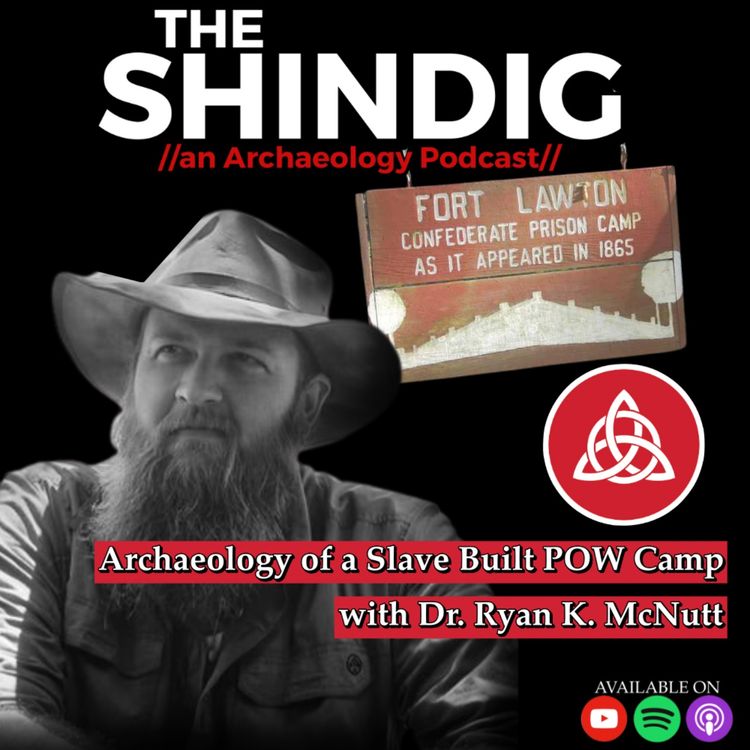
A Slave-Built US Civil War POW camp (Part 2) - with Dr. Ryan K. McNutt
Part 2: Join archaeologist Dr. Ryan K. McNutt as he leads us through stories of human misery from both enslaved camp builder and Prisoner of War perspectives, informed by his directorship of the archaeology and history project at Camp Lawton, a slave-built open-air US Civil War POW Camp established in the horrific winter of 1864 by the Confederacy to hold Union Prisoners moved from hellish prisons like Andersonville.
Meant to be Over By Christmas, the US Civil War lasted for four horrific years, leading to nightmarish conditions for POWs incarcerated within vast and poorly-planned prisoner of war camps.
In Part 2 of this podcast, Ryan talks about:
- Malnourishment, disease and death
- (TW) PTSD
- The wartime chronology of the site - Union invasion of the South
- Today's outreach program(me) and African-American finds
01:58 - local wildlife: alligators, mosquitos, tarantula-sized spiders
03:48 - digging the archaeological site of Camp Lawton surrounded by alligators
04:22 - POWs eating rodents like gophers and turtles to stave off starvation
05:07 - snakes: desperate POWs capturing, skinning and eating a 6-foot snake
06:04 - the horrors of malnutrition, disease, gangrene, blood poisoning, scurvy, smallpox, exposure
09:55 - money: 'Your survivability is tied on how lucky you are to have money'
10:28 - PTSD as a killer: the horrors of war and Camp Lawton POWs digging their own graves
12:45 - POW mental health issues: letters home talk about 'other' prisoners' torment
14:10 - boredom: keeping yourself busy with escape attempts, crafting (chess pieces)
16:02 - wartime chronology: Sherman's March to the Sea through Georgia and evacuating Lawton
18:44 - Lawton evacuees' deadly winter journeys to new POW camps; some back to Andersonville
20:10 - winter clothing in short supply: taking clothes off dead POWs
23:39 - past and future archaeological finds at Camp Lawton: 'time capsule' site
28:30 - investigating the African-American presence at and around Camp Lawton
Links:
https://twitter.com/CampLawtonGSU
https://cbss.georgiasouthern.edu/camp-lawton/from-the-director/
The Shindig is a Rubicon Archaeology Production.
Keep up to date with everything Rubicon here: Click for More
More episodes
View all episodes
1. Luas Cross City with Emer Dennehy and Teresa Bolger
54:04||Season 1, Ep. 1For the premier of the Shindig, we talked to Emer Dennehy, at Transport Infrastructure Ireland, and Teresa Bolger, who formerly of Rubicon Heritage, about excavating Dublin city centre for the Luas Cross City project.
2. Matthew Harffy on Anglo-Saxon Northumbria
56:27||Season 1, Ep. 2Our former colleague Craig Huddart sat down with Matthew Harffy, the award-winning author of the Bernica Chronicles. The series follows warrior Beobrand on his action-packed adventures in 7th century Northumbria. Craig and Matthew discuss the history of northern England, how Matthew incorporates historical and archaeology research into his fiction, and what it means to bring history to life.His new book, For Lord and Land, is out now. Matthew Harffy - Author3. The heritage of a city with Jens Thoms Ivarsson
39:08||Season 1, Ep. 3Jens Thoms Iversson, the creative director of the Rain Gothenburg project in Sweden, talks to us about weather and heritage, developing in historical cities, and how to design creative infrastructure. You can learn more about the project here: Rain Gothenburg - Göteborg 2021 (goteborg2021.com)4. The Battle of Vinegar Hill with Damian Shiels and Sam Wilson
55:43||Season 1, Ep. 4The Battle of Vinegar Hill was fought on 21 June 1798 between Irish Rebel forces and the British Army. The loss of the Irish forces marked a turning point in the Irish Rebellion of '98, and the site of the battle in and near Enniscorthy, Co Wexford has become a site of national importance. Jonathan Millar joined Damian Shiels (@irishacw) of Abarta Hertiage (Abarta Heritage – Explore Ireland's Heritage with the Experts) and Sam Wilson (SAM WILSON BATTLEFIELD ARCHAEOLOGY - Home (weebly.com) at Vinegar Hill to discuss the site and battlefield archaeology.6. Secrets of the Ice with Julian Robert Post-Melbye
48:36||Season 1, Ep. 6Julian Robert Post-Melbye, a member of the glacial archaeology team for the Museum of Cultural History in Oslo, Norway, speaks to us about life as a glacial archaeologist, some of the incredible finds their team has uncovered, and how they are racing against time to recover as many artefacts as possible before the glaciers of Norway disappear forever.To learn more, you can visit their website Secrets Of The Ice and follow them on social media: Secrets Of The Ice (@brearkeologi) / Twitter, @secretsoftheice (Instagram).5. Protecting our Coastal Heritage with Sandra Henry from the CHERISH Project
35:39||Season 1, Ep. 5Sandra Henry, the lead research archaeologist for the CHERISH project, talks to us about her work surveying coastal heritage in Ireland and Wales.To learn more about the project, you can visit their website Home - CHERISH (cherishproject.eu), or follow them on social media CHERISH Project (@CHERISHproj) / Twitter or @cherish_project (Instagram).7. The Caithness Broch Project with Kenneth McElroy and Iain Maclean
49:55||Season 1, Ep. 7What is a broch? Considered the most enigmatic structures of Scottish prehistory, brochs are massive circular stone towers with a long history of folklore, amateur enquiry, and academic investigation and excavation. Built between 400 BC and 100 AD, these unusually tall structures were design withed a degree of sophistication and ingenuity unparalleled in the British Isles at the time. Despite everything we know, there is still so much left to learn about these impressive structures! Iain Maclean and Kenneth McElroy sit down with us to talk about the Caithness Broch Project, a grass-roots charity working to promote, preserve, and conserve the archaeology and heritage of Caithness. They answer our most burning questions, including: what were brochs used for? How long were they in use? And - most important of all - did they have a roof?Learn more and donate at their website: Caithness Broch Project - Archaeology in Caithness, Scotland (thebrochproject.co.uk)Follow them on social media:Facebook: (1) Caithness Broch Project | FacebookInstagram: Caithness Broch Project (@caithnessbrochproject) • Instagram photos and videosTwitter: Caithness Broch Project (@TheBrochProject) / Twitter0.5. The Twyford Roman wooden figure with INFRA JV archaeologists
19:43||Season 1, Ep. 0.5On Thursday 13 January, BBC's "Digging for Britain" featured a rare Early Roman wooden figure discovered at Twyford. The excavation was undertaken by INFRA, a joint venture between Network Archaeology and our own Rubicon Heritage. We pulled Ciaran Feeney from Network and Louis Stafford from Rubicon out of the field to talk to them about the moment of discovery and ask them what they think the wooden figure was used for.8. Meet our Archaeologists with Dr Enda O'Flaherty
41:52||Season 1, Ep. 8In the first of our Meet our Archaeologist series, we sit down with Dr Enda O'Flaherty. Enda works as an archaeologist for Rubicon Heritage, where he fulfills many roles within operations, survey, and post-excavation, and he recently completed his PhD at NUI Galway. Enda shares how he got into archaeology, why he decided to do his PhD, and explains exactly what a turlough is.Disused School Houses – Home Page | Disused School Houses of Ireland (endaoflaherty.com)Buy his book here: Deserted Schoolhouses of Ireland - Enda O'Flaherty - 9781848893511 (kennys.ie)