Share
Scaffold
Tacita Dean
•
This episode was originally aired in Novemebr 2022.
"The direction in which I’m going is never fixed. Because I don’t know where I’m going, I’m very able to change direction. . . only at the very end of the process does all this nascent information suddenly have resonance – only in the singularity of the final work does the impact of this desperate journey make any sense." – Tacita Dean.
Tickets are now available for Architecture in the Age of Artificial Intelligence – a landmark panel taking place on 2 June at the Barbican Concert Hall.
Support our work by becoming a Patreon Member or Practice Supporter
More episodes
View all episodes
Richard Wentworth (October 2022)
01:31:09|
John Tuomey
01:24:39|John Tuomey comes on the pod to discuss Middle Quarter, the second volume of his memoir, recorded live at the Barbican on 27 July 2026 as part of the Architecture Foundation's Architecture on Stage series.Tuomey co-founded O'Donnell + Tuomey with Sheila O'Donnell in 1988. Together they have built the Irish Film Institute in Temple Bar, the Glucksman in Cork, the Lyric Theatre in Belfast, the Saw Swee Hock Student Centre at the LSE, and the V&A East in Stratford, and were jointly awarded the RIBA Royal Gold Medal in 2015.The conversation traces a childhood spent moving every two years between his father's construction sites, an education at UCD in the wake of the Flying Circus, and a first job in James Stirling's office secured by a phone call at six on a Friday evening. Tuomey talks about returning to Dublin in the 1980s to work on a derelict city, the founding of Group 91 and the competition for Temple Bar, the shift from cellular to volumetric thinking at Letterfrack, and the pinball machine that gave the Irish language centre in Derry its plan. He is also candid about the years after the LSE when work dried up entirely, and about being retired from UCD on his birthday after four decades of teaching.Middle Quarter is published by Lilliput Press. First Quarter, the first volume, is also available.Scaffold is an Architecture Foundation production. Special thanks to VELUX for supporting this episode: https://velux.com/design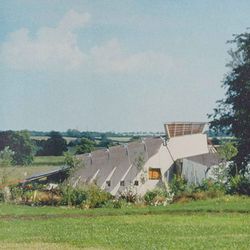
Níall McLaughlin (Live at POST PRESS)
01:11:18|Níall McLaughlin is this year's recipient of the RIBA Royal Gold Medal—awarded for more than three decades of work ranging from a seaside bandstand at Bexhill to the Stirling Prize-winning library at Magdalene College, Cambridge. To mark the occasion, his practice has released a new book, published by Objectif Edition and co-edited with Bryony Jones. And it's far from your typical architecture monograph.Uncle Toby's Garden, and it takes its title from Tristram Shandy, Laurence Sterne's mid-eighteenth-century novel—a book that seems to have arrived from the future, treating the conventions of the still-young English novel as toys to be dismantled, and anticipating experimental fiction by roughly two centuries. It tries to capture real experience, and the movement of consciousness, in a way that tidy, linear narrative can't.Níall's book is similarly non-linear, organised around digressions rather than buildings. Its title character, Uncle Toby, is a wounded veteran who spends his days re-enacting old battles on his bowling green, in a pastime both trivial and profound. In that spirit, the book reframes architecture as a performance of ritual, collaboration, speculation and play.Fittingly, our conversation took place at 10 Bowling Green Lane, home of the Zaha Hadid Foundation, and the temporary site of the Architecture Foundation's summer programme, POST PRESS. It was recorded on Tuesday 21 July 2026.Link to Níall's lecture Circling a Star - a Daylight Talk: https://www.niallmclaughlin.com/media/circling-a-star-a-daylight-talk/Thanks to Velux for supporting the podcast. Velux.com/design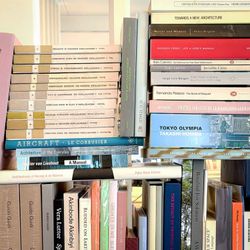
Michael Mack (Live at POST PRESS)
01:09:32|Michael Mack is the founder of London-based independent art and photography publishing house MACK. This conversation was recorded live at POST PRESS. More info and upcoming event tickets here.Thanks to VELUX for supporting the podcast: velux.com/designLink to the AF POST PRESS programme Books discussed:W. G. Sebald, On the Natural History of Destruction (Hamish Hamilton, 2003)Le Corbusier, Aircraft (The Studio, 1935)Reconstructing Space: Architecture in Recent German Photography, ed. Michael Mack (AA Publications, 1999)Contemporary Architecture series, ed. Leonardo Benevolo (Cappelli, 1964–)Manfredo Tafuri, Modern Architecture in Japan, ed. Mohsen Mostafavi (MACK, 2022)Andrea Bagnato, Terra Infecta: Disease and the Italian Landscape (MACK Sightlines, 2026)Kwan Queenie Li, Weeds: A Germinating Theory (MACK Sightlines, 2026)Caruso St John, Collected Works: Volume 1 1990–2005 (MACK, 2022)Takashi Homma, Tokyo Olympia (Nieves, 2023)Adam Broomberg & Oliver Chanarin, Holy Bible (MACK / Archive of Modern Conflict, 2013)Collier Schorr, Jens F. (SteidlMACK, 2005)Hermann Hesse, The Glass Bead Game (1943; Winston translation, 1969)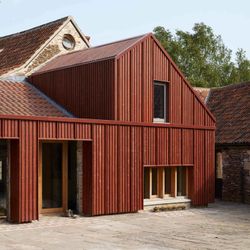
Jonathan Tuckey
01:38:28|Jonathan Tuckey founded his design practice in 2000 having previously worked for David Chipperfield Architects and Fletcher Priest Architects. He has long been one of the UK's leading advocates for remodelling and radically transforming old buildings for modern uses.The podcast is supported this week by VELUX and features a short pre-reel interview with Thomas Vonier — architect and former president of the International Union of Architects. th UIA is assembling in Barcelona this month for the World Congress of Architects, which VELUX are also supporting.Jonathan's episode begins around the 12 minute mark.Scaffold is an Architecture Foundation production, hosted by Matthew Blunderfield.
Morgan Day (Part 2)
32:41|Morgan Day is a writer based in Tucson Arizona who works across professional architecture writing and literary fiction. Her debut novel,The Oldest Bitch Alive, is out this month from Akoya Publishing in the UK, and Astra House in the US.“We tend to think of our bodies as having barriers, but we’re actually very porous. We’re in this constant state of becoming and effecting our environment, and our environment is constantly affecting and infecting us. I wanted to put these ideas on the page in a story, not only through living creatures, but through built structures too.” –MD
Morgan Day (Part 1)
40:26|Morgan Day is a writer based in Tucson Arizona who works across professional architecture writing and literary fiction. Her debut novel,The Oldest Bitch Alive, is out this month from Akoya Publishing in the UK, and Astra House in the US.“We tend to think of our bodies as having barriers, but we’re actually very porous. We’re in this constant state of becoming and effecting our environment, and our environment is constantly affecting and infecting us. I wanted to put these ideas on the page in a story, not only through living creatures, but through built structures too.” –MDImage credit: “Ungodly” by Ambera Wellman, 2021.
Jaakko Pallasvuo (Avocado Ibuprofen) Part 2
34:07|Part 2 of our interview with the Finnish artist and writer Jaakko Pallasvuo, author most recently of Amber (Rrose Editions, 2026) and Mouthing the Words (Khaos, 2025)
Jaakko Pallasvuo (Avocado Ibuprofen)
01:25:41|Jaakko Pallasvuo is a Helsinki-based artist and writer, best known for his Instagram account Avocado Ibuprofen. In this episode he reflects on the role he sees for art and writing in a world increasingly shaped by social media platforms and artificial intelligence, and he discusses his recently published collection of performance texts Mouthing the Words (Khaos, 2025).Scaffold is an Architecture Foundation production, hosted by Matthew Blunderfield. Download the London Architecture Guide App via the App Store or Google PlayBecome an Architecture Foundation Patreon member and be a part of a growing coalition of architects and built environment professionals supporting our vital and independent work.