Share
Savvy Psychologist
Why you can't stop people-pleasing (and it's not because you're too nice)
554. This week, Dr. Ho reveals that people-pleasing isn't a personality trait—it’s a survival strategy. If you constantly say "yes" while feeling a quiet sense of self-betrayal, you’re likely stuck in the fawn response, a nervous system reflex designed to keep you safe by keeping others happy.
Dr. Judy breaks down:
- Kindness vs. Compulsion: Why true generosity feels good, but people-pleasing feels like fear.
- The "Social Pain" Connection: How your brain processes rejection exactly like physical injury.
- The High Cost of Silence: Why "keeping the peace" actually destroys intimacy and fuels resentment.
Take Action: Learn three practical tools to break the cycle, including the "Pause Practice" to stop the automatic yes and how to name the specific fears driving your behavior.
Stop performing and start being known.
Have a mental health question? Email Dr. Judy's team at at psychologist@quickanddirtytips.com
Find Savvy Psychologist on Facebook and subscribe to the newsletter for more psychology tips.
Watch on YouTube: www.youtube.com/@SavvyPsychologist
More from Dr. Ho on her other channels:
Dr. Ho's website, Substack, LinkedIn.
Savvy Psychologist is a part of Quick and Dirty Tips. Find a transcript at QuickandDirtyTips.com.
More episodes
View all episodes
573. Why do I feel lonely even when my life is full?
18:46||Ep. 573573. You have a full life. People who love you. A calendar that barely has room to breathe. And somehow, underneath all of it, you still feel alone. Today Dr. Judy Ho unpacks the loneliness that nobody talks about — the kind that lives inside a full life — why it happens, what it's actually doing to your body, and three simple, evidence-based things you can start doing today to feel genuinely more connected.Have a mental health question? Email Dr. Judy's team at psychologist@quickanddirtytips.comFind Savvy Psychologist on Facebook and subscribe to the newsletter for more psychology tips.Watch on YouTube: www.youtube.com/@SavvyPsychologistMore from Dr. Ho on her other channels:Dr. Ho's website, Substack, LinkedIn.Savvy Psychologist is a part of Quick and Dirty Tips. Find a transcript at QuickandDirtyTips.com.
572. Have you always been "a lot"? You might be a highly sensitive person
17:31||Ep. 572572. If you were ever told you were too sensitive, too intense, or that you feel things too much — this episode is for you. The Highly Sensitive Person trait affects 15–30% of the population, shows up in over 100 animal species, and has measurable differences on brain scans. It is not a flaw. This week Dr. Judy Ho breaks down what HSP actually is, what makes the HSP brain genuinely different, the strengths that almost never get named, and three tools for thriving as an HSP rather than just surviving.Have a mental health question? Email Dr. Judy's team at psychologist@quickanddirtytips.comFind Savvy Psychologist on Facebook and subscribe to the newsletter for more psychology tips.Watch on YouTube: www.youtube.com/@SavvyPsychologistMore from Dr. Ho on her other channels:Dr. Ho's website, Substack, LinkedIn.Savvy Psychologist is a part of Quick and Dirty Tips. Find a transcript at QuickandDirtyTips.com.
571. What the Lindsay Clancy trial gets wrong about postpartum psychosis — and what every parent needs to know
17:53||Ep. 571571. The trial of Lindsay Clancy — the Massachusetts mother who allegedly strangled her three young children and says she was in the grip of postpartum psychosis — has reopened a conversation the public has been getting wrong for years. Baby blues, postpartum depression, and postpartum psychosis are three completely different conditions. Only one is a psychiatric emergency. This week Dr. Judy Ho explains the clinical distinctions, the warning signs that loved ones and clinicians miss, the systemic failures that allow this illness to go untreated, and the forensic question at the center of the trial: can a person be both sick and responsible?Have a mental health question? Email Dr. Judy's team at psychologist@quickanddirtytips.comFind Savvy Psychologist on Facebook and subscribe to the newsletter for more psychology tips.Watch on YouTube: www.youtube.com/@SavvyPsychologistMore from Dr. Ho on her other channels:Dr. Ho's website, Substack, LinkedIn.Savvy Psychologist is a part of Quick and Dirty Tips. Find a transcript at QuickandDirtyTips.com.CORRECTION: In this episode I originally misspoke about the burden of proof in lack-of-criminal-responsibility cases. In Massachusetts, once the defense raises the issue, the burden actually falls on the prosecution to prove beyond a reasonable doubt that the defendant was criminally responsible. I know this — it just didn't come out right on the recording. We remove that line in the audio podcast. Thank you all for listening and for contributing to this important discussion about mental health.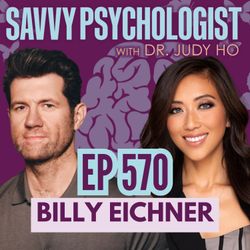
570. Billy Eichner on how to be fearless without trauma or shame
33:58||Ep. 570570. People constantly tell Billy Eichner he's fearless, and they always want to know how he does it. In Savvy Psychologist's first-ever interview episode, Dr. Judy Ho sits down with the comedian behind "Billy on the Street" and "Parks and Recreation" to trace that boldness back to its source, and it isn't the one you'd expect. There's a stubborn myth that artists have to suffer to be great, but Billy's story is the opposite: two middle-class parents in a small Queens apartment who never instilled an ounce of shame in him and leaned all the way into who he was. His new audio memoir, "Billy on Billy," reveals how feeling completely safe and accepted as a kid is what gave him permission to take risks and become fully himself. The reframe at the heart of it: real confidence is built by love, not forged through pain. Listen to "Billy on Billy: An Audio Memoir" Have a mental health question? Email Dr. Judy's team at psychologist@quickanddirtytips.comFind Savvy Psychologist on Facebook and subscribe to the newsletter for more psychology tips.Watch on YouTube: www.youtube.com/@SavvyPsychologistMore from Dr. Ho on her other channels:Dr. Ho's website, Substack, LinkedIn.Savvy Psychologist is a part of Quick and Dirty Tips. Find a transcript at QuickandDirtyTips.com.
569. Why you stay up way too late even when you’re exhausted: The psychology of revenge bedtime procrastination
17:21||Ep. 569569. It's midnight. You're exhausted. You have to be up in six hours. And you are absolutely not going to bed yet. Sound familiar? There's a name for it — and it's not laziness. Revenge bedtime procrastination is what happens when your brain decides that staying up is the only way to get something back after a day that felt completely out of your control. This week Dr. Judy Ho breaks down the psychology and neuroscience behind why we do this, including the surprising cortisol effect that means ignoring your first wave of tiredness can keep you awake an extra 60 to 90 minutes, and how to actually break the cycle.Have a mental health question? Email Dr. Judy's team at psychologist@quickanddirtytips.comFind Savvy Psychologist on Facebook and subscribe to the newsletter for more psychology tips.Watch on YouTube: www.youtube.com/@SavvyPsychologistMore from Dr. Ho on her other channels:Dr. Ho's website, Substack, LinkedIn.Savvy Psychologist is a part of Quick and Dirty Tips. Find a transcript at QuickandDirtyTips.com.
568. Why do certain people leave you completely drained?
17:50||Ep. 568568. You know that feeling. Five minutes with a certain person and you need a three-hour nap. You leave the conversation and realize you've given everything while receiving nothing. Energy vampires are real — and the science behind why they drain you is more interesting than the term suggests. This week Dr. Judy Ho unpacks the psychology of emotionally depleting relationships: what's actually happening in your brain and body during these interactions, why some people are far more vulnerable than others, what distinguishes the unconscious drainer from the deliberate one, and three tools to protect yourself without becoming someone who cuts off everyone who's ever had a hard day.Have a mental health question? Email Dr. Judy's team at psychologist@quickanddirtytips.comFind Savvy Psychologist on Facebook and subscribe to the newsletter for more psychology tips.Watch on YouTube: www.youtube.com/@SavvyPsychologistMore from Dr. Ho on her other channels:Dr. Ho's website, Substack, LinkedIn.Savvy Psychologist is a part of Quick and Dirty Tips. Find a transcript at QuickandDirtyTips.com.
567. Why your inner critic is so loud (and three ways to change that)
20:24||Ep. 567567. There’s a voice in your head that has opinions about everything you do — and most of them are unkind. It replays your mistakes. It pre-edits your ideas before you even say them. It tells you that you’re too much, not enough, or both at once. This week Dr. Judy Ho unpacks the inner critic: where it comes from, why it’s louder for some people than others, what the neuroscience says about why it’s so hard to shut up — and three evidence-based tools to change your relationship with it for good.Have a mental health question? Email Dr. Judy's team at psychologist@quickanddirtytips.comFind Savvy Psychologist on Facebook and subscribe to the newsletter for more psychology tips.Watch on YouTube: www.youtube.com/@SavvyPsychologistMore from Dr. Ho on her other channels:Dr. Ho's website, Substack, LinkedIn.Savvy Psychologist is a part of Quick and Dirty Tips. Find a transcript at QuickandDirtyTips.com.
566. Imposter Syndrome: why the most competent people doubt themselves most
17:40||Ep. 566566. You got the promotion, the degree, the recognition — and still you're waiting for someone to figure out you don't actually belong there. That feeling has a name, a neuroscience, and — surprisingly — a silver lining. This week Dr. Judy Ho unpacks imposter syndrome: why even the most confident people feel it, where it shows up beyond the workplace, how it presents differently across genders, and why it might secretly be one of the engines behind your best work. Plus three tools to stop it from running the show.Have a mental health question? Email Dr. Judy's team at at psychologist@quickanddirtytips.comFind Savvy Psychologist on Facebook and subscribe to the newsletter for more psychology tips.Watch on YouTube: www.youtube.com/@SavvyPsychologistMore from Dr. Ho on her other channels:Dr. Ho's website, Substack, LinkedIn.Savvy Psychologist is a part of Quick and Dirty Tips. Find a transcript at QuickandDirtyTips.com.
565. Adult ADHD: Why so many people are diagnosed late and what actually helps
19:56||Ep. 565565. You've always been this way. You've just gotten better at hiding it. Adult ADHD is one of the most underdiagnosed and misunderstood conditions in mental health — particularly in women, high-achievers, and anyone who learned to compensate before anyone noticed. This week, Dr. Judy Ho cuts through the myths, explains how adult ADHD differs from the childhood version, clarifies what the diagnostic criteria actually require, and offers three evidence-based attention-training tools you can start using today.Have a mental health question? Email Dr. Judy's team at at psychologist@quickanddirtytips.comFind Savvy Psychologist on Facebook and subscribe to the newsletter for more psychology tips.Watch on YouTube: www.youtube.com/@SavvyPsychologistMore from Dr. Ho on her other channels:Dr. Ho's website, Substack, LinkedIn.Savvy Psychologist is a part of Quick and Dirty Tips. Find a transcript at QuickandDirtyTips.com.