Share
The Shakespeare and Company Interview
Conversations with internationally acclaimed authors, recorded from our bookshop in the heart of Paris.
Latest episode
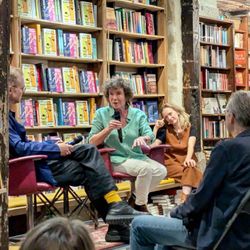
Alternative Intelligence: Jeanette Winterson on storytelling, AI and the Power of Imagination
53:42|Jeanette Winterson joined us to celebrate the French edition of One Aladdin, Two Lamps, her book-length exploration of storytelling, built around One Thousand and One Nights. She recalls finding Shahrazad in her hometown library and the insight this led her to: that she could read herself as fiction as well as fact, and so rewrite her own story. The conversation moves from Freud, epigenetics and the plasticity of the brain to Manchester's Industrial Revolution and the lessons we failed to learn from it. Winterson traces AI from Ada Lovelace to Turing to today's tech moguls, making a case for cautious optimism and for calling it "alternative intelligence." She also argues for being present in the world, and looking at art without a phone. Buy One Aladdin Two Lamps here: https://www.shakespeareandcompany.com/books/one-aladdin-two-lamps-2*Jeanette Winterson CBE was born in Manchester. She published her first novel, Oranges Are Not the Only Fruit, at twenty-five. Over two decades later she revisited that material in her internationally bestselling memoir Why Be Happy When You Could Be Normal?. Winterson has written thirteen novels for adults and two previous collections of short stories, as well as children's books, non-fiction and screenplays. She is Professor of New Writing at the University of Manchester. She lives in the Cotswolds in a wood and in Spitalfields, London.Adam Biles is Literary Director at Shakespeare and Company.Listen to Alex Freiman’s latest EP, In The Beginning: https://open.spotify.com/album/5iZYPMCUnG7xiCtsFCBlVa?si=h5x3FK1URq6SwH9Kb_SO3w
More episodes
View all episodes

How Big Tech Took Control, with Beeban Kidron
01:05:55|“Childhood is once again a resource to be extracted at any cost.” Filmmaker-turned-legislator Beeban Kidron joined us to discuss Users: How Big Tech Took Control and How to Fight Back. Kidron traces her path from directing documentaries to entering the House of Lords in 2012 (the same year smartphones became affordable enough for parents to hand to children) and how a strange, silent moment with four teenage girls in her kitchen launched a fourteen-year campaign. She unpacks the deliberate design choices behind addictive notifications and CSAM failures, and discusses why she focused her fight on children's rights as a strategic, less polarising lever. The conversation covers tech's grip on governments from Starmer to Trump, and considers how the industry's "free" business model is quietly reversing 150 years of social progress: from child labour laws to a generation working, unpaid, for the attention economy.Buy Users: https://www.shakespeareandcompany.com/books/users-3*BARONESS BEEBAN KIDRON is a global authority on digital regulation and accountability and is a leading voice on children’s rights in the digital environment. She has played a determinative role in establishing standards for online safety and privacy across the world. Baroness Kidron sits as a crossbench peer in the UK’s House of Lords, and is founder and former Chair of the 5Rights Foundation. She serves on the Joint Committee on the National Security Strategy and is a former member of the UN Broadband Committee. She is a Visiting Professor in Practice at the London School of Economics, where she chairs the Digital Futures for Children research centre, and is an advisor to the University of Oxford Institute for Ethics in AI. Before she became a peer, Baroness Kidron was an award-winning film director. She co-founded the charity Filmclub (now Into Film) in 2006, and was awarded an OBE for services to drama in 2012.Adam Biles is Literary Director at Shakespeare and Company.Listen to Alex Freiman’s latest EP, In The Beginning: https://open.spotify.com/album/5iZYPMCUnG7xiCtsFCBlVa?si=h5x3FK1URq6SwH9Kb_SO3w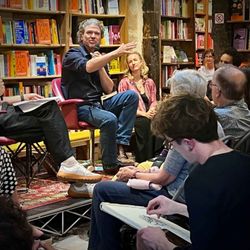
Dave Eggers: Contrapposto, Craft, and the Case Against AI
49:10|Dave Eggers joins us to discuss his 14th novel, Contrapposto, a six-decade love story between childhood friends Cricket and Olympia, illustrated with his own drawings. Eggers traces the book's twenty-year gestation, the moment Olympia's character unlocked its structure, and why he gave Cricket his own boyhood fantasy of being "apprenticed" as a young artist. The conversation ranges widely: the decline of art-school access and the pier-side art collective he's launched in San Francisco; his literacy nonprofit 826 Valencia and its typewriter-obsessed students; and a candid, sometimes fiery take on AI's effect on writing, translation, and education, including an anecdote from his visit to OpenAI's offices. Buy Contrapposto: https://www.shakespeareandcompany.com/books/contrapposto-3*Dave Eggers is the author of many books for adults and kids. He’s the founder of McSweeney's and the co-founder of 826 Valencia, and the International Alliance of Youth Writing Centers. A finalist for the National Book Award and the Pulitzer Prize, he was recently awarded the Newbery Medal for his all-ages book, The Eyes & the Impossible.Adam Biles is Literary Director at Shakespeare and Company.Listen to Alex Freiman’s latest EP, In The Beginning: https://open.spotify.com/album/5iZYPMCUnG7xiCtsFCBlVa?si=h5x3FK1URq6SwH9Kb_SO3w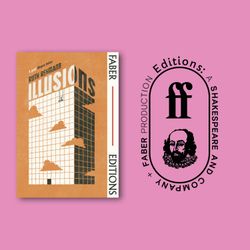
Editions - Episode 2 - Illusions with Megan Nolan
55:29|In the second episode of Editions, a podcast from Shakespeare and Company and Faber, literary director Adam Biles and Faber Editions curator Ella Griffiths are joined by novelist Megan Nolan to discuss Illusions by Ruth Rehmann, in a new translation by Rob Madole, the latest title in the Faber Editions imprint.First published in Germany in 1959 and lost to English-language readers for decades, the novel follows four employees of a vast West German corporation across a single weekend. Cinematic, fragmented, and seductively modernist, it is at once an intimate and hypnotic portrait of four inner lives and an incisive state-of-the-nation novel about West Germany's postwar "economic miracle" - and the illusions that sustain it.Our conversation covers Rehmann's place in the influential German postwar literary movement Gruppe 47, the novel's debts to and divergences from Virginia Woolf's Mrs Dalloway and James Joyce's Ulysses, the way that the war haunts a generation trying to forget it, the mischievous omniscient window cleaner who watches over the story, and what it means for a woman writer to be faulted, as contemporary reviewers said of Rehmann, for "an excess of contemporaneity."Buy IllusionsUK: https://www.faber.co.uk/product/9780571396580-illusions-faber-editions/Rest of World: https://www.shakespeareandcompany.com/books/illusions-faber-editions Megan Nolan's novels Acts of Desperation and Ordinary Human Failings are also available from Shakespeare and Company, and your local independent bookstore.Sign up to Faber's Heritage Subscription, featuring all Faber Editions titles: Subscribers get a book in the post each month for just £9 alongside a curated email with exclusive extra content about the book and its author. https://tr.ee/DsDYp5Books & Authors DiscussedThe Tin Drum — Günter GrassMrs Dalloway — Virginia WoolfUlysses — James JoyceThe Forged Coupon — Leo TolstoyPerfection — Vincenzo LatronicoAmerican Psycho — Bret Easton EllisActs of Desperation — Megan NolanOrdinary Human Failings — Megan NolanFilms/TV Shows DiscussedJeanne Dielman, 23 Quai du Commerce, 1080 Bruxelles — dir. Chantal AkermanPlaytime — dir. Jacques TatiThe White Ribbon — dir. Michael HanekeFrozen Land — dir. Aku LouhimiesBiosMegan Nolan is an Irish writer based in New York. Her most recent novel is Ordinary Human Failings (Little, Brown and Company, 2024), chosen as one of the best books of the year by The Guardian, The Times, and Sunday Times. It was shortlisted for the Orwell Prize for Political Fiction, the Nero Prize for Fiction, The Gordon Burn Prize, The Royal Society of Literature Encore Award, and longlisted for the Women's Prize. Her debut novel, Acts of Desperation (Little, Brown and Company, 2021) was an international bestseller, and was chosen as a best book of the year by Time. Nolan was also among The Observer’s Best Debut Novelists of 2021.Ella Griffiths is Faber's Head of Classics & HeritageAdam Biles is Literary Director at Shakespeare and CompanyListen to Alex Freiman Spotify: https://open.spotify.com/artist/3dbKbpFyqPbklwEdeLYYZR?si=Q5vy9KkRTrqf1BqU1v33cg Insta: @alex.guitarfreiman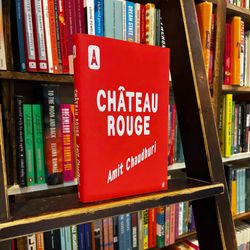
Paris, Deconstructed: Amit Chaudhuri’s Château Rouge
46:46|Amit Chaudhuri joins Adam Biles to discuss his new novel Chateau Rouge, set not in the postcard Paris of Hemingway and Midnight in Paris, but in the neighbourhood around Gare du Nord — a Paris that resists being known, curated, or confirmed.Chaudhuri talks about writing against the "already known" city, drawing on Roland Barthes and the idea of "heritage modernity" to explain why he wanted to deconstruct Paris's status as a museum-piece rather than a lived-in place. He discusses his narrator's disorientation on arrival, the subtle presence of race and visibility in the book, and how global events — the Gilets Jaunes, the Notre Dame fire — pass through the novel as lived, unfinished moments rather than history. The conversation turns, too, to marriage: how a decades-old, unread copy of A Moveable Feast, gifted by his wife, becomes a quiet emotional throughline.Buy Château Rouge: https://www.shakespeareandcompany.com/books/chateau-rouge*Amit Chaudhuri is the author of nine novels, whose ‘languorous, elliptical, beautiful prose is impressively impossible to put in any category at all’ (Salman Rushdie). He is also an essayist, poet, short story writer, singer and composer.Adam Biles is Literary Director at Shakespeare and Company.Listen to Alex Freiman’s latest EP, In The Beginning: https://open.spotify.com/album/5iZYPMCUnG7xiCtsFCBlVa?si=h5x3FK1URq6SwH9Kb_SO3w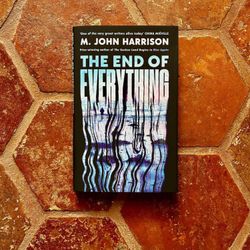
The End of Everything, with M. John Harrison
52:58|M. John Harrison returns to the Shakespeare and Company Podcast to talk with Adam Biles about his new novel, The End of Everything, a disaster story set in a "wrong UK" where societal collapse coincides with the arrival of an alien presence, and the strange shape-shifting "artefacts" it leaves behind.Harrison discusses writing an "epistemological" catastrophe rather than a physical one, the decades of discipline it took to trust readers without over-explaining, and how the book's permacrisis mirrors post-2008 Britain and Brexit. He talks character-building from "bits and pieces" of real people, why he refuses to fully reveal his monsters, and how AI anxieties seeped into a book largely conceived before ChatGPT. Buy The End of Everything: https://www.shakespeareandcompany.com/books/anabasis-2*MICHAEL JOHN HARRISON is the author of, among others, the Viriconium stories, The Centauri Device, Climbers, The Course of the Heart, The Sunken Land Begins to Rise Again, Signs of Life, Light and Nova Swing. He has won the Boardman Tasker Prize (Climbers), the James Tiptree Jr Award (Light), the Arthur C. Clarke Award (Nova Swing) and the Goldsmiths Prize (The Sunken Land Begins to Rise Again). He lives in Shropshire.Adam Biles is Literary Director at Shakespeare and Company.Listen to Alex Freiman’s latest EP, In The Beginning: https://open.spotify.com/album/5iZYPMCUnG7xiCtsFCBlVa?si=h5x3FK1URq6SwH9Kb_SO3w
Alain Delon, Murder and Paris ’68, with Edward Chisholm
59:33|Edward Chisholm joins Adam Biles to discuss Murder in Paris '68, his deep-dive into the Markovic Affair, one of the most explosive scandals of postwar France. In October 1968, the dismembered body of Stevan Markovic, a Yugoslav immigrant and bodyguard to Alain Delon, was found on the outskirts of Paris. The case implicated France's most iconic film star, the Corsican “milieu”, and eventually the Élysée Palace itself.Chisholm traces how he stumbled onto the story in an obscure Parisian crime library, and what followed: years of obsessive research, classified archives in the suburbs of Versailles, and a surveillance-heavy reading desk watched over by attentive archivists. The conversation covers Delon's impenetrable persona, the Ripley parallels, France's Resistance-era ties between politicians and gangsters, and why a murder nobody solved still can't be fully declassified today.Buy Murder in Paris ’68: https://www.shakespeareandcompany.com/books/murder-in-paris-68-2*Edward Chisholm was born in Dorset, England, and moved to Paris in 2012 where he worked all manner of low-paid jobs, from waiting and bar work to museum security and market hand, while trying to build a career as a writer. His memoir, A Waiter In Paris has sold over 100,000 copies and has been translated into several languages. Now, Chisholm makes a living as a creative director, author and screenwriter, based in Switzerland. His writing has appeared in the New York Times, the Guardian and the Financial Times magazine.Adam Biles is Literary Director at Shakespeare and Company.Listen to Alex Freiman’s latest EP, In The Beginning: https://open.spotify.com/album/5iZYPMCUnG7xiCtsFCBlVa?si=h5x3FK1URq6SwH9Kb_SO3w