Share
ReConsider
[2.6] The One Wisdom
[AUDIO FIXED!]
Today we explore wisdom. Not the "don't put tomatoes in a fruit salad" kind. Serious business wisdom.
It turns out, the wise tend to converge on understanding the world in a similar way.
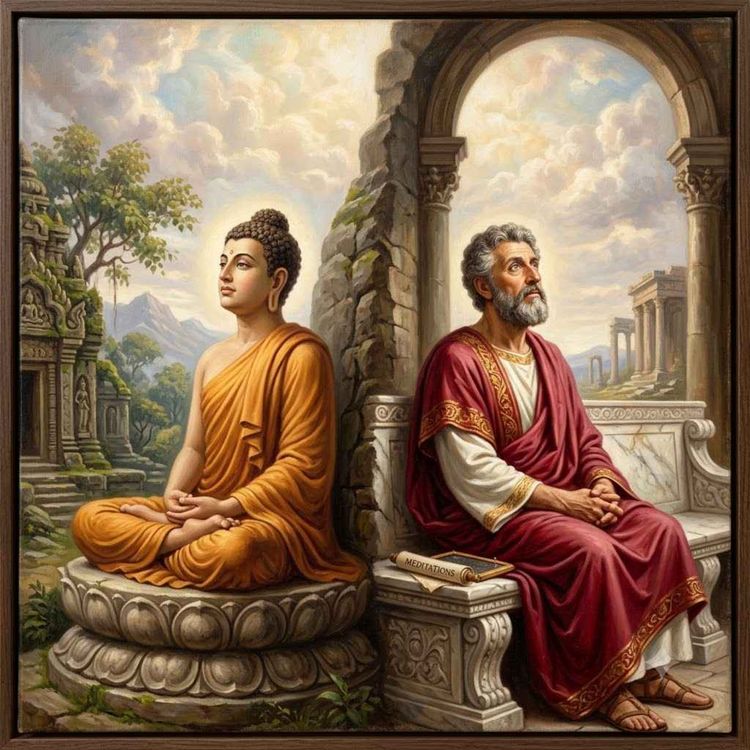
In the 20th century, philosophical titans saw this convergence. They look back to the original seers of wisdom and see in them parallels that run so deep, that upon deep contemplation of these philosophies, they found a "highest common factor," including among:
- Epicteus, Marcus Aurelius, and the Stoics
- Plato, and various Neoplatonists such as Plotinus
- Spinoza, Schopenhauer
- Possibly Hegel, Wittgenstein, though they are famously difficult to interpret
- Jiddu Krishnamurti
- Lao Tzu, who authored the Tao Te Ching
- ALso Chuang Tzu and Lieh Tzu
- Jewish philosophers such as Philo of Alexandria
- Sufi mystics of Islam, most famously Jalal al-Din Rumi
- Jesus of Nazareth
- St. Paul
- Meister Eckhart, the mystic Christian
- St. Jon of the Cross
- Hinduism:
- The Sages of the Upanishads
- Adi Shankara’s The Crest-Jewel of Wisdom
- The Bhagavad Gita
- The Buddha
- Particularly Zen masters who followed
- Various Sutras
- The Bardo Thodol
It is the Perennial Philosophy. I call it the One Wisdom. Huxley called it the “Highest Common Factor” of universal truth.
SOURCES
Camus, Albert. The Myth of Sisyphus. 1942.
Huxley, Aldous. The Perennial Philosophy. Harper & Row, 1945.
John of the Cross, St. Dark Night of the Soul (La noche oscura del alma).
Jung, C. G. Letters, Volume 1: 1906–1950. Princeton University Press.
Kahan, Dan. Identity-protective cognition research (cross-referenced, this project).
Platform Sutra of the Sixth Patriarch (Liuzu Tan Jing).
Polanyi, Michael. Personal Knowledge: Towards a Post-Critical Philosophy. University of Chicago Press, 1958.
Polanyi, Michael. The Tacit Dimension. Doubleday, 1966.
Tolle, Eckhart. A New Earth: Awakening to Your Life's Purpose. Dutton, 2005.
Tao Te Ching (Laozi).
Watts, Alan. Become What You Are. Shambhala, 1995 (essays, 1930s–1950s).
Watts, Alan. The Wisdom of Insecurity. Pantheon, 1951.
Wittgenstein, Ludwig. Tractatus Logico-Philosophicus. 1921.
Wright, Robert. Why Buddhism Is True. Simon & Schuster, 2017.
Xiangyan Zhixian — traditional Chan/Zen biographical account (Tang dynasty, c. 820–898).
Zhuangzi (Chuang Tzu), "On the Equality of Things" ("Discussion on Making All Things Equal").
Bible. Job 42:5–6; Luke 15:11–32 (KJV).
Bhagavad Gita, 2.47.
Ovid. Metamorphoses.
McGilchrist, Iain. The Master and His Emissary: The Divided Brain and the Making of the Western World. Yale University Press, 2009.
Miles Kington. Quoted in The Independent (UK), Mar 28, 2003.
Joseph Campbell. The Hero with a Thousand Faces. Pantheon, 1949 — "Freedom to Live," Stage 17.
Eckhart Tolle. The Power of Now: A Guide to Spiritual Enlightenment. New World Library, 1997
Ramana Maharshi, quoted in Ram Dass, "Dying Is Absolutely Safe"
Alan Watts, Become Who You Are.
Sam Harris, Waking Up: A Guide to Spirituality Without Religion.
Dalai Lama & Paul Ekman, Emotional Awareness: Overcoming the Obstacles to Psychological Balance and Compassion. Times Books, 2008
Emmet Fox, The Sermon on the Mount
Ernest Kurtz & Katherine Ketcham, The Spirituality of Imperfection. Bantam
Byron Katie, Loving What Is. Harmony, 2002.
Diana Chapman & Jim Dethmer (with Kaley Klemp), The 15 Commitments of Conscious Leadership. 2014.
Epictetus, Discourses / Enchiridion.
Marcus Aurelius, Meditations.
Plato, Republic
Plotinus, The Enneads.
Spinoza, Ethics
Schopenhauer, The World as Will and Representation.
Hegel, Phenomenology of Spirit.
Jiddu Krishnamurti, Freedom from the Known
Philo of Alexandria, On the Creation of the World.
1 Corinthians 1:20, 1:25, 3:19 — "the wisdom of the world is foolishness"
John 14:6 — "I am the way, the truth, and the life."
Galatians 2:20 or 2 Corinthians 5:17 -- "in Christ"
ERRATA:
- Heller, not Huxley, wrote Catch-22.
- Pauline, not Jesus, says "The wisdom of the world will be foolish..."
More episodes
View all episodes

[2.12c] The Hero's Journey In Your Life
01:17:46|We see throughout myth and fable that the hero does not just wake up and decide to leave everything behind. They are thrust into things. Gandalf shows up with a bunch of dwarves to wrest Bilbo from his dinner. Now may or may not be the time for your Hero’s Journey to start. But you may already hear the call to adventure. Whenever your time comes, I hope this episode helps you recognize it’s happening, and participate fully in it.Bibliography:Joseph Campbell, The Hero With a Thousand FacesJoseph Campbell with Bill Moyers, The Power of MythStephen Larsen and Robin Larsen, A Fire in the Mind: The Life of Joseph CampbellCJ Jung, Collected Works (translated by RFC Hull)Robert A Johnson Inner Work: Using Dreams and Active Imagination for Personal GrowthRobert A Johnson, Owning Your Own Shadow: Understanding the Dark Side of the PsycheMarie-Louise von Franz, Projection and Re-Collection in Jungian Psychology: Reflections of the SoulEdward Edinger, Ego and ArchetypeJames Hollis, The Middle Passage: From Misery to Meaning in MidlifeJames Hollis, Finding Meaning in the Second Half of LifeMurray Stein, In Midlife: A Jungian PerspectiveConnie Zweig, Meeting the Shadow: The Hidden Power of the Dark Side of Human NatureIain McGhilchrist, The Master and His Emissary: The Divided Brain and the Making of the Western WorldThe Matrix
[2.12b] The Hero's Journey in Film
01:30:46|Modern cinema is chock full of Hero's Journeys. Today I cover 3 of my favorites, each more interesting and sophisticated than the last. We will actually see three variants on the Hero's Journey, with different details that we can relate to. This episode is not evidence that the Hero's Journey is bubbling up without the conscious attention of the screenwriters or directors, but instead my hope is that you will be able to engage with story and myth in a new, more powerful way.Movies include:The Star Wars Trilogy (Episodes IV, V, VI)Mad Max: Fury RoadEurovision Song Contest: The Story of Fire Saga
[2.12a] The Hero's Journey
42:35|When you realize something is very wrong, that life is not all it was cracked up to be, that the meaning has been drained from the world, then you have heard the call to adventure. If you answer it, you begin the Hero's Journey. Joseph Campbell shows us how the Hero's Journey has been told in myth and legend across all cultures and times, as a roadmap to our very enlightenment.
[2.11] The Dark Night of the Soul
39:59|In Silicon Eden, the loss of the immortality project means a collapse of meaning and a gaping hole where a value system used to be. Right now, the only good news is that you will be far from the first to go through this problem.SourcesEliot, T.S. The Waste Land. 1922.Eliot, Valerie, ed. The Waste Land: A Facsimile and Transcript of the Original Drafts. 1971.ietzsche, Friedrich. The Gay Science. 1882Kierkegaard, Søren The Sickness Unto Death. 1849.Camus, Albert. The Myth of Sisyphus. 1942.Jung, Carl. "The Stages of Life," in The Structure and Dynamics of the Psyche (Collected Works, Vol. 8).Jaques, Elliott. "Death and the Mid-life Crisis." International Journal of Psychoanalysis 46 (1965): 502–514.Hollis, James. The Middle Passage: From Misery to Meaning in Midlife. Inner City Books, 1993.Becker, Ernest. The Denial of Death. 1973.Campbell, Joseph. The Hero with a Thousand Faces
[2.10b] Welcome to Silicon Eden: Pt 2, The Wasteland
48:32|Everything you want is right at your fingertips. There is no struggle, nothing to accomplish. Can humans figure out how to just enjoy life as the pets of a superintelligence? SourcesPlato. Republic, Book VII Sukhumāla SuttaRussell, Bertrand. "In Praise of Idleness." 1932. Keynes, John Maynard. "Economic Possibilities for our Grandchildren." 1930. Susskind, Daniel. A World Without Work. Metropolitan Books, 2020. Robinson, Terry E., and Kent C. Berridge. "The neural basis of drug craving: an incentive-sensitization theory of addiction." Brain Research Reviews 18(3), 1993, 247–291. Robinson, Terry E., and Kent C. Berridge. "The Incentive-Sensitization Theory of Addiction 30 Years On." Annual Review of Psychology 76, 2025, 29–58.Berridge, Kent C., and Terry E. Robinson. "Liking, wanting, and the incentive-sensitization theory of addiction." American Psychologist 71, 2016, 670–679. "A reward and incentive-sensitization perspective on compulsive use of social networking sites — Wanting but not liking predicts checking frequency and problematic use behavior." Addictive Behaviors 116, 2021, article 106808Bostrom, Nicholas. "Deep Utopia: Life and Meaning in a Solved World." Ideapress Publishing, 2024.
[2.10a] Welcome to Silicon Eden: Pt 1, The Last Man
50:20|Many people believe that in a the robo-communist future of superintelligent AI, humans will flourish: artists, scholars -- perhaps Burning Man 24/7. Human nature suggests a very different picture.Nietzsche, Friedrich. Thus Spoke ZarathustraBecker, Ernest. The Denial of Death.Bostrom, Nick. Deep Utopia: Life and Meaning in a Solved World. Ideapress, 2024Kosmyna, Nataliya, et al. "Your Brain on ChatGPT: Accumulation of Cognitive Debt when Using an AI Assistant for Essay Writing Task." arXiv:2506.08872, 2025. MIT Media Lab.Stanković, Miloš, et al. "Comment on: Your Brain on ChatGPT." arXiv:2601.00856, 2026. Lee, Hao-Ping (Hank), Advait Sarkar, Lev Tankelevitch, Ian Drosos, Sean Rintel, Richard Banks, and Nicholas Wilson. "The Impact of Generative AI on Critical Thinking." Proceedings of CHI 2025, Yokohama.Aguiar, Mark, Erik Hurst, and Loukas Karabarbounis. "Time Use during the Great Recession." American Economic Review 103(5), 2013, 1664–1696. Sleep and TV absorb the largest share of foregone work hours.Aguiar, Mark, and Erik Hurst. "Measuring Trends in Leisure: The Allocation of Time over Five Decades." Quarterly Journal of Economics, 2007. Leisure up roughly 4–8 hrs/week, 1965–2003. Cowen, Tyler. "Human Life in a Post-AGI World." Talk at Google DeepMind, July 8, 2026. tylercowen.com. - Note Cowen disagrees significantly with me!National Assessment of Educational Progress (NAEP), 2024 results. 12th-grade reading lowest ever reported, 10 points below 1992; 4th and 8th grade at early-1990s levels. Programme for the International Assessment of Adult Competencies (PIAAC), 2023 cycle, released Dec 2024 (NCES). Bone et al. "Reading for pleasure" trends from the American Time Use Survey, 2003–2023. iScience, August 2025.Aguiar, Mark, Mark Bils, Kerwin Kofi Charles, and Erik Hurst. "Leisure Luxuries and the Labor Supply of Young Men." Journal of Political Economy 129(2), 2021, 337–382.
[2.9b] Solving the Fermi Paradox (Bonus)
30:02|In this episode we walk through some potential solutions to the fermi paradox, and then apply the now-likely reality that our own Von Neumann probes are probably only a few million years away from seeing most of the galaxy. What is out there waiting for them? What does our pending success mean for the likelihood of different fermi paradox hypotheses? Eric Jones, Los Alamos memo reconstructing Fermi's 1950 lunch remark (1985)Frank Drake, the Drake Equation (1961)Michael Hart, "An Explanation for the Absence of Extraterrestrials on Earth" (1975)Ian Crawford, Scientific American (July 2000)Frank Tipler, "Extraterrestrial Intelligent Beings Do Not Exist" (1980)Robin Hanson, "The Great Filter — Are We Almost Past It?" (1996)Vernor Vinge, "The Coming Technological Singularity" (1993)Robin Hanson, Daniel Martin, Calvin McCarter, Jonathan Paulson, "If Loud Aliens Explain Human Earliness, Quiet Aliens Are Also Rare" (2021)Peter Behroozi & Molly Peeples, MNRAS (2015)
[2.9] Building Silicon Eden
54:46|The world is barreling towards disaster on many fronts. Crises include: climate change, depopulation, government debt, sagging welfare states, housing affordability, healthcare affordability, political polarization, government paralysis.By 2050 they will all be irrelevant, as will the structures trying to grapple with them.SOURCES:Kokotajlo, Daniel, et al. AI 2027. ai-2027.com.Kokotajlo, Daniel. "What 2026 Looks Like." 2021.Amodei, Dario. "Machines of Loving Grace." 2024.TechTimes. "OpenAI GPT-5 Biological Risk Classification." July 27, 2026.Axios. "The AI Titans' Biggest Private Fear." July 24, 2026.Center for a New American Security (CNAS). "AI and the Evolution of Biological National Security Risks." August 2024.AI Incident Reporting Act. 2026.AI Kill Switch Act. 2026.Schneier, Bruce. "AI Surveillance Is Being Supercharged." Schneier on Security, July 2026.DeepMind. "AlphaFold: Five Years of Impact." 2024.Bostrom, Nick. "The Superintelligent Will: Motivation and Instrumental Rationality in Advanced Artificial Agents." Minds and Machines, 2012.Bostrom, Nick. "Astronomical Waste: The Opportunity Cost of Delayed Technological Development." Utilitas, 2003.Vinge, Vernor. A Fire Upon the Deep. Tor Books, 1992.Freitas, Robert A., Jr. "A Self-Reproducing Interstellar Probe." Journal of the British Interplanetary Society, vol. 33 (1980): 251–264.Wikipedia. "Great Horse Manure Crisis of 1894."Oxford Academic. Book chapter on William Crookes and the wheat-supply crisis (1898 address to the British Association for the Advancement of Science).Jevons, William Stanley. The Coal Question: An Inquiry Concerning the Progress of the Nation, and the Probable Exhaustion of Our Coal-Mines. Macmillan, 1865.Ricardo, David. "On Machinery." Chapter 31, On the Principles of Political Economy and Taxation, 3rd ed. John Murray, 1821.United Kingdom. Report of the Inter-Departmental Committee on Physical Deterioration. 1904.Vinge, Vernor. "The Coming Technological Singularity: How to Survive in the Post-Human Era." 1993ERRATA:Haber-Bosch synthesized fertilizer in 1909, not 1934Borlaug did not use transgenic methods; golden rice didI forgot to mention Scott Alexander at AI Futures; sorry, Scott!Hayek's "Price and Production" touches only briefly on epistemology; "The Use of Knowledge in Society" is a better source.
[2.8] You Are Food for The Machine
01:11:35|The Matrix looks more and more like the perfect allegory for the modern age. States, corporations, social systems, and even ideas have a mind of their own, and they are hungry. By participating blindly and uncritically in these systems, we feed them, and they take over more and more of our lives. Sources:• Dawkins, The Selfish Gene (1976)• Earth.org / Environment+Energy Leader fast-fashion waste roundups (2025–26)• Reed Hastings, Netflix earnings call / Summit LA17 remarks (2017)• Tristan Harris, Senate testimony (2017)• Dale & Krueger, NBER working paper (1999) / QJE (2002); follow-up NBER (2011) / Journal of Human Resources (2014) • ProPublica & *The Chronicle of Higher Education*, “The Newest College Admissions Ploy: Paying to Make Your Teen a 'Peer-Reviewed' Author,” May 2023.