Share
Queens, Kings, and Dastardly Things
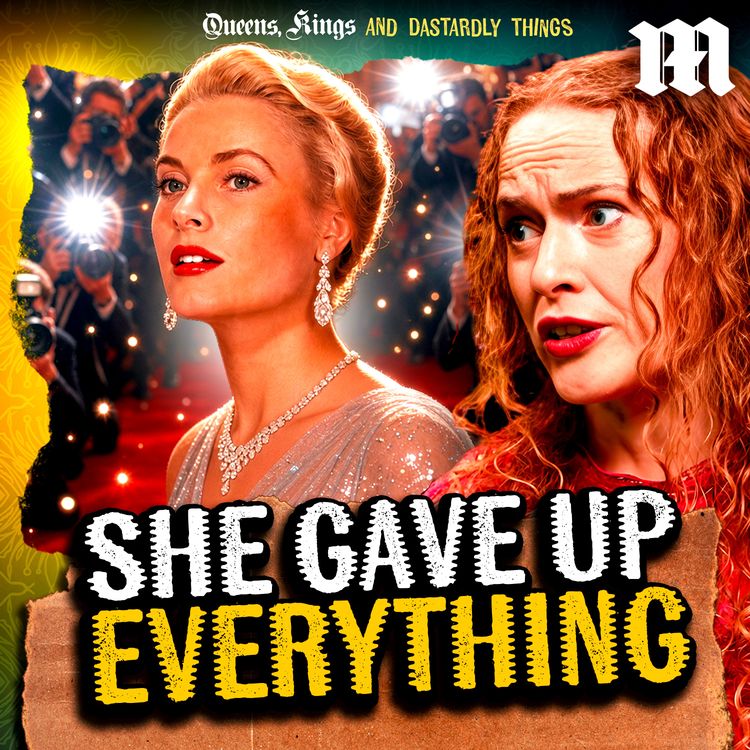
Grace Kelly: Hollywood Princess
Grace Kelly had it all: beauty, an Oscar, Hollywood stardom and a glittering career ahead of her. Then she married a prince.
Robert Hardman and Professor Kate Williams revisit one of the great celebrity fairy tales of the 20th century: the marriage of Grace Kelly to Prince Rainier of Monaco. But behind the wedding-of-the-century photographs lay a rather more complicated story.
From Grace’s battles to make it in the decidedly sleazy world of 1950s Hollywood to an extraordinary royal courtship – involving Aristotle Onassis, Marilyn Monroe and even a young JFK – they explore how an American movie star found herself transformed into a European princess.
There was also a price. Grace was required to give up acting, provide a $2 million dowry and even undergo a fertility test before the marriage could go ahead. Yet the woman who surrendered her Hollywood career would ultimately transform Monaco itself, bringing glamour, money and international respectability to the tiny principality.
So was Grace Kelly’s marriage really the fairy tale the world was sold or did becoming a princess cost her far more than anyone realised?
Hosts: Robert Hardman and Professor Kate Williams
Series Producer: Ben Devlin
Production Manager: Vittoria Cecchini
Content Editor: Joseph Palmer
Executive Producer: Bella Soames
A Daily Mail production. Seriously Popular.
Sign up to Palace Confidential, the FREE royals newsletter from the Mail's top experts. Delivered straight to your inbox every Thursday, it's the smartest way to stay in the royal inner circle. Just head to dailymail.co.uk/palaceconfidential to sign up today.
More episodes
View all episodes
83. The Great Windsor Fire
32:44||Season 1, Ep. 83How did a builder's lamp, a velvet curtain and a tea break nearly destroy 900 years of royal history?On 20 November 1992, fire broke out at Windsor Castle, turning one of Britain's greatest royal landmarks into an inferno. It was Queen Elizabeth II's 45th wedding anniversary, and the latest catastrophe in a year she would famously describe as her annus horribilis.Robert Hardman and Professor Kate Williams revisit the extraordinary events of that day, from the frantic rescue of priceless paintings and royal treasures to the Queen's arrival at the burning castle. Robert also reveals what Prince Philip told him about the disaster and how the fire spread through Windsor's ancient rooms and hidden passageways.But the flames were only the beginning. As the damage mounted, so did public fury. Why should taxpayers foot the bill for repairing the home of one of the world's wealthiest families? With royal popularity already in freefall, the fire threatened to become a constitutional and public relations disaster.And then came the extraordinary rebuilding project, complete with proposals for a wave machine, a glass roof and even an eternal flame.From a royal inferno to a remarkable restoration, this is the story of how Windsor Castle nearly went up in smoke.
82. Victoria: Death of an Empress
25:38||Season 1, Ep. 82Queen Victoria: Scandal, and a Funeral Fiasco.What happens when the most powerful Queen in the world dies and even her funeral doesn't go according to plan?Robert Hardman and Professor Kate Williams bring their Queen Victoria story to a close, with a monarch who has become a global icon, an empire at the height of its power and a Royal Household still finding plenty to be scandalised about.There's a new favourite at court: Abdul Karim, the young Indian servant who becomes Victoria's trusted companion and teacher, to the fury of her family and courtiers. Meanwhile, her wayward son Bertie is still waiting impatiently for the throne, and the Queen is enjoying the adoration of a nation celebrating her Diamond Jubilee.But in January 1901, after more than 63 years on the throne, Victoria finally dies. The news sends shockwaves around the world and triggers a royal funeral of extraordinary proportions, complete with runaway horses, a furious new King and an astonishing gatecrasher at the graveside.From the Queen's unlikely friendships to the extraordinary blunders of her final farewell, Robert and Kate explore the end of the Victorian age and the remarkable legacy of a woman who opposed votes for women but became an inspiration to the suffragettes
81. Victoria's Secrets
28:44||Season 1, Ep. 81Did Queen Victoria find love again and become more powerful than ever?Robert Hardman and Professor Kate Williams explore the extraordinary second act of Victoria’s reign: a story of grief, scandal, royal gossip and an unlikely new man in the Queen’s life.After the death of her beloved Prince Albert, the 42-year-old Victoria retreats into mourning and largely disappears from public view. Her popularity plummets, republican sentiment grows and then along comes John Brown, the blunt Highland servant who becomes one of her closest companions. Their intense friendship sets tongues wagging, infuriates the Royal Family and earns Victoria the nickname “Mrs Brown”.But the Widow of Windsor is far from finished. There’s an assassination attempt, the recovery of her wayward son Bertie, the spectacular flattery of Benjamin Disraeli and, in 1876, an imposing new title: Empress of India.By her Golden Jubilee, the Queen who had virtually vanished from public life had transformed herself into an imperial matriarch at the centre of a global empire.So what brought Victoria back ... John Brown, Disraeli, or the Queen’s own formidable instinct for survival?
80. Victoria in Love
26:38||Season 1, Ep. 80A passionate marriage. Nine children. Assassination attempts, and the monarchy is threatened with a scandal.In the second part of our deep dive into Queen Victoria, Robert Hardman and Professor Kate Williams explore Victoria as wife, mother, monarch and increasingly formidable stateswoman.Her marriage to Prince Albert begins as an intense love affair, but behind the carefully cultivated image of domestic bliss lies a more complicated struggle over who really holds power. As Victoria endures pregnancy after pregnancy, Albert carves out an increasingly influential role beside her, while together they reshape the monarchy and create the intimate royal getaways of Osborne House and Balmoral Castle.Victoria survives multiple assassinations, embraces the new and controversial use of chloroform in childbirth and begins using her growing family to forge dynastic links across Europe.But trouble is brewing much closer to home. Her wayward heir, Bertie, is caught up in a potentially explosive affair, and when an already ailing Albert intervenes, events culminate in his sudden death at just 42.Victoria is left a widow, a mother of nine and a Queen devastated by grief. And she knows exactly who she blames.
79. Victoria: The Girl Who Became Queen
28:01||Season 1, Ep. 79Queen Victoria would give her name to an age, but she was never really supposed to be Queen at all.Robert Hardman and Professor Kate Williams go back to the chaotic royal family of George III and the unexpected death that triggered a desperate race to produce an heir, a contest that eventually produced the baby Alexandrina Victoria.Her childhood at Kensington Palace was anything but happy. Controlled by her mother and the domineering John Conroy, Victoria was rarely allowed to be alone, couldn't even walk downstairs without someone holding her hand and grew up knowing that others expected to rule through her.Then, just weeks after her 18th birthday, two men arrived at Kensington Palace with the news that changed everything: William IV was dead, and Victoria was Queen. Her first requests? An hour completely alone – and to have her bed moved out of her mother's room.
78. The Countess at Nuremberg
32:52||Season 3, Ep. 78An unusual Royal connection to the Nuremberg Trials that prosecuted members of the Nazi leadership.Eighty years after the trials, we know the names of the Nazi leaders in the dock and the MEN who prosecuted them. But what about the extraordinary women who helped bring them to justice?Robert Hardman and Professor Kate Williams are joined by Natalie Livingstone, author of The Nuremberg Women, to uncover the forgotten female stories behind one of the defining legal events of the 20th century.One of these women was Countess Ingeborg Kálnoky, an aristocratic refugee with links to today’s Royal Family, who found herself running an extraordinary 'witness house' where Holocaust survivors lived under the same roof as members of Hitler’s inner circle as they waited to give evidence at the trials.Above all, there is Marie-Claude Vaillant-Couturier, the French Resistance fighter who survived Auschwitz and Ravensbrück before confronting the Nazi leadership at Nuremberg with an unforgettable eyewitness account of the horrors she had witnessed.From castles and courtrooms to concentration camps, this is the remarkable story of the women who witnessed history, helped make history, and were then too often written out of it.
75. The Bayeux Mysteries!
28:29||Season 3, Ep. 75The Bayeux Tapestry is one of the most famous works of art in the world: nearly 70 metres of kings, battles, betrayals and bloodshed. But how much of the story it tells can we actually believe?Robert Hardman and Professor Kate Williams unravel the extraordinary 11th-century embroidery that turned the Norman Conquest into a medieval propaganda epic. Who commissioned it? Why was it probably made by English women? And did Harold really die with an arrow in his eye?There are mysteries in the margins too, including the enigmatic Aelfgifu, Halley’s Comet and a surprisingly large number of naked men.And then there’s the remarkable survival of the tapestry itself. From revolutionaries who nearly used it as a wagon cover to Napoleon and the Nazis, it has repeatedly come within a whisker of disappearing altogether.Nearly a thousand years after the Battle of Hastings, what can the Bayeux Tapestry really tell us about 1066, and about the people who wanted history to remember their version of it?
74. The Aragon Girls
24:59||Season 3, Ep. 74We’ve had the Boleyn girls. Now meet the Aragon girls: two sisters born into perhaps the most powerful royal family in Europe, whose lives would take very different but equally extraordinary turns.Robert Hardman and Professor Kate Williams head to Renaissance Spain to meet their formidable mother, Isabella of Castile: warrior queen, patron of Christopher Columbus and, with Ferdinand of Aragon, architect of a new Spanish superpower.Her youngest daughter Catherine would become Henry VIII’s first wife, an educated, politically astute queen who proved considerably harder to get rid of than Henry expected. But Catherine’s elder sister Joanna faced an even darker fate. Married to Philip the Handsome and heir to Castile, she was declared insane and shut away while first her husband, then her father and finally her own son ruled in her place.So was “Joanna the Mad” really mad at all? Or was one of Europe’s most powerful women simply the victim of the men who wanted her throne?