Share
Psychology of the Strange
Glitched
Have you ever stepped into an unfamiliar room, only to be struck by the chilling, unshakable certainty that you have stood in that exact spot before?
For generations, humanity has blamed this unsettling phenomenon on previous lives, ancestral memory, or a literal glitch in our simulated reality. But what is even stranger than the feeling itself is its secondary symptom: the sudden, overwhelming conviction that you can predict the immediate future. Whether your mind is playing a brilliant spatial trick on itself, or you are briefly tuning into a parallel self vibrating across the cosmos, the reality is far stranger than we think.
Settle in, get comfortable, and let’s explore the spaces where psychology meets the edge of the unknown.
Join the Circle:
- Deepen the Study: Join our community and subscribe to the paid tier on Substack for exclusive deep-dive show notes, bibliography, and bonus essays.
- Share Your Story: Have you ever had a déjà vu experience where you could have sworn you saw the future? Leave a comment on our Substack or reach out to us on socials @PsychStrangePod
- Support the Show: If you love our mix of science and the strange, please leave a five-star review on Apple Podcasts or Spotify. It helps our dark academia library grow!
More episodes
View all episodes
53. Voodoo Death And The Question Of Whether Belief Can Kill You
32:44||Season 3, Ep. 53Sometime in the late 1930s, a man in rural Alabama met another man in a cemetery at night. The second man waved a bottle in his face, told him he had been hexed, and told him there was nothing left to do but go home and wait. He went home. He stopped eating. Weeks later he was near death in a hospital bed with a chart that said nothing was wrong with him. What his physician did next involved a syringe, an elaborate lie, and a lizard.This episode is about the question underneath that story, which turns out to be harder than it looks. Can a person be told they are going to die and then die of it? The evidence says yes, sometimes, under conditions that have almost nothing to do with magic. In 1942 a Harvard physiologist named Walter Cannon gave the phenomenon its name and its physiology, and he also filed it under the exotic, describing it as foreign to the experience of civilized people. That framing turns out to be the most interesting mistake in the whole literature, because the mechanism never stayed where he put it. It changed clothes.I walk through what the nocebo effect actually is and why two labs working independently just traced it to a specific circuit in the brains of mice, which matters more than it sounds like it should. I get into John Leach's clinical description of psychogenic death, the five-stage collapse that prisoners of war called give-up-itis, including the detail about the last cigarette that I have not been able to shake. I revisit the night hag, because a number I gave you back in 2023 has since been settled by a hundred and sixty-seven thousand people. And I close with a patient in Nashville in 1973 who received a death sentence from someone in a white coat, kept it, and died on schedule of a tumor two centimeters across.The question was never whether curses are real. The question is what a mind does with a prediction it accepts and cannot act against.Companion essay drops Thursday on Substack, where paid subscribers also get every episode ad-free. https://substack.com/@psychstrangepodBook picks for this one are on The Strange Shelf. https://www.amazon.com/shop/influencer-b7bd654b/list/1OX5UZT4WR668?ref_=hype_hm_sf_eUntil next time, stay curious and stay strange.
52. Olga of Kyiv, The Saint Who Buried 20 Men Alive
27:54||Season 3, Ep. 52In roughly 945, Prince Igor of Kyiv went back for a second round of tribute from the Drevlians and paid for it with his life. What his widow did next has been retold for a thousand years: four escalating acts of revenge that ended with a fortified city burning from the inside out, and a rival tribe erased as an independent political force.This episode traces the story of Olga of Kyiv from the death of her husband through the siege of Iskorosten, then follows the stranger part: how the woman responsible for it all was eventually canonized as a saint, venerated in both the Eastern Orthodox and Roman Catholic churches under the title "Equal to the Apostles," and named patron saint of widows and converts.Along the way: what social identity theory explains about why an audience roots for her, what honor culture research says about societies where retaliation functions as maintenance rather than excess, and why the concept of double deviance explains the particular shape her legend took. Olga stands as one of the earliest examples of the female antihero in Western storytelling, and the way her chroniclers handled that says as much about them as it does about her.The episode closes on the Primary Chronicle itself, compiled by monks in Kyiv a century after Olga's death, under the rule of her Christianized descendants, with every reason in the world to make the story land exactly the way it does. Where the history ends and the myth begins is not a question that has a clean answer.
51. The Haunted Room Experiment: Infrasound, Ghosts, and the Power of Suggestion
31:46||Season 3, Ep. 51In 2009, a team of psychologists published the results of a haunted house they built on purpose. Ghost sightings, sensed presences, cold spots, and unexplained dread had already been linked to infrasound and electromagnetic fields, so Chris French at Goldsmiths and architect Usman Haque constructed a featureless circular chamber inside a north London flat and ran seventy-nine people through it to find out whether a haunting could be manufactured from physics alone.It could not. Whether the machinery was running or switched off made no difference to what people experienced inside that room. What did predict a person's report was the person, and the single most powerful variable in the entire study turned out to be the ethics paperwork they had to sign before walking in.This episode starts with Vic Tandy, the engineer who found his laboratory ghost hiding inside an extractor fan, and traces the theory forward through Michael Persinger's God Helmet, the Swedish replication that undercut it, and the argument that never resolved before he died. Then it goes into what happens in a body left alone in a dim, curved, silent room for fifty minutes after somebody has told it that something might happen. Predictive perception, the misattribution of physical arousal, and why some people meet something in that chamber while the person after them gets bored.Eight percent of participants reported terror. Some of them were in the group where the room was doing nothing at all.The uncomfortable question this episode holds open is whether the traffic in a haunted place runs the direction everybody assumes it does. Wiseman's work at Hampton Court and the Edinburgh vaults suggests the buildings really are doing something. What that something is stays unsettled.Until next time, stay curious and stay strange.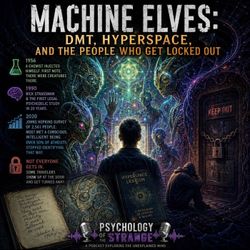
50. Machine Elves- DMT, Hyperspace, and the People Who Get Locked Out
37:50||Season 3, Ep. 50DMT entities, machine elves, and the hyperspace breakthrough: what people report meeting under N,N-dimethyltryptamine, and why the reports match. A Johns Hopkins survey of 2,561 people found that most described a conscious, intelligent being, and that more than half of the atheists in the sample stopped identifying that way afterward. This episode covers Rick Strassman's University of New Mexico research, Terence McKenna's machine elves, the Hyperspace Lexicon, and the listeners who get locked out of hyperspace entirely.Show notes:A Hungarian chemist injected himself with a compound he had synthesized in 1956, and the first thing he wrote down was that there were creatures there. Thirty-five years later a psychiatrist at the University of New Mexico ran the first legal psychedelic study in the United States in two decades, and half his session notes involved his volunteers meeting somebody. In 2020, Johns Hopkins surveyed 2,561 people who had encountered an autonomous entity under DMT and found that most of them believed the being was conscious, intelligent, and still out there after they left.This episode is about the machine elves, the insectoids, the half-animal figures, and the vocabulary a forum full of strangers built to describe them. It's about why so many accounts converge when the people giving them have never spoken. And it's about the part nobody planned for, which is the travelers who show up at the door and get turned away.Along the way I get into predictive perception, Caputo's strange-face research, Shibutani's work on rumor as improvised news, and the liminality framework that explains why an experience with gatekeepers feels like an initiation. I also come back to the Lanmaoa asiatica episode, because the little people in Yunnan complicate the tidiest explanation available.The book behind a lot of this episode is Rick Strassman's DMT: The Spirit Molecule, and it's on The Strange Shelf along with Terence McKenna's True Hallucinations: https://www.amazon.com/shop/influencer-b7bd654b/list/1OX5UZT4WR668?ref_=aip_sf_list_spv_ons_mixed_dThe companion essay goes up this week on Substack and takes the Yunnan question further than I could take it here. Paid subscribers get ad-free listening and the full essays: https://substack.com/@psychstrangepodUntil next time, stay curious and stay strange.
49. Psychic Bonds
23:15||Season 3, Ep. 49Witch's familiars, psychic pets, and telepathic cats: this episode digs into the centuries-old belief that animals can sense things they have no ordinary way of knowing. From seventeenth-century witch trial confessions to a modern scientist's experiments on dogs that wait at the window, I trace how the same core claim has survived in different forms for hundreds of years.I start with the witch's familiar in early modern England and Scotland, including Elizabeth Clarke's 1645 confession under Matthew Hopkins From there I move through shamanic animal guides and the Norse fylgja, and what these traditions across cultures agree on even when they disagree on mechanism. Then it's J.B. Rhine's psi-trailing research at Duke University in the 1930s, followed by Rupert Sheldrake's experiments on Jaytee the dog and his ongoing dispute with psychologist Richard Wiseman over what that data actually shows.On the skeptical side, I get into the Clever Hans effect and ideomotor cueing, along with how cats may actually find their way home through scent-mapping and possible magnetoreception. I also spend some time on apophenia, grief, and why the story that includes you always feels truer than the one that doesn't. Toward the end I bring in the Earth Species Project's NatureLM-audio and what AI-decoded animal communication might mean for this whole question going forward.My own cat Sabrina makes an appearance too.The companion essay for this episode, which goes deeper on the witch trial records, is up on Substack now. Paid subscribers get that essay in full along with ad-free listening. Until next time, stay curious and stay strange.
47. The Blood Goddess of Yerba Buena
31:30||Season 3, Ep. 47In 1963, deep in the isolated mountains of Tamaulipas, Mexico, a routine police investigation uncovered a nightmare: a remote mining village transformed into an apocalyptic cult of ritual sacrifice, ruled by a twenty-six-year-old woman claiming to be the ancient Aztec goddess Coatlicue. Her name was Magdalena Solís, historically remembered as "The High Priestess of Blood."But the true horror of Yerba Buena isn’t just the crimes committed in that torch-lit cave. It’s how they began. Magdalena wasn't a born cult leader; she was a destitute young woman hired by two petty con men to play a part in a financial scam.In this episode, we step away from standard true-crime sensationalism to examine the terrifying fluidness of the human psyche. How does a conscious grift mutate into genuine, dangerous megalomania? How do ordinary, peaceful people become complicit in atrocities within a matter of weeks? We trace the story of Magdalena Solís through the lens of social psychology, exploring folie à plusieurs (shared psychosis), deindividuation, and the dark architecture of total isolation.Deepen Your Research on SubstackWant to go beyond the audio? Read our companion essay for this episode over on the Substack Go Ad-Free: Paid Substack subscribers get exclusive access to academic deep-dives, source bibliographies, and completely ad-free listening for every single episode. Join the community at: psychologyofthestrange.substack.comFurther ReadingCultish: The Language of Fanaticism — Amanda MontellNot every cult needs a cave and a chalice. Montell breaks down the actual mechanism, the language, that turns a group into something closer to a cult than anyone inside it wants to admit. If this episode had you thinking about how belief gets built one word at a time, start here.Connect with the Show:Substack: psychologyofthestrange.substack.comTikTok / Reels: @PsychStrangePod
46. Akashic Library and Near Death Experiences
34:25||Season 3, Ep. 46Have you ever wondered what happens in those final milliseconds when the lights go out? Pop culture loves to promise that clinical death is a peaceful journey toward a warm light, but the data tells a much more complicated, occasionally terrifying story.This week, we are pulling on two deeply intertwined, thoroughly bizarre threads of human consciousness. First, we explore the esoteric concept of the Akashic Records. The infinite, celestial library that hundreds of modern NDE (Near-Death Experience) survivors claim to have visited to view the pre-birth blueprints of their mortal lives.Then, we pivot into the dark underbelly of resuscitation science: Distressing NDEs. Statistics show that a significant portion of the population doesn't get a cosmic hug when they flatline; instead, their minds serve up a custom horror film. We break down the neurobiology of a dying brain, Jung’s collective unconscious, and the three distinct archetypes of hellish experiences. Finally, we look at why cutting-edge cognitive models like 4E Cognition might mean these realms are far more than mere hallucinations.Go Deeper on Substack:Want to pull on these threads even further? Join our inner circle on Substack! Paid subscribers get completely ad-free listening for every single episode so your atmosphere remains uninterrupted. Plus, this week I’m dropping an exclusive subscriber-only companion essay that dives deep into the clinical case studies of hellish NDEs, the exact mechanics of veridical perception, and the messy philosophy behind 4E cognition theory. Subscribe at https://psychstrangepod.substack.com/?r=4ajm1n&utm_campaign=profile&utm_medium=profile-pageReferences & Recommended Reading:Greyson, B., & Bush, N. E. (1992). Distressing Near-Death Experiences. Psychiatry: Interpersonal and Biological Processes. (The foundational study establishing the 11-22% statistic on dark NDEs).Jung, C. G. The Archetypes and the Collective Unconscious. Princeton University Press.Gallagher, S. (2017). Enactivist Interventions: Rethinking the Mind. Oxford University Press. (An excellent foundational text for understanding 4E cognition).Pasricha, S. (1993). A systematic survey of near-death experiences as reported by inpatient populations in India. Journal of Scientific Exploration. (For the cross-cultural administrative and Yamadoota data).Connect With the Show:Host: Tara PerreaultInstagram/Twitter: @PsychStrangePodListen & Review: If this episode gave you a healthy dose of intellectual existential dread, please leave us a 5-star review on Apple Podcasts or Spotify, it directly helps our independent library grow!
45. The Old Ursuline Convent & the Casket Girls
31:14||Season 3, Ep. 45If you walk down Chartres Street in the French Quarter of New Orleans late at night, your eyes will naturally drift upward to the third floor of the Old Ursuline Convent. There, behind the heavy brickwork, sit rows of dark wooden shutters. They are always closed. Always sealed.Local folklore says that inside that attic rests a collection of hundreds of small, wooden trunks—trunks shaped suspiciously like coffins. Legend claims that in 1728, a fleet of ships arrived carrying young, pale women who clutched these boxes like lifelines: the Filles à la Cassette, or Casket Girls. And the rumor that keeps tourists up at night? They smuggled the first vampires into America, forcing the nuns to seal the windows with 800 Pope-blessed silver nails and threatening anyone who enters with automatic excommunication.But what if the real horror story isn't what flew out of that attic, but why the townspeople needed a monster to be there?In this episode of Psychology of the Strange, we dissect the Old Ursuline Convent not as a haunted house, but as a laboratory of human behavior. Pulling back the gothic romance, we explore how a primitive, isolated society weaponized psychological projection, linguistic drift, and institutional secrecy to turn traumatized young women into the ultimate dark triad predators. Finally, we look at the thin line between scientific parsimony and the primal elegance of the monster—and why our minds have an evolved appetite for the thrill of recreational fear.Support the Show on Substack!Want to go deeper into the psychology behind the lore? Upgrade to a paid subscription at Substack to unlock:Premium Companion Essays: This week, dive into the data behind Morality-as-Cooperation Theory and a deeper look at how Dark Triad traits manifest in high-stress ecosystems.Ad-Free Listening: Immerse yourself in the dark without interruption.Exclusive Community: Join discussion threads and vote on upcoming episode topics.Check Out the Reading List on Amazon!