Share

Productivi-Tree: The Human Side of Productivity
One Lawsuit From Losing Everything You Built with Scherrie L. Prince
Nearly all productivity advice assumes you get to keep what you build. Scherrie L. Prince spends her working Life proving that assumption wrong.
She is a trial attorney, a JD MBA, managing partner of Prince & Associates PLLC, and host of the Play Big Faster Podcast, now past 252 episodes. She got here the hard way: a probate fight after her mother died, a business built on a handshake that fell apart, and a mortgage brokerage wiped out in 2008. Those three losses sent her to law school and into asset protection.
In this episode, she gives Santi the framework she uses with entrepreneurs. Four questions to answer before you even think about an LLC or a corporation. Why your estate plan and your business plan cannot live in separate drawers. What "own nothing, control everything" really means, and why nobody is fully judgment-proof. Then the productivity half: how she runs a law firm, a coaching practice, and a twice-weekly podcast, all based on one rule she got from a commercial real estate broker: plan your fun first.
She also tells the story of the AI mistake that made it into her court filings and what she changed afterward. If you have been growing something without protecting it, this conversation is the audit you have been putting off.
- Answer four questions before you pick a structure: do you have a will-centered or trust-centered estate plan, is the business product, service, or hybrid, is it physical, virtual, or e-commerce, and do you need anonymity or are you public-facing? Structure comes after, not before.
- An exit is not a failure. It can be a sale, a retirement, a handover to the next generation, or a reorganisation. Deciding which one you want changes what you build today.
- A trust does not stop anyone suing you. It organises what you own and builds a moat around it. Nobody is 100 percent judgment proof, and any adviser who claims otherwise is selling something.
- Insurance is not only about dying. Disability and incapacity are the more likely events. If the business stops when you stop, you are the bottleneck.
- Plan your fun first. Family events, holidays and the things that light you up go on the calendar before the work does, and the work fills in around them.
- Every major activity gets a system. Separate CRMs where privacy demands it, Dropbox as the common file layer, Zapier for the gaps, Asana for tasks, and SOPs that get updated by voice into an AI tool.
- AI is a tool, not a solution. Her firm had an SOP and training and still filed fictitious legal precedent while she was out. The control is human review, not a ban.
- Service businesses can scale, but only with scope clarity. Group coaching, masterminds and one-to-many delivery are how you duplicate yourself without a clone.
00:00 The one document you are missing
00:47 Who is Scherrie L. Prince
01:49 Two failed businesses and a probate fight
03:15 Begin with the end in mind, even at day one
04:58 What playing big actually costs
06:15 The four questions to answer before you pick a structure
09:24 Estate plan and business plan, explained simply
10:32 Why founders avoid planning for disability and death
11:26 Own nothing, control everything 12:56 Plan your fun first
14:35 Court dates you cannot move
15:49 The system behind 252 podcast episodes
17:44 Mindset or structure, what separates the founders who scale
19:36 The calendar advice she would give her younger self
21:09 The AI mistake that reached her court filings
23:59 Using AI to do more instead of to work less
25:31 Can a service business detach income from time
27:24 The guest who impressed her most
29:12 Quickfire round
31:28 What Santi took away
Scherrie L. Prince on LinkedIn: https://www.linkedin.com/in/scherriespeaks/
Website: https://scherrieprince.com/
Prince & Associates PLLC: https://princelawassociates.com/
Play Big Faster Podcast: https://podcasts.apple.com/us/podcast/play-big-faster-podcast/id1635345946
Want to know where you are losing time and energy?Take the free Productivity Assessment and get your personal results in minutes. https://links.santiagotacoronte.com/Productivity-Assessment- More Productivity resources at https://santiagotacoronte.com/productivity-tips/
- Become a Guest: info@santiagotacoronte.com
More episodes
View all episodes
85. AI at Work: The Hidden Work Your Rollout Will Break First, with David Dean
49:26||Season 3, Ep. 85🧭 Find Your Weakest Productivity Vector in 5 Minutes (Free Assessment) https://links.santiagotacoronte.com/Productivity-Assessment 🎓 Productive, Not Busy (live cohort on Maven) https://links.santiagotacoronte.com/productive-not-busyYour process documents describe one company. The workarounds, the chasing and the four-day approvals describe another. Point AI at the second one and it copies the mess at speed.David Dean spent 20 years in enterprise technology, 10 of them leading AI, automation and data programmes across healthcare, insurance, hospitality and regulated industries. In this conversation he explains the gap between the official contract of a job and the unwritten contract that keeps the work moving, why he puts 79 percent of the workforce in a group he calls AI survivalists, and what the inbox already records about how a company behaves.By the end of the episode, you can do three things. Name the undocumented behaviours your own role depends on, so a tool decision stops being a guess. Spot an AI project that will fail before the budget is gone, using one question about who was asked. Start a work diary this week with nothing beyond the notes app on your phone.Listen now if someone is about to roll a tool out across your team and nobody has asked the people who do the work.Key Takeaways1. Every job description ends with "other duties apply", and that line is where the real work lives.2. Workarounds come from a need for control or a need to survive the week, and they outlive the reason they were created.3. David puts 79 percent of workers in a group he calls AI survivalists, people who are neither for AI nor against it.4. AI copies and industrialises human behaviour, including the dysfunction, which is one reason projects stall.5. Lived experience and lived consequence stay human, so risk decisions stay with leaders.6. The first sign an AI project will fail is that nobody spoke to the people who will use the tool.7. A dictated work diary on your phone turns invisible behaviour into something a team can actually read.Guest LinksDavid Dean website: https://www.davidchristopherdean.com/About David: https://www.davidchristopherdean.com/about/An Inbox Between Us: AI and the Reality of Modern Work: https://www.davidchristopherdean.com/book/Media: https://www.davidchristopherdean.com/media/Appearances: https://www.davidchristopherdean.com/appearances/LinkedIn: https://www.linkedin.com/in/davidchristopherdean/The AI Mirror (David's newsletter, published on LinkedIn)Chapters0:00 Why AI and people both have to earn trust0:52 Find your weakest productivity vector in five minutes1:15 Meet David Dean, business AI realist2:37 Twenty years in enterprise tech, and what it taught him5:10 Why AI pilots run on assumptions and stall7:17 The official contract and the unwritten one8:54 "Other duties apply" is where the real work hides12:54 Control, survival, and the workarounds nobody wrote down16:39 The 79% nobody is designing the rollout for21:16 Why pushing tools at people never lands25:14 Four behaviours that keep work moving26:33 Risk, lived experience, and what you give up31:14 Output above quality, and where that ends32:45 How AI industrialises dysfunction at scale37:42 Quickfire: the AI use with no business value39:07 The meeting costing twenty four thousand dollars in payroll40:29 The slide every company puts up and nobody believes41:16 The first sign an AI project will fail41:55 What to put on your calendar before Friday42:34 The frontline worker who felt replaceable46:46 Where to find the book and the audiobook47:31 Double down on human capital, differently
84. Automate a Mess and You Get a Faster Mess, with Mike Toguchi
43:59||Season 3, Ep. 84🧭 Find Your Weakest Productivity Vector in 5 Minutes (Free Assessment) https://links.santiagotacoronte.com/Productivity-Assessment 🎓 Productive, Not Busy (live cohort on Maven) https://links.santiagotacoronte.com/productive-not-busyYour team has good software and the work still feels heavy. Nobody wants to say it out loud, because the tool was approved, paid for and announced.Mike Toguchi has spent 25 years inside that exact room, in universities, nonprofits, foundations and corporates, and he has a blunt diagnosis: the technology is rarely what broke. He walks through a nonprofit scholarship programme that put AI on top of a convoluted review process and got "continued mess, faster mess", and he explains why a team that cannot say what is working has no feedback loop, only a sign-off.By the end you will be able to spot survival mode in a team whose tools are running fine, test whether you have approval or alignment before a project goes sideways, and run a readiness check before you sign the next renewal.Listen before your next software renewal lands on your desk, because the cheapest version of this lesson is the one you get secondhand.Key Takeaways1. A tool amplifies the workflow it lands on. Mike: "a lot of times the technology ends up being the thing that exposes the fissures in your workflow as opposed to fixing them."2. Survival mode looks like smooth technology and overwhelmed staff. The signs are unclear ownership, incentives pointing in different directions and no line back to the mission.3. Automating a convoluted review process gave one nonprofit richer summaries and worse decisions. Mike: "It's not making the process cleaner."4. Approval is a signature. Alignment is a shared understanding of the problem, the success criteria and the tradeoffs, held together by a feedback loop people can actually use.5. Every organisation runs two processes: the documented one and the real one. Mike calls them prescriptive and descriptive, and the gap between them is where the workarounds live.6. Low adoption tells you something about leadership. Mike: "I think adoption is a leadership issue."7. Readiness takes three things and none of them takes a year: strategic discovery, stakeholders bought in, due diligence done. Then hit the gas.8. AI gives time back only when leadership decides what the time is for. Otherwise it scales the same busywork at higher volume.Guest LinksMike Toguchi on LinkedIn: https://www.linkedin.com/in/miketoguchi/Tectonic: https://www.teamtectonic.com/Orchestrate: https://onlineapplications.netOrchestrate AMS: https://www.orchestrateams.com/Mentioned in the episode: Democracy in America by Alexis de Tocqueville (Mike's book pick), Slack, HubSpot.Host links: https://santiagotacoronte.com/ | https://www.linkedin.com/in/santiago-tacoronte/ | https://x.com/TacoronteSantiFree Productivity Test: https://links.santiagotacoronte.com/Productivity-AssessmentProductive, Not Busy (live cohort on Maven): https://links.santiagotacoronte.com/productive-not-busy
83. Why Top Performers Are Turning Down Promotions, with Kimia Penton
47:02||Season 3, Ep. 83🧭 Find Your Weakest Productivity Vector in 5 Minutes (Free Assessment) https://links.santiagotacoronte.com/Productivity-AssessmentYou have the title, the salary and the team, and you are lying awake working out how to get out. Nobody at work is having that conversation out loud.Kimia Penton has it for a living. She runs a global PMO inside a Fortune 10 company; she is President of the PMI Dallas Chapter, and she would take a six-month paid sabbatical over a promotion tomorrow. She is also an organisational psychologist, which is why her account of burnout doesn't match what you have heard. She says she would happily spend a week in a music studio, packing her lunch so she does not have to stop, and leave refreshed. The hours are not the problem. The problem is being in a role where you have no agency, no trust in your leader, and nothing you recognise as yourself.Listen, and you will come away with three things. One, the two moves to make now so stepping down is even an option later: never let your day job be your only identity or network, and never grow your expenses to match every raise. Two, the test Kimia applies before joining any team, which has nothing to do with the title or the money. Three, what emotional regulation looks like in a meeting that is going badly, from someone who has had to raise her voice five times in twenty years and can tell you why each one counted.If you have a promotion conversation coming, have this one first.Key Takeaways1. Long hours do not cause burnout on their own. Losing agency, working for a leader you do not trust and doing work you no longer recognise yourself in is what does the damage.2. Wellness apps and on-site gyms are one more thing on the list. Kimia has given up on her company's app. Culture is the retention strategy, and culture is set by the team leader, not the mission statement.3. Before you can step down, two things have to be true: your job is not your only identity or network, and your expenses have not grown to match your last raise.4. Build the next thing in parallel while you still have the job. Kimia teaches a university course on Friday nights now because she wants to teach more later.5. Robert Walters found that 52% of Gen Z professionals in the UK do not want a middle management role, and 69% call it high stress and low reward. The responsibility went up, the autonomy and the pay did not.6. Staying calm in a conflict takes more discipline than escalating. If you are known as reactionary, people stop taking you seriously unless you are reacting.7. Asking your direct manager for performance feedback is overrated career advice. Their word does not have to define you.8. Your job title is not your identity.Guest LinksKimia Penton, website: https://kimiapenton.com/Kimia Penton, music: https://kimiapmusic.com/Kimia Penton, book (Power, on Purpose): https://www.amazon.com/Power-Purpose-Authenticity-Becomes-Leadership/dp/B0GH5Y4RM8Kimia Penton, LinkedIn: https://www.linkedin.com/in/kimiapenton/Kimia Penton on Spotify: https://open.spotify.com/artist/2x1RG5Y0QitBt9mqrEaOFQ
82. Overwhelmed at Home? Run Your Household Like a CEO with Lisa Woodruff
40:32||Season 3, Ep. 82Find Your Weakest Productivity Vector in 5 Minutes (Free Assessment)https://links.santiagotacoronte.com/Productivity-AssessmentYou run the house, you run your job, and every week you end up further behind.Lisa Woodruff has spent more than a decade studying the invisible work of household management, and she found that overwhelm at home is a planning problem, not a personal failure. The fix she teaches is to run the household the way a CEO runs a company: batch the admin, fund two or three projects at a time, and plan the season ahead instead of reacting to the week.In this episode you will learn:- How the Sunday Basket replaces an hour of daily admin with one 90-minute session and frees up about 5 hours a week- Why organizing your own closet before the family spaces is what makes the rest of the house stay organized- How to use time, talent and treasure to pick fewer home projects and finish them fasterListen now if you feel like the harder you work at home, the deeper you sink. Lisa shows you the first two steps to take this weekend.Key Takeaways1. Batch the household admin. Bills, forms, mail and weekly checklists go in one basket and get handled in one 90-minute to two-hour session. An hour a day becomes one sitting, and about 5 hours of the week come back.2. Organize for yourself first. A family room cleared on a long weekend is a mess again by next weekend. Your own closet, bathroom shelf or desk stays organized for three or four months and supports you every morning.3. Run the home like a CEO, not a manager. Check time, talent and treasure before you start a project. Two or three projects a quarter get finished. Eight get started and stall.4. Plan the season, not just the week. Summer camps get booked in February, trips while everyone is healthy, big personal goals when the family calendar allows. Lisa finished a PhD at 54 by planning it this way.5. Lower the bar for done. The invisible scorecard built from Instagram and Pinterest makes the workload look bigger than it is.6. Set a stop time. Lisa stops all work, business and household, at 6:30 pm, even with to-dos left on the list.7. If you are overwhelmed right now: clean out your closet this weekend, and every evening write tomorrow's list, including the weather, the outfit and the meals.Chapters0:00 The Sunday Basket: one session instead of an hour a day1:30 Meet Lisa Woodruff2:35 Where the idea of invisible work came from4:59 Are women still doing more of the work at home?7:30 How Lisa made her invisible work visible to her family9:34 Swiss cheese organizing, and why your closet comes first11:46 What a household CEO does that a manager does not14:19 Strategic planning at home: camps, trips, retirement, a PhD17:23 Time, talent and treasure: CEO skills applied to the home19:47 Too much work, or not organized enough?22:53 Productivity guilt and Lisa's 6:30 stop time24:45 Escaping Quicksand: how overwhelm pulls you under27:31 Two things to do this week if you feel overwhelmed28:52 How the Sunday Basket frees up 5 hours a week30:36 Should household managers use AI?32:48 Can anyone learn to run a home well?35:30 Quickfire round37:36 What's next: the Productive Home CEO framework38:23 Where to find LisaGuest Links- Organize 365: https://organize365.com/- Escaping Quicksand: https://organize365.com/escapingquicksand/- Instagram: https://www.instagram.com/organize365/- Organize 365 Podcast: search "Organize 365" on any podcast app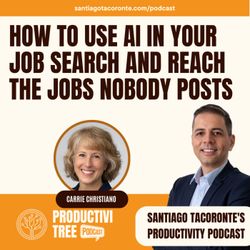
81. How to Use AI in Your Job Search, and Reach the Jobs Nobody Posts
43:16||Season 3, Ep. 81SummaryYou are using AI to tailor every resume, and you are still hearing nothing back.Carrie Christiano spent two decades recruiting at companies including IBM and LexisNexis before she started coaching the people whose applications she used to screen. Her position is that AI does not fix a weak job search; it scales it. Paste the posting, paste the resume, ask for a tailored version, and you have automated the least valuable step in the process.In this episode, she shows what the valuable use looks like. Ask AI why the role is actually open at that company before you write a word. Use open questions instead of stacked constraints, because over-prompting turns the model into a compliant writer and gives you the same flat summary everyone else is submitting. Then use what you learn to get into the conversations that happen before a job is ever posted, which is where, as Carrie says, half the hires are decided.You will leave with the one prompt she gives every job seeker, a five-step sequence for reaching decision makers cold, the two questions every recruiter is silently asking about you, and the numbers on how AI is reshaping the roles you are applying for.If AI has made your search faster but not effective, start here.Key Takeaways- AI amplifies your strategy, good or bad, so the strategy has to come first- Before tailoring a resume, ask AI to research the company and explain why the role is open- Over-constrained prompts produce canned writing, open questions produce usable material- Every AI-written resume summary sounds the same, which makes yours forgettable rather than disqualified- Half the time the hiring decision is made before the job is posted, because a referral triggered the requisition- Recruiters are asking two things: can we afford you, and will you leave- 76% of employees now use AI at work, and AI-skilled workers command a 56% wage premiumChapters0:00 What being stuck in a job search actually looks like2:13 Why sending more applications gets you fewer interviews4:21 How ATS and AI screening really filter your resume6:00 What a recruiter does with a stack of 100 applicants7:26 The hidden job market, explained8:43 Cold outreach versus warm introductions10:40 What a strong pitch looks like next to a weak one12:14 Where AI belongs in research and networking13:37 The most dangerous way job seekers are using AI15:46 Using AI without losing your own voice17:30 The open question that beats an hour of prompt engineering18:58 Does AI-sounding resume language work against you?20:00 The two questions every recruiter asks themselves21:57 The EMPOWER method, in Carrie's words23:55 Do you need to become an AI expert to stay employable?24:59 The numbers: 76% using AI at work, 170M new roles coming27:26 How to prove you can contribute instead of claiming it30:13 Confidence, humility and the imposter syndrome trap31:17 Should you prepare before you get laid off?33:54 Quickfire round39:01 Where to find Carrie and her bookGuest Links- Website: https://empowercareerstudio.com/- LinkedIn: https://www.linkedin.com/in/carriechristiano/- Book: EMPOWER Your Job Search with AI — https://www.amazon.com/EMPOWER-Your-Job-Search-Future-Ready-ebook/dp/B0GYBKPJ8H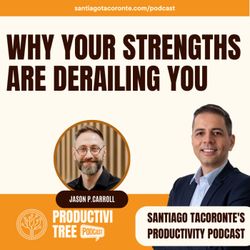
80. Why Your Strengths Are Derailing You | Jason P. Carroll
41:22||Season 3, Ep. 80Jason P. Carroll grew Champion National Security to 2,500 employees, sold it at the end of 2020, and then woke up with no role, no team, and no clear purpose. The same period brought a lockdown, the loss of a community he had belonged to for a decade, and the end of his first marriage. He used those two years to rebuild and then founded Aptive Index, a behavioral assessment company that measures conative traits: the innate drives that shape how you act at work.In this episode, Jason explains why personality shifts with context and mood while your drives stay stable from your preteens onward. He shows how one drive, the need to shape outcomes, made him steamroll his own executive team, and why asking "why do I do this?" pushed him toward shame instead of change. He also explains the difference between sociability and prosocial behavior, why the loudest voice in a meeting is not the most productive one, and why people who stretch too far from their wiring for too long burn out faster.You will leave with a better question to ask when a behavior is hurting your team, a way to think about role fit that doesn't end in firing anyone, and a clear view of when your strengths need to be turned down so others can contribute.Jason is the founder and CEO of Aptive Index and trained under Dr. Brené Brown. Connect with him on LinkedIn: https://www.linkedin.com/in/jasonpcarroll/Take the free Productivity Test: https://links.santiagotacoronte.com/Productivity-AssessmentJoin the newsletter: https://links.santiagotacoronte.com/NewsletterKey Takeaways1. Personality changes with the room you are in, your sleep, and your season of Life. Conative drives stay stable, making them a better basis for decisions about roles and teams.2. Knowing a bad behavior is only a data point. Jason changed when he saw its impact: his team felt he did not value their input.3. Swap "why do I do this?" for "what is driving this behavior?" The first question tends to elicit identity statements such as "I am a bad leader." The second point points you to a need you can meet in a healthier way.4. Sociability (warm, animated, outgoing) and prosociality (seeking consensus and the best ideas from the group) are separate traits. The loudest voice often wins the room without contributing more.5. A team made only of people who want to be in charge cannot resolve conflict. Blended wiring brings more perspectives into every project.6. People can succeed in roles that do not fit their wiring, but they burn out faster. The fix can be a change in position or simply resetting the leader's expectations.7. Jason's message to his 30-year-old self: weakness was not derailing him. His strengths were cranked up too loud.Chapters0:00 Intro0:12 Two years that rebuilt Jason's Life3:58 Selling the company and losing his purpose6:25 Why he bet on behavioral science8:53 Why he didn't retire after the exit10:45 What "conative" means and why it beats personality13:16 How hardwired drives predict the way people work15:15 What the data shows inside companies18:27 Why asking "why" hurts self-awareness22:12 Prosocial vs sociability and the myth of alpha teams26:03 When your wiring doesn't match your role29:10 How to find your conative profile30:49 From a toxic first job to a culture that works33:12 Quickfire round38:07 How to connect with Jason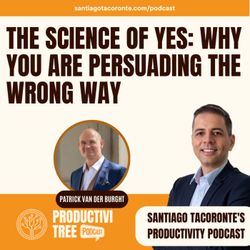
78. The Science of YES: Why you are Persuading the Wrong Way
01:08:48||Season 3, Ep. 78You build a strong case. You bring the data. You explain your reasoning. And the other person still says they need to think about it.Patrick van der Burght has spent 25 years explaining why that happens. He is a founding member of the Cialdini Institute, one of the top ranked Cialdini Certified Trainers in the world, and a business partner of Dr. Robert Cialdini. His clients include Google, Apple, Canva and Cisco.🤫 How Productive are you Really? Take the Free Productivity Test - https://links.santiagotacoronte.com/Productivity-Assessment🎁 More Free Productivity Tools and Templates - https://links.santiagotacoronte.com/free-productivity-resources📩 Join my Productivity Newsletter - https://links.santiagotacoronte.com/NewsletterIn this episode he walks through the research on how people actually decide. Around 95% of decisions come from System 1, the fast intuitive part of the brain that runs on shortcuts. Yet when you sit down to write a pitch, an email or a proposal, you are consciously thinking, which means you are in System 2. So you produce logic and justification for a part of the brain that handles a fraction of the decisions. The result is not a no. It is an indecision, and Patrick argues those indecisions are where most of your lost yeses live.He then walks through all seven universal principles of persuasion, with workplace examples for each: Reciprocity, Liking, Unity, Social Proof, Authority, Consistency and Scarcity. Santi pushes back on scarcity fatigue, brings a real case from a Swiss retailer that deleted 350,000 unverified reviews, and asks what happens to authority when people start trusting AI more than experts.The through line is ethics. Manipulation removes choice. Persuasion surfaces the reasons a yes was already there. One holds when the boss leaves the room. The other does not.- Around 95% of decisions are made by System 1, the fast, automatic, shortcut driven part of the brain. Attention spans have dropped from 20 minutes in the 1980s to about 7 seconds, which pushes that number higher every year.- Most professional communication addresses System 2, the slow logical part, which handles roughly 5% of decisions. That mismatch creates uncertainty, and uncertain people postpone rather than refuse.- Manipulation removes choice. Persuasion gives options and lets the yes surface on its own. When the decision comes from inside the other person, the behaviour holds without supervision.- A gift with a condition attached is a reward, not a gift, and it does not trigger reciprocity. The downloadable ebook behind an email form is a lead magnet, not a favour.- In a study on email negotiation, sharing personal information before talking business dropped deadlocked negotiations from 30% to 6%. The effect came from the number of similarities uncovered, not the volume of information shared.- Do not introduce your own credentials. Have someone else do it, before you speak, so every sentence lands with the weight it deserves.- The most persuasive average review score is 4.2 to 4.7. A perfect 5.0 reads as filtered or bought.- The word "because" raised compliance in the photocopier queue study from roughly 64% to 93%, even when the reason that followed it carried no information.- AI understands persuasion science but has no situational awareness. It does not know your relationship history, so it picks the wrong principle for the moment and invents supporting detail.💬 Guest Links:Patrick van der Burght LinkedIn - https://www.linkedin.com/in/patrick-van-der-burght/Ethical Persuasion Unlocked podcast - https://ethicalpersuasion.com.au/podcast/Patrick on YouTube - https://www.youtube.com/@ethicalpersuasionPatrick on Instagram - https://www.instagram.com/ethical_persuasion/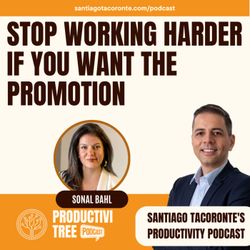
77. Stop Working Harder If You Want The Promotion
46:58||Season 3, Ep. 77Career strategist Sonal Bahl, who has screened 250,000 resumes as a former HR Director at GE and PwC, breaks down why high performers get passed over for promotions and shares the Candy, Vitamin, Painkiller framework for career positioning that actually gets you seen.Key topicsCareer transition from corporate to entrepreneurshipCommon patterns in high performers who are stuckCandy, Vitamin, Pain Killer positioning modelThe importance of visibility in career advancementStrategic approaches to job search and personal branding💬 Guest Links:Sonal Bahl, Website: https://www.superchargeyourself.com/Sonal Bahl, LinkedIn: https://www.linkedin.com/in/sonalbahl/Sonal Bahl, YouTube: https://www.youtube.com/SuperChargeYourself🤫 How Productive are you Really? Take the Free Productivity Test - https://links.santiagotacoronte.com/Productivity-Assessment🎁 More Free Productivity Tools and Templates - https://links.santiagotacoronte.com/free-productivity-resources📩 Join my Productivity Newsletter - https://links.santiagotacoronte.com/Newsletter