Share
Productivi-Tree: The Human Side of Productivity
The ROI of Kindness: How Being Human Became the Smartest Business Strategy
Ep. 69
•
Key Takeaways
- People don't make decisions rationally -- they make them emotionally, then justify with logic. The best communicators, leaders, and salespeople know this and act accordingly.
- "How you do anything is how you do everything." The way you set up a meeting, a room, or a conversation sends a signal before you say a single word.
- The ROI of kindness is not abstract -- Neal's car dealer case study shows how small acts of generosity (a free oil change, a windshield repair) compounded into a thriving service base of nearly 100 customers and a workforce that wore the company shirt to dinner.
- Short-termism is the enemy. Toyota planned 70 years ahead -- and their recall response left customers more satisfied than before the recall.
- There's a "cynical middle" in most organizations -- the people between the idealistic CEO and the enthusiastic new hires. Neal's mission is to remind them: you don't have to be an a-hole to get ahead.
- Human beings survived because of cooperation, not individual dominance. Teams that finish aren't always the fastest -- they're the most cohesive.
Neal Foard -- nealfoard.com Storyfire (Neal's company) -- storyfire.net Email -- neal@storyfire.net TikTok, YouTube, LinkedIn, Instagram -- search "Neal Foard" TED Talk -- "The ROI of Kindness"
Chapters
00:00 The Emotional Architecture of Advertising
05:33 Redefining Success in Business
09:23 Teaching Creativity and Selling Ideas
17:38 The ROI of Kindness in Business
27:24 Short-Termism vs. Long-Term Values
34:18 Countering Social Media Rage with Kindness
41:16 The Power of Cooperation in Business
- More Productivity resources at https://santiagotacoronte.com/productivity-tips/
- Become a Guest: info@santiagotacoronte.com
More episodes
View all episodes
77. Stop Working Harder If You Want The Promotion
46:58||Season 3, Ep. 77Career strategist Sonal Bahl, who has screened 250,000 resumes as a former HR Director at GE and PwC, breaks down why high performers get passed over for promotions and shares the Candy, Vitamin, Painkiller framework for career positioning that actually gets you seen.Key topicsCareer transition from corporate to entrepreneurshipCommon patterns in high performers who are stuckCandy, Vitamin, Pain Killer positioning modelThe importance of visibility in career advancementStrategic approaches to job search and personal branding💬 Guest Links:Sonal Bahl, Website: https://www.superchargeyourself.com/Sonal Bahl, LinkedIn: https://www.linkedin.com/in/sonalbahl/Sonal Bahl, YouTube: https://www.youtube.com/SuperChargeYourself🤫 How Productive are you Really? Take the Free Productivity Test - https://links.santiagotacoronte.com/Productivity-Assessment🎁 More Free Productivity Tools and Templates - https://links.santiagotacoronte.com/free-productivity-resources📩 Join my Productivity Newsletter - https://links.santiagotacoronte.com/Newsletter
76. Your Resume Has 18 Months Left, with Sameer Ranjan
46:13||Season 3, Ep. 76Sameer Ranjan holds a US patent for an AI platform that measures the nine soft skills your resume never shows. He gives the resume about eighteen months before it becomes obsolete for most white collar roles.He started as a mining engineer, graduated top of his class, worked a thousand feet underground with five hundred people under him, then walked away from the field entirely. Today he is CTO and co-founder of Catenate Corp and founder of Cognitive Sprints AI Labs.In this conversation we get into why companies hire for job skills and lose people over soft skills, why an AI interview cannot do the one thing an interview exists to do, and why hiring managers get measurably worse at reading people after 1pm.What we cover:Why nobody has ever survived twenty years at a company for being a great coderThe three failure points in how companies select people todaySympathy versus empathy, and why the difference kills AI interviewingHow MayaMaya builds a digital twin from behavioural data over timePersonality drift as an early warning system for burnoutWhere the privacy line sits, and who owns the dataHow to audit your own soft skills this week without any platformWhich soft skills map to healthcare, IT and salesWhy the resume has eighteen months left, and what replaces itWhat organisations get wrong about measuring productivityChapters:0:00 Hired on day one for skills, kept for years for personality0:47 Who Sameer Ranjan is1:58 From mining engineer to AI founder3:58 What boardrooms decide vs what actually happens7:37 People, process, technology: why hiring broke10:18 Where companies get hiring wrong12:58 Inside MayaMaya14:57 Why adults are as confused as students17:28 Can hiring managers actually read people?18:52 Tracking personality over time and catching burnout21:05 The privacy line22:42 Beyond employee surveys25:49 How to audit your own soft skills28:21 Which soft skills fit which industry32:41 Will resumes disappear?35:25 What organizations get wrong about productivity39:21 Quickfire round41:15 Cognitive Sprints, MiraMira and money as a personalityGuest links:Sameer Ranjan on LinkedIn: https://www.linkedin.com/in/sameerranjan009/MayaMaya: https://mayamaya.us/Catenate Corp: https://catenate.io/Cognitive Sprints AI Labs: https://www.cognitive-sprints.in/ailabsResources from Santiago:Free Productivity Assessment: https://links.santiagotacoronte.com/Productivity-AssessmentFree productivity tools and templates: https://links.santiagotacoronte.com/free-productivity-resourcesProductivity newsletter: https://links.santiagotacoronte.com/NewsletterWebsite: https://santiagotacoronte.com/
75. The Wisdom Gap: Why AI Gives You Information But Not the Answer
44:17||Season 2, Ep. 75AI has made information cheap, but wisdom is more expensive than ever. Andrew Winton, CMO at Digital Advisory and creator of BOOM Marketing, explains why executives confuse the two, what governed advisory looks like next to a consulting deck, and why senior leaders are building portfolios instead of climbing one ladder.Guest LinksAndrew Winton - LinkedIn: https://www.linkedin.com/in/globalmarketingleaderDigital Advisory: https://www.digitaladvisory.comBOOM Marketing (Qosmos): https://boom.qosmos.ai
74. Why Smart People Have a Thinking Gap (And How to Close It)
53:11||Season 2, Ep. 74Most productivity advice focuses on improving your output, but it often misses the source of real progress: the quality of your thinking. Michael Lukich, analytics executive, former Georgetown professor, and author of "The Stoic Systems Thinker," argues that the real leverage is upstream. In this episode, he explores the modern thinking crisis, the DSRP framework, fluid versus crystallized intelligence, and why Stoicism and systems thinking may be the same discipline, separated by 2,000 years.Guest linksBook, The Stoic Systems Thinker: https://www.stoicsystemsthinker.com/bookLinkedIn: https://www.linkedin.com/in/lukich/X/Twitter: https://x.com/michaellukichSolver School, Poker and Analytics: https://www.youtube.com/c/solverschool
73. The Real Reason You Don't Finish What You Start | Adam Tilove | EP73
52:57||Season 2, Ep. 73Adam Tilove spent decades watching brilliant ideas die before they became anything real. In this episode, he breaks down why initiating tasks is harder than doing them, names the six emotional "F-loads" that make you take the off-ramp before you even know it, and explains how irrevocable action and embracing ugly work can finally close the gap between idea and execution. He also shares what a second-grade report card from 1980 taught him about his own ADHD, and why he doesn't believe the superpower framing.💬 Guest Links:Website - neurodiscipline.com Book: Split Second (available on Amazon) Email: adam@neurodiscipline.com🤫 How Productive are you Really? Take the Free Productivity Test - https://links.santiagotacoronte.com/Productivity-Assessment 🎁 More Free Productivity Tools and Templates - https://links.santiagotacoronte.com/free-productivity-resources 📩 Join my Productivity Newsletter - https://links.santiagotacoronte.com/Newsletter🤝 Let's Connect: LinkedIn: https://www.linkedin.com/in/santiago-tacoronte/ X (Twitter): https://x.com/TacoronteSanti
72. Podcasts as a Productivity Tool, and How to Become a Guest
38:54||Season 2, Ep. 72Noémi Beres, founder of Podcast Connections, breaks down two sides of podcasting most professionals ignore. First: how to use podcast listening as a genuine productivity advantage -- learning faster, matching content to activity, and building better habits around audio. Second: how to become a podcast guest, write pitches that land, handle imposter syndrome, and turn a single interview into long-term business relationships. If you consume podcasts passively or have been sitting on the idea of getting on the other side of the mic, this episode is for you.Noémi on LinkedIn: search "Noémi Beres" (look for the microphone icon next to the name)https://www.podcastconnections.co
71. Wellness Washing: Why Your Company's Wellbeing Programme Is Making Burnout Worse
56:44||Season 2, Ep. 71Your company has a meditation app, a mental health awareness poster, and maybe a yoga class at lunch. And yet people are burning out faster than ever. Jody Brooks calls this wellness washing: performing wellbeing without changing the structural conditions that actually cause burnout. In this episode, he shares the Nine Principles of Authentic Living, built from his own journey through severe anxiety, depression, and suicidal thinking, and explains what real wellbeing in the workplace actually requires.🤫 How Productive are you Really? Take the Free Productivity Test - https://links.santiagotacoronte.com/Productivity-Assessment🎁 More Free Productivity Tools and Templates - https://links.santiagotacoronte.com/free-productivity-resources📩 Join my Productivity Newsletter - https://links.santiagotacoronte.com/Newsletter💬 Guest Links:Jody Brooks - https://authenticcoaching.me/LinkedIn - https://www.linkedin.com/in/jody-brooks-coach/Instagram - https://www.instagram.com/the_authenticcoach/⏰ Time Stamps:0:00 Intro -- Jody's story: successful on the outside, breaking on the inside2:15 The moment it broke: crying in a toilet cubicle3:30 The slow erosion: how burnout builds before you name it5:15 What is wellness washing? The car wash analogy7:00 Real examples: apps, yoga classes, mental health first aiders9:00 Why yoga classes polarize instead of help10:30 HR's impossible position: gatekeepers, not guardians12:50 Are HR departments doomed by short-termism?15:00 What it actually costs companies: sickness, turnover, hidden losses19:10 UK burnout stats: 91% experience extreme stress every year21:10 The Nine Principles of Authentic Living -- all 9 explained31:35 Psychological safety: what companies get wrong34:00 Ownership: personal agency when you can't fix the system38:50 AI and burnout: why output models make it worse42:15 Remote work and the return-to-office debate46:50 What every person needs: to be seen, heard, listened to, and to belong49:20 Quickfire round51:05 How to connect with Jody Brooks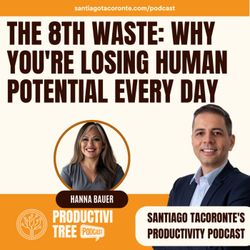
70. The 8th Waste: Why Untapped Human Potential Is Your Biggest Productivity Problem
46:02||Season 2, Ep. 70Hanna Bauer, Lean Six Sigma Black Belt, Baldrige Examiner, and founder of HEARTnomics, makes the case that your workday has the same waste problems as a factory floor, and the most expensive one is untapped human potential. Rigorous, practical, and unexpectedly human.Guest Links- Website: https://heartnomics.com- LinkedIn: https://www.linkedin.com/in/bauerhanna/- HEART Leadership Profile: https://heartnomics.com/discover-your-heart-leadership-profile/