Share

PR in the Real World
The Career Advice Every PR Professional Needs with Steve Dunne
How do you build enough authority to run corporate communications for a major multinational company by your mid-20s? In this episode of PR in the Real World, training expert and PR veteran Steve Dunne shares the exact strategies needed to build a resilient, high-value career in public relations.
Steve Dunne’s career started by accident at age 16 when a corporate aptitude test declared him a hazard to engineering and placed him into the British Telecom press office. Over the next eight years, Steve used keen observation and structural mentorship to fast-track his growth, eventually running corporate comms for the massive brand before directing PR for HSBC and South African Airways. Steve reframes the traditional timeline for career progression, proving that authority in a boardroom relies entirely on professional expertise rather than age.
The conversation explores the rigorous psychological demands of the PR sector, examining why public relations remains one of the toughest, most rejection-heavy industries. Steve outlines the fundamental mechanics of earning client respect, building a reliable media-triage instinct and why strategic practitioners must treat PR as a game of third-party endorsement rather than self-promotion. Whether you are entering an agency role or steering a corporate function, this episode offers a refreshing guide to managing your own career path.
From a PR perspective, this episode covers:
- The Power of Mentorship: Finding a "warm dominant" mentor early in your career to accelerate skill development and build operational confidence.
- Earning Boardroom Authority: Shifting client perception away from age or demographic markers by establishing yourself as an expert with undeniable domain value.
- The Psychology of Rejection: Developing the thick skin and resilience required to handle the daily friction of a high-pressure corporate press office.
- PR as Third-Party Endorsement: Moving client expectations away from simple brand posturing toward trusted external validation.
- Accidental Skill Gathering: Capitalising on early career placement (such as hospital radio) to train an intuitive sense for headlines and spin.
- Strategic Self-Management: Taking direct accountability for your professional development loop rather than waiting for an employer to map it out.
Steve shares a humorous look at his 16-year-old self conducting celebrity interviews for hospital radio at the Royal Free Hospital in North London, a venue right in the middle of historic constituencies held by Margaret Thatcher and Keir Starmer. He also explains why a solid foundation in basic English grammar and clear structural writing is still the ultimate differentiator for starting practitioners on Monday morning.
This episode is relevant for professionals working in:
- Junior PR Account Executives: Looking for tactical steps to transition safely into account management and corporate pitching.
- In-House Communications Teams: Tasked with building trust and credibility alongside sceptical corporate executives and board members.
- PR Agency Founders & Directors: Seeking structured methods for internal talent management and professional mentoring.
- Marketing & Media Students: Looking for a realistic overview of the core competencies that define modern public relations success.
Links and References
- Steve Dunne – Digital Drums: https://www.digitaldrums.co.uk
- Steve Dunne on LinkedIn: https://www.linkedin.com/in/steve-dunne-fprca-a1b527a/
- The PRCA: https://www.prca.global/
- The CIPR: https://www.cipr.co.uk/
- PR in the Real World podcast: https://www.vivapr.co.uk/viva-podcast/
- Viva PR: https://www.vivapr.co.uk
Similar episodes
- 25 Lessons from 25 Years with Graham Goodkind: https://www.vivapr.co.uk/graham-goodkind-on-25-lessons-from-25-years-of-frank-pr/
More episodes
View all episodes

70. Are Timesheets Really Worth It? With Andy West and Darryl Sparey
42:59||Season 1, Ep. 70Can you run a profitable PR agency without timesheets? In our first ever PR in the Real World debate for AMEC Measurement Month, Darryl Sparey of Hard Numbers takes on agency adviser Andy West from West of Center. Darryl calls timesheets a “confection”, whilst Andy argues they are essential management data for spotting over-servicing, planning capacity and knowing when to hire. Expect Plato, Baudrillard, surprising agreement and a question every agency owner should ask: are you growing, or just getting busier?
69. Why Local Papers Are Reaching Readers a Press Release Can't with Carl Hudspith
44:29||Season 1, Ep. 69Carl Hudspith moved from a 19,000-circulation Lancashire paper to press officer at the National Farmers Union, and now runs media relations for the University of Lancashire (formerly UCLan). He talks to Tony Garner about why farmers became better storytellers than the institutions representing them, how local papers and social media now reach readers a press release can’t, and why Clarkson’s Farm succeeded where years of NFU campaigning on bovine TB could not. A conversation on journalism, local news and reputation.
68. Why PR Has Never Managed Its Own PR Well with Victoria Tomlinson
33:02||Season 1, Ep. 68Victoria Tomlinson, founder of Next-Up and former founder of Northern Lights PR, joins Tony Garner on PR in the Real World to explain why PR has never managed its own PR, after thirty years running her own agency. They cover why "we want awareness" is the wrong brief, what owning a target really means for a boardroom seat, how AI is making credibility harder to prove, and the case for rethinking retirement in her new book, Expiry Date Never. Essential listening for PR and comms professionals.Expiry Date Never: Age is the New Superpower - https://expirydatenever.co.uk/ Next-Up - https://www.next-up.com/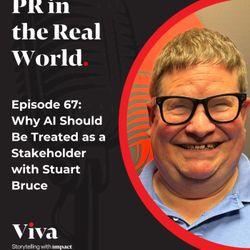
67. Why AI Should Be Treated as a Stakeholder with Stuart Bruce
50:02||Season 1, Ep. 67Stuart Bruce, self-styled PR futurist and joint CEO of Purposeful Relations, joins Tony Garner on PR in the Real World to explain why AI has become the world's biggest reputation management engine. They unpack generative engine optimisation, the three factors shaping AI answers – recency, relevance and reputation – why crisis plans must treat AI as a stakeholder, and the story of helping now-PM Andy Burnham find his social media voice. Essential listening for PR and comms professionals.
66. The Case for PR at the Top Table with CIPR President Farzana Baduel
27:35||Season 1, Ep. 66Why are organisations with talented PR teams still ending up in reputational crisis? Farzana Baduel has the answer, and she sees it play out every week on BBC Radio 4.Farzana - founder of Curzon PR, CIPR president, Oxford Saïd Business School resident PR expert, and co-host of BBC Radio 4's When It Hits the Fan - joins PR in the Real World to explore why this is the most consequential moment in PR's history.She unpacks AI's real impact on the profession, why PR professionals are 'diagonal thinkers' who belong in the boardroom, and why the crises organisations find themselves in are so often avoidable.
65. Why Judgement Beats Data in PR Measurement with Nik Pearson
39:42||Season 1, Ep. 65In this episode of PR in the Real World, Tony Garner talks to Nik Pearson, who leads corporate communications and external affairs across Europe for Honda, about earning a seat at the table in PR. They discuss sharing downside risk, using the AMEC framework and judgement over data in measurement, and building trust across multinational comms teams. Nik also reflects on his move from Toyota dealerships into leadership, and what makes an inclusive, high‑trust culture.
64. Methodology and Mindsets with Shayoni Lynn
45:16||Season 1, Ep. 64Behavioural science is one of the most talked-about, and least understood, areas in PR. Shayoni Lynn, founder of behavioural science consultancy Lynn, joins Tony Garner on PR in the Real World to separate evidence from hype. She explains why diagnosis must come before intervention, how her team's research and randomised control trials shaped Welsh Government's 20mph campaign, and why protecting behaviours matters as much as creating them. Practical advice for teams of any size on building behavioural capability.
63. What Makes a Story Worth Printing with Richard Slater
41:18||Season 1, Ep. 63Richard Slater, founder of Lancashire Business View and the Red Rose Awards, joins Tony Garner on PR in the Real World to reveal what makes journalists bin a PR pitch, why AI-written press releases are instantly spotted, and how to craft a story worth printing. From newsroom instincts to judging a 1,000-strong awards night, Richard shares practical tips on pitching, storytelling, media relations and award entries that PR and marketing professionals can use today.
62. Communicating Complex Ideas Clearly with Alison Ramsay
48:39||Season 1, Ep. 62How do you communicate complexity without losing clarity? In this episode of PR in the Real World, Alison Ramsay, Corporate Communications & Employee Experience Director at AWE, shares lessons from her career in defence communications. Discover why simplifying isn't "dumbing down", how data and employee experience are reshaping internal communications, and why great communicators treat employees like adults, not audiences.