Share
Paul Maleary's Ex-Job Downloaded Podcast
The lives of incredible people who have served
Latest episode

117. Graham Paul Roberts - The Echoes in the Silence:
01:29:33||Ep. 117This podcast summary features the experiences of Graham Roberts, a former member of the Welsh Guards, whose service record and subsequent transition to civilian life offer a raw look at the realities of modern military duty.Military Service and TransitionGraham Paul Roberts served as a soldier in the Welsh Guards. His transition to civilian life was marked by extreme psychological distress, leading him to the brink of suicide. He recounts a harrowing moment where he planned to take his own life in the woods, only to be stopped by a sudden, overwhelming emotional breakdown that resulted in him seeking help instead. He eventually found support through North Wales Veterans and a dedicated medical team, which he credits with saving his life.Candor Regarding Service in KenyaRoberts speaks with significant candor about the trauma he carried from his deployments, specifically highlighting the moral and emotional toll of his time in Kenya.Environmental Trauma: He describes vivid, recurring nightmares involving the faces and bodies and events he witnessed or dealt with during his service.The Weight of Silence: He explains that for years, he "bottled up" the things he had seen, including the smuggling of goods and other "stuff" that he felt unable to discuss with his family or peers.Emotional Detachment: He admits to purposely detaching himself emotionally from his experiences to survive the scenarios he was placed in, a tactic that later contributed to his mental health struggles.The "Bravado" Myth: Roberts is critical of the military "bravado" that prevents soldiers from seeking help, noting that he initially refused medication and support because he wanted to handle it alone.Recovery and ReflectionTo process his trauma, Roberts turned to writing as a form of therapy. His book, "Echoes in the Silence," was written over several months as a way to "explore" the elements of his past that he had previously blocked out. He emphasizes that while medication (such as quetiapine and anti-depressants) helped stabilize him, the act of documenting his experiences was vital to his recovery.#WelshGuards #VeteranMentalHealth #PTSDAwareness #EchoesInTheSilence #MilitaryTransition #KenyaService #VeteransSupport
More episodes
View all episodes

116. Alka Mistry - What life was like in Leicestershire Police for a girl from Kenya
55:11||Ep. 116Early Life and Cultural BackgroundBorn in Kenya in 1969, Alka moved to Leicester as a toddler. Raised in a strict Hindu household, she grew up with defined gender expectations: girls were encouraged to pursue education only as a precursor to arranged marriages within their caste. Despite an early interest in crime and pathology sparked by Agatha Christie novels, Alka initially followed a conventional path, working in insurance for nine years.The Turning Point: Defiance and DutyAlka’s entry into the police was a profound act of personal rebellion and courage. Facing an unwanted arranged marriage to a man living abroad, she chose to break the engagement. This decision, coupled with her desire to join the police—a profession her family deemed unsuitable for a woman—resulted in her being asked to leave her family home and a long-term estrangement from her father, who was himself a traffic warden.In 1997, without knowing where she would live, Alka posted her acceptance to Leicestershire Police.Career Highlights and ChallengesAlka joined the service in 1998, training at Ashford during a time when Asian female officers were a "rarity". Her career spanned several diverse roles:Frontline Policing: She served in rural areas like Ashby and Coalville, where she faced significant racial abuse from the community.Specialized Units: She spent time in the Youth Offending Team, which allowed her to balance work with raising her children.Detective Work: Alka eventually became a detective, working in child abuse investigation, serious and complex crime, and a secondment in Counter Corruption, which she described as her toughest role due to the emotional weight of investigating colleagues.Mutual Aid: Near the end of her career, she assisted in Merseyside following the tragic murders of three children.Legacy and RetirementThroughout her 27-year career, Alka balanced the "heavy lifting" of being a mother, wife, and professional. She remains a staunch believer in meritocracy, refusing to join identity-specific police associations and instead focusing on her skills as an investigator.Upon retiring, she transitioned into her "second vocation": sports safeguarding. She currently works with the Leicester City Football Club Academy, aligning her professional expertise with her lifelong passion for sport. Despite the personal sacrifices, Alka maintains that she would do it all again "100%"The Story & Inspiration#BreakingBarriers#CulturalIdentity#ResilienceStory#WomenWhoInspire#PersonalGrowth#OvercomingObstacles#CourageousConversations#TrailblazerPolice & Detective Life#PolicePodcast#ThinBlueLineUK#DetectiveWork#WomenInPolicing#LeicestershirePolice#LawEnforcement#TrueCrimeCommunity#BehindTheBadgeCulture & Representation#SouthAsianExcellence#BritishAsian#RepresentationMatters#Leicester#ShatteringGlassCeilings#EmpoweredWomenCareer & Transition#CareerPivot#SportsSafeguarding#LCFC#SecondAct#ProfessionalDevelopment#WorkingMomsNiche & Catchy#FromPatrolToPitch#DefyingExpectations#DetectiveAlka#PodcastSpotlight
115. Janet Percival - Who is Alex Belfield? Part 2
41:39||Ep. 115Alex Belfield is a former radio presenter for BBC Radio Leeds who was dismissed for misconduct. He was convicted of stalking charges in September 2022 and imprisoned.Belfield worked at Mansfield 103.2 FM in the early 2000s. He presented the mid-morning show on BBC Radio Leeds. In 2010 he made lewd comments about weather presenter Keeley Donovan's broadcasts at home that resulted in complaints from listeners. As punishment, Belfield was suspended from the station for a day and strongly reprimanded by BBC bosses.On 18 June 2021 Belfield was summonsed to appear at Nottingham Magistrates' Court, where he was charged with 12 counts of stalking "involving fear of violence or serious alarm or distress" on 1 July.On 29 July 2021, Belfield appeared at Nottingham Crown Court accused of stalking eight people between November 2012 and March 2021, including BBC staff members Stephanie Hirst and Jeremy Vine.Belfield was convicted in September 2022 for four of eight stalking charges at Nottingham Crown Court. He was sentenced to five and a half years in prison; before sentencing "he was allowed to deliver a closing speech deriding the case as a 'BBC and police witch-hunt' based on five arrests and 3 invasions of his home, without a warrant and any evidence of any crime, and describing himself as 'the No 1 anti-BBC journalist'". He told the jury "I am offensive... My human right allows me to speak words that are not to everyone's taste". The judge said that while Belfield acknowledged the distress he caused the victims, he showed more concern during the proceedings about being treated unfairly and how the process impacted him (Belfield) personally. A bid for leave to appeal was refused in February 2023.In May 2024, the Nottinghamshire police detective who had led the stalking investigation into Belfield won a libel case against him. Belfield had falsely accused the detective of being corrupt, lying in court and colluding with the BBC in a witch hunt against him.Belfield was released from prison in June 2025, after 2 years and 9 months. He will serve the remainder of his sentence on licence.Janet has her own channel on Ticktok#AlexBelfield#StalkingInvestigator#CriminalConviction#TrueCrime#JusticeServed#CrimeDocumentary#CyberStalkingAwareness#LegalSystemInsights#PrisonSentence#VictimAdvocacy#InvestigativeJournalism#CrimeNewsUpdate#SocialMediaSafety#CourtCaseAnalysis#PublicInterestStory
114. Janet Percival - is 38 too old to join the police Part 1
42:08||Ep. 114"Janet always wanted to be a police officer. Growing up, she would sit beside her uncle, who had been chief constable, listening intently to his tales of the job—stories filled with bravery, camaraderie, and the occasional humour that only those in law enforcement could appreciate. The desire to don the uniform and protect her community coursed through her veins. However, when she turned 18 and applied for the Surrey Police, she faced disappointment as she failed the selection process. Undeterred, she joined the special constabulary in Nottinghamshire, where she learned the ropes of policing, even though the ongoing failures in her applications for the regular service felt like a persistent shadow looming over her aspirations.It was during a heartfelt conversation with her brother that the spark of hope reignited. He informed her that Sussex Police were seeking recruits. The excitement bubbled up inside her as she envisioned herself wearing the badge she so dearly coveted. In 2003, after rigorous training and determination, she finally passed the fitness test. Her first posting at Brighton was a blend of nostalgia and novelty, where she was immersed in old-school processes—making tea for her colleagues as a rite of passage before stepping into a police car. Each sip of that tea felt like a connection to those stories from her uncle, a small reminder of where she came from and the journey ahead.Yet, as she transferred to Nottinghamshire, the reality hit hard. The stark contrast between her experiences in Brighton and Nottinghamshire was shocking. The lack of staff and resources forced her into situations where she had to rely solely on her instincts and skills. Unlike Brighton, where support was always a radio call away, here she had to navigate the challenges independently. It was a steep learning curve, but Janet was resolute. With grit, she took her detective exams, transforming her into a competent investigator. Each case was not just a job but a puzzle she was determined to solve—a testament to her dedication.Despite the challenges, Janet’s transition to Nottinghamshire often felt like a backward step. The outdated practices she encountered were immensely frustrating. While Sussex embraced modern techniques, Nottinghamshire seemed entrenched in the past, making her feel out of place. She often reflected on how different things could be, fuelling her drive to advocate for change in policing methods.As she tackled high-profile cases that captured public attention, including one notorious suspect who received a staggering 32-year prison sentence , Janet found her true calling. It was a particular case involving stalkers that struck a chord with her. Drawing on her empathy and understanding, she successfully obtained the first non-domestic stalking protection notice in the UK. It was a landmark achievement that made headlines, but she was not just a figurehead; she was deeply involved, reviewing investigations meticulously. Her recommendations led to actionable outcomes that resulted in prosecutions, giving a voice to victims who often felt powerless. Each successful case reinforced Janet’s commitment to ensuring justice, leaving an indelible mark on her career and the community she served.
113. Ross Wolf- Are Orange County Sheriffs Reserve The Best In Florida?
44:58||Ep. 113Are Orange County Sheriffs the best in Florida? Explore everything you wanted to know about policing in the Sunshine State!Meet Ross, a passionate professor of criminal justice at the University of Central Florida in Orlando. Not only is he dedicated to educating the future leaders of law enforcement, but he also serves as the dean of the College of Innovation and Education, encompassing disciplines like Criminal Justice, Legal Studies, and Police Administration. Ross’s journey into the world of law enforcement began unexpectedly, sparked by a simple yet transformative suggestion from a friend who was a deputy sheriff in Orange County."You have to experience it for yourself," she urged, and thus began Ross's adventure. He joined her on a ride-along, filled with excitement and a hint of trepidation. As the patrol car cruised through the vibrant neighborhoods of Orange County, Ross felt a rush of adrenaline each time they responded to a call. He became hooked on the thrill of policing, leading him to undertake an auxiliary deputy training course. However, the dynamics of the precinct—filled with camaraderie, challenges, and community service—only fueled his desire to dive deeper into the badge-wearing world.Initially feeling unfulfilled in his full-time role, Ross made a pivotal decision to join the Orange County Sheriff's Office as a regular deputy. His journey transformed him from a patrolman into a road policing officer, and eventually, a detective on a specialized stolen vehicle squad. Each day brought a new set of challenges and the opportunity to make a tangible difference in the community. While balancing work with his academic aspirations, Ross pursued a doctorate, demonstrating an unyielding commitment to both education and public service. Once he completed this significant milestone, he recognized that a better work-life balance awaited him as a reservist.When Ross first donned the uniform of the Orange County Sheriff, he was met with the vastness of his jurisdiction—900 square miles filled with urban settings, suburban neighborhoods, and sprawling natural landscapes. This expansive area is patrolled by over 1,600 law enforcement officers, not counting those from individual cities and federal agencies. Ross recalls the sense of responsibility that enveloped him as he realized the sheer scale of policing in Florida. He vividly remembers one late night when he attended a call that involved a large community gathering. The energy was palpable, and he felt honored to be part of a team ensuring the safety of so many.The complexities of policing in Florida often weigh heavily on the shoulders of officers, especially reservists like Ross, who can perform any role that regular officers tackle, provided they possess the appropriate training. Yet, he acknowledges that the commitment to specialist units can be rigorous and demanding. "If you serve as a reservist for 20 years, you can choose your role," Ross explains, emphasizing the dedication and perseverance required in law enforcement.Training also plays a crucial role in police work, particularly when it comes to firearms. Ross remarks on the stark contrast between the exposure to firearms in Florida compared to the UK, where he often shares his experiences with students. He recalls the tragic shooting at the Pulse Nightclub on June 12, 2016, where 49 lives were lost, and 53 were injured. It was a stark reminder of the dangers officers face daily. Reserve officers were on the scene, and the gravity of that night shaped their resolve to protect and serve the community.Beyond the routine patrols and high-stakes situations, Ross highlights the unique opportunities that reservists have to earn while engaging in community events, such as providing support at Disney World.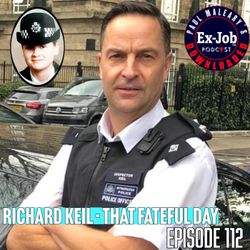
112. Richard Keil - I was with Nina when she was murdered
01:26:25||Ep. 112This podcast contains graphic content relating to the death of Nina Mackay, a tragic event that has left a profound impact on the community.Richard Keil, a determined individual from South Woodham Ferrers, initially faced disappointment when his application to join a public service course at Chelmsford College was rejected. Yet, destiny had other plans for him. Encouraged by his sister, who was dating a Met Police Cadet, Richard decided to take a leap of faith and apply to join the cadets himself. This time, fortune smiled upon him, and he was accepted. His journey began in the heart of the community; Richard found himself immersed in the lives of others as he worked at a local boy’s club and at Plaistow Hospital, where he acted as a bingo caller for elderly residents. The laughter and joy he brought to those faces revealed the power of connection and compassion in everyday life.Upon joining the regular service, Richard was stationed at Leeman Street, navigating through some of the most iconic parts of the East End of London. He patrolled areas that had once been terrorized by Jack the Ripper, feeling the weight of history on his shoulders. Each day brought new challenges, as he learned the intricacies of policing amid the bustling streets that had seen both love and loss. The pulse of the city resonated in his every step, and he was continually deployed alongside his colleagues, each of whom became a vital part of his evolving narrative.After a few years, Richard made the transition to the Territorial Support Group (TSG), where he encountered a colourful cast of characters who imparted invaluable lessons about the art of policing. These experiences shaped his identity as an officer, nurturing a deep respect for the complexities of human behaviour in the face of adversity. The camaraderie he shared with his colleagues fostered an environment of mutual support, allowing them to face the challenges of policing together.His policing life changed on 24th October 1997. Richard was part of the team who was deployed to arrest a suspect in East London during this arrest Nina Mackay was fatally stabbed by the suspect. As Richard concluded his time on the TSG, he transitioned to the surveillance team, honing his skills in targeting criminals who roamed the metropolis. The thrill of the chase was palpable, but it was his eventual move to the armed surveillance team that marked a significant turning point in his career. Here, he faced the stark realities of high-level crime and terrorist activity, a world where split-second decisions could mean the difference between life and death. He vividly recalls his first day as a plain-clothes armed officer; it was a surreal experience, filled with tension and excitement, forever etched in his memory.In 2008, Richard's dedication and hard work paid off when he was promoted to Sergeant and assigned to Paddington. Two years later, he ascended to the rank of Inspector and took up his post in Ealing. With each promotion, his commitment to maintaining police standards deepened, especially regarding the controversial yet necessary practice of stop-and-search. Richard believed that empowering officers to value their position was crucial not just for effective policing, but for building trust within the community. His journey illustrates the resilience and dedication of those who serve, a testament to the spirit of the Metropolitan Police and the complexities of modern policing.#policingjourney #communityfirst #serveandprotect #londonpolice #NinaMackay #dedicationtojustice #policingwithheart #eastlondonstories
111. Tony Long - Controversial Police Marksman - Part 3
58:18||Ep. 111