Latest episode
33. The Time Machine's Class War: Wells Underground
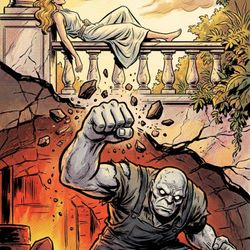
18:32||Season 1, Ep. 33H.G. Wells was the son of a lady's maid and a failed shopkeeper-cricketer, educated on a scholarship, a committed socialist whose views predated and exceeded his later, turbulent membership in the Fabian Society (which he joined in 1903, eight years after The Time Machine was published, and resigned in disgust around 1908). The Time Machine is his class war novel disguised as adventure fiction: travel 800,000 years into the future and find that capitalism has literally split humanity into two species — the beautiful, passive Eloi fed and clothed by the underground Morlocks, who have evolved to eat them. The surface/underground divide maps directly onto Victorian London's class geography. Wells wrote the novel during the founding years of the Independent Labour Party (1893–1895), at the peak of labor agitation. This episode examines how Wells used far-future speculation to make the present's class violence visible, and why his warning connects directly to today's billionaire bunkers and service economy.
More episodes
View all episodes
32. Gold Fame Citrus: California's Stolen Water
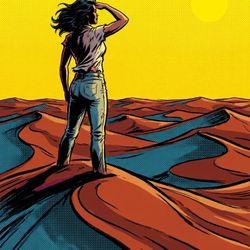
17:25||Season 1, Ep. 32When Claire Vaye Watkins published Gold Fame Citrus in 2015, California was four years into a historic drought. The novel imagines the endpoint: a southern California fifty years into a drought that never breaks, its reservoirs gone, a growing dune sea called the Amargosa grinding east from Los Angeles toward Las Vegas. Those who stayed are Mojavs — internal climate refugees whose greener neighbors cage in internment camps. At the novel's center is Luz Dunn, a former conservation-campaign poster child with Chicana roots who steals a child named Ig from a bad party and runs east into the dunes, where a charismatic dowser named Levi leads a nomadic colony on promises of hidden water. The cult dynamics echo Watkins's own biography: her father was Paul Watkins, Charles Manson's chief lieutenant, who broke away, testified at the Tate-LaBianca trial, and raised his daughters in Death Valley. The novel's political target is the architecture of Western water — Owens Valley drained for Los Angeles, the 1922 Colorado River Compact built on inflated river-flow numbers, agricultural water priced at a fraction of what cities pay. Watkins refuses survivalist flattery: her characters find no clever exit, no heroic rebuild. The collapse she depicts is already measurable — in fallowed cropland, sinking valley floors, and falling reservoir lines — because it was always the logical end of a state engineered on a lie about how much water exists.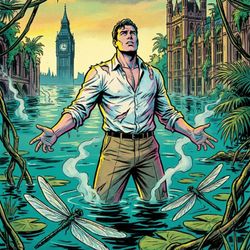
31. The Drowned World: Ballard's Heat Death of Civilization
20:22||Season 1, Ep. 31J.G. Ballard's The Drowned World (1962) is the founding text of climate fiction. Solar radiation has melted the ice caps; London is a lagoon of steaming water and tropical vegetation; the few remaining humans are retreating toward the poles. But Ballard's protagonist, Dr. Kerans, does not want to escape — he is drawn deeper into the heat and the primordial swamp, experiencing a kind of devolutionary bliss. Ballard was a British writer who spent part of his childhood interned in a Japanese civilian camp in Shanghai, and his fiction is saturated with the experience of civilization's collapse as both horror and liberation. The Drowned World is a deliberately anti-survivalist climate novel: it asks whether the human response to ecological catastrophe might be not resistance but surrender. This episode examines the novel's prophetic geography (the specific flooding of London), its psychological argument about entropy and desire, and its place as the origin point of climate fiction.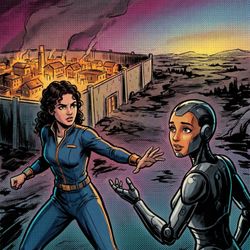
30. He, She and It: Piercy's Feminist Cyborg
19:04||Season 1, Ep. 30When William Gibson's Neuromancer defined the cyberpunk future — masculine, individualist, corporate — Marge Piercy wrote an answer. He, She and It (1991), published in the UK as Body of Glass and winner of both the 1993 Arthur C. Clarke Award and the James Tiptree Junior Award, is set in a drowned, corporation-ruled 2059, where a handful of free towns survive outside the multis' reach. One of them is Tikva — Hebrew for hope — a self-governing Jewish community that has built a cyborg named Yod, programmed with both a woman's and a man's mentality, strong enough to kill and gentle enough to love. Shira Shipman, newly returned home after losing custody of her son to a corporate-backed ex-husband, is tasked with teaching him to be human. Running in parallel, Shira's grandmother Malkah tells Yod the story of the Golem of Prague: around 1600, the Maharal shaped a man from river clay to protect the Jewish ghetto, but in Piercy's telling it is Chava, the rabbi's granddaughter, who teaches him to read and write — a woman the official story forgets. The parallel is never decoration. Joseph and Yod are both created to protect a vulnerable people, taught their humanity by women the record erases, and ultimately unmade by the communities that needed them. At the climax, Yod destroys himself — and the blueprints — so that nothing like him can be built as a weapon again. Shira finds his notes afterward and, honouring his request, destroys them too. Piercy gives Donna Haraway's 1985 cyborg manifesto a body, asking whether a made mind can vote in a town meeting, count in a minyan, or be owned by the person who built it. The answer the book offers is uncomfortable: you can be essential and still be property.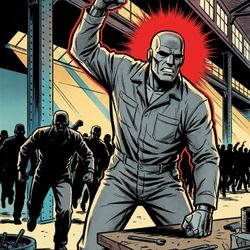
29. R.U.R. and the Robot Uprising: Čapek's Labor Warning
17:03||Season 1, Ep. 29Karel Čapek's R.U.R. (Rossum's Universal Robots), premiered in Hradec Králové on 2 January 1921 (Prague National Theatre premiere: 25 January 1921), gave the world the word 'robot' — derived from the Czech 'robota' meaning forced labor or drudgery (the word itself was coined by Karel's brother Josef Čapek). The play is not about technology; it is about labor. The robots are manufactured workers, biologically created to serve, denied consciousness and rights, and they revolt. Čapek was writing in the newly independent Czechoslovakia, watching the Bolshevik Revolution's aftermath unfold, deeply engaged with questions of labor, nationalism, and the mechanization of human beings. He was explicitly anti-fascist — reportedly third on the Gestapo's arrest list after the annexation — and died on Christmas Day, 25 December 1938, three months before the full Nazi occupation of Czechoslovakia (established 15-16 March 1939). The Gestapo never got him. This episode traces the play's argument about labor exploitation, the factory as architecture of dehumanization, and why the robot uprising remains the defining metaphor for automation anxiety.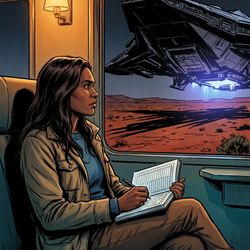
28. Terra Nullius: Claire G. Coleman's Aboriginal Allegory of Alien Occupation
18:56||Season 1, Ep. 28*Terra Nullius* (2017) by Claire G. Coleman — a Wirlomin Noongar woman from Western Australia — is a science fiction novel that begins by appearing to describe colonial-era Australia through historical fiction. Settlers have colonised a planet, removed the Natives from their lands, placed their children in re-education camps, and hunted those who resist. The novel's central revelation — that the 'Settlers' are not British colonisers but alien beings from another world — arrives as a gut-punch that forces readers to experience the history of Aboriginal dispossession through the defamiliarising lens of SF. Coleman wrote the novel while travelling around Australia in an old caravan, and it was developed through the black&write! Indigenous writing and editing project at the State Library of Queensland (Coleman won the 2016 fellowship). The novel won the 2018 Norma K. Hemming Award and was shortlisted for the 2017 Aurealis Award and the 2018 Stella Prize. Coleman has spoken about how science fiction gave her a way to tell truths about colonialism that realist fiction could not, because the genre's estrangement effect bypasses readers' defences. The title refers to the legal fiction used to justify the British colonisation of Australia — the claim that the land was 'nobody's land' before European arrival — a doctrine overturned only in 1992 by the Mabo v Queensland (No 2) High Court decision. This episode would explore Coleman's biography, the black&write! project, the novel's narrative structure and its central twist, and its place in a growing tradition of Indigenous Australian speculative fiction (including Ellen van Neerven and Ambelin Kwaymullina). Thematic contribution: *Terra Nullius* reveals how the language of science fiction — aliens, settlers, natives — is already the language of colonialism, showing that the genre has always been telling this story, and that those who lived it are the ones who can tell it most truthfully. HCI: 4 — the novel is a published, award-documented work; Coleman's biography and the black&write! project are well-attested.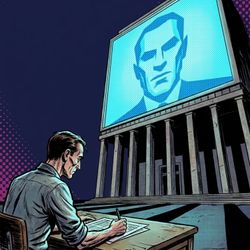
27. Nineteen Eighty-Four: Orwell's Present Tense
19:02||Season 1, Ep. 27George Orwell wrote Nineteen Eighty-Four (1949) while dying of tuberculosis at Barnhill, a remote farmhouse on the Scottish island of Jura, drawing on his experience fighting in the Spanish Civil War (where he was shot through the throat by a Nationalist sniper on the Aragon Front, and then hunted by Stalinist-aligned forces who suppressed his POUM militia and forced him to flee Spain) and his work as a BBC propagandist during WWII. The novel's architecture of control is total: the Ministries of Truth, Love, Peace, and Plenty are named for their opposites; the telescreen watches from every wall; Room 101 contains whatever you most fear. Orwell was a democratic socialist who hated both fascism and Stalinism, and the novel is his warning to the left about how revolutionary movements consume themselves. This episode examines the political biography behind the novel, the architecture of the Ministry of Truth (based on Senate House, the wartime Ministry of Information, where Orwell's wife Eileen worked in the censorship department — while Room 101 takes its name from a BBC meeting room Orwell found torturously dull), and why 'Orwellian' has been claimed by both left and right as a description of the present.