Share
Open City
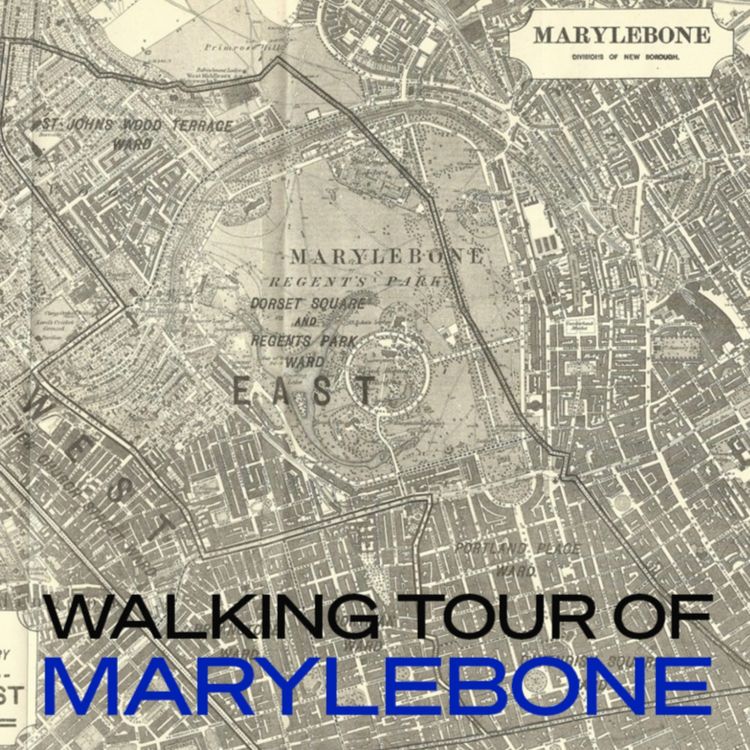
Audio Walking Tour of Marylebone
Listen to Open City’s on-demand audio tour of Marylebone, one of central London’s most attractive and atmospheric neighbourhoods and home to The Howard de Walden Estate.
This fun and engaging audio walking tour led by expert guide Mike Althorpe — an urban historian, architectural researcher, educator and storyteller — follows the route of our popular real-life tour exploring the architecture and history of this urban village.
Listening point 1: St Marylebone Parish Church
1817 landmark by architect Thomas Hardwick in a grand classical style. It is the fourth such building to serve the parish of Marylebone and symbolic of early 19th century urban changes.
Listening point 2: Devonshire Street
Development of Portland Estate summary close to fine examples of 18th century streets and speculative building pattern and site of old Marylebone Gardens - a popular rural entertainment spot.
Listening point 3: Marylebone High Street
Home to Marylebone Village. It started life as a rural lane between the highway of Oxford Street and the Manor House. In recent decades carefully curation by The Haward de Walden Estate has created a retail destination with genuine balance and character. – unlike so many other cookie cutter high streets.
Listening point 4: Grotto Passage
Behind the scenes Grotto Ragged and Industrial School opened in 1846 and Ossington Estate model dwellings1888 and 1892 - landmarks of the urban diversity of the area and shifting pattern of living.
Listening point 5: Paddington Street Gardens
Historic 1880s landscaped gardens and former site of 18th century Marylebone workhouse - important story of urban change on the edge of the historic estate and life of the parish
Listening point 6: Manchester Square
Landmark square developed with Hertford House in the 1760s, home to international Wallace collection since 1900. Former site of EMI offices and iconic Beatles photo shoot
Listening point 7: Hinde & Mandeville Streets
Landmark neoclassical Hinde Street Methodist church 1887 by James Weir created in aftermath of impressive 1870s urban clearance projects in French renaissance style at bottom of high street
Listening point 8: Scheon Clinic
Landmark new development with hidden depths on site of former ironworks with sculpture marking gateway to Marylebone High Street from south.
Listening point 9: Debenhams & Wigmore Hall
Colossal department store designed by architects William Wallace and James Gibson in 1907 in an grandiose Edwardian Baroque style and covered in dolton carrara ceramics. And celebrated 1901 concert venue by Thomas Edward Colcutt.
Listening point 10: Henrietta Place
Former private estate chapel of St Peters, 1724 by James Gibbs and nearby Royal Society of Medicine.
Listening point 11: Cavendish Square
First move of the historic Portland estate in 1719, mixed fortunes landmark architectural set pieces, sculpture and new development as part of public realm enhancements.
Listening point 12: Chandos House
Speculatively landmark house built between 1769 - 1761 by Robert Adam, the most prominent architect in Georgian Britain. Rare London house in Edinburgh quarried stone.
Listening point 13: Harley Street
The Harley Street Medical Area (HSMA) is a community of Marylebone-based hospitals, clinics and specialists, renowned for their outstanding patient care, pioneering treatments and use of cutting-edge technologies. – The Centre of which is Harley Street which was first laid out in 1729.
Listening point 14: Portland Place
Landmark urban space laid out by the brothers Robert and James Adam as part of second wave of historic Portland estate surviving terraces of 1780s, transformed in 1820s as part of Nash’s royal route, remade in 1930s with apartments and office. RIBA Landmark at heart of space subject to proposals to change.
More episodes
View all episodes
Deconstructed: Vanbrugh Castle - Crenellations in Greenwich
30:19|In this episode, Matthew Lloyd Roberts is joined by the architect Piers Gough, co-founder of CZWG and a major figure in post-modern British architecture. They discussed Vanbrugh Castle, one of the few surviving buildings in London designed by John Vanbrugh, a hugely important English baroque architect, whose tercentenary is being celebrated this year #Vanbrugh300. The ‘Castle’ itself is a curious and precocious piece of medieval revival architecture, built by Vanbrugh towards the end of his life in 1719 alongside a compound of small buildings on the edge of Greenwich for his extended family. Piers suggests the connections between Vanbrugh’s approach to architectural language and the post-modern architecture pursued in his own practice. For more information about John Vanbrugh, check out: https://www.vanbrugh300.co.uk/
Deconstructed: The BBC Television Centre - Broadcasting to a Nation
29:37|In this episode, Matthew Lloyd Roberts is joined by Samira Ahmed, journalist, broadcaster, presenter and President of C20, to discuss the BBC Television Centre. Opened in 1960 in White City, the building became one of the most recognisable homes of British broadcasting, where countless television programmes were made and transmitted for over half a century. In this episode, we explored the history and architecture of the Television Centre, its place in Britain's cultural imagination, and what its transformation tells us about the changing role of the BBC and public broadcasting.Subscribe to the Open City Podcast on Spotify, Soundcloud or iTunesThe Open City Podcast is supported by Bloomberg Connects, the free arts and culture platform and produced in association with the Architects’ Journal, London Society, C20 Society and Save Britain's Heritage.The Open City Podcast is recorded and produced at the Open City offices located in Bureau. Bureau is a co-working space for creatives offering a new approach to membership workspace. Bureau prioritises not just room to think and do, but also shared resources and space to collaborate.
Deconstructed: Leighton House - Art and Orientalism
30:48|In this episode Matthew Lloyd Roberts was joined by Hannah Lund, Curator of Exhibitions and Displays at Leighton House and Sambourne House. Leighton House was built in Kensington by the Frederic Leighton, a painter, sculptor and president of the Royal Academy famed during the reign of Queen Victoria who vanished into relative obscurity during the 20th century. His house was an important place to create and exhibit his paintings, with a double height studio lit by north facing windows for the vast canvasses on which he worked. Fascinated by the material culture of the Islamic world, he created his ‘Arab Hall’, tiling a domed extension to his house with West Asian ceramics gathered on a trip to Damascus. In this episode we discussed Leighton House, Victorian interest in Arabian culture, and the new curatorial interventions being made this year to mark the centenary of the house as a public museum run by the local authority, with new commissions from artists which query the meaning of such spaces their original context and to us today.The podcast is produced in association with the Architects’ Journal, London Society, C20 Society and Save Britain's Heritage. It's recorded and produced at the Open City offices located in Bureau. Subscribe on Spotify, Soundcloud or iTunes and to further support, become an Open City Friend.
Deconstructed: Grosvenor Square - Protest and the State
30:48|In this episode Matthew Lloyd Roberts was joined by the historian Katrina Navickas to discuss the history of Grosvenor Square in Mayfair as a site of protest and policing. From the early twentieth century the square was home to the US Embassy, and it was the site of several protests against American foreign policy, most notably the Vietnam War in 1968. The policing of the Vietnam Solidarity Campaign led to the first CCTV system in the UK being erected in the square. The Embassy building itself, designed by Eero Saarinen, became a potent symbol of American power in London, but more recently the Embassy has moved to a more secure location in Nine Elms.Katrina Navickas is Professor of History at the University of Hertfordshire. Her latest book is Contested Commons: a History of Protest and Public Space in England (Reaktion Books, 2025). She contributed the ‘Croydon’ chapter to Owen Hatherley’s The Alternative Guide to the London Boroughs (Open House London, 2020), and also the Croydon guide for the Open City Pocket London maps. She is also a founding member of the Rural Modernism network.The podcast is produced in association with the Architects’ Journal, London Society, C20 Society and Save Britain's Heritage. It's recorded and produced at the Open City offices located in Bureau. Subscribe on Spotify, Soundcloud or iTunes and to further support, become an Open City Friend.
The Home That Made Me: 1 Plot, 3 Families
29:34|In this episode Fiona Chilton is joined by Miriam, who lives in rural Devon in a home that she bought together with two other households so that they could raise their families side by side. But the dream was more challenging in reality as they tackled the practicalities of dividing land, buildings and responsibilities fairly between them. It’s a story of a dream becoming a reality, but also of the trade-off between city and country and the quest to combine the joy of wide-open space with the intimacy of a neighbourhood. Is it possible to have both?
Deconstructed: Culling Road Ventilation Shaft - Adventurous Vents
31:04|In this episode Matthew Lloyd Roberts is joined by Judy Ovens, one of the authors of the new book ‘Adventurous Vents: A Journey through the Ventilation Shafts of Britain’. They discussed the Culling Road Ventilation shaft on the edge of Southwark Park, designed for the Jubilee Line by Ian Ritchie Architects. They also discussed ventilation shafts designed by Eduardo Paolozzi in Pimlico, William Whitfield in Paternoster Square and the ‘Camberwell Submarine’.Judy co-founded the architecture education charity Our Hut alongside Lucy Lavers and Suzanna Prizeman, with whom she co-wrote ‘Adventurous Vents’. She has a background in art and architecture, is a teacher and has recently become an accredited Lambeth tour guide.The podcast is produced in association with the Architects’ Journal, London Society, C20 Society and Save Britain's Heritage. It's recorded and produced at the Open City offices located in Bureau. Subscribe on Spotify, Soundcloud or iTunes and to further support, become an Open City Friend.
In the Room at Accelerate Debates: Healthy Competition
55:13|In The Room at Accelerate Debates is a podcast which broadcasts the live debates from Accelerate, Open City’s free educational programme. In this episode, you’ll hear our fifth and final debate of 2025, “Heatlhy Competition", where we ask: is there a healthier way to run architectural competitions that makes them worth the risk? Moderators Siraaj Mitha and Jasmin Yeo were joined by six guest speakers: Selasi Setufe, Principal Project Officer at the Greater London Authority (GLA) and Co-Founder of Black Females in Architecture; Rosa Rogina, Associate Director of Place Partnerships at New London Architecture, and Director of the London Festival of Architecture; Jonathan Hagos, architect and Director of Freehaus and a Mayor's Design Advocate; Tomi Balogun, an Accelerate-alumna, second-year architecture student at the Bartlett School of Architecture and winning designer of the 2023 People’s Pavilion; and Chloë Phelps, architect and Director at Grounded & BPTW and Co-Chair of Camden’s Design Review Panels.Hosts: Siraaj Mitha and Jasmin YeoMusic: Massive MusicFurther reading:London Festival of ArchitectureFreehaus wins Grenfell Memorial competition // FreehausGLA - A+U FrameworkBlack Females in ArchitectureBeyond the Box - People's Pavilion 2023GroundedThe podcast is produced in association with the Architects’ Journal, London Society, C20 Society and Save Britain's Heritage. It's recorded and produced at the Open City offices located in Bureau. Subscribe on Spotify, Soundcloud or iTunes and to further support, become an Open City Friend.
Four more new towns announced and the future of the Museum of London
29:58|This week on The Brief Sahiba Chadha is joined by Henrietta Billings. Henrietta is the director of SAVE Britain’s Heritage, an organisation dedicated to protecting historical buildings. Since joining SAVE in 2016, she has worked on campaigns such as M&S Oxford Street, Anglia Square in Norwich and the historic Grimsby Docks.The government confirms four more locations for its new towns programme // A derelict church with a Grade II listed mural is finding new life as an arts and community centre // A court has rejected a legal challenge opposing the demolition of the former Museum of London // And a storm is brewing in Edinburgh over plans to transform four listed buildings in the New Town into a pod hostelSubscribe to the Open City Podcast on Spotify, Soundcloud or iTunesThe Open City Podcast is supported by Bloomberg Connects, the free arts and culture platform and produced in association with the Architects’ Journal, London Society, C20 Society and Save Britain's Heritage.The Open City Podcast is recorded and produced at the Open City offices located in Bureau. Bureau is a co-working space for creatives offering a new approach to membership workspace. Bureau prioritises not just room to think and do, but also shared resources and space to collaborate.
The Home That Made Me: The place that raised me
30:35|In this episode of the Home that Made me, Nabil Al Kinani reflects on his experience growing up on the Chalk Hill Estate in Wembley, and how his sense of self was challenged as he saw his home through the eyes of others without first hand experience of the place and its community. This experience has profoundly shaped what he wants for his future as well as the responsibility he feels he has to the place and community that helped raise him. Background image for the artwork is by Nabil Al Kinani. Subscribe to the Open City Podcast on Spotify, Soundcloud or iTunesThe Open City Podcast is recorded and produced at the Open City offices located in Bureau. Bureau is a co-working space for creatives offering a new approach to membership workspace. Bureau prioritises not just room to think and do, but also shared resources and space to collaborate.