Share
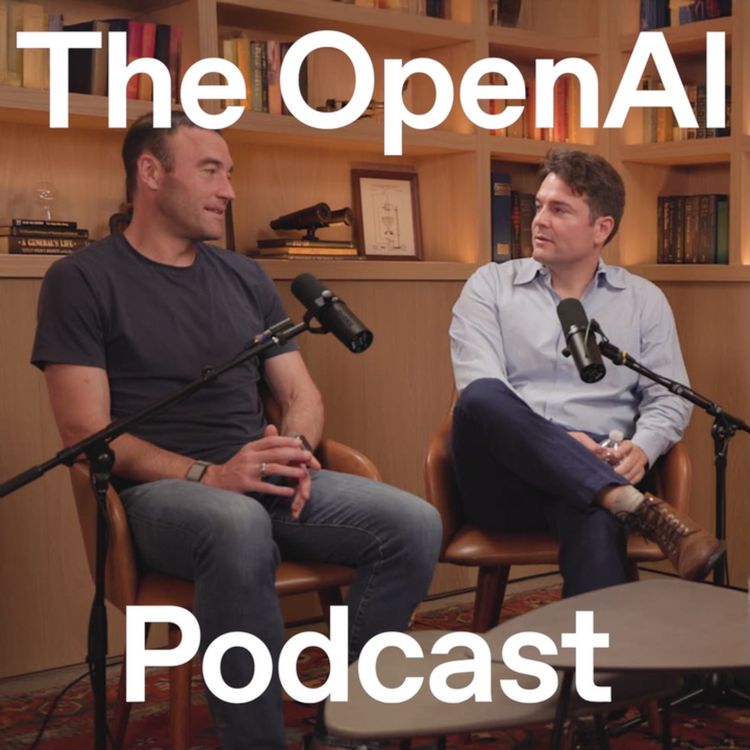
OpenAI Podcast
How AI Is Accelerating Scientific Discovery Today and What's Ahead - Episode 10
AI is beginning to change how science gets done. Head of OpenAI for Science Kevin Weil and OpenAI research scientist Alex Lupsasca talk about the early signs of acceleration researchers are seeing with GPT-5—from surfacing literature across fields and languages, to speeding up complex calculations, to designing follow-up experiments. They unpack what’s possible today, what doesn’t work yet, and why the next few years could reshape the trajectory of scientific progress across physics, math, biology and beyond.
Chapters
- 00:00:40 — OpenAI for Science mission
- 00:06:00 — Literature search and intersections across fields
- 00:11:19 — A fusion physicist shows what GPT-5 can do
- 00:15:08 — GPT-5 Pro and black hole symmetries
- 00:19:02 — Getting the most out of the models
- 00:24:33 — OpenAI’s new research paper (https://openai.com/index/accelerating-science-gpt-5/)
- 00:29:59 — Looking ahead to the next 5 years
- 00:32:05 — Will predictions outpace experiments?
- 00:36:43 — The pace of model improvement
- 00:40:31 — What do scientific benchmarks look like?
- 00:44:16 — Fusion and the promise of abundant energy
- 00:48:07 — Closing: Science 2.0 moment
More episodes
View all episodes
22. What racing reveals about working with AI - Episode 22
41:23||Ep. 22Racing is a sport of tiny margins and mountains of data. OpenAI researcher Joyce Ruffell and RaceTek Systems co-founder Chase Holden are each using AI to help teams make better use of information from the track, the garage, and the people behind the wheel. They discuss OpenAI’s research collaboration with Chip Ganassi Racing and how Chase used ChatGPT and Codex to go from hosting a NASCAR podcast to building a racing intelligence company. They also examine how AI could give smaller teams an edge without replacing the human expertise at the heart of racing, and why car culture runs so deep at OpenAI.Chapters00:43 Intro to OpenAI researcher Joyce Ruffell and Chip Ganassi Racing02:43 Intro to Chase Holden and RaceTek Systems07:45 Joyce’s path into racing10:00 Helping racing teams work with AI15:31 Combining human feedback with racing data18:26 How AI helps smaller teams compete21:43 Spreadsheets and the “data wars” in racing27:03 Getting started with AI and Codex30:08 How RaceTek won its first customer33:01 Humans, robot racing, and the future of competition39:26 Using AI beyond the racetrack
21. Why Tejal Patwardhan stopped underestimating the models - Episode 21
44:22||Ep. 21The old tests are getting too easy. Tejal Patwardhan leads OpenAI’s frontier evals team, which is finding new ways to measure and forecast progress as models become more capable. She and host Andrew Mayne discuss why evals matter for research, how benchmarks can break or get gamed, and what models need to be judged on next.Chapters00:00:24 Growing up at OpenAI00:03:10 Why reasoning changed everything00:06:28 What made o1 surprising00:11:20 Why old benchmarks stopped working00:14:45 What makes a good benchmark00:17:35 Why evals are getting harder00:22:09 Measuring voice and vision models00:24:48 Testing models on real science00:33:23 How OpenAI tracks frontier progress00:40:47 What AI means for work
20. How a reasoning model cracked an 80-year-old math problem - Episode 20
41:17||Ep. 20Last month AI found something mathematicians had missed for decades. Reasoning researchers Alexander Wei, Hongxun Wu, and Lijie Chen join the podcast to discuss how a general-purpose model helped disprove an 80-year-old conjecture from famed mathematician Paul Erdős. They walk through the moment the result started looking real, what it took to verify the proof, and what’s happened since sharing the discovery with the world. They also explore what this means for the future of math and for researchers learning to work with AI.Chapters0:44 AI and the International Math Olympiad and International Olympiad of Informatics6:35 An OpenAI model disproves the Erdős unit distance conjecture8:33 Running the model and checking the proof11:04 Why general models matter for discovery15:55 Creativity, tools, and how the proof worked18:25 Why AI should feel empowering for mathematicians22:31 Advice for researchers using AI27:24 What comes next for math and AI research37:30 Cryptography, quantum computing, and the future
19. Inside image generation’s Renaissance moment - Episode 19
29:22||Ep. 19People are generating over 1.5 billion images a week in ChatGPT. In this episode, Product lead Adele Li and researcher Kenji Hata share some of the new use cases and trends since the launch of Images 2.0. Together with host Andrew Mayne, they trace the progress from the early DALL-E days and dive into the latest capabilities, including better text rendering, photorealism, multilingual support, world knowledge, aspect ratios, and character consistency. They also explore what comes next as image generation models evolve into more capable creative assistants.Chapters00:36 How Adele and Kenji came to work on Images02:27 Images 2.0 launch reception05:25 Productivity use cases and and 360 images09:34: Viral trends, authenticity, and imperfection10:51 Training breakthroughs and photorealism14:06 Evals, prompting, and creative control22:16 Creative agents and what comes next22:27 Images + Codex28:08 Prompt tips
18. Why AI needs a new kind of supercomputer network - Episode 18
37:38||Ep. 18Training frontier models isn’t as simple as adding more GPUs—one small problem and the whole coordinated dance falls apart. OpenAI’s Mark Handley and Greg Steinbrecher discuss how a new supercomputer network design, used to train some of the company’s latest models, keeps the whole system moving in lockstep, even with record numbers of GPUs. They break down Multipath Reliable Connection, a new protocol OpenAI developed with AMD, Broadcom, Intel, Microsoft, and Nvidia, and why they’re making it available for the whole industry to use.Chapters00:00 Intro00:39 Greg and Mark's paths to OpenAI04:34 Why training AI stresses networks differently10:05 Bottlenecks, failures, and the cost of waiting15:19 How Multipath Reliable Connection works18:59 A protocol to route around failures25:05 Why OpenAI is making MRC an open standard35:09 Could AI compute move to space?
17. What happens now that AI is good at math? - Episode 17
43:28||Ep. 17Math is one of the clearest ways to see how far AI has come in a short span. OpenAI researchers Sébastien Bubeck and Ernest Ryu join host Andrew Mayne to explain what changed and what it could mean for the future of research. They reflect on how Ernest used ChatGPT to help solve a 42-year-old open problem, the difference between deep literature search and original mathematical discovery, and what changes when AI can work over longer timelines. Chapters01:27 The surprising progress of AI’s math capabilities 03:01 Solving an open problem with ChatGPT06:57 How models went from basic math to research level11:32 Why math matters for AGI14:26 AI and the Erdős problems21:26 Building an automated researcher28:19 The role of humans as models improve33:52 Verifying proofs with AI36:00 The risk of shallow understanding41:19 Advice for learning math with ChatGPT
16. Building AI for Life Sciences - Episode 16
44:25||Ep. 16What does it take to build AI systems that can actually help scientists? Research lead Joy Jiao and product lead Yunyun Wang discuss how OpenAI is developing models for life sciences and what responsible deployment means in a field with real biosecurity stakes. They explore how AI is already improving research workflows and where it could lead in drug discovery and more autonomous labs — including why a future with less pipetting sounds pretty good to most scientists.Chapters0:39 Introducing the Life Sciences model series3:47 Joy’s path into life sciences5:00 Autonomous lab with Ginkgo Bioworks7:27 Yunyun’s path into life sciences8:12 OpenAI’s life sciences work9:48 Biorisk, access, and safeguards15:43 What models can do in the lab17:51 Building scientific infrastructure20:14 Why compute matters for science24:54 Where are we in 6-12 months?29:51 Scientific adoption and skepticism33:17 Advice for students and researchers40:27 Where are we in 10 years?
15. Inside the Model Spec - Episode 15
37:26||Ep. 15The more AI can do, the more we need to ask what it should and shouldn’t do. In this episode, OpenAI researcher Jason Wolfe joins host Andrew Mayne to talk about the Model Spec, the public framework that defines intended model behavior. They discuss how the Model Spec works in practice, including how the chain of command handles conflicts between instructions, and how OpenAI evolves it based on feedback, real-world use, and new model capabilities.Chapters00:00 Introduction01:10 What is the Model Spec?03:55 How does the Model Spec work in practice?06:26 Transparency: Where to read the Model Spec & give feedback07:51 How did the Model Spec originate?10:02 How does the spec translate into model behavior?11:26 What is the hierarchy / chain of command?13:35 Handling edge cases like Santa Claus17:41 How does the Model Spec evolve over time?19:59 What happens when models disagree with the spec?22:05 How do smaller models follow the spec?23:16 Is chain-of-thought useful for alignment?24:16 Model Spec vs Anthropic’s Constitution26:28 What surprised you most?26:56 How do you define the scope of the spec?27:44 What is the future of the Model Spec?31:16 How should developers think about the spec?34:44 Asimov’s laws vs Model Spec37:16 Could AI write a Human Spec?
14. Building AI for better healthcare - Episode 14
30:54||Ep. 14Healthcare systems around the world are under strain, and both patients and clinicians are feeling the impact. OpenAI's Head of Health Dr. Nate Gross and Karan Singhal, who leads Health AI Research, discuss how AI can help address the biggest challenges. They cover how OpenAI is training models to handle sensitive health questions in collaboration with physicians, and how that foundation is unlocking a new generation of tools for patients, clinicians, and healthcare systems.Chapters00:00:38 – Origins of Nate and Karan’s interest in AI and healthcare00:05:01 – Strategy for building AI tools for clinicians00:06:57 – How AI models are trained for health use cases00:10:15 – How OpenAI is able to score well on health evals00:14:21 – Key challenges deploying AI in healthcare00:21:05 – Collaboration with hospitals and healthcare systems00:23:05 – Practical everyday uses of AI health assistants00:26:43 – Biggest “wow” moment during development00:28:46 – Feedback from clinicians and early users