Share
Oncology for the Inquisitive Mind
183. ESMO Awards - Episode 3
For our third instalment of ESMO 2025, we explore lung cancer in all its glory, including small cell, mesothelioma and non-small cell lung cancer.
Studies:
For more episodes, resources and blog posts, visit www.inquisitiveonc.com
Please find us on Twitter @InquisitiveOnc!
If you want us to look at a specific trial or subject, email us at inquisitiveonc@gmail.com
Art courtesy of Taryn Silver
Music courtesy of AlisiaBeats: https://pixabay.com/users/alisiabeats-39461785/
Disclaimer: This podcast is for educational purposes only. If you are unwell, seek medical advice.
Oncology for the Inquisitive Mind is recorded with the support of education grants from our foundation partners Pfizer, Gilead Pharmaceuticals and Merck Pharmaceuticals. MSD provided virtual participation with ESMO. Our partners have access to the episode at the same time you do and have no editorial control over the content.
More episodes
View all episodes
31. 215. Back to Basics - Advanced Melanoma
27:22||Season 4, Ep. 31On this episode, Josh and Michael examine the treatment of advanced melanoma, the condition that blazed the trail for immunotherapy to change the face of cancer treatment. However, immunotherapy is not the ONLY treatment for melanoma, as a significant proportion of cases also harbour a BRAF mutation. So, if you have someone with such an example, what do you do? How would you sequence your treatment? This question, and a reflection on the incredible beginnings of immunotherapy is coming to you on today's episode.Studies Discussed in Today's EpisodeCheckmate 067DreamSeqFor more episodes, resources and blog posts, visit www.inquisitiveonc.comPlease find us on Twitter @InquisitiveOnc!If you want us to look at a specific trial or subject, email us at inquisitiveonc@gmail.comArt courtesy of Taryn SilverMusic courtesy of AlisiaBeats: https://pixabay.com/users/alisiabeats-39461785/Disclaimer: This podcast is for educational purposes only. If you are unwell, seek medical advice.Oncology for the Inquisitive Mind is recorded with the support of education grants from our foundation partners Pfizer and Merck Pharmaceuticals. Our partners have access to the episode at the same time you do and have no editorial control over the content.30. 214. Dr Narjust Florez and the rise of early onset lung cancer
34:51||Season 4, Ep. 30Our guest today is someone whose work touches almost every corner of oncology: from the exam room to the lab to the systems we work within.Dr Narjust Florez, MD, FASCO, is a thoracic medical oncologist at Dana-Farber Cancer Institute and Assistant Professor of Medicine at Harvard Medical School, where she treats young patients and women with lung cancer and leads a research program spanning early diagnosis, clinical trials, and cancer health disparities. She's the Associate Director of the Cancer Care Equity Program and leads the EQUAL Study, which tackles disparities in lung cancer screening among Hispanic and East Asian patients. She's also become one of the most influential voices on physician wellness and burnout in oncology, and on building a more equitable path for women and underrepresented trainees in the field — work that's earned her recognition as the youngest Fellow ever named to the Association for Clinical Oncology, and a spot as JAMA Oncology's first Latina Associate Editor for Diversity, Equity, and Inclusion.Please welcome Dr Narjust Florez.For more episodes, resources and blog posts, visit www.inquisitiveonc.comPlease find us on Twitter @InquisitiveOnc!If you want us to look at a specific trial or subject, email us at inquisitiveonc@gmail.comArt courtesy of Taryn SilverMusic courtesy of AlisiaBeats: https://pixabay.com/users/alisiabeats-39461785/Disclaimer: This podcast is for educational purposes only. If you are unwell, seek medical advice.Oncology for the Inquisitive Mind is recorded with the support of education grants from our foundation partners, Pfizer and Merck Pharmaceuticals. Our partners have access to the episode at the same time you do and have no editorial control over the content.29. 213. Back to Basics - Early Melanoma
28:49||Season 4, Ep. 29In this episode, Michael and Josh delve into the world of early melanoma. Some may think that melanoma has had its moment in the sun (pun slightly intended) and that other cancer treatments are passing it by. But in this instance, you can teach an old dog new tricks, an old immunotherapy dog, to be precise. In addition, one of today's studies has Michael's favourite design of any trial: see if you can figure out which one!Studies Discussed in Today's EpisodeKEYNOTE-054NADINAFor more episodes, resources and blog posts, visit www.inquisitiveonc.comPlease find us on Twitter @InquisitiveOnc!If you want us to look at a specific trial or subject, email us at inquisitiveonc@gmail.comArt courtesy of Taryn SilverMusic courtesy of AlisiaBeats: https://pixabay.com/users/alisiabeats-39461785/Disclaimer: This podcast is for educational purposes only. If you are unwell, seek medical advice.Oncology for the Inquisitive Mind is recorded with the support of education grants from our foundation partners Pfizer and Merck Pharmaceuticals. Our partners have access to the episode at the same time you do and have no editorial control over the content.28. 212. Back to Basics - Non-Melanoma Skin Cancer
24:48||Season 4, Ep. 28If you like cemiplimab, you will like this episode. Since its introduction, cemiplimab has become the mainstay of treatment for cutaneous SCC, the most common non-melanoma skin cancer likely to attend an oncologist. Cemiplimab's scope is expanding; once reserved purely for the locally advanced or metastatic setting, evidence is emerging for its efficacy in the neoadjuvant setting. Today, Josh and Michael explore the use cases for cemiplimab in cSCCNOTE: this episode was NOT sponsored by cemiplimab!Studies Discussed in Today's EpisodeMigden et al. (2018)Gross et al (2023)For more episodes, resources and blog posts, visit www.inquisitiveonc.comPlease find us on Twitter @InquisitiveOnc!If you want us to look at a specific trial or subject, email us at inquisitiveonc@gmail.comArt courtesy of Taryn SilverMusic courtesy of AlisiaBeats: https://pixabay.com/users/alisiabeats-39461785/Disclaimer: This podcast is for educational purposes only. If you are unwell, seek medical advice.Oncology for the Inquisitive Mind is recorded with the support of education grants from our foundation partners Pfizer and Merck Pharmaceuticals. Our partners have access to the episode at the same time you do and have no editorial control over the content.27. 211. Back to Basics - Hepatocellular Carcinoma
26:17||Season 4, Ep. 27For over a decade, sorafenib remained unchallenged as first-line therapy for hepatocellular carcinoma, based on the SHARP trial, which showed survival increasing from 7.9 to 10.7 months. This demonstrated modest efficacy in a disease notoriously resistant to systemic treatment. That drought broke in 2020, when IMbrave150 demonstrated that atezolizumab plus bevacizumab beat sorafenib outright, pushing median survival past 19 months and putting immunotherapy on the map for liver cancer. Two years later, HIMALAYA proved that a single priming dose of anti-CTLA-4 could unlock durable responses, with the STRIDE regimen nearly doubling five-year survival compared with sorafenib. Then IMbrave050 asked whether that success could move earlier, into the adjuvant setting after resection — and the early promise didn’t hold up on longer follow-up. Together, these three trials mark both immunotherapy’s arrival in liver cancer and the limits of assuming it translates cleanly across settings.Trials Discussed on Today's Episode:HIMALAYA TrialIMbrave 050IMbrave 150For more episodes, resources and blog posts, visit www.inquisitiveonc.comPlease find us on Twitter @InquisitiveOnc!If you want us to look at a specific trial or subject, email us at inquisitiveonc@gmail.comArt courtesy of Taryn SilverMusic courtesy of AlisiaBeats: https://pixabay.com/users/alisiabeats-39461785/Disclaimer: This podcast is for educational purposes only. If you are unwell, seek medical advice.Oncology for the Inquisitive Mind is recorded with the support of education grants from our foundation partners Pfizer and Merck Pharmaceuticals. Our partners have access to the episode at the same time you do and have no editorial control over the content.26. 210. Back to Basics - Biliary Tract Cancers
22:16||Season 4, Ep. 26Until recently, biliary tract cancers were relegated to orphan cancer status: rare cancers such as cholangiocarcinoma and gallbladder cancers. These aggressive malignancies were lumped together, historic trials were small, and patients were stuck with gemcitabine-cisplatin chemotherapy as the only real option, a regimen that hadn't changed for almost a decade. Then two trials cracked the field open. BILCAP, reported in 2019, gave resected patients their first evidence-based reason to take adjuvant capecitabine, pushing median survival from around three years to over four. And in 2022, TOPAZ-1 became the first trial to prove immunotherapy has a place in biliary cancer. Durvalumab was added to standard chemo, and in the latest three-year follow-up, it cut the risk of death by over a quarter. Together, these two trials didn't just add drugs to a protocol; they turned biliary tract cancer from an afterthought into a disease with modern treatment pathways.Trials Discussed on Today's Episode:BILCAPTOPAZ-1For more episodes, resources and blog posts, visit www.inquisitiveonc.comPlease find us on Twitter @InquisitiveOnc!If you want us to look at a specific trial or subject, email us at inquisitiveonc@gmail.comArt courtesy of Taryn SilverMusic courtesy of AlisiaBeats: https://pixabay.com/users/alisiabeats-39461785/Disclaimer: This podcast is for educational purposes only. If you are unwell, seek medical advice.Oncology for the Inquisitive Mind is recorded with the support of education grants from our foundation partners Pfizer and Merck Pharmaceuticals. Our partners have access to the episode at the same time you do and have no editorial control over the content.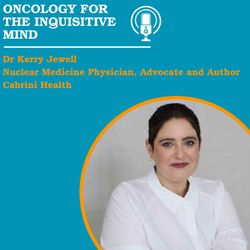
25. 209. Interview with Dr Kerry Jewell
01:07:38||Season 4, Ep. 25On today's episode, we have a very special guest: Dr Kerry Jewell is a nuclear medicine physician, medical advocate and very good friend of the show, who recently published her debut novel A Little Unwell. Kerry is wonderfully eloquent doctor who frequently chooses violence when with dealing with Michael, whom she has known for his entire medical career. Today, Kerry discusses her book, working as a nuclear medicine physician, provides some of her amazing wisdom for our oncology colleagues and gets candid about a recent, heart-breaking diagnosis. A Little Unwell available here: https://www.amazon.com.au/Little-Unwell-Kerry-Jewell/dp/0733653952*This is not an affiliate link. We just think the book is great!For more episodes, resources and blog posts, visit www.inquisitiveonc.comPlease find us on Twitter @InquisitiveOnc!If you want us to look at a specific trial or subject, email us at inquisitiveonc@gmail.comArt courtesy of Taryn SilverMusic courtesy of AlisiaBeats: https://pixabay.com/users/alisiabeats-39461785/Disclaimer: This podcast is for educational purposes only. If you are unwell, seek medical advice.Oncology for the Inquisitive Mind is recorded with the support of education grants from our foundation partners Pfizer and Merck Pharmaceuticals. Our partners have access to the episode at the same time you do and have no editorial control over the content.
24. 208. ASCO 2026 - The Plenary Episode - Part 3
52:54||Season 4, Ep. 24This episode is the ASCO 2026 Plenary Episode. This week, all of the pivotal, game-changing, life-changing trials are discussed here. Some describe the plenary session as practice-changing, and we will always agree that better treatments with significant improvements in life expectancy and quality of life need their time in the spotlight.Today, five trials are discussed, including SARC041, a liposarcoma study utilising the CDK 4/6 inhibigtor abemacicilib. Our second study is HARMONI-6, investigating whether ivonescimab plus chemotherapy is effective in patients with advanced squamous non-small cell lung cancer. Our third, almost like something written for an opera (LIBRETTO0-432), a lung cancer trial looking at selpercatinib in those with RET fusion early-stage NSCLCa. PROTEUS emerges as our fourth trial, rising from the depths of the ocean to evaluate apalutamide in the perioperative prostate cancer space.Finally, and most importantly in our opinion, is RASolute302, the pancreatic cancer trial, showing that even the most difficult mutation is now treatable. An incredible story of an exceptionally difficult cancer to treat, Daraxonrasib is the star of this year's ASCO.Studies Discussed in this EpisodeSARC041HARMONI-6LIBRETTO0-432PROTEUSRASolute302For more episodes, resources and blog posts, visit www.inquisitiveonc.comPlease find us on Twitter @InquisitiveOnc!If you want us to look at a specific trial or subject, email us at inquisitiveonc@gmail.comArt courtesy of Taryn SilverMusic courtesy of AlisiaBeats: https://pixabay.com/users/alisiabeats-39461785/Disclaimer: This podcast is for educational purposes only. If you are unwell, seek medical advice.Oncology for the Inquisitive Mind is recorded with the support of education grants from our foundation partners Pfizer and Merck Pharmaceuticals. Our partners have access to the episode at the same time you do and have no editorial control over the content.
23. 207. ASCO 2026 - Agents of the Future - Part 2
01:04:25||Season 4, Ep. 23This week, Josh and Michael's ASCO 2026 coverage looks at "Agents of the Future", trials of intrigue, promise and potential beyond its status. This episode also sheds light on more orphan status cancers like head and neck cancer, basket cohort studies, resistant EGFR lung cancer, metastatic colorectal cancer and hepatocellular carcinoma.One more episode left of this arc - The Plenary! Stay tuned.Studies Discussed in this EpisodeOrigAMI-4WU-KONG28A Phase 1/2 Study of JK06, a 5T4-Targeted Antibody Drug Conjugate (ADC), In Patients with Unresectable Locally Advanced or Metastatic CancerESANOAROSETTA Lung-02Ivonescimab + FOLFOXHERIZON-CRC01CIRCULATEEMERALD-3BLUESTARGLP-1 agonist in breast cancer (Palleschi et al)For more episodes, resources and blog posts, visit www.inquisitiveonc.comPlease find us on Twitter @InquisitiveOnc!If you want us to look at a specific trial or subject, email us at inquisitiveonc@gmail.comArt courtesy of Taryn SilverMusic courtesy of AlisiaBeats: https://pixabay.com/users/alisiabeats-39461785/Disclaimer: This podcast is for educational purposes only. If you are unwell, seek medical advice.Oncology for the Inquisitive Mind is recorded with the support of education grants from our foundation partners Pfizer and Merck Pharmaceuticals. Our partners have access to the episode at the same time you do and have no editorial control over the content.