Share
Oncology for the Inquisitive Mind
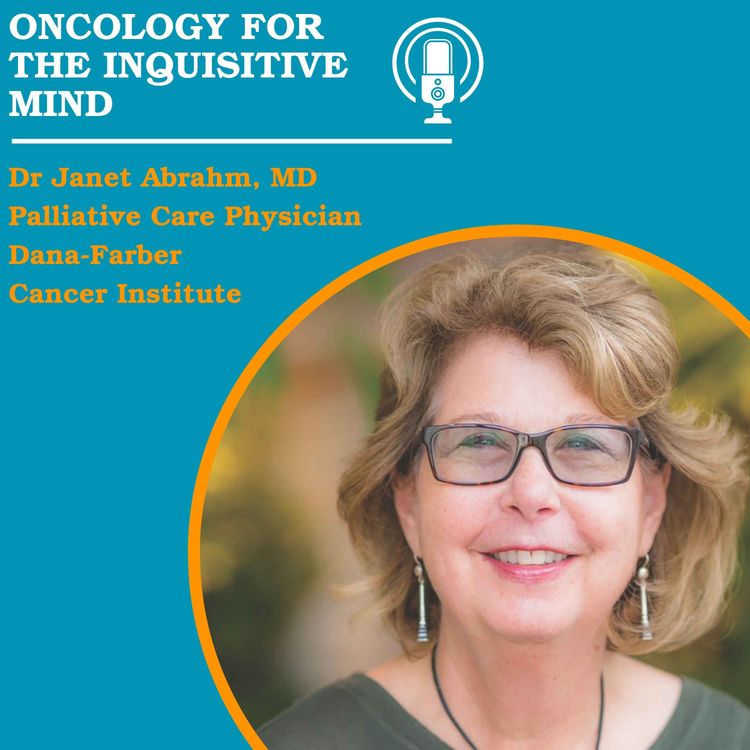
122. Palliative Care with Dr Janet Abrahm
It is rare on any show to be able to interview a true pioneer. On today's episode of Oncology for the Inquisitive Mind, we have the privilege of interviewing Dr Janet Abrahm, a pioneer in every sense of the word. An internist with over 20 years experience, Dr Abrahm was one of the founders and earliest proponents of palliative care in the United States. A staff specialist at the Dana Farber Cancer Institute, she is board-certified in Hematology, Hospice and Palliative Medicine, Internal Medicine, and Oncology. She has lectured on palliative care in the DFCI Master Course for oncologists throughout the US. Since 2010 she has participated internationally in the Education in Palliative and End-of-Life (EPEC)-Oncology course as a Master teacher. Most recently, she was the recipient of the 2024 Walther Cancer Foundation Supportive Oncology Award, recognising a distinguished lecturer and leader with multiple, significant, and enduring contributions to palliative and supportive care in oncology through the prevention, assessment and management of cancer- and treatment-related suffering. Oncology for the Inquisitive Mind is truly privileged to have Dr Abrahm on the show.
For more information on Dr Abrahm, or to subscribe to her palliative care newsletter, visit: https://janetabrahm.com/
For more episodes, resources and blog posts, visit www.inquisitiveonc.com
Please find us on Twitter @InquisitiveOnc!
If you want us to look at a specific trial or subject, email us at inquisitiveonc@gmail.com
Oncology for the Inquisitive Mind is recorded with the support of education grants from Pfizer, Gilead Pharmaceuticals and Merck Pharmaceuticals. Our partners have no editorial rights or early previews, and they have access to the episode at the same time you do.
Art courtesy of Taryn Silver
Music courtesy of AlisiaBeats: https://pixabay.com/users/alisiabeats-39461785/
Disclaimer: This podcast is for educational purposes only. If you are unwell, seek medical advice.
More episodes
View all episodes
37. 221. Making Metastatic Breast Cancer Count with Vicki Durston
33:49||Season 4, Ep. 37How many Australians are living with metastatic breast cancer? Until recently, nobody could tell you.This episode we’re joined by Vicki Durston, Director of Policy and Advocacy at Breast Cancer Network Australia (BCNA). Vicki started out as a nurse and has spent more than 30 years in health leadership. Her team produced Australia’s first national estimate of people living with metastatic breast cancer.BCNA is the peak national organisation for Australians affected by breast cancer. It began in 1998 with a few hundred women sharing information in their living rooms. It’s now a network of more than 250,000 people with lived experience, with a national Helpline and a strong voice in Parliament House.We talk about why counting matters, how a medicines access campaign actually gets won, and why your postcode still shapes your outcome. We also touch on BCNA’s Seat at the Table program and Vicki’s work with the ABC Global Alliance and the WHO.For more episodes, resources and blog posts, visit www.inquisitiveonc.comPlease find us on Twitter @InquisitiveOnc!If you want us to look at a specific trial or subject, email us at inquisitiveonc@gmail.comArt courtesy of Taryn SilverMusic courtesy of AlisiaBeats: https://pixabay.com/users/alisiabeats-39461785/Disclaimer: This podcast is for educational purposes only. If you are unwell, seek medical advice.Oncology for the Inquisitive Mind is recorded with the support of education grants from our foundation partners Pfizer and Merck Pharmaceuticals. Our partners have access to the episode at the same time you do and have no editorial control over the content.36. 220. Back to Basics - Central Nervous System Tumours
28:38||Season 4, Ep. 36This episode is about IDH-mutant glioma, a cancer that often hits people in their thirties and forties who may live for decades, which makes the long-term cost of treatment matter as much as the benefit. We’re looking at two trials, almost thirty years apart. RTOG 9402 opened in 1994 and asked whether adding PCV chemotherapy to radiotherapy did better than radiotherapy alone in anaplastic oligodendroglioma. INDIGO asked whether a daily tablet, the IDH inhibitor vorasidenib, could let patients with grade 2 disease put off radiotherapy and chemotherapy altogether. One asks whether more is better. The other asks whether we can safely wait. What did they find, and what do they mean for the patient in front of you on Monday? Let’s get into it.Studies Discussed in Today's EpisodeRTOG 9402INDIGOFor more episodes, resources and blog posts, visit www.inquisitiveonc.comPlease find us on Twitter @InquisitiveOnc!If you want us to look at a specific trial or subject, email us at inquisitiveonc@gmail.comArt courtesy of Taryn SilverMusic courtesy of AlisiaBeats: https://pixabay.com/users/alisiabeats-39461785/Disclaimer: This podcast is for educational purposes only. If you are unwell, seek medical advice.Oncology for the Inquisitive Mind is recorded with the support of education grants from our foundation partners Pfizer and Merck Pharmaceuticals. Our partners have access to the episode at the same time you do and have no editorial control over the content.35. 219. Back to Basics - Cervical Cancer
23:35||Season 4, Ep. 35Cervical cancer is notoriously difficult to treat, but treatment like most cancers continue to improve. This week we discuss two pivotal immunotherapy (Keynote) trials.KEYNOTE-826 was the first trial to show that adding immunotherapy to first-line chemotherapy helps women whose cervical cancer has come back or spread. They lived longer, and five-year results confirm the benefit lasts. KEYNOTE-A18 then moved pembrolizumab earlier, adding it to chemoradiation for newly diagnosed, high-risk disease, when the aim is cure. At three years, 82.6% of women were alive, compared with 74.8% with chemoradiation alone. Together, the two trials have made immunotherapy part of standard care across the course of this disease.Studies Discussed in Today's EpisodeKEYNOTE-826KEYNOTE A18For more episodes, resources and blog posts, visit www.inquisitiveonc.comPlease find us on Twitter @InquisitiveOnc!If you want us to look at a specific trial or subject, email us at inquisitiveonc@gmail.comArt courtesy of Taryn SilverMusic courtesy of AlisiaBeats: https://pixabay.com/users/alisiabeats-39461785/Disclaimer: This podcast is for educational purposes only. If you are unwell, seek medical advice.Oncology for the Inquisitive Mind is recorded with the support of education grants from our foundation partners Pfizer and Merck Pharmaceuticals. Our partners have access to the episode at the same time you do and have no editorial control over the content.34. 218. Back to Basics - Endometrial Cancer
28:41||Season 4, Ep. 34This week we cover endometrial cancer. It is one of the clearest examples of molecular classification changing how we treat patients. PORTEC-3 randomised women with high-risk disease to pelvic radiotherapy with or without chemotherapy. Adding chemotherapy improved survival, and the benefit held at 10 years. The molecular analysis is where it gets interesting, but you'll have to tune in to find out why! RUBY then showed those same dMMR tumours respond to something else entirely. Adding dostarlimab to carboplatin-paclitaxel in advanced or recurrent disease improved overall survival. Should one molecular result now decide whether a patient gets chemotherapy, immunotherapy or both? In this episode, we unpack both trials and what they mean for practice.Studies Discussed in Today's EpisodePORTEC-3RUBYFor more episodes, resources and blog posts, visit www.inquisitiveonc.comPlease find us on Twitter @InquisitiveOnc!If you want us to look at a specific trial or subject, email us at inquisitiveonc@gmail.comArt courtesy of Taryn SilverMusic courtesy of AlisiaBeats: https://pixabay.com/users/alisiabeats-39461785/Disclaimer: This podcast is for educational purposes only. If you are unwell, seek medical advice.Oncology for the Inquisitive Mind is recorded with the support of education grants from our foundation partners Pfizer and Merck Pharmaceuticals. Our partners have access to the episode at the same time you do and have no editorial control over the content.33. 217. Back to Basics - Advanced Ovarian Cancer
25:50||Season 4, Ep. 33Last week Josh and Michael discussed early ovarian cancer, but as is always the case many patients either do not respond completely to treatment of their early disease or present with advanced disease and thus are robbed of that chance. In these patients, getting the treatment right is a complex discussion but a vital one. In this episode, we discuss two studies in the advanced ovarian cancer space, a space that could still use more love, but has seen developments in recent years. Studies Discussed in Today's EpisodeAURELIAICON4For more episodes, resources and blog posts, visit www.inquisitiveonc.comPlease find us on Twitter @InquisitiveOnc!If you want us to look at a specific trial or subject, email us at inquisitiveonc@gmail.comArt courtesy of Taryn SilverMusic courtesy of AlisiaBeats: https://pixabay.com/users/alisiabeats-39461785/Disclaimer: This podcast is for educational purposes only. If you are unwell, seek medical advice.Oncology for the Inquisitive Mind is recorded with the support of education grants from our foundation partners Pfizer and Merck Pharmaceuticals. Our partners have access to the episode at the same time you do and have no editorial control over the content.32. 216. Back to Basics - Early Ovarian Cancer
21:35||Season 4, Ep. 32Our Back to Basics odyssey nears its end, a journey just as epic as Matt Damon's (we think so, anyway). As we enter the final stretch, we discuss ovarian cancer, a cancer with significant mortality and morbidity despite advances in treatment. In this episode Josh and Michael discuss two studies in the early ovarian cancer space, a topic fraught with challenges as unique as Scylla and Charybdis.Studies Discussed in Today's EpisodeICON7PAOLA-1For more episodes, resources and blog posts, visit www.inquisitiveonc.comPlease find us on Twitter @InquisitiveOnc!If you want us to look at a specific trial or subject, email us at inquisitiveonc@gmail.comArt courtesy of Taryn SilverMusic courtesy of AlisiaBeats: https://pixabay.com/users/alisiabeats-39461785/Disclaimer: This podcast is for educational purposes only. If you are unwell, seek medical advice.Oncology for the Inquisitive Mind is recorded with the support of education grants from our foundation partners Pfizer and Merck Pharmaceuticals. Our partners have access to the episode at the same time you do and have no editorial control over the content.31. 215. Back to Basics - Advanced Melanoma
27:22||Season 4, Ep. 31On this episode, Josh and Michael examine the treatment of advanced melanoma, the condition that blazed the trail for immunotherapy to change the face of cancer treatment. However, immunotherapy is not the ONLY treatment for melanoma, as a significant proportion of cases also harbour a BRAF mutation. So, if you have someone with such an example, what do you do? How would you sequence your treatment? This question, and a reflection on the incredible beginnings of immunotherapy is coming to you on today's episode.Studies Discussed in Today's EpisodeCheckmate 067DreamSeqFor more episodes, resources and blog posts, visit www.inquisitiveonc.comPlease find us on Twitter @InquisitiveOnc!If you want us to look at a specific trial or subject, email us at inquisitiveonc@gmail.comArt courtesy of Taryn SilverMusic courtesy of AlisiaBeats: https://pixabay.com/users/alisiabeats-39461785/Disclaimer: This podcast is for educational purposes only. If you are unwell, seek medical advice.Oncology for the Inquisitive Mind is recorded with the support of education grants from our foundation partners Pfizer and Merck Pharmaceuticals. Our partners have access to the episode at the same time you do and have no editorial control over the content.30. 214. Dr Narjust Florez and the rise of early onset lung cancer
34:51||Season 4, Ep. 30Our guest today is someone whose work touches almost every corner of oncology: from the exam room to the lab to the systems we work within.Dr Narjust Florez, MD, FASCO, is a thoracic medical oncologist at Dana-Farber Cancer Institute and Assistant Professor of Medicine at Harvard Medical School, where she treats young patients and women with lung cancer and leads a research program spanning early diagnosis, clinical trials, and cancer health disparities. She's the Associate Director of the Cancer Care Equity Program and leads the EQUAL Study, which tackles disparities in lung cancer screening among Hispanic and East Asian patients. She's also become one of the most influential voices on physician wellness and burnout in oncology, and on building a more equitable path for women and underrepresented trainees in the field — work that's earned her recognition as the youngest Fellow ever named to the Association for Clinical Oncology, and a spot as JAMA Oncology's first Latina Associate Editor for Diversity, Equity, and Inclusion.Please welcome Dr Narjust Florez.For more episodes, resources and blog posts, visit www.inquisitiveonc.comPlease find us on Twitter @InquisitiveOnc!If you want us to look at a specific trial or subject, email us at inquisitiveonc@gmail.comArt courtesy of Taryn SilverMusic courtesy of AlisiaBeats: https://pixabay.com/users/alisiabeats-39461785/Disclaimer: This podcast is for educational purposes only. If you are unwell, seek medical advice.Oncology for the Inquisitive Mind is recorded with the support of education grants from our foundation partners, Pfizer and Merck Pharmaceuticals. Our partners have access to the episode at the same time you do and have no editorial control over the content.29. 213. Back to Basics - Early Melanoma
28:49||Season 4, Ep. 29In this episode, Michael and Josh delve into the world of early melanoma. Some may think that melanoma has had its moment in the sun (pun slightly intended) and that other cancer treatments are passing it by. But in this instance, you can teach an old dog new tricks, an old immunotherapy dog, to be precise. In addition, one of today's studies has Michael's favourite design of any trial: see if you can figure out which one!Studies Discussed in Today's EpisodeKEYNOTE-054NADINAFor more episodes, resources and blog posts, visit www.inquisitiveonc.comPlease find us on Twitter @InquisitiveOnc!If you want us to look at a specific trial or subject, email us at inquisitiveonc@gmail.comArt courtesy of Taryn SilverMusic courtesy of AlisiaBeats: https://pixabay.com/users/alisiabeats-39461785/Disclaimer: This podcast is for educational purposes only. If you are unwell, seek medical advice.Oncology for the Inquisitive Mind is recorded with the support of education grants from our foundation partners Pfizer and Merck Pharmaceuticals. Our partners have access to the episode at the same time you do and have no editorial control over the content.