No One Is Coming
All Episodes
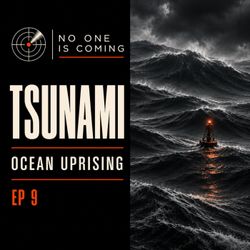
9. TSUNAMI
44:44||Season 1, Ep. 9Why do we picture a tsunami as a giant, cinematic wave, when the reality is far more deceptive—and far more dangerous?In this episode of No One Is Coming, Lance Still explores the terrifying physics of tsunamis and the hidden history buried right beneath our feet. From the devastating 2004 Indian Ocean tsunami to the 2011 Tōhoku disaster in Japan, we look at what happens when the sea stops behaving like the sea and becomes a fast-moving, destructive flood.The episode also uncovers how a catastrophe can disappear from living memory while its evidence remains behind—in coastal soil, ghost forests, geological records, and Indigenous oral histories. Scientists can read those traces centuries later, reconstructing disasters that entire communities once knew firsthand.From there, we turn to the human side of survival. Why do people sometimes hesitate when every minute matters? What happens when we wait for confirmation instead of trusting the warning signs in front of us? You’ll hear how a little bit of knowledge helped save an entire beach in Thailand, how a 12-year-old girl helped evacuate a Chilean village in the middle of the night, and why preparedness is less about predicting every contingency than knowing enough to recognize when something has changed.Featuring:Dr. Vasily Titov: Tsunami scientist with NOAA’s Pacific Marine Environmental Laboratory and a member of the NOAA Center for Tsunami Research. He has spent decades developing and improving operational tsunami forecasting tools and translating tsunami science into faster, more accurate warnings intended to save lives.Dr. Carrie Garrison-Laney: Coastal Hazards Specialist & PMEL Liaison, Washington Sea Grant — A skilled science communicator and trained scientist, Dr. Carrie Garrison-Laney contributes to tsunami hazard research through studies of evidence for past tsunamis and earthquakes in Washington. Her work has improved understanding of past tsunami sources and the timing of tsunami flooding, helping strengthen hazard assessments for coastal residents. She also conducts tsunami hazard outreach and works with emergency managers, maritime groups, and other stakeholders on education and preparedness.Dr. Anawat Suppasri: Associate Professor at Tohoku University’s International Research Institute of Disaster Science (IRIDeS) and its Tsunami Engineering Laboratory. His research includes tsunami numerical modeling, tsunami generation, damage surveys, vulnerability, hazard and risk assessment, disaster-prevention education, and cascading disasters.Dr. Tina Dura: Associate Professor of Natural Hazards at Virginia Tech. Her research uses coastal geology, sedimentology, microfossils, paleoseismology, modeling, and sea-level evidence to reconstruct the history of major subduction-zone earthquakes and tsunami inundation.Elyssa Tappero: Tsunami Program Manager for Washington Emergency Management Division. She works with coastal communities and partners on tsunami preparedness, public education, warning, mitigation, and response planning.Follow No One Is Coming:YouTube: @NoOneIsComingPodInstagram: @nooneiscomingpodcastTikTok: @nooneiscomingpodNo One Is Coming is survival for the non-camo crowd: a documentary podcast about disasters, uncertainty, and what ordinary people can do before the plan falls apart.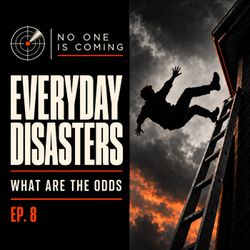
8. EVERYDAY DISASTERS
48:12||Season 1, Ep. 8Everyday Disasters | What Are the OddsWhy can we picture a plane crash so clearly, but barely notice the warning signs in our cars, our homes, or the people beside us?In this episode of No One Is Coming, Lance Still looks at the risks that come with ordinary life—and why familiarity makes them easy to miss.From drowsy driving and roadside breakdowns to water stains, dryer vents, smoke alarms, and DIY repairs, the episode asks how small problems announce themselves before they become emergencies. It also examines the harder warnings to read: a person who may be following you, a driver whose anger is escalating, or a medical symptom that might be nothing—or might need help now.From there, the episode turns to the first move. When should you call 911? What should you do when someone collapses? How can Poison Control help with a possible medication mistake? You’ll hear about CPR, opioid overdose, naloxone, and a few practical ways to prepare while there’s still time to think clearly.Featuring:William E. Van Tassel, PhD: Manager of Driver Training Programs at AAA’s national office, with a doctorate in driving safety and decades of experience as a sports-car racer. He explains what attentive driving looks like and how drivers can give themselves more room to respond.Leah Bolden: Carpenter, contractor, former building-trades instructor, and creator of See Jane Drill. For more than 25 years, she has helped people understand, maintain, and repair their homes.Arly Streed: Co-host of How to Handyma’am and Field Services Manager at MyHandyma’am. She teaches practical home repair and helps people judge when a project calls for a professional.Adam O’Neill: Retired LAPD sergeant whose career included patrol, training, undercover narcotics, and gang assignments. He discusses situational awareness and the small decisions that can create distance and options when something feels wrong.Ricardo Martinez II: Former 911 dispatcher, host of the Within the Trenches podcast, and founder of the #IAM911 movement. He explains what dispatchers need to know when a caller feels threatened or uncertain.Jared L. Ross, MD: Board-certified emergency physician with a background as a paramedic and firefighter. He discusses heart attacks, strokes, CPR, and the care an ambulance can provide before a patient reaches the hospital.Shannon Markus, MD: Board-certified emergency physician and public-health professional. She discusses bystander CPR, abnormal breathing, opioid overdose, and how ordinary people can help before emergency responders arrive.Michael Chary, MD, PhD: Emergency physician, medical toxicologist at Weill Cornell Medicine, and co-director of webPOISONCONTROL. He explains how Poison Control assesses medication mistakes and possible exposures.Learn more about the episode and find transcripts, expert information, and preparedness resources at nooneiscomingpodcast.com.Follow No One Is Coming:YouTube: @NoOneIsComingPodInstagram: @nooneiscomingpodcastTikTok: @nooneiscomingpodNo One Is Coming is survival for the non-camo crowd: a documentary podcast about disasters, uncertainty, and what ordinary people can do before the plan falls apart.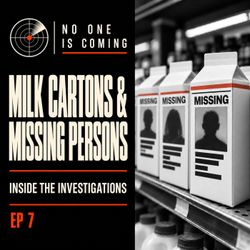
7. MILK CARTONS & MISSING PERSONS
51:11||Season 1, Ep. 7What actually happens when someone goes missing — and how do investigators decide whether a person is lost, hiding, in danger, or simply somewhere they chose to be?In this episode of No One Is Coming, Lance Still looks past the milk cartons, missing-child headlines, true-crime mythology, and television detectives to examine how missing-person investigations really work. From the disappearance of Etan Patz and the fear that shaped a generation of parents and children, to the enduring myth that you have to wait 24 hours before reporting someone missing, the episode explores what “missing” actually means — and why very different situations can end up carrying the same label.You’ll hear how law enforcement and private investigators assess risk, why circumstances matter more than an arbitrary clock, what investigators need to know in the first hours, and how search-and-rescue teams use lost-person behavior, terrain, probability models, and tools like FIND to decide where limited search resources should go. The episode also looks at wellness checks, long-term missing-person cases, the role of ordinary people who notice when something is wrong, and an uncomfortable reality: finding a competent adult does not necessarily mean returning them to the people who were looking for them.Then the perspective flips. What happens when you are the missing person? We examine why hikers miss decision points, how confirmation bias and sunk-cost thinking can keep people moving in the wrong direction, what search experts mean by “bending the map,” and why the STOP framework — Stop, Think, Observe, Plan — can help when you realize you are lost.Finally, the episode turns practical: what to do if someone you know goes missing, what police and search teams need to know in the first hours, why honesty matters even when the facts are embarrassing, how location-sharing and trip plans can make someone easier to find, and what you can do now to give the people looking for you a better place to start.Featuring:Robert J. Koester, PhD, FRGS, FInSTR: Internationally recognized search-and-rescue researcher and practitioner; CEO of dbS Productions LLC; Co-Editor of the Journal of Search & Rescue; Visiting Researcher at the University of Portsmouth; and Search Mission Coordinator with the Virginia Department of Emergency Management. His work on lost-person behavior examines how different categories of missing people move, make decisions, and respond once they realize they are lost.John Ferriso: Former NYPD officer who served from 1993 to 2013 and spent part of his 20-year career assigned to the Missing Persons Squad, where he supervised and investigated missing-person cases. He now runs Ferris Investigations and works as a police-procedural technical advisor.Meaghan Good: Founder of The Charley Project, an extensive online database profiling missing-person cases. She founded the project in 2004 and has maintained it as her vocation ever since.Jay J. Armes III: Second-generation international private investigator and Founder, President & Chief Investigator of Armes International Investigative Services LLC. Licensed as a private investigator at 18, Armes has spent four decades investigating missing persons, kidnappings, homicides, threats, fraud, and other complex cases in the United States and internationally.Learn more about the episode and find transcripts, expert information, and preparedness resources at nooneiscomingpodcast.com.Follow No One Is Coming:YouTube: @NoOneIsComingPodInstagram: @nooneiscomingpodcastTikTok: @nooneiscomingpodNo One Is Coming is survival for the non-camo crowd: a documentary podcast about disasters, uncertainty, and what ordinary people can do before the plan falls apart.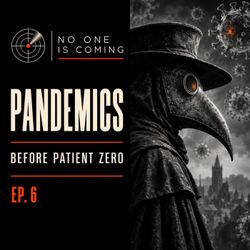
6. PANDEMICS
45:51||Season 1, Ep. 6Pandemics: Before Patient Zero — What happens before a pandemic has a name — when the pathogen is already moving, the evidence is incomplete, and someone has to decide whether a strange cluster of illness is noise or the beginning of something much bigger?In this episode of No One Is Coming, Lance Still traces pandemics backward from the moment the world notices them to the conditions that make them possible in the first place.From the first ProMED alert about unexplained pneumonia in Wuhan and the mythology of “patient zero,” to Typhoid Mary, the Black Death, smallpox eradication, polio, cholera in the Bay of Bengal, COVID-19, and Ebola in the Democratic Republic of the Congo, the episode examines how infectious-disease outbreaks are detected, how epidemiologists work with incomplete information, why early conclusions change, and how politics, trust, conflict, poverty, land use, and human behavior can determine whether an outbreak becomes a global health crisis.From there, the episode turns to prevention: what can we do before the next one? You’ll hear how zoonotic spillover happens, why disease surveillance can fail even when the technology works, what pandemic preparedness actually requires, how the One Health approach connects human, animal, and environmental health, and what ordinary people can reasonably do without turning themselves into amateur epidemic-intelligence officers.Featuring:Dr. Charlotte Hammer: Applied infectious-disease epidemiologist and public-health emergency specialist at the University of Cambridge, specializing in outbreak science, pandemic preparedness, and health security.Abigail Wright: Global-health specialist with experience at the World Health Organization in disease surveillance, pandemic preparedness, and One Health, including coordinating the One Health High-Level Expert Panel.Dr. Mark Honigsbaum: Medical historian, journalist, and author of The Pandemic Century, specializing in pandemics and infectious disease.Sonia Shah: Science journalist, Guggenheim Fellow, and author of Pandemic: Tracking the Next Contagion from Cholera to Ebola and Beyond.Professor Wanda Markotter: One Health researcher at Future Africa, University of Pretoria, and Director of the Centre for Viral Zoonoses, whose work focuses on bat pathogens and predicting and preventing spillover risk in Africa.David Quammen: Science writer and author of Spillover and Breathless, whose work explores evolution, emerging infectious disease, and the places where humans and the natural world collide.Learn more about the episode and find transcripts, expert information, and preparedness resources at nooneiscomingpodcast.com.Follow No One Is Coming:YouTube: @NoOneIsComingPodInstagram: @nooneiscomingpodcastTikTok: @nooneiscomingpodNo One Is Coming is survival for the non-camo crowd: a documentary podcast about disasters, uncertainty, and what ordinary people can do before the plan falls apart.
5. THE URGENCY TRAP
51:19||Season 1, Ep. 5What happens when a con artist hijacks your survival instincts?In this episode of No One Is Coming, Lance Still breaks down how scammers manufacture emergencies, shut down rational thought, and force you to act before you can think. You will learn how to interrupt the panic response and protect yourself when a call or text demands immediate action.Featuring:Brett Johnson: Former cybercriminal turned security expert, once dubbed “The Original Internet Godfather” by the Secret Service.Jenny Radcliffe: “The People Hacker,” a world-renowned social engineer who bypasses high-security systems using human psychology.Pope Brock: Author of Charlatan, the true story of one of America’s most audacious con men—and an expert on the spectacle, persuasion and psychology of the con.Jorij Abraham: Managing Director of the Global Anti-Scam Alliance, tracking the international networks and industrial-scale operations behind modern scams.Eva Velasquez: CEO of the Identity Theft Resource Center, fighting on the front lines of consumer fraud defense.Learn more about the episode and find transcripts, expert information and preparedness resources at nooneiscomingpodcast.com.Follow No One Is Coming:YouTube: @NoOneIsComingPodInstagram: @nooneiscomingpodcastTikTok: @nooneiscomingpodNo One Is Coming is survival for the non-camo crowd: a documentary podcast about disasters, uncertainty and what ordinary people can do before the plan falls apart.
4. Ship Happens
59:26||Season 1, Ep. 4A cruise ship is a $2-billion floating resort where you can watch the sunset over a private balcony, eat breakfast prepared by a chef you’ll never meet, and contract norovirus via buffet tongs before you’ve even cleared international waters.In this episode of No One Is Coming, we’re looking at the strange, highly optimized world of modern cruising. We talk to Titanic expert Tim Maltin about atmospheric illusions, travel journalist Daniel Klein on why the ship itself became the destination, Cambridge epidemiologist Dr. Charlotte Hammer on why floating cities are a pathogen’s dream, cruise-industry expert Ross Klein on medicine, crime, and jurisdiction at sea, and former FBI investigator Vince McNally on what happens when a crime scene is moving at 22 knots.From the ghost of the Titanic to the legendary “Poop Cruise” and the legal black holes of international waters, we break down what goes on behind the scenes of your next vacation.Resources & Links:For links to our guests, cruise safety guides, and more info, visit nooneiscomingpodcast.com.New episodes weekly.
3. Reading the Room
44:33||Season 1, Ep. 3A crowded bar. A concert. A festival. Most nights, the music stops and everybody goes home.But when a room turns dangerous, it can happen faster than you think — and by the time everyone realizes something is wrong, some of your choices may already be gone.In Reading the Room: Fire, Crowds, and the Night You Didn’t Plan For, we look at what makes concerts, nightclubs and crowded events safe — and what happens when the systems behind them fail. From Van Halen’s famous brown M&M test and The Station nightclub fire to Hillsborough, crowd crushes and the psychology that makes people hesitate when something feels wrong, this episode is about learning to notice the room before the room becomes the emergency.We explore crowd dynamics, emergency evacuation, the myth of mass panic, situational awareness, duty of care — and the small decisions that can buy you time when a night out stops going according to plan.You shouldn’t need a background in crowd science to go dancing. But knowing what to notice can give you an advantage.FeaturingProf. G. Keith Still — Professor of Crowd Science, University of Suffolk; Director, Crowd Risk Analysis Ltd.Steve Adelman — Head of Adelman Law Group, PLLC; Director of Event Safety, International Festivals & Events AssociationDr. Kayley D. Estes — Risk researcher specializing in decision-making, uncertainty and pluralistic ignoranceBaruch Fischhoff, Ph.D. — Howard Heinz University Professor, Engineering and Public Policy, Carnegie Mellon UniversityDaniel Farren — In-house Fire Marshal, Phoenix Convention CenterMartin Casillas — Fire Inspector, Clark County Fire DepartmentDonna Starkes — Deputy Fire Marshal, Clark County Fire Department
1. Tofino: Preparing for the Unpreparable
41:17||Season 1, Ep. 1On Vancouver Island's remote west coast, Tofino is beautiful, isolated and vulnerable to the kinds of emergencies that can quickly become compound crises. In the series premiere, Lance Still asks what preparedness means in a place where outside help may be delayed, and why survival often depends on ordinary people making decisions before certainty arrives.Featuring Tim Webb, Hilary O'Reilly, Marcie DeWitt and Nathalie Chouinard-Nolet, this episode explores search and rescue, local leadership and the difference between preventing disaster and preserving options.Awareness buys time. Time buys options.
2. NOIC Goes to the Movies: Summer Alien Invasion Special
01:01:31||Season 1, Ep. 2Aliens are having quite the summer. From Steven Spielberg’s Disclosure Day to a dedicated government website, No One Is Coming takes it all seriously enough to ask the important questions: In the event of an alien invasion, who survives, who makes everything worse, and what should you absolutely not do when something enormous appears in the sky?Featuring Dr. Seth Shostak, Dr. Stephen Ehmann DiKerby, Ryan Sprague, Dr. Charlotte Hammer, and Rosie Knight.The truth may be out there. The emergency plan probably isn’t.
loading...