Share
News Sidequest Megafeed
News Sidequest - Zoom calls at 30,000 feet are becoming a thing / Vegetables are half as nutritious as they were in the 1960s / Two thirds of Gen Z have tried psychics or spells to find love
Starlink satellite internet is now on hundreds of planes across United, British Airways, Qatar, Air France and others, with speeds fast enough for actual Zoom calls — and some airlines are now explicitly allowing them, while passenger complaints are already mounting. Also: a new report from Deep Science Ventures finds that fruits and vegetables have lost 20 to 50% of key minerals since the 1960s due to declining soil quality and breeding crops for yield over nutrition — you now need to eat twice as many vegetables to get the same levels of potassium, magnesium, and copper. And a new DatingNews survey of 1,013 Americans finds 64% of Gen Z has tried manifestation, psychics, tarot cards, astrology, or love spells to improve their dating life — and 19% paid for a love spell, with Etsy offering them for as little as $2. Plus 10 birds in a traveler's underwear, a flight diverted for broken bathrooms, a Spirit Halloween planet, and a fake substitute teacher in Milwaukee.
More episodes
View all episodes
News Sidequest - Remembering Margaret Hamilton / Halloween candy is up 71% / Your Keurig is doing something and nobody knows what
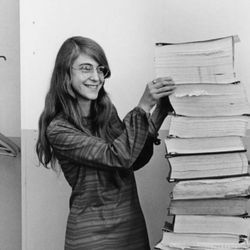
10:11|Margaret Hamilton, the computer scientist who led the team that wrote the software guiding Apollo’s astronauts to the moon and coined the term “software engineering,” died September 30 at 90. Then: Halloween candy prices have risen 71% since 2021 — a 100-piece bag that cost $9.91 in 2021 now costs $16.96 — driven by cocoa deficits, sugar prices, and tariffs, with 80% of Halloween shoppers expecting to pay more this year. And an IT professional named Anthony discovered his parents’ Keurig K-Supreme SMART coffee maker had uploaded 1,008 gigabytes of data in 10 days and 9 hours — saturating their home Wi-Fi access point on its own. Most of the data apparently stayed on the local network. A reboot fixed it. Nobody knows what it was doing. Plus a passenger who stole an airport tug, the 844-pound alligator Snaggletooth, a woman who married 14 men to fund a gambling habit, and an STI that is becoming a drug-resistant superbug.
Sidequests - The Reality of Modern Deployments and Military Leadership
24:39|The USS Abraham Lincoln spent ten months at sea. It left port in peacetime and came home from a war, and port calls were ruled out because every nearby harbor was within range of Iran. Rich Kolko, a former Navy P-3 pilot and retired FBI agent, joins Keith Conrad to separate fact from viral photos. Kolko explains why the deployment's toughness was circumstantial rather than a failure of planning, and why social media is showing Americans what sailors have always gone through. He also weighs in on Defense Secretary Pete Hegseth's agenda, including cutting admirals and generals, creating a new autonomous warfare command, and bringing in outsiders to fix procurement. His verdict is that some ideas are overdue and others need a second look, but the drone war won't wait. The truth usually lies somewhere in the middle, and so does the work.
Bringing Up The Lights - Chicago Shakespeare Theater: One Set, Two Shows
23:12|In both The Winter's Tale and A Midsummer Night's Dream, it snows on stage. That's a small piece of a much bigger puzzle for Wendy Stark Prey, Chicago Shakespeare Theater's director of production. Her job is to take everyone else's vision and figure out how to build it, night after night, without anyone slipping on stage.Wendy talks about how she got into theater almost by accident, through speech and debate club, and how a costume background led her to run one of the largest costume shops in the country before eventually landing in production management. She explains how LED screens and projections are changing what's possible on stage, and why newer technology doesn't always mean a better show. She also covers the specific headaches of a theater that sits on Navy Pier, right on the lake, from HVAC systems that can ruin a scene to a live flame effect that needed sign-off from the Chicago Fire Department.And she breaks down the real puzzle of this season: two plays, one set, one cast, and two production teams who each see it a little differently.Bringing Up the Lights is an original series from Sound Concept Media, written and narrated by Keith Conrad.
News Sidequest - Man turns 108 and has opinions about your diet / Parents are using AI to skip the school photo racket / Why we're hiding a skeleton in the Mackinac Island house
11:02|Beryl Dillman, a retired educator who spent 50 years as a principal and professor, turned 108 in Eugene, Oregon last week — his family believes he may be the oldest living man in the state — and credits a clean diet, no alcohol, and his "good mind" for getting here. "As long as I've got my good mind, I can meet people," he said. Also: a TikTok creator named Carlie Bond went viral for photographing her three kids against a plain wall, uploading the images to ChatGPT with the prompt "make it look like a school picture," and posting the results — drawing a wave of parents sharing their own cost-saving AI school photo hacks, with some also using AI to remove watermarks from proof photos they didn't pay for, which legal experts note is copyright infringement. And a story about a wallet found after 51 years in a home renovation — which is a perfect jumping-off point for the Mackinac Island house, the skeleton in the wall, and what you'd want to leave behind for whoever comes after you. Plus the Sasquatch calling competition, the $30 painting that sold for $1.35 million, MIT's stellar cannibalism observation, and the Jefferson DNA study.
Sidequests - The Great Chicago Fire: The Cow, the Comet, and the City That Burned
10:34|Everyone knows how the Great Chicago Fire started. The problem is, that story probably isn't true.On October 8, 1871, a fire tore through Chicago and destroyed one of the fastest-growing cities in America. The official explanation became legend. But the real story — the one historians eventually uncovered — is far more interesting, and far stranger, than the version most people learned.In this episode of Sidequests, we look at what actually happened that night, why the myth took hold so completely, and one wild theory that might just change how you think about the whole event.
News Sidequest - Are babies conscious? Researchers think yes, and much earlier than we assumed / Breakfast is the new first date / What happens to your relationships when you stop drinking
11:09|The New York Times published a piece this week synthesizing the latest research on infant consciousness — and the scientific consensus is shifting toward yes, with growing evidence that some form of conscious experience is present at birth or even in late pregnancy, long before anyone can ask a baby what it's thinking. Also: a Kellogg's survey of Australian singles finds 64% are open to breakfast or coffee as a first date, with 54% saying dating is harder than it used to be and 66% saying apps have drained the authenticity out of it — and with average first date costs now hitting $252 for millennials, a $15 eggs benedict is looking strategic. And the Washington Post profiled what actually happens to marriages and friendships when one person stops drinking — and the pattern is consistent, well-documented, and more complicated than most people anticipate. Plus a British Airways 28,000-foot drop, a 6-carat diamond found in Arkansas, whisky aging in orbit, and chimp friendship dynamics.
News Sidequest - Being a reader is now a dating green flag / Artery plaque is showing up in people under 30 who feel perfectly healthy / The space station might win the Nobel Peace Prize
10:13|The Washington Post profiled the growing trend of readers treating non-readers as a dealbreaker — including a new dating app called Readme built specifically for bibliophiles — with Bumble data finding that straight women are 66% more likely to swipe right if a man lists reading as a hobby, and 75% of people across genders finding readers more attractive. Also: a major international study published in The New England Journal of Medicine examined more than 16,800 healthy adults aged 18 to 70 with no known cardiovascular disease and found artery plaque in 57.1% of them — including about 1 in 13 adults under 30. And the Nobel Peace Prize is being announced this Friday, October 9th, with the International Space Station emerging as a genuine top contender — a symbol of continuous international scientific cooperation between the US, Russia, Europe, Japan, and Canada through 25 years of wars, elections, and geopolitical turbulence. Plus the Red Lobster fake emergency, the $128K ATM finder, phantom phone vibrations, and the Florida beach paying you to vacation.
News Sidequest - Americans stopped believing in college / McDonald's AI decides how much your Big Mac costs — and you'd be surprised how much it varies / 1 in 8 cancers worldwide are caused by infections you can prevent
10:14|Gallup released new data today showing only 31% of Americans say a college education is "very important" — down from 70% in 2013, and the lowest reading since the question was first asked in 1978. Only 12% say college is affordable. Also: a Reuters investigation finds McDonald's has been using an AI pricing engine since at least 2019 to calculate the "optimal price" for every menu item at every restaurant based on what customers in that area are willing to pay — the same Big Mac costs $5.69 at one Fresno store and $6.89 two miles away — and the company once recommended an $18 Big Mac meal at a highway rest stop. And the International Agency for Research on Cancer published a Lancet Oncology analysis finding that 2.3 million cancer cases worldwide in 2024 — one in eight — were caused by infections including H. pylori, HPV, hepatitis B, and Epstein-Barr virus, most of which are preventable with vaccines or treatment. Plus the TSA peanut butter reminder, the escaped auction cow, the dog finding lost children, and a sausage recall.