Share
Mysteries at Bedtime
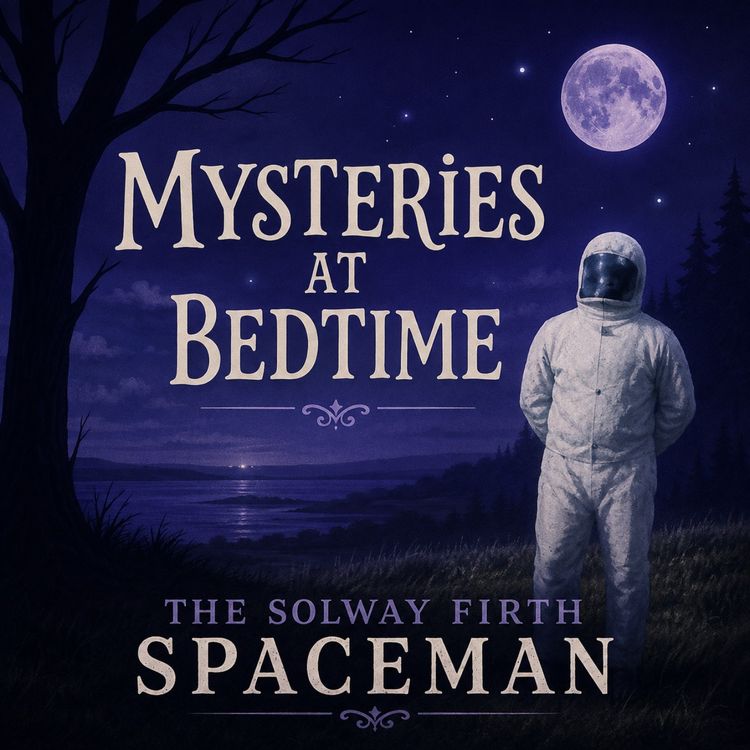
The Solway Firth Spaceman: The 1964 Photograph No One Can Explain
The Solway Firth Spaceman is one of the most famous unexplained photographs in British history, and after more than sixty years, people are still arguing about what it shows. On the afternoon of the 23rd of May 1964, a Carlisle firefighter named Jim Templeton took three photographs of his five-year-old daughter Elizabeth on Burgh Marsh, overlooking the Solway Firth in Cumberland, England. It was an ordinary family day out on an ordinary spring afternoon. But when the film came back from Kodak, the middle photograph showed something that should not have been there: a tall figure in what looked like a white spacesuit, standing silently in the empty marsh behind the little girl. Templeton swore no one had been there when he took the picture. The police examined it and found nothing suspicious. Kodak confirmed the negative had not been faked or tampered with. Within days, the photograph was in newspapers around the world. Then two strange men in dark suits arrived at Templeton's fire station, refused to give their names, and demanded he take them to the marsh. And on the far side of the world, at a rocket testing range in Australia, a launch was said to have been aborted after two similar figures were seen on the firing range. In this episode of Mysteries at Bedtime, we tell the full story of the Solway Firth Spaceman: the photograph, the family, the Men in Black, the Blue Streak missile connection, and the surprisingly persuasive explanation, offered nearly fifty years later, that may finally have solved it, or may only have deepened the mystery. Settle in, get comfortable, and let us tell you the story of the figure on the marsh.
You can get early and ad free access to this show and more here
More episodes
View all episodes
86. The Disappearance of Brandon Lawson: The 911 Call in the Dark
26:58||Season 1, Ep. 86The disappearance of Brandon Lawson is one of the most haunting missing-persons cases of the modern age, and it is captured, in part, on a chilling 911 call. In August 2013, the 26-year-old father ran out of petrol on a dark rural road in Texas. He phoned his brother for help, then called 911, breathless and terrified, saying men were chasing him and that he'd run out into a field. He begged the operator to hurry. Then the line went dead. When his brother reached the abandoned truck minutes later, Brandon was gone. He was so afraid of whatever was out there that he called the police despite having a warrant out for his arrest. In this episode of Mysteries at Bedtime, we tell the full story: the frantic phone calls, the search that found nothing, the remains discovered nine years later in already-searched ground, and the question no one can answer, what was he running from? Settle in, get comfortable, and let us tell you the story of the voice in the field.
85. The Ilkley Moor Alien: The 1987 UFO Photograph Mystery
28:59||Season 1, Ep. 85The Ilkley Moor alien case is one of Britain's most famous UFO photographs. In December 1987, a retired police officer photographed a small green figure on a Yorkshire moor, then found his compass reversed and an hour of time missing. Experts examined the photo and could not prove it a fake. We lay out the evidence, the sceptics' case, and why, nearly 40 years on, no one can explain it. Settle in, get comfortable, and let us tell you the story of the figure by the quarry.
84. The Man Who Walked Off Camera: The Disappearance of Steven Koecher
23:48||Season 1, Ep. 84The disappearance of Steven Koecher in December 2009 is one of the most quietly baffling vanishings of the modern age, and more than sixteen years later, not a single trace of him has ever been found. Steven Koecher was a devout and much-loved 30-year-old journalist from Utah who, in the days before he disappeared, made a series of long and secret road trips that he explained to no one. On a sunny Sunday two days before Christmas, he drove 135 miles to a retirement community in Henderson, Nevada, a place where he knew no one and had no reason on earth to be. A residential security camera caught him parking his car, getting out, and walking purposefully down a quiet suburban sidewalk with something tucked under his arm. He turned a corner, out of the camera's view, and was never seen again. His car sat for days, full of Christmas presents he never came back for, and in the days after he vanished, his phone pinged from a tower miles away. In this episode of Mysteries at Bedtime, we tell the full story of the disappearance of Steven Koecher: the secret drives, the last footage of a man walking off camera, the untouched Christmas gifts, the phone that moved without him, and a mystery so complete that every theory anyone has offered runs straight into a wall. Settle in, get comfortable, and let us tell you the story of the man who walked off camera.
83. Ninety Flashes in the Dark: The Disappearance of Kris Kremers and Lisanne Froon
26:22||Season 1, Ep. 83The disappearance of Kris Kremers and Lisanne Froon in April 2014 is one of the most haunting and hotly debated mysteries of the modern age, and more than a decade later, no one agrees on what really happened. The two young Dutch women, best friends near the end of the trip of a lifetime, set out on a popular jungle trail near Boquete, Panama, on a bright afternoon. They photographed themselves smiling at the foot of the trail at 11 in the morning. They never came back. Six hours later, one of their phones dialled the emergency number. It did not connect, and for the next ten days the phones kept trying, again and again, and never once reached a soul. Then, one week in, in the dead of night, their camera took ninety photographs in near-total darkness: rocks, jungle, running water, and images no one has ever been able to fully explain. Ten weeks later, a backpack was found by a remote river, dry and neatly packed, far from where the two women should ever have been. In this episode of Mysteries at Bedtime, we tell the full story of Kris Kremers and Lisanne Froon: the ten days of calls into the void, the ninety flashes in the dark, the strange condition of the backpack and the remains, and the two competing explanations that still divide everyone who studies the case. Settle in, get comfortable, and let us tell you the story of the ninety flashes in the dark.
82. The Mystery of Kaspar Hauser: The Boy Who Came From Nowhere
26:24||Season 1, Ep. 82The mystery of Kaspar Hauser has haunted Europe for nearly 200 years, and it began on a spring afternoon in 1828 when a bewildered teenage boy appeared in the streets of Nuremberg, barely able to speak. He carried two letters and a single strange request: he wanted to be a cavalryman, like his father. He could not use a candle without burning himself. He recoiled from meat and drank only water. And when he could finally tell his own story, it was almost unbelievable: he claimed to have spent his entire life imprisoned alone in a darkened cell, never seeing another human face. Kaspar Hauser became a sensation across Europe, and a theory soon took hold that he was a stolen prince, the true heir to a German throne, hidden away by a ruthless plot. Five years later he was stabbed to death in circumstances that have never been explained. In this episode of Mysteries at Bedtime, we tell the full story of Kaspar Hauser: the boy who came from nowhere, the letters that may have been forged in his own hand, the lost-prince theory, the mirror-writing note found beside his dying body, the question of whether he was murdered or died by his own hand, and the remarkable DNA analysis of 2024 that finally answered one question about him while leaving the deepest mystery exactly as it was. Settle in, get comfortable, and let us tell you the story of the riddle of his time.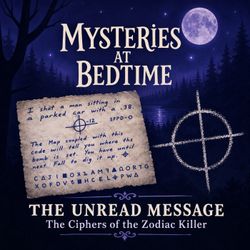
81. The Unread Message: The Ciphers of the Zodiac Killer
26:40||Season 1, Ep. 81The Zodiac Killer ciphers are among the most famous unsolved codes in the world, and after more than fifty years, two of them have still never been cracked. Between 1969 and 1970, the unidentified serial killer who called himself the Zodiac sent four coded messages to San Francisco newspapers, each a block of strange symbols mixing letters, numbers, and astrological signs. He promised that his codes would reveal his identity. The first cipher, 408 characters long, was solved in about a week by a schoolteacher and his wife at their kitchen table, but it revealed only a chilling boast, not a name. The second, known as Z340, defeated the FBI, the NSA, and the world's best codebreakers for 51 years, until an international team of three amateurs finally cracked it in December 2020, one of them working through Melbourne's COVID lockdown on the far side of the world. And two ciphers remain unsolved to this day, including a 13-character message that the Zodiac introduced with the words "My name is". In this episode of Mysteries at Bedtime, we tell the full story of the Zodiac ciphers: how the codes worked, who solved them, why the last two may be impossible to crack, and the genuinely haunting possibility that the name of a killer who was never caught has been sitting in plain sight, printed on a newspaper page, for more than half a century, in a code that no one has ever been able to read. Settle in, get comfortable, and let us tell you the story of the unread message.
79. The Thing on the Hill: The Mothman of Point Pleasant
30:48||Season 1, Ep. 79Shortly after midnight on the morning of Tuesday the 15th of November 1966, in the small Ohio River town of Point Pleasant, West Virginia, in the county of Mason, two young married couples in a black 1957 Chevrolet drove out along State Route 62 to see what there was to see at the abandoned munitions plant seven miles north of town. The plant had been decommissioned since the end of the Second World War. It was known, to everyone in Mason County, as the TNT Area. It consisted of several hundred acres of overgrown vegetation, crumbling concrete storage bunkers, and an abandoned power plant building. The four young people in the car were Roger Scarberry and his wife Linda, and Steve Mallette and his wife Mary. Roger was driving. It was a Monday night rolling over into a Tuesday morning. They had been out. On the drive back into town, they had decided to take the long way home, past the TNT Area. As they approached the abandoned power plant building at approximately five minutes past midnight, their headlights fell on what appeared to be two red points of light standing beside the road. Roger slowed the car. The four of them looked out through the windscreen. The two red points of light, they realised as they got closer, were not lights. They were eyes. The eyes belonged to a figure that was standing perfectly still at the side of the road, watching them. The figure was, in Roger Scarberry's later description to police, shaped like a man, but bigger. Approximately six or seven feet tall. It was covered in a dark grey substance that might have been feathers, or might have been skin, or might have been something else entirely. Behind its back, folded, were what appeared to be a pair of very large wings. For a moment, the four young people in the car sat and looked at it. Then the figure moved. The story of the 13 months that followed, in which more than 100 people across Mason County reported sightings of the same creature. Of the extraordinary investigation conducted by American paranormal researcher John Keel. Of the disturbing dreams that spread through Point Pleasant in the autumn of 1967. And of the terrible event that occurred, in the darkness of the early evening of Friday the 15th of December 1967, exactly 13 months and one day after the first sighting, that killed 46 people and, in a strange coincidence that has never been explained, ended the Mothman sightings entirely.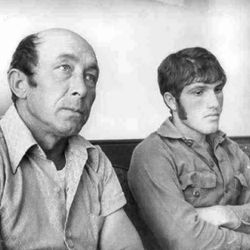
78. The Fishermen and the Craft: The Pascagoula Abduction
31:30||Season 1, Ep. 78At approximately 11 o'clock on the evening of Thursday the 11th of October 1973, two men walked into the Jackson County Sheriff's Office in the small Gulf Coast city of Pascagoula, Mississippi, and told the sheriff on duty that a few hours earlier, on the west bank of the Pascagoula River, they had been abducted by aliens. The older of the two men was Charles Hickson. He was 42 years old. He was a former military man. He was a shipyard fitter at the local Walker Shipyard. The younger was Calvin Parker. He was 19 years old. He was Hickson's co-worker. Neither of them, prior to that Thursday evening, had ever given a moment's thought to flying saucers. They had brought with them, to the sheriff's office, two catfish. They had, they explained, been fishing on the river when it happened. They had brought the catfish as evidence that the fishing part of their story, at least, was true. The sheriff, a man named Fred Diamond, listened to them describe a piercing sound in the air, blue lights on the water, an oval-shaped craft hovering silently at the edge of the river, and three creatures with grey folded skin, no visible eyes, and pincer-like claws for hands, who had paralysed them, floated them aboard the craft, and subjected them to a medical examination before returning them to the pier. Sheriff Diamond assumed, as any sheriff in Mississippi in 1973 would have assumed, that it was a hoax. He then, in the way that experienced law enforcement officers deal with suspected hoaxes, decided to test it. He put both men in an interview room. He ran a hidden tape recorder. He left them alone, expecting to catch them laughing. What he captured, on that tape, was two men, believing themselves to be unobserved, still absolutely terrified. Fifty-three years later, that tape has been recovered from a lost archive, listened to by researchers, and analysed alongside polygraph results, radiation testing, multiple corroborating witnesses, and the testimony of an American astronomer who had spent his career debunking UFO claims and who described this one, in careful language, as credible and deeply puzzling. The story of a night on the Pascagoula River in October 1973, of two ordinary men who reported an extraordinary experience, and of a mystery that has, in the 52 years since it happened, never been explained.