Share
The Moynihan Report
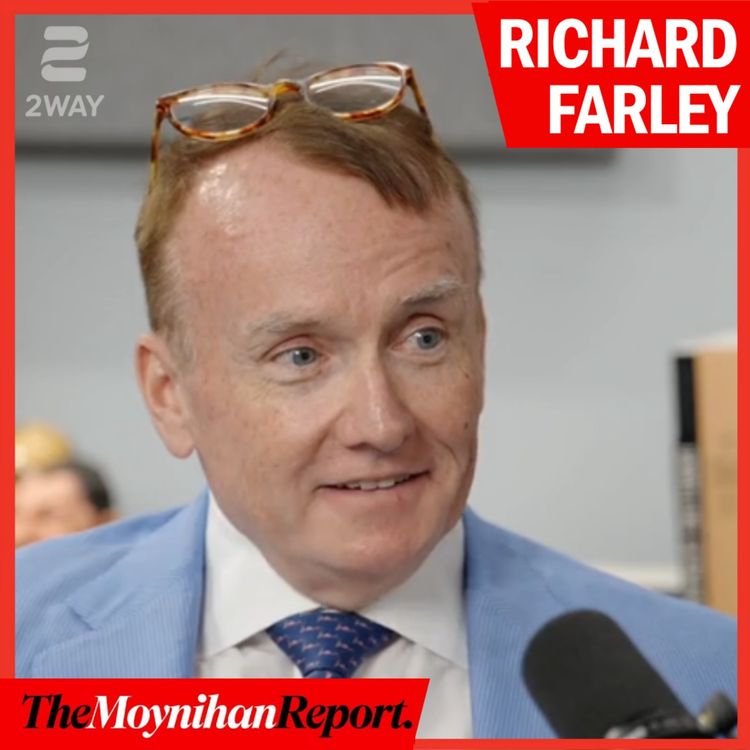
"Drop Dead" author Richard E. Farley on power and graft in NYC | The Moynihan Report
Season 1, Ep. 35
•
Michael is joined by New York attorney Richard E. Farley, author of "Drop Dead: How a Coterie of Corrupt Politicians, Bankers, Lawyers, Spinmeisters, and Mobsters Bankrupted New York, Got Bailed Out, Blamed the President, and Went Back to Business as Usual (And It Might Be Happening Again)"
Subscribe to The Moynihan Report on YouTube.
(00:00) Introduction
(01:00) NYC Economy
(08:05) Corruption and Influence
(24:36) Roy Cohn
(27:30) Lawyers of NY
(31:06) Corruption in America
(32:35) Donald Trump
(33:52) Roger Stone
(36:02) Jeffrey Epstein
(42:52) Ghislaine Maxwell
(45:02) Conspiracy Theories
(51:41) Final Thoughts
More episodes
View all episodes
83. Have a conversation with Michael Moynihan | The Moynihan Report
01:16:38||Season 1, Ep. 83In the final episode of The. Moynihan Report, Michael Moynihan takes a deep dive into the "stupid era" of modern media and the weaponization of history. From the useful idiots romanticizing the Cuban regime to the decline of the public intellectual in favor of the hyper-reactive influencer, Moynihan dissects how context is lost in our chopped-up media landscape.The conversation moves from the town square test of free societies to the curious parallels between far-left and far-right propaganda. Michael also answers listener questions regarding his tenure at The Fifth Column, his diverging paths with other media figures, and why studying history is the only defense against an epidemic of dangerous stupidity.(00:00) Welcome and Announcement: The Final Episode in This Format (01:16) How to Stay Connected via Substack (01:56) The "Open Swim" Q&A: Addressing Online Criticism (02:35) Confronting "Useful Idiots" and the Trip to Cuba (02:59) Discussing Brace Belden and the TrueAnon Podcast (03:46) Criticizing Hassan Piker and The Young Turks (04:44) The Culture of Chopped-Up Media and Contextual Misunderstandings (06:08) Natan Sharansky’s "Town Square Test" for Free Societies (08:17) Debunking Pro-Castro Myths and the Reality of Cuban Repression (12:59) The Exoticization of Poverty and Propaganda Tours (14:18) Examining Cuban Foreign Policy and Historical War Crimes (16:13) Fact-Checking Ryan Grim and Misinformation Regarding Cuban Hotels (20:18) Audience Question: The Similarities Between Far-Left and Far-Right Propaganda (23:48) Douglas Murray and the Challenges of Independent Journalism (25:07) Paul Hollander and the Psychology of Anti-Americanism (27:29) Documenting Russian Casualties in the Ukraine War (30:12) Audience Question: The Rise of Influencers Over Public Intellectuals (32:42) The Benny Johnson Plagiarism Scandal and "Deep State" Narratives (35:43) Victor Klemperer and the Manipulation of Language (39:26) Audience Question: Diverging Paths with Megyn Kelly (43:41) The "Real Housewives" of Conservative Politics: TPUSA and Candace Owens (46:12) Reflecting on Ten Years of The Fifth Column (48:33) Audience Question: Anti-Semitism and the Influence of the Israel Lobby (55:10) Analyzing Public Support and Bipartisan Policy Toward Israel (59:37) Audience Question: Why We Study History and the "Weaponization" of the Past (01:10:39) Distorting Figures like Winston Churchill and Oswald Mosley (01:13:58) Final Sign-off: Shaking Up the Snow Globe
82. Iran, Israel, & a new era of political violence | The Moynihan Report
01:03:24||Season 1, Ep. 82Eli Lake of The Free Press joins Michael Moynihan to break down his latest reporting on Donald Trump’s strategy toward Iran—what the administration is trying to achieve, how serious the military threat is, and what it could mean for the region.They’ll unpack the policy, the politics, and the risks of escalation.(00:11) Intro & Recent Violent Attacks (03:27) Welcoming Eli Lake & Trump's Iran Plan (11:41) The "Day After" in Iran & Regime Change Scenarios (15:25) The History of Iranian Protests & State Violence (23:43) October 7th, Hamas, & Western Leftist Support for Iran (26:09) Critiquing Tucker Carlson & the "Israel Controls America" Narrative (32:03) Israeli Intelligence, Operations, & Military Subsidies (38:42) Megan Kelly, Ryan Grim, & Justifying Anti-Semitism (54:29) MAGA Polling on Iran & Independent Media Conspiracies (01:01:42) Show Wrap-up & Upcoming Automation Nation Event
81. Iran, War, and the Nuclear Panic Machine | The Moynihan Report
01:04:12||Season 1, Ep. 81The Moynihan Report is an in-depth 1-on-1 interview program broadcast live from 2WAY’s New York studio The U.S. says it is not a war. Reality looks different. Ships are being sunk in international waters. Militias are firing rockets across the region. Drones are crisscrossing the skies. Assassinations have become an instrument of statecraft. And the Strait of Hormuz, the narrow chokepoint through which roughly a fifth of the world’s oil flows, is more dangerous than ever.This week we’re joined by Emmy-nominated journalist Caroline Modarressy-Tehrani, former correspondent for VICE News Tonight, to unpack the strange geopolitical standoff between Washington and Tehran and the narrative that seems to hover over it all: the idea that Iran is perpetually on the verge of building a nuclear bomb.(00:00) Introduction & Upcoming "Automation Nation" Live Event (06:16) The Firing of Kristi Noem & DHS Spending Scandals (18:46) Anthropic AI vs. The Department of Defense (24:14) Middle East Conflict: Oil Prices & Iran's Expanded Retaliation (29:06) Interview with Caroline Modarressy-Tehrani Begins (31:02) The Mood in Iran: Internet Blackouts & Cautious Optimism (38:28) The Lack of a US "Grand Plan" for Post-Regime Iran (42:56) The Plight of Political Prisoners & Evin Prison Strikes (48:35) Civilian Casualties & Controlling the Information War (54:21) Caroline's Family History, US Moral Responsibility, & Book Recommendations(1:03:23) Closing Remarks
80. Epstein 101 with Arick Fudali | The Moynihan Report
01:01:13||Season 1, Ep. 80Attorney Arick Fudali, managing partner at The Bloom Firm and counsel for 11 survivors of Jeffrey Epstein, joins us to break down the latest controversy surrounding the DOJ’s release of millions of pages of Epstein documents. Fudali has said publicly that his clients were never contacted by the DOJ before the recent document dump, calling the rollout a “gross mishandling” that risks exposing survivors while withholding key information.We discuss what the files reveal, what’s still missing, and why survivors’ advocates say the process falls short on transparency, accountability, and basic protections.
79. Jason Zengerle author of Hated by All the Right People: Tucker Carlson | The Moynihan Report
01:00:51||Season 1, Ep. 79Michael welcomes Jason Zengerle to discuss his new book, Hated by All the Right People: Tucker Carlson and the Unraveling of the Conservative Mind. The book traces Carlson's ascendency, and explains how he became one of the most influential people on the far right.Buy the book!
78. What happened last week with Colby Hall | The Moynihan Report
56:23||Season 1, Ep. 78Michael Moynihan is joined by Colby Hall, founding editor of Mediaite, for a wide-ranging discussion on the news of the day — including the release of the Melania Trump movie and what early projections suggest about turnout and ratings. Expect a sharp, candid exchange on media, politics, and what’s actually breaking through right now.
77. The age of American Fascism? Oxford Professor Explains | The Moynihan Report
01:00:57||Season 1, Ep. 77What do we actually mean when we say “fascism,” and who gets to decide?In this episode, Michael Moynihan is joined by Professor Roger Griffin of Oxford Brookes University, one of the world’s foremost scholars of fascism, for a careful and unsparing look at a claim now ricocheting through American media and politics: that Donald Trump represents a fascist turn in U.S. history.The conversation engages directly with Jonathan Rauch’s recent Atlantic essay, “Yes, It’s Fascism,” and uses it as a jumping-off point to interrogate the term itself. What distinguishes fascism from authoritarianism, populism, or demagoguery? How do historians and political theorists define it? And when those definitions are applied rigorously, does Trump qualify?This is not a debate by slogan or vibe. It is an attempt to slow the moment down, clarify the language, and examine the charge with scholarly precision rather than panic or partisanship.Atlantic essay referenced:https://www.theatlantic.com/ideas/2026/01/america-fascism-trump-maga-ice/685751/
76. Trump at the WEF, defining fascism, Hitler revisionist history, + more | The Moynihan Report
01:04:53||Season 1, Ep. 76In this episode of The Moynihan Report, Moynihan tackles the latest New York Times/Siena poll regarding Donald Trump’s approval ratings and the American economy. Moynihan breaks down the disparity between Trump’s overall numbers and his low approval on specific issues like the Russia-Ukraine war and the Epstein files. The conversation then pivots to a critical look at the economic impact of tariffs, citing recent data from the Wall Street Journal on who actually foots the bill for trade wars.Listeners join the show to discuss heavy-hitting historical and political topics. The discussion covers the definition of fascism versus authoritarianism (and whether modern labels fit Trump), the forgotten contributions of Danish soldiers in the War on Terror, and a deep dive into historical revisionism with Brendan Simms’ biography of Hitler. The episode concludes with a nostalgic look at intellectual combat, featuring William F. Buckley, Norman Mailer, and the classic documentary Town Bloody Hall.Key Questions Answered in This Episode:1. What does the latest NYT/Siena poll say about Trump’s approval? 2. Who really pays for tariffs: China or the American consumer?3. Is buying gold and silver a solution to the U.S. National Debt? 4. What is the difference between Fascism and Authoritarianism? 5. What is Brendan Simms’ theory about Hitler’s motivation? 6. Did Denmark fight in the War on Terror? 7. Who won the debate between Norman Mailer and Feminists in Town Bloody Hall?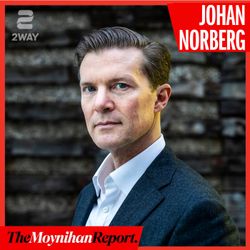
75. Everything MAGA gets wrong about economics | The Moynihan Report
01:05:33||Season 1, Ep. 75This episode of The Moynihan Report features Swedish author Johan Norberg, who joins Moynihan to discuss the shifting global economic and political landscape in 2026. The conversation begins with a critical look at U.S. trade policy, where Norberg argues that recent tariffs act as a "stupid consumption tax" that harms American manufacturing by raising the cost of input materials. Contrary to the America First narrative, he contends that these costs are absorbed by consumers and businesses rather than foreign exporters, fueling inflation that remains higher in the U.S. than in Europe. While the world has avoided a 1930s-style trade collapse so far by not retaliating, Norberg warns that new threats of tariffs on European nations could trigger a more damaging trade war.Transitioning to his home country, Norberg dispels the myth of Sweden as a socialist paradise, explaining that its wealth was actually built on a century of ruthless free market capitalism before the stagnation caused by 1970s socialist experiments. He notes that while Sweden is a large welfare state, its tax system is less progressive than America's, relying heavily on taxing the middle class and consumption rather than "soaking the rich." The discussion also touches on the geopolitical fallout of U.S. aggression toward Greenland, which Norberg suggests marks the end of the American world order. This instability is driving European nations to rearm and even consider nuclear deterrents, while global markets begin diversifying away from the U.S. dollar due to perceived political risk. Finally, they address the paradox of capitalism's declining popularity among young people despite creating unprecedented abundance, which Norberg attributes to a deep-seated human bias toward viewing wealth as a zero-sum game.