Share

Moneylife News Bites
The ‘Golden Age’ Theory of Indian Stock Market
Is India’s stock market entering a “Golden Age” — or is that narrative too optimistic?
In this audio, Debashis Basu examines a popular theory circulating in financial circles: that India is poised for decades of 8% growth, low inflation and a stable rupee, creating extraordinary returns for foreign investors. The idea suggests global funds could potentially multiply their investments many times over the next two decades.
But how realistic are these assumptions?
Debashis Basu breaks down the structural challenges that make this thesis questionable — including weak private investment, the difficulty of shifting labour out of agriculture, uneven education quality, regulatory complexity, infrastructure bottlenecks and a shallow corporate bond market. He also explains why the relationship between inflation and rupee depreciation is far weaker than commonly believed.
The result is a nuanced look at India’s economic trajectory and why simplistic narratives about a guaranteed boom can mislead investors.
More episodes
View all episodes

Why HDFC Bank Chairman’s Cryptic Exit Comment Demands Introspection
12:42|A single cryptic resignation at HDFC Bank wiped out over ₹1 lakh crore in market value—raising serious questions about governance, disclosure, and market sensitivity.In this audio, Sucheta Dalal breaks down why the abrupt exit of chairman Atanu Chakraborty triggered panic, how unclear communication can destabilise even India’s strongest banks, and what this episode reveals about deeper systemic risks.From parallels with past banking shocks like IL&FS and RBL Bank, to the growing danger of digital-era bank runs, this is a critical look at why trust—not just capital—is the backbone of banking.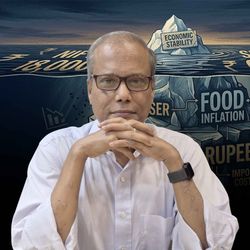
268. Gulf War: Are the Effects Priced in?
16:46||Ep. 268As tensions escalate in West Asia, markets have already reacted—but have they fully priced in the real impact?In this insightful analysis, Debashis Basu breaks down how the ongoing conflict and disruption of the Strait of Hormuz could trigger far deeper economic consequences for India than what we see today.From rising crude prices and supply chain disruptions to hidden second- and third-order effects on food inflation, fertiliser costs, aviation, consumer goods and fiscal stability—this video explains why the real shock may still be ahead.With India heavily dependent on energy imports through Hormuz, even a temporary disruption can set off a chain reaction across sectors, impacting inflation, growth, government finances and household spending.Are investors underestimating the risks?
267. Is Health Insurance in India Failing You?
16:46||Ep. 267India’s health insurance system is under serious strain — and it’s the middle class that is paying the price.Premiums have surged by 50%–200% in just three years, but when it comes to claims, policyholders are facing delays, partial payouts, and outright rejections. What was meant to be financial protection is increasingly becoming a source of stress during medical emergencies.Despite regulations by IRDAI — including timelines for approvals and caps on premium hikes — enforcement remains weak. Mis-selling by banks, opaque policy terms, outdated coverage limits, and unchecked hospital billing practices have created a system where:- Insurers minimise payouts- Hospitals maximise billing- Consumers are left stuck in betweenWith a 73% health protection gap and rising medical inflation, even those who are insured are discovering that coverage may not be enough when it matters most.Is health insurance still a safety net — or just an expensive illusion?
266. SEBI's Year After Storm: Calm, Reform & Unfinished Business
14:33||Ep. 266Has India’s market regulator truly turned a corner?In this audio, Sucheta Dalal examines the first year of SEBI chairman Tuhin Kanta Pandey after a turbulent period for the regulator. While the year has been marked by stability and dozens of regulatory changes, key reforms remain pending.From the delayed conflict-of-interest code for SEBI’s leadership to the unresolved enforcement case involving Jane Street, important questions remain about transparency, accountability and the future of India’s rapidly expanding derivatives market.The discussion also explores SEBI’s crackdown on finfluencers, the long-awaited move toward listing the NSE, and the deeper structural issues facing Indian markets.Has SEBI truly rebuilt credibility—or is the harder work still ahead?
264. सावधान! ये साधारण दिखने वाले चश्मे आपकी हर हरकत रिकॉर्ड कर सकते हैं |
05:50||Ep. 264आजकल AI-powered smart glasses तेजी से लोकप्रिय हो रहे हैं। लेकिन क्या आप जानते हैं कि कुछ स्मार्ट चश्मों में लगे कैमरे आपकी जानकारी के बिना वीडियो रिकॉर्ड कर सकते हैं?हाल ही में प्रकाशित एक जांच रिपोर्ट में खुलासा हुआ कि AI स्मार्ट ग्लासेस से रिकॉर्ड हुए वीडियो क्लिप्स को human reviewers देख सकते हैं, ताकि AI सिस्टम को बेहतर बनाया जा सके। इसका मतलब है कि कई बार ऐसे वीडियो भी देखे जा सकते हैं जिनमें लोग अनजाने में रिकॉर्ड हो जाते हैं।
263. Enforcement as Punishment: The Cost of Investigation Overreach
16:14||Ep. 263The arrest of Fino Payments Bank MD & CEO Rishi Gupta in a GST case has triggered fresh concerns about enforcement overreach in India.Angel investor TV Mohandas Pai publicly questioned the action, tagging Finance Minister Nirmala Sitharaman, who responded that she would examine the issue. Yet the incident raises deeper questions: Are enforcement agencies increasingly using arrest as a tool even before establishing clear evidence?The controversy comes alongside a major Delhi court judgement discharging 23 accused in the widely publicised Delhi excise policy case, where the court criticised investigators for relying on conjecture rather than solid proof after years of incarceration.In this audio, Sucheta Dalal examines a troubling pattern where the process itself becomes punishment—through arrests, prolonged investigations and delayed justice. With millions of pending cases and a prison system dominated by undertrial prisoners, the debate over accountability in enforcement powers has never been more urgent.
262. India’s Education Crisis: Fake Data, Degrees, Claims
15:43||Ep. 262At the India AI Impact Summit 2026, a claim by Galgotias University about developing a robotic dog triggered nationwide embarrassment and sparked a larger debate about credibility in India’s education system. The incident exposed deeper concerns about inflated research claims, patent filings for rankings, manipulated placement data and regulatory gaps.In this episode of Crosshairs, Sucheta Dalal examines how the problem stretches across the spectrum—from fake universities identified by the UGC, to internship certificate rackets, to allegations of gaming research metrics and placements by elite institutions. Drawing on data analyses, RTI findings and recent reports, the article also highlights troubling trends in primary education, including school closures, falling enrolment and concerns raised in ASER 2024.When rankings, patents and enrolment numbers become ends in themselves, what happens to quality, credibility and competence? Watch this detailed analysis of India’s education crisis—from fake data to fake degrees and fake claims.
261. Small Caps: Strength through Adversity
07:00||Ep. 261India’s stock market is witnessing a striking paradox. Large-cap stocks appear resilient despite weak earnings growth, while small- and micro-cap companies—many reporting strong sales and profit growth—have seen their stock prices decline sharply. In this analysis, Debashis Basu examines how this divergence emerged after the September 2024 peak, the impact of reduced government capex, US tariffs, FII outflows, rupee weakness, and slowing consumption, and why market underperformance has been more severe beneath the surface.Drawing on the latest quarterly data, he highlights how Nifty Smallcap and Microcap companies have delivered robust operating and net profit growth, in sharp contrast to muted performance from Nifty 50 heavyweights. With valuations correcting and fundamentals improving across several quality small-cap businesses, the video explores whether we may now be approaching a phase of small-cap outperformance and continued large-cap stagnation.Is this the beginning of a reversal in market leadership? Watch to understand the data, the risks, and the potential opportunity.