Share
Minding Memory
Exploring Research on Alzheimer’s Disease and other Types of Dementia
Latest episode
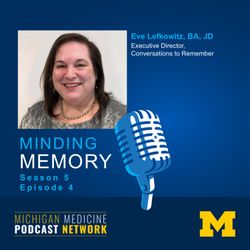
4. Addressing Senior Social Isolation in the Community
38:30||Season 5, Ep. 4In this episode, Matt & Lauren build off their previous conversation with Ashwin Kotwal about social isolation by speaking with Eve Lefkowitz, the Executive Director of the non-profit organization, A Conversation to Remember, which connects older adults – including those who live with cognitive decline – with young adult college students to combat the epidemic of social isolation and loneliness. Lauren & Matt learn about the populations this non-profit serve as well as perspectives on how to address social isolation with older adults. Episode TranscriptResources:c2r.chat: Conversations to RememberYou can subscribe to Minding Memory on Apple Podcasts, Spotify, or wherever you listen to podcasts.
More episodes
View all episodes
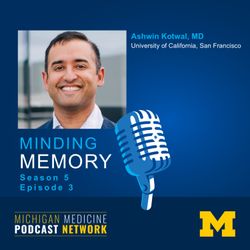
3. The Impact of Social Isolation and Loneliness on Cognitive Health
35:39||Season 5, Ep. 3In this episode we're going to discuss a topic that's increasingly recognized as central to cognitive health and social connection. We'll define what it is and what happens when it's missing. Social isolation and loneliness are now widely discussed as public health concerns, and evidence has really mounted that social disconnection has profound effects on health, including cognitive decline and dementia risk. To help us think through this, we're joined by Dr. Ashwin Kotwal, a geriatrician and health services researcher at UCSF and the director of the Social Connections and Aging Lab. His work examines how social relationships shape aging related outcomes, including cognitive health, disability, and mortality. The transcript for this episode can be found here.Additional Links: Ashwin Kotwal Faculty Profile Social Connections & Aging Lab @ UCSF Relevant Articles: Kotwal AA, Cenzer IS, Yaffe K, Perissinotto C, Smith AK. End-of-life health care use among socially isolated and cognitively impaired older adults. J Am Geriatr Soc. 2023 Mar;71(3):880-887. doi: 10.1111/jgs.18131. Epub 2022 Nov 23. PMID: 36420540; PMCID: PMC10023302. Kotwal AA, Allison TA, Halim M, Garrett SB, Perissinotto CM, Ritchie CS, Smith AK, Harrison KL. "Relationships, Very Quickly, Turn to Nothing": Loneliness, Social Isolation, and Adaptation to Changing Social Lives Among Persons Living With Dementia and Care Partners. Gerontologist. 2024 Apr 1;64(4):gnae014. doi: 10.1093/geront/gnae014. PMID: 38499400; PMCID: PMC10948338. Kotwal AA, Cenzer I, Hunt LJ, Ankuda C, Torres JM, Smith AK, Aldridge M, Harrison KL. Psychosocial distress among spouses of persons with dementia before and after their partner's death. J Am Geriatric Soc. 2024 Aug;72(8):2336-2346. doi: 10.1111/jgs.19030. Epub 2024 Jun 1. PMID: 38822746; PMCID: PMC11323186. You can subscribe to Minding Memory on Apple Podcasts, Spotify, or wherever you listen to podcasts.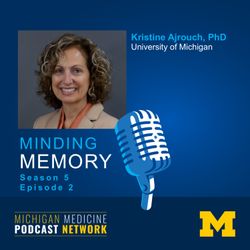
2. Convoys of Caregiving: Arab American Families Living with Dementia
40:02||Season 5, Ep. 2In this episode, Matt & Lauren speak with Kristine Ajrouch, PhD - a new member of our CAPRA leadership team. Kristine is a Research Professor at the Institute for Social Research whose work focuses on aging, health, immigration and family in the United Statues and the Middle East; social networks over the life course; and Arab American identity and well-being. Kristine discusses a recent article that examined an intervention to improve outcomes among Arab American caregivers who provide care to a family member living with dementia. She also shares what this work teaches us about caregiving as a family system rather than the responsibility of a single individual. The transcript for this episode can be found here. Link of Interest: Kristine Ajrouch Faculty Profile Article referenced in podcast: Ajrouch KJ, Barada FM, Janevic MR, Antonucci TC. Supporting Arab-American Families Living With Dementia: Testing a Culturally Adapted Program. J Appl Gerontol. 2025 Apr;44(4):515-519. doi: 10.1177/07334648241281153. Epub 2024 Sep 23. PMID: 39313309. You can subscribe to Minding Memory on Apple Podcasts, Spotify, or wherever you listen to podcasts.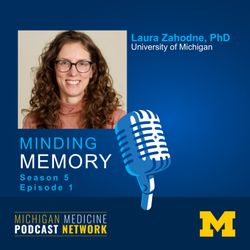
1. Neighborhood Income and Cognitive Health
26:42||Season 5, Ep. 1Welcome back to Minding Memory! In today’s episode, Lauren & Matt speak with Dr. Laura Zahodne – a professor of psychology at the University of Michigan and an affiliate of the Institute for Social Research. She's a clinical neuropsychologist by training and studies how psychosocial experiences shape late life, cognitive health, and risk of neurodegenerative disease. Also, a new member of our CAPRA leadership team! In this episode, we’ll get to know Laura a little better and talk with her about one of her research studies, the Neighborhood Racial Income Inequality in Cognitive Health, which looks at the association between racial income differences and a variety of cognitive measures. The transcript for this episode can be found here. Links of Interest: Laura Zahodne Faculty Profile Introduction to the Michigan Cognitive Aging Project Articles Referenced in Podcast: Zahodne LB, Sol K, Scambray K, Lee JH, Palms JD, Morris EP, Taylor L, Ku V, Lesniak M, Melendez R, Elliott MR, Clarke PJ. Neighborhood racial income inequality and cognitive health. Alzheimers Dement. 2024 Aug;20(8):5338-5346. doi: 10.1002/alz.13911. Epub 2024 Jun 27. PMID: 38934219; PMCID: PMC11350017. Hu Y, Elliott MR, Meier HCS, Chen L, Walters ME, Sol K, Zahodne LB. The impact of census-tract level mortgage discrimination on cognitive function: accounting for measurement instability in small-area data via joint modeling. Am J Epidemiol. 2025 Nov 4;194(11):3258-3266. doi: 10.1093/aje/kwaf131. PMID: 40522478; PMCID: PMC12634109. You can subscribe to Minding Memory on Apple Podcasts, Spotify, or wherever you listen to podcasts.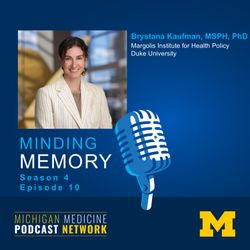
10. An Introduction to the Guiding an Improved Dementia Experience (GUIDE) Model of Care
32:34||Season 4, Ep. 10In today’s episode, Matt and Lauren discuss the new CMS GUIDE model for dementia care with Dr. Brystana Kaufman, MSPH, PhD – a health services researcher at the Duke-Margolis Institute for Health Policy at Duke University. The GUIDE model aims to improve the quality of life for people living with dementia by reducing strain on caregivers and enabling individuals to remain in their homes. Brystana talks with the Minding Memory team about a spectrum of topics as related to the GUIDE model including, what motivated CMS to develop and implement the model; what defines a serious illness; how the model supports caregivers; and what an organization needs to have in terms of services in order to participate in the implementation of the GUIDE model. Dr. Kaufman is the co-author of an article in the Journal of the American Geriatrics Society titled “GUIDE Dementia Model: Opportunities for Serious Illness Care” which provides additional insight into the model. Episode Transcript Brystana Kaufman, PhD, MSPH Faculty Profile Article referenced in this episode: Kaufman BG, Grant M. GUIDE dementia model: Opportunities for serious illness care. J Am Geriatr Soc. 2024 Jun;72(6):1935-1938. doi: 10.1111/jgs.18787. Epub 2024 Feb 5. PMID: 38315037. Additional Resources: Guiding an Improved Dementia Experience (GUIDE) Model Health and Aging Policy Fellows You can subscribe to Minding Memory on Apple Podcasts, Spotify, or wherever you listen to podcasts.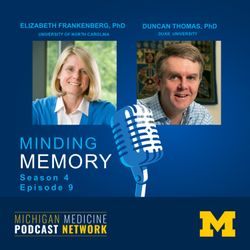
9. Exposure to a Natural Disaster and Long-term Cognition
46:41||Season 4, Ep. 9In this episode, Matt and Lauren speak with Drs. Elizabeth Frankenberg at the University of North Carolina at Chapel Hill and Duncan Thomas at Duke University about their research which focuses on understanding how survival and physical health evolve after exposure to large scale shocks like the 2004 Indian Ocean Earthquake and Tsunami. They will specifically speak about the STAR Study and what they’re learning about long-term effects on cognitive outcomes. Faculty Profiles: Elizabeth Frankenberg, PhD Duncan Thomas, PhD Resources from the Episode: Study of the Tsunami Aftermath and Recovery (STAR) STAR Study Design and Results The transcript for this episode can be found here.You can subscribe to Minding Memory on Apple Podcasts, Spotify, or wherever you listen to podcasts.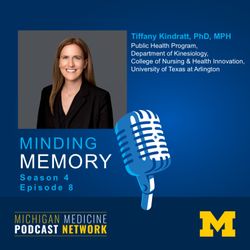
Identifying Cognitive Difficulty among Middle Eastern and North African (MENA) Americans
32:23|In this episode, Matt and Lauren speak with Dr. Tiffany Kindratt whose research focuses on examining health outcomes among the Middle Eastern and North African (MENA) population, a group that was – until recently – categorized as “white” by the US government despite. Evidence showing their health and lived experiences are different. We’ll get into a recent American Journal of Public Health article authored by Dr. Kindratt that that examines how cognitive difficulties differ among the MENA population when compared with other racial and ethnic categories. Faculty Profile: Tiffany Kindratt, PhD, MPH Health Survey Research (HSR) Lab @ University of Texas at Arlington American Community Survey (ACS) AJPH Article: Kindratt TB, Smith A. Cognitive Difficulty in Middle Eastern and North African Adults Living in the United States Compared With Other Racial and Ethnic Categories, 2017-2021. Am J Public Health. 2024 Nov;114(11):1265-1274. doi: 10.2105/AJPH.2024.307803. PMID: 39357001; PMCID: PMC11447784. The transcript for this episode can be found here.You can subscribe to Minding Memory on Apple Podcasts, Spotify, or wherever you listen to podcasts.