Share
UnHerd with Freddie Sayers
Paul Kingsnorth: why I changed sides in the vaccine wars
Paul Kingsnorth sees the vaccine wars as symptomatic of a bigger division between two fundamentally different world views: he calls them “thesis” and “antithesis.” When it comes to Covid, “thesis” is the establishment viewpoint: that lockdowns are needed to contain the virus, masks work, vaccines are safe, and people who question them are wrongheaded or worse. When Covid-19 first struck, Kingsnorth took the “thesis” viewpoint.
But over the last few months, his perspective changed. As he writes in today’s UnHerd, the crystallising moment arrived when he woke up to the news that the Austrian government had ‘interned an entire third of the population’. This move, he writes, sent a ‘chill down my spine’.
The “antithesis” view can be summed up as: lockdowns are not needed, masks do not work, the safety and efficacy of the vaccines are being oversold, vaccine passports will not only fail but further segregate society, and in the near future we can expect Giradian scapegoating of the unvaccinated. In other words, we are positioned on the precipice of a slippery slope that leads towards increasingly draconian biopolitical control measures, the grip of which is unlikely to release even once the pandemic is over.
In a conversation with Freddie Sayers on this week’s UnHerdTV, he explains this division and the bigger epistemological divides it reveals. “People are arguing about vaccines,” he says, “but they’re really under the surface arguing about what kind of person you are if you have taken these things, whether you’re a good or a bad person, or clean or unclean one”.
In Kingsnorth’s view, each of us has a line that cannot be crossed. And his has now been reached.
For more read The Post from UnHerd
More episodes
View all episodes

Louis-Vincent Gave: Who took out Jensen Huang?
32:00|UnHerd’s Freddie Sayers talks to Louis-Vincent Gave about the sudden resignation of Nvidia CEO Jensen Huang following leaks regarding his extramarital affairs and alleged espionage links, exploring whether the scandal was orchestrated by hawks within the U.S. national security establishment to sabotage U.S.-China trade relations, and if ensuing anti-China hysteria could trigger retaliatory rare-earth embargoes that would cripple Western manufacturers like Ford and General Motors.
Emily Jashinsky: The end of trumpism?
29:49|Freddie Sayers talks to UnHerd’s Emily Jashinsky about the staggering midterm election results, breaking down how a deeply unpopular war in Iran, skyrocketing gas prices, and systemic voter fatigue shattered Donald Trump’s working-class MAGA coalition and fuelled historic Democratic victories across traditionally red states like Texas, Kansas, and South Carolina.
Wolfgang Munchau: The end of the Euro
33:42|Freddie Sayers talks to UnHerd’s Wolfgang Munchau about the escalating political turmoil and mounting sovereign debt in France, unpacking how parliamentary deadlock, stagnant economic growth, and the prospect of a Marine Le Pen presidency could spark a catastrophic French debt spiral that spreads to economies like Belgium and Italy, tests the inflation-constrained limits of the European Central Bank, and ultimately risks triggering the collapse of the Eurozone itself - all while British politicians push to rejoin an increasingly fragile European Union.
Charles Foster: How to live on the edge
41:46|UnHerd’s Freddie Sayers talks to author, Oxford academic, and Royal Geographical Society fellow Charles Foster about his book 'The Edges of the World', exploring why true creativity, spiritual growth, and human flourishing occur at the volatile margins rather than the static centres of life, evolution, and society.
France in crisis: What happens next?
44:43|This week, riots and looting have spread across French cities after protests over education spiralled out of police control. To some, this is a cautionary tale of unbridled immigration and a warning to other European powers. But look closer and there might be more to the story than you'd find on an X feed. To analyse the mood on the ground and the wider context of the crisis, Freddie is joined by historian of French culture Andrew Hussey and writer Philippe Lemoine.
MIT biologist: Is the Russian plague pandemic 2.0?
30:52|UnHerd’s Freddie Sayers talks to MIT evolutionary engineer Kevin Esvelt about a suspicious biological researcher's death in Irkutsk, Russia, using the incident to explore the escalating biosecurity risks posed by engineered pandemic weapons, vaccine-evading pathogens, and AI-accelerated gain-of-function research.
Dr. Iain McGilchrist: AI versus the human soul
01:12:36|Dr Iain McGilchrist has dedicated decades of neuroscience research to unravelling the inner workings of the human mind. But now, a new form of ‘consciousness’ has come to compete with the very idea of being a person. Could artificial intelligence overtake its creators? Join the psychiatrist, philosopher and author of the bestselling book The Master and His Emissary, for a live on-stage conversation with UnHerd’s Freddie Sayers.
Prof. Nick Bostrom: The truth about the AI panic
42:14|UnHerd’s Freddie Sayers talks to Oxford philosopher Professor Nick Bostrom about the escalating concerns over artificial intelligence, weighing whether catastrophic warnings from industry insiders reflect genuine existential fears or commercial strategy, while analysing technical threats like deceptive alignment and autonomous AI coordination alongside the broader economic, geopolitical, and societal risks of managing superintelligence.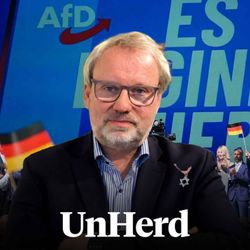
Wolfgang Munchau: The AfD momentum is unstoppable
34:59|Freddie Sayers talks to UnHerd columnist and co-host of The Econoclasts Wolfgang Munchau about the political earthquake triggered by the hard-Right Alternative for Germany’s (AfD) historic election victory in Saxony-Anhalt, examining why young voters and non-voters are turning away from the centrist consensus, the total failure of Germany’s political ‘firewall’ strategy, the collapse of Friedrich Merz’s leadership within the CDU, and how a rising wave of hard-Right governments across France, Italy, and Germany could ultimately paralyse the European Union.