Share
This Sustainable Life
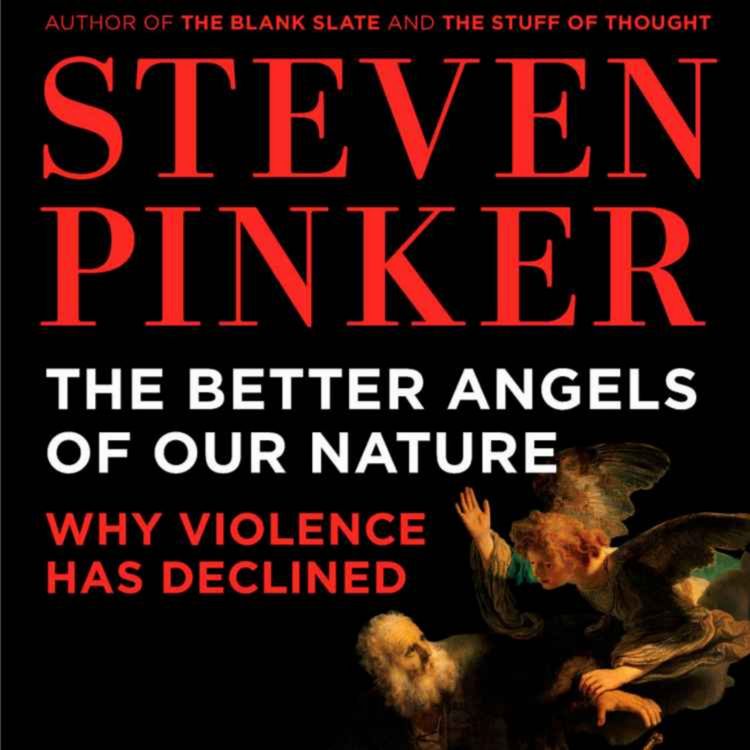
492: Did Steven Pinker's Better Angels of our Nature miss why we're less violent?
Here are the notes I read from:
Comments on Better Angels of Our Nature
I finally finished Steven Pinker’s Better Angels of Our Nature. I started it more than skeptical of its main thesis. The book is 800 pages long, so I’m sure I’ll oversimplify and not do it justice, but I recommend it so you can get his full message. He says that we are living in the least violent time in history and it was due to enlightenment values of classical liberalism. I was sure he’d missed some important issue or discounted the risk of nuclear war or pandemic. I’d find some flaw in his analysis.
On the contrary, the more I read, or listened to to be precise, the more compelling I found his case. I won’t recapitulate the whole thing, but I agree with his thesis, if I’m not oversimplifying, that we live in the least violent time and it’s due to classical liberalism.
What caused liberalism is another question. He spent time looking for exogenous causes. After all, humans were human when we were more violent and now that we’re less violent. Did something change? One main cause he found was the development of printing. Printing spread ideas. Some cultures adopted it and others didn’t so observing their different evolutions suggested its value. I agree printing was a major cause.
In this episode, I want to suggest a major potential point he barely touched on, but that 1. I believe is a greater cause, or at least worth considering more, and 2. if we miss this cause, we miss other effects, especially if the cause disappears. More importantly, this cause may be changing today, and if we misunderstand it, if a critical pillar of support goes away, we could lose everything we’ve gained and a lot more.
Reading from The Smithsonian Magazine and The Nation:
People risked their jobs whose cash flows dwarfed mere dollars to scramble for them.
With that historical example in your mind, imagine this fictional scene: a battle where suddenly manna fell from heaven. By manna, I mean something that satisfies all your wants. You can kill the guy next to you or gather manna. Once everyone starts gathering manna, who wants to fight and risk being killed when you can gather more? Now imagine you learn that not only will tomorrow bring more manna, but so will the next year, decade, generation, century, and as far as anyone can foresee.
Would you expect people to fight less? I would. Would they not devote themselves to more liberal pursuits in the traditional sense of the word—culture, arts, learning, trade? I believe humans with an unending supply of manna would trace the path Steven Pinker’s book described.
Well, the manna started appearing over 500 years ago. Well, before written history, people knew of coal, but our ancestors really started learning its utility, though not its potential global danger, centuries before the Industrial Revolution. That foundation, among others, eventually enabled the Industrial Revolution to happen.
Most people attribute the gains of the Industrial Revolution to human ingenuity in creating machines, economic systems, political systems, and so on. They built machines to cross oceans and continents, manufacture things to scrape the sky, and so on, enabling people to work in teams as large as nations. Sure, humans were ingenious, but imagine a locomotive or steamboat without coal. Ingenuity doesn’t boil water to make steam. It tells you how, but we didn’t create the coal. We found it.
Besides increased liberal pursuits, would you not have more kids, especially if your neighbors did? After all, your need to work to feed them or bequeath them land just dropped precipitously. If everyone you knew had just learned of two new continents, isn’t that manna in the form of real estate?
Of course, independent of fossil fuel and real estate manna, plenty of other advances in science and humanities contributed to the explosion of technology that led to the Industrial Revolution and its material abundance but once Watt's steam engine and Smith's Wealth of Nations kicked in, they were tied together in a cycle driven by that manna.
As long as you take that manna for granted, you might assign the progress to human ingenuity, but we needed the fossil fuels too. Without them we would have had no steamships, no railroads, no steam-powered factories, no coal mines, no substitute for slavery, no artificial fertilizer so no Green Revolution, no solar panels, no nuclear. Just windmills, water wheels, sailboats. Ability to amass armies, navies, and build pyramids and empires.
Even if we discover that the manna will run out—that is, we have limited fossil fuels—a system based on it with enough momentum will sustain itself long after we’d want to stop using it. We can’t easily stop using them today even if we want to. I would say we’re addicted to their results.
Because we now know that the limit to this fossil fuel manna is only partly running of it. Equally, the global danger is that It poisons our air, land, water, and wildlife we depend on, like bees. Burning fossil fuels is lowering Earth’s ability to sustain life. We've used up the space and resources to process that waste and with plastic and toxic chemical increased its toxicity.
Back to Steven Pinker, he searched for an exogenous cause to the changes he described. He found printing as one candidate. Europe's adoption led to its liberalization while Islam's rejection led to its stagnation.
I started his book expecting to find flaw. I thought, “he must not realize how much less violent we are today, or how less stable our peace today is compared to his imagination,” but I found him completely persuasive. I agree we're less violent than ever and the causes all as he suggests.
I grant him everything in his book and offer this one change that I think will strengthen his case, fill in the missing exogenous sources he sought, but change his outlook. While not the only contribution, the fossil fuel manna contributed to everything he described.
I’m not a historian, so I’m only going on broad trends. The timing seems to work. Fossil fuels started kicking in on brightening human futures well before the Industrial Revolution so around the right times and places, as well as not in the wrong times and places. I’m not saying fossil fuels were the only cause, but I expect a major one.
I don't mean to take away from all the achievements he described. They're tremendous, but they depend in part on discovering something we can take no credit for producing and whose deadly side effects, combined with the laws of thermodynamics they helped us discover, force us to choose from stopping accepting the manna or allowing it to kill us. First we didn’t know the side-effects. I don’t blame anyone. But now they are undeniable and incalculably deadly, on the scale of billions.
I believe we can retain the advances fossil fuels helped us discover and achieve without them, but the transition requires time. Had we started transitioning generations ago, with a smaller population and less addiction, we could take time.
If we start today, and we haven't in earnest, well, already nine million died in 2019 from breathing air, a number on par with the Holocaust and Atlantic slave trade, except annual and increasing, so there's no avoiding destruction.
But if we reduce fossil fuel use with everything we've got, we'll face economic shocks. A lot of economists worry about them, but I understand that government management within historical norms could keep those shocks within historical boundaries, as described in JB MacKinnon's upcoming book The Day the World Stopped Shopping, but we can keep from losing billions of lives.
To clarify, by reducing fossil fuels I don't just mean adding more renewable sources. Humans throughout history have met new manna with new growth. So yes we have to produce more energy through renewables, but also shut down what burns fossil fuels first: coal plants, airplane engines, container ships, car engines, artificial fertilizers, and more. To leave it in the ground or risk billions of people dying.
My point is to speak to one person—Steve Pinker—in, I believe, the view of his thesis, that I agree in his view of the better angels of our nature, but I believe those angels were fed on fossil fuels beyond what he recognized. I didn't spend the time in this discussion to reach his rhetorical level, but I hope I crossed enough of a threshold for him to engage on the topic: how much did our society develop from fossil fuels and what happens if we remove them?
I have no self-interest to promote. I'm motivated as much through the wonder I felt at his masterful book. It's almost fifteen years since I read The Blank Slate and loved it. I’ve seen him speak in person and found it riveting. I saw him once in my neighborhood and said hi.
I believe that if he considers this one element, that he will either see flaw in my perspective or not. If he does, I would love to be relieved of my mistaken view. If not, I believe he will feel compelled to consider it more and may even reach the point I have, that it is the most important pursuit anyone could work on.
I think many people don't consider it because, well what can anyone do? Only governments and corporations can make a difference. But believing one's first attempt at a solution won't work is no proof no solution exists. I have found many and would love to pick up from this point.
As I said, he walked right into likely reader disagreement, took it on, and persuaded. I expected to disagree with him. I expect most did. But I agree with him and consider myself educated for it, plus admire his research and writing skills. If I’m off point or he considered it, I hope to learn what I missed. If I hit something critical, I’d love to engage him further on how to spread word of the danger.
I’ll put on the page a plot that previous guest Tom Murphy calls his most important plot with a link to his description of it. It shows humanity’s source of energy. Wood and food for hundreds of thousands of years. Then suddenly it shoots up almost instantaneously. Then for the next hundreds of thousands of years, he has a question mark, but makes a strong case there will be a drop.
Question remains: how much of our decreasing violence resulted from blind luck of fossil fuels? Independent of contribution to past, how much of present lack of violence depends on fossil fuels and disregard of pollution? If we remove fossil fuels or take heed of pollution and future looks less abundant than assumptions contributing to peace, do we lose peace? If we believe renewables and nuclear will replace, what if time scale is off -if can't ramp them up as fast as fossil fuels decrease. Problem isn't lack of coal. What if pollution lowers future more than expectations?
Even accepting seamless shift to renewables, positive-sum of future from fossil fuels will disappear. Will our philosophies adjust fast enough?
What if some things can't substitute, like container ships, flying, and artificial fertilizers? What if pollution overwhelms?
Seems to me his thesis may be correct, but if fundamental cause is not human philosophy and if much of the philosophy that was proximate cause resulted from that fundemental cause, and that fundamental cause will disappear or harm than help, then the final takeaway may be to eloquently showcase what we erroneously take credit for and may lose.
Are we sitting on a four-legged stool about to lose one, which might mildly affect our stability? Or a three-legged stool about lose one? Or two or all three?
Not a matter of opinion. Can be quantified, not argued as belief.
But greater issue is what to do if we're about to lose a leg or two of a three-legged stool.
More episodes
View all episodes

863. 863: Robert Parkinson: Tyrants and Rogues: Understanding the Declaration of Independence
01:27:56||Ep. 863I can't help but copy from my blog post on finishing reading Robert's book. It describes what to expect from the first half of our conversation and his book. The second half of our conversation relates the revolutionary era and leadership today applied to a situation that is far closer to their situation then than most people see. We can learn from them.It's tempting to think of our impact on the environment as an issue of technology, legislation, and stewardship. It's about liberty, freedom, equality, democracy, and security, personal and national, which means enforcing the Constitution that Robert's book conveys the foundation for.Here's my comments on his book:Wow, I’ve been learning a lot about the revolution, but didn’t realize how much challenge the colonists faced, nor did I learn about the people on the British side.I knew about the big events and interactions that make the history books like the Stamp Tax, Coercive Acts, Boston Massacre, Lexington and Concord, and the ones you know about. I didn’t know about events like the Gaspée affair, the burning of Falmouth, Gwynn’s Island, and all the British aristocracy and military acting. I had only learned about people like Hutchinson, Gage, Dartmouth, and so on as caricatures, not real people. I didn’t know what motivated them.Parkinson points out that as much as we value the timeless words of the start and end of the Declaration of Independence, the rebels and patriots acted on the 27 grievances. I’ve read them before and could pick up some of the meaning behind them, but knew little to no detail. This book recounts what all the colonists knew intimately.Before this book, I had wondered why farmers risked their lives for independence. Sure, they didn’t want to be taxed without representation or imperial soldiers quartered in their homes, but were those things worth dying for? From what I knew before this book, the offenses seemed problematic but something seemed missing. I learned there were far more incidents, many more deadly, and more people involved than I knew of before, yet they drove independence and the revolution.His writing ties many pieces together, so I kept finding names and places affecting each other and being affected by each other. The book read like a tapestry with a rhythm throughout the book. The head of King George from the statue on Bowling Green starts the book and reappears at the end. The boats and people using them going to and from Gwynn’s Island had me going forward and backward like I was reading a mystery novel or a Christopher Nolan movie. The numbers 42, 45, 88, and 92 recur (two refer to years of British revolutions, 1642 and 1688; one is the edition of a publication, 45; and the other is the number of votes supporting a Circular Letter in support of union, 92).Finally, each incident tied back to Jefferson, Franklin, the three other editors, and the congress learning about them, figuring out what to make of them, writing them, editing them, and sending the Declaration to the colonies.Robert's faculty page at SUNY Binghamton
862. 862: Andrew Levy: A role model for today: Robert Carter III freed more slaves than any other American
01:05:32||Ep. 862Regular readers of my blog know how important Robert Carter III has become to me as a role model. He inspires me. I believe this episode will inspire many of you.If you don't know who he is, you're in luck. Here is a post of mine with links to many resources on him: Resources on Robert Carter III. Probably the top thing to know about him is that he is the American who freed the most number of slaves before the thirteenth amendment.Actually, you're in better luck because the first two resources in that post are by today's guest, Andrew Levy. In this episode we talk about Carter, slavery, slave culture, changing culture, his relevance to today, his relevance to my work, and more. It was a pleasure to speak with the person most knowledgeable about him.Andrew shares more than knowledge. For example, he's thought about Carter and today. He asks why we don't remember him more and what that burying says about us.The Anti-Jefferson: Why Robert Carter III Freed His Slaves (And Why We Couldn’t Care Less), by Andrew Levy: This piece was a journal article in the spring 2001 issue of The American Scholar.The First Emancipator: Slavery, Religion, and the Quiet Revolution of Robert Carter, Andrew Levy’s bookI can't recommend these works enough for two reasons: First, Carter exhibits values and actions we can learn from. Second, Andrew covers the man from many angles, all useful. Plus his writing is engaging and readable.
861. 861: Cara Judea Alhadeff, part 1: Actually acting, the joys we feel, and the friction we face
01:02:07||Ep. 861A mutual friend introduced Cara and me. He knew we both were doing our best to live by our values in avoiding hurting others through pollution and depletion.On the face of it, our living situations look different. Her family converted a bus into a home. I disconnected my apartment from the electric grid. We share plenty more in the conversation.Our motivations are similar, which it didn't take us long to bond over. We also face similar misunderstanding and friction from society, especially people who purport to share our values of not hurting people (or wildlife) without consent. Also, people confuse themselves into thinking that because we do what we do, we don't do anything else.More importantly, we also discovered similar joys, rewards, and ways to keep acting.In this conversation, we talk about the joys and challenges of living by our values in a culture that claims to share those values but often rewards behavior that violates them. I don't get to talk to many people with similar situations so it was very refreshing. Feeling understood feels great. I hope you pick up on it.I hope you'll join us too.Cara's homepageHer intersectional nonprofit: Radical Art in ActionHer family's eco-art converted school bus home, using 100% reclaimed materials: The Love Bus: Beauty & Waste In the Face of Climate Crisis (youtube.com), creative, affordable housingS.O.U.L. (Shared Opportunity Used Local) Commons that supports mutual aid economies and gift economies through the local free store she and her partner created for their communityHer book, mentioned in our conversation: Zazu Dreams: Between the Scarab and the Dung Beetle, A Cautionary Fable for the Anthropocene Era: Her cross-cultural, climate justice-through-alternative economies (includes a traveling exhibition and animated film adaptation)
860. 860: Christopher Ryan, part 1: Civilized to Death
01:34:27||Ep. 860The predominant responses to the idea of polluting and depleting less include fears of reverting to the Stone Age, losing civilization, being invaded by aggressive opponents, dying at 30, dying from small cuts, and reverting to a past viewed as worse than today.My upcoming book describes why we feel those fears and why what we fear losing is exactly what we can expect to get more of. A key part of that pattern is that all those fears are false, based on misunderstanding humanity's past.Christopher Ryan's latest book, Civilized to Death, is the clearest, most comprehensive single work describing the past accurately. I spent years researching, learning from countless sources. The results were conclusive, but difficult to communicate. What could I say, "Read these dozens of academic papers and books and watch all these documentaries"?Chris researched more and compiled it more clearly, concisely, and readably than I could have dreamed to. Now I can say, "Read Civilized to Death."I mean it: Read Civilized to Death.Our conversation covers the highlights. It will help you see why you believe legitimizing myths fear changes that when you do them you will only wish you had done them earlier. Things about yourself, humanity, culture, and life will make sense that never did before.Chris's home pageHis books, including Civilized to Death
859. 859: Jack El-Hai: The Nazi, the Psychiatrist, Nuremberg, and Why to Find Humanity in Those We Call Monsters
55:04||Ep. 859How do you make sense of an entire society or nation violating its values? Consider Germany in the 1930s, in which a whole nation seemed to embrace Nazism.It's tempting to say they're all monsters, but how could over 50 million people change in a few years? Not genetics. They must have been no more or less human in 1940 as 1920.It's tempting to say that monsters took over and changed them. Many people thought so. At the end of World War II, a psychiatrist, Douglas Kelley, was sent to evaluate the highest level Nazis who had been captured and were to be tried in the Nuremberg trials. He believed that these leaders must have differed from most people. He wanted to find that difference in order to help prevent people with whatever traits he found from repeating what they did. He was deeply troubled to find no meaningful difference between them and normal results on his tests.Jack El-Hai told Kelley's story in his book The Nazi and the Psychiatrist, including interacting directly with Herman Göring, at one point the second highest ranking Nazi. In our conversation, Jack tells the highlights of his book. I discuss the relevance to polluting and depleting today, where everyone is contributing, violating our own values, but contributing to much more suffering and death than even the Holocaust.We also talk about the movie Nuremberg based on the book, including its stars, Russell Crowe and Rami Malek.Jack's home pageHis book page
858. 858: Beth Bailey, the great-grandmother influencer leading the cleaning of Mérida, Mexico
01:00:57||Ep. 858As a great-grandmother, Beth probably wouldn't describe herself as an influencer, but what else do you call it when videos of her go viral and prompt people to follow her?Longtime podcast listeners may remember episode 754: (Aunt) Trish Ellis and (Niece) Evelyn Wallace, part 1: Not Even Cancer Holds Her Back. We mentioned Beth, Evelyn’s mom and Trish’s sister. All three of them took the workshop. Beth and Evelyn also took my leadership and initiative courses that I offered to workshop alumni.Beth's initiative project was to pick up litter daily, but not just pick it up. She was inspired by an initiative she'd seen to restore pride in a community. For example, I pick up litter, but I just do it to clean where I walk. Her goal was bigger: to restore and inspire pride in where she lives, Mérida, Mexico. She planned things like a sign to invite favorable attention, what to wear, when to go out, how to talk to people.She's been picking up litter since. Then last month, at an alumni online lunch, she shared that someone secretly recorded her, posted the video, and by then the video had been seen over 1 million times. Plus, attention was leading to people joining her movement, opportunity to work with government, and more. I posted about it on my blog: Secret video of Beth picking up litter goes viral in Mexico.I invited her to share here. Listen for what happens when you persist.Beth's community page: Yo ❤ Mérida limpia. ¿Y tú?My post on her, linking to her videos and some media coverage: Secret video of Beth picking up litter goes viral in Mexico
857. 857: Kim Stanley Robinson: Science fiction writing and leadership
51:23||Ep. 857I met Stan in person at an event in Brooklyn. I had read Ministry for the Future a few years ago. He pointed out something I hadn't noticed since most people identify him as a science fiction writer. Ministry for the Future isn't exactly science fiction. He projects into the future, but he only includes plausible things---no flying cars or time travel.This practice invigorated my interest in his work. I also asked him how he handled water in New York 2140, since I knew it would have to be heavily polluted from sea level rise would flood landfills and cause their contents to disperse throughout the oceans. I enjoyed talking to him and invited him here.He has another identify besides as an author. He knows a lot about our environmental situation and attempts to address it. He's not an activist but more than an educator.I couldn't wait to engage with him on both identities. For him as an author, I found more to learn from him than I expected relevant to leadership, which I consider a performance art. As a writer, he has to create visions that readers accept and embrace. He has to express himself candidly but in a language the reader likes and feels engaged to continue. These points are relevant to leadership I asked him a bunch about the art and craft of writing from the perspective of someone wanting to improve his leadership.Naturally, we also talked about creativity regarding solutions.
856. 856: David Jenkins, President of Conservatives for Responsible Stewardship
01:03:05||Ep. 856Most environmentalists that I know of consider themselves progressive or liberal. They propose solutions that increase regulation and grow government, often in the style of the New Deal. Their role models are generally also progressive and liberal. They present conservatives as opponents, even enemies, sometimes evil. They consider them interested in themselves and profit, not caring who suffers for it.Over and over, they say about conservatives, "They don't care." Meanwhile, they pollute as much as anyone. They fund future extraction, companies that extract and pollute, their politicians, and lobbyists promoting more.I don't think they actually talk to conservatives. They project their preconceptions onto them and treat them as straw men.David Jenkins helps lead a conservative group that promotes stewardship. I suspect many environmentalists would consider the combination impossible, wondering if it's a front group.What do you expect? Could conservative values promote decreasing pollution, depletion, plunder, and misappropriating nature?Listen and find out.Conservatives for Responsible Stewardship's web page
855. 855: Peter DeCarlo PhD: Shocking Cancer Alley research from the scientist who did it
01:05:37||Ep. 855That this country has a region called Cancer Alley is beyond tragic. We know we're causing it, not just the companies operating the polluting refineries and other industrial plants. All of us who buy their products are funding them.I wondered if it was fair to call the region Cancer Alley. Is the evidence clear enough, even if not for a court to award damages?Peter DeCarlo is a researcher at Johns Hopkins who did original research and answered definitively: Yes. In our conversation, he described what motivated him to this research, the research, interacting with residents of Cancer Alley, how it affects him, physically and emotionally, and why he keeps going. It turns out his motivation started long before the research.The conversation returns at the end to some parts of his life at the beginning. I hope it motivates some to act out of the potential for life fulfillment.Peter's faculty page at Johns HopkinsThe video of Peter produced by podcast guest Maya Lilly: Justice for Saint James