Share
BREAKTHROUGHS
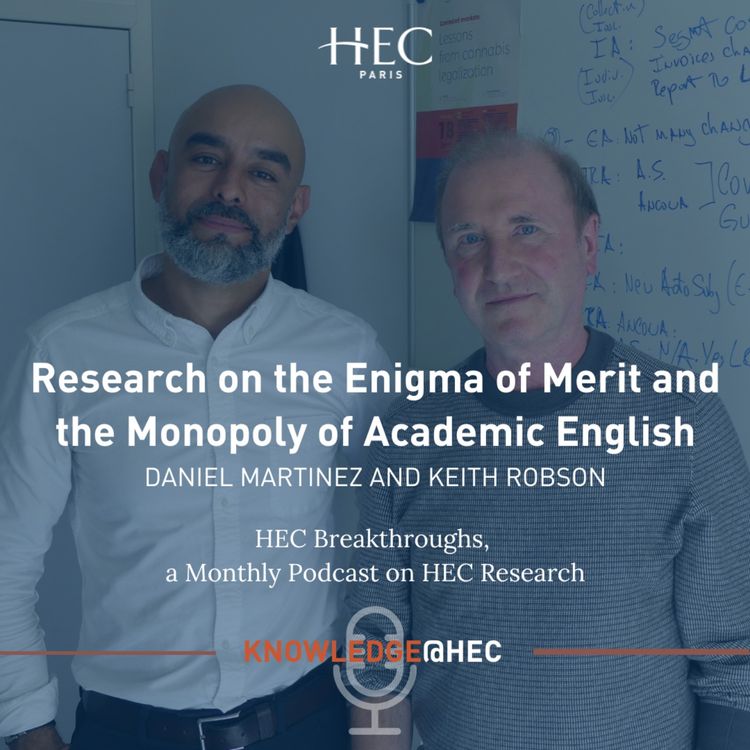
Research on the Enigma of Merit and Monopoly of Academic English
•
The questions of language, culture and merit have long intrigued researchers. HEC accounting professors Daniel Martinez and Keith Robson share the challenges these issues pose for diversity and equity. Professor Robson describes the cultural notions like language that favor the progression of elite groups in service firms in the UK. Whilst Associate Professor Martinez joins with fellow-researchers Javier Husillos and Carlos Larranaga to challenge the monolingual hegemony of English in academic publishing. This, he claims, affects non-native speaking academics’ very identity and puts them in a position of subservience.
Find the written highlights in Knowledge@HEC here.
More episodes
View all episodes

Yes, There Are More Sexes than Male and Female, Claims Study
43:58|Has there always been only two genders? Or have there been societies, including in the Western world, where additional genders were recognized? A recent study by Matteo Winkler shows that many cultures throughout history, including Western cultures, did not necessarily conceive of sex and gender as binary. This comes at a time when an Italian court dismissed a case demanding the recognition of one of its citizens as non-binary, saying that in the Italian legal system there is no sex or gender beyond male and female.
Top Finance Researcher Shows Why AI’s Hidden Bill Is About to Hit Everyone
58:48|AI may feel weightless, but Olivier Darmouni argues that its real-world costs are anything but virtual. In this episode of Breakthroughs, the HEC Paris professor explains when and where the boom in data centers could raise electricity prices in the future; and how these centers could reshape investment in power infrastructure and force Europe to think much harder about energy security. Olivier also reflects on his recent hearing at France’s National Assembly, the difference between productive finance and financial extraction, and why overcoming the financial barriers to sustainability means finding credible ways to crowd in private capital.
Have Banks Outsourced Financial Fragility?
27:30|When credit markets seize up in crisis periods, most people still blame the banks. But new research suggests the bigger pullback may come from nonbanks like those in the syndicated loan market. These have grown fast but remain fragile, cutting lending harder in times of stress – with negative consequences on employment. That shift could reshape how we think about crises, jobs and financial resilience. HEC Assistant Professor in Finance Quirin Fleckenstein explores these issues as part of his research into macro-finance, financial intermediation, and corporate finance. Original research paper: https://papers.ssrn.com/sol3/papers.cfm?abstract_id=3629232 (open source), and the published article in the prestigious Review of Financial Studies (https://academic.oup.com/rfs/article/39/4/925/8114830)
How Oscar Nominations Influence Our Choices - SHORT PODCAST
09:22|The 98th Academy Awards are just days away, six weeks after the Academy listed the nominees. But what do Oscar nominations really do to moviegoers? According to Marketing professor Michelangelo Rossi, they don’t just guide what we watch, they can also raise expectations enough to change how much we enjoy a film. Michelangelo joins Breakthroughs to unpack his latest research, cosigned by Hi! PARIS academic Felix Schleff.
How Platform Architecture and Oscar Nominations Influence Our Choices
32:42|Marketing professor Michelangelo Rossi shares with Breakthroughs the research he and Hi! Paris academic Felix Schleff published on Oscar nominations and their impact on movie-goers’ expectations. On the eve of the 98th Academy Awards, Rossi describes the overlooked downside of such quality disclosures. He also shares his latest research on the impact that Europe’s Digital Markets Act (DMA) has had on consumers using Google Maps.
SHORT BREAKTHROUGHS: Digital Scorecards to Improve Sustainability
11:43|What if we put standardized barcodes on products we buy which inform us of their sustainability, supply chain, human rights records, etc? That’s the proposal of HEC & CNRS researcher Brian Hill. In his recent policy paper, he maps out an efficient way of shifting disclosure rules from companies to products - in the name of sustainability. This is a timely exchange, coming as it does as Europe reached an agreement last month to simplify sustainability reporting and due diligence requirements. Could Brian's digital, standardized scorecard be the key to filling in information and data gaps in this drive for smart product-level disclosure Europe should be aiming for? This ten-minute compact version of our monthly podcast discusses the essential points of his breakthrough research.
Digital Scorecards for Sustainability Disclosure
45:26|A bumper christmas edition of Breakthrough featuring Brian Hill. He's Research Director at the CNRS and HEC Professor in the Economics and Decision Sciences Department. Brian discusses his new policy paper which shifts the focus of disclosure rules from companies to products - in the name of sustainability. A timely exchange, coming as it does as Europe reaches a provisional agreement to simplify sustainability reporting and due diligence requirements. Could Brian's digital, standardized scorecard be the key to filling in information and data gaps in this drive for smart product-level disclosure Europe should be aiming for?
PUISSANTES by HEC - Rendez-vous en janvier
01:40|Puissantes by HEC est un podcast qui révèle des entrepreneuses qui ont bâti leur propre voie. Elles transforment une idée, un désir ou un manque en un projet qui leur ressemble profondément et racontent leur parcours, leur détermination et le déclic qui les a poussées à franchir le pas, jusqu'à la fierté d'être devenues des entrepreneures. Ce podcast est porté par HEC Stand Up, le programme qui accompagne les femmes qui souhaitent se lancer dans l’entrepreneuriat, qu’importe leur âge, leur parcours, ou leur horizon social.
SHORT BREAKTHROUGHS: Gaza Humanitarian Foundation Challenges UN Bodies and International Law
11:52|SHORT BREAKTHROUGHS: Gaza Humanitarian Foundation Challenges UN Bodies and International LawWhile the GHF has closed its doors, could its controversial approach to humanitarian aid be a blueprint for the administrating of Gaza? Law academic Julia Emtseva analyzes this US-Israel initiative and its possible implications for a territory shattered by violence and famine. This is a condensed version of the Breakthroughs first broadcast on November 25.