Share

Jonathan's Musical instruments from found objects podcast
Demonstrating a shepherd's whistle
In this episode, I demonstrate a "shepherd's whistle." The source of inspiration was a children's book about making simple instruments. If I remember correctly, the instructions called for a piece of bamboo. Luckily, I live in a place where bamboo is prevalent--South Florida. The whistle, or whistle flute, includes six finger holes and a thumb hole--similar to a recorder. Also, this particular instrument features an air duct assembly as part of the mouthpiece. The air duct assembly includes a square hole cut into the side of the flute. The far edge of the hole (the edge closer to the foot end of the flute) is filed and sanded into a wedge shape. There is also a plug with one side flattened in such a way as to create a wind channel with the inside of the mouthpiece. When you blow into the mouthpiece, the air stream is directed toward the far edge of the square hole. Upon hitting the edge, the air stream produces a sound. Air duct assemblies are common to penny whistles, tin whistles, toy and police whistles and flutes similar to recorders.
More episodes
View all episodes
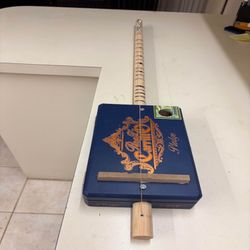
Blues riffs on an acoustic cigar box Diddley bow
01:41|In this episode, I play a cigar box Diddley bow. This is a single-stringed instrument similar to a guitar. My source of inspiration was a similar instrument I built from a kit.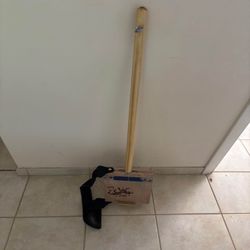
Blues riffs on cigar box bass with broom stick neck
02:03|In this episode, I play some blues riffs on a homemade cigar box bass featuring a broom stick neck, steel wire string, a screw eye, an eyebolt with accompanying nut, two washers and a wing nut, along with a scrap wood bridge.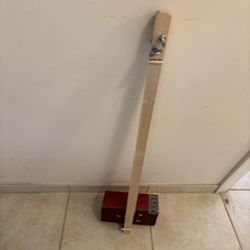
Blues on a two-string cigar box guitar
02:06|In this episode, I play some improvised blues riffs on a two-string cigar box guitar of my own design. A previous episode features a similar instrument. The only difference is probably just the cigar box I used to build the instruments and possibly the actual strings I used, along with the respective tunings.
Blues riffs on two string cigar box guitar
02:27|In this episode, I play some blues riffs on a two-string fretless two-string cigar box guitar of my own design. This instrument features tuners consisting of eye bolts with accompanying nuts, wing nuts and washers.
Blues riffs on a cigar box guitar with zither pin tuner and screw eye for a nut
02:15|In this episode, I play an experimental cigar box guitar with one string, a zither pin for a tuner and a small screw eye for a nut.
Blues on a one-string cigar box fiddle
01:35|In this episode, I play a one-string cigar box fiddle of my own design. Here I play the instrument as if it was a guitar, such as a cigar box guitar, instead of as a fiddle or a violin.
Blues riffs on three string acoustic cigar box guitar
01:50|In this episode, I play an acoustic three string cigar box guitar of my own design. Most of the parts, specifically the neck, bridge, strings and tuners, come by way of a local supplier of cigar box guitars, kits and parts.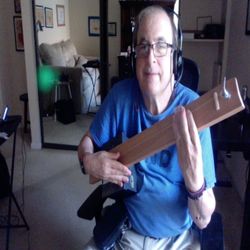
"Old Joe Clark" on one-string cigar box guitar
01:36|In this episode, I play a simple acoustic cigar box guitar of my own design. This instrument features a single string consisting of weed whacker cord, a tuner composed of an eye bolt with its accompanying nut, a wing nut and washers, as well as a nut and bridge consisting of wood dowels. The song I play is my rendition of a traditional bluegrass tune called "Old Joe Clark.""
Demonstrating another acoustic fretless three-string cigar box guitar
01:39|In this episode, I play "Dreaming of the steppes," an original composition, on a three-string acoustic fretless cigar box guitar of my own design.