Share
IT SPARC Cast
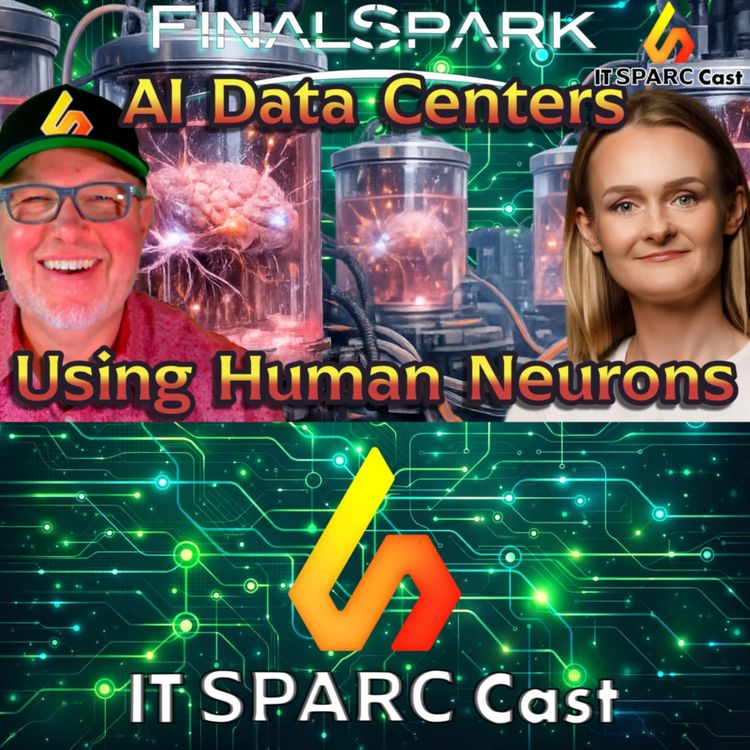
Computers Built From Living Neurons?! Inside Final Spark’s Bio-AI Future
📄 Episode Description
In this episode of IT SPARC Cast – Interview, John Barger sits down with Dr. Ewelina Kurtys of Final Spark to explore one of the most futuristic ideas in computing: building computers from living neurons.
Final Spark is a Swiss startup working to create biological computing systems using neurons derived from human stem cells. The goal is to develop a new form of compute that is dramatically more energy-efficient than traditional silicon—potentially by orders of magnitude.
In this conversation, John and Dr. Kurtys explore how neurons are sourced, how they are interfaced with traditional systems, and what it will take to build neuron-based data centers. They also discuss the challenges of programming biological systems, the timeline for commercialization, and what enterprise IT professionals should be doing today to prepare for this emerging paradigm.
This is a deep dive into the intersection of biology, AI, and infrastructure—and what could become the next major evolution of computing.
⸻
⏱️ Show Notes
00:00 – Intro
An introduction to Final Spark and the concept of building computing systems using living neurons as an alternative to traditional silicon-based infrastructure.
⸻
❓ Questions
00:32 - Who Is Final Spark?
01:00 - How Do You Source Your Neurons?
01:43 - Neuron Quality Control
02:43 - Neurons In AI Data Centers
03:14 - Benefit Of Using Neurons
04:19 - When Will Neuron Based Compute Be Commercially Available
05:43 - Operating System Or Programming Language For Neurons
06:49 - What Does A Neuron Based Data Center Look Like?
07:55 - Containment And Security
08:28 - Data Persistence And Memory Erasure
09:10 - What Should IT Professionals Do Today To Prepare?
12:04 - How Does A Start-Up Get Involved Today?
12:44 - How Do You Program Neurons “Bits”? Are They Binary?
14:54 - How Do You Connect Neurons To Silicon Based Compute?
16:00 - Final Thoughts from Dr. Kurtys
⸻
https://www.finalspark.com
https://finalspark.com/articles/
⸻
🔁 Wrap Up
17:19 – Wrap Up
John reflects on the interview and the long-term implications of neuron-based computing. While still early-stage, the technology represents a potential shift in how compute is delivered—driven by energy efficiency, biological processing models, and new programming paradigms.
⸻
🔗 Connect With Us
IT SPARC Cast
@ITSPARCCast on X
https://www.linkedin.com/company/sparc-sales/ on LinkedIn
John Barger
@john_Video on X
https://www.linkedin.com/in/johnbarger/ on LinkedIn
Lou Schmidt
@loudoggeek on X
https://www.linkedin.com/in/louis-schmidt-b102446/ on LinkedIn
More episodes
View all episodes

31. Musk Builds a Chip Empire, Zuckerberg’s AI CEO, and Arm Enters the AI Chip War
27:48||Season 2, Ep. 31In this episode of IT SPARC Cast – News Bytes, John Barger & Lou Schmidt break down three major moves reshaping the future of AI infrastructure, chip design, and enterprise automation.Elon Musk announces TeraFab, a massive new effort to bring chip fabrication back in-house for greater control over AI hardware and supply chains. Mark Zuckerberg pushes deeper into agentic AI with plans for a personal “AI CEO” to manage workflows and decision-making. And Arm signals a major strategic shift with a new AI-focused chip designed for agent-based systems—putting it in direct competition with its own ecosystem.From supply chain control and custom silicon to AI-driven leadership tools and next-generation chip architectures, this episode explores how the foundation of enterprise IT is rapidly evolving. ⸻⏱️ Show Notes00:00 – Intro📰 News Bytes00:45 – Elon Musk Announces TeraFab for AI Chips and MemoryElon Musk has announced plans for TeraFab, a massive chip fabrication initiative aimed at regaining full control over chip design and production.The strategy includes:• A prototype fabrication facility for rapid iteration• A large-scale production fab for mass manufacturing• Vertical integration to reduce dependency on external foundries• Faster time-to-market for AI-driven hardwareAs chip demand surges due to AI workloads, companies are reconsidering outsourced manufacturing models. TeraFab represents a return to end-to-end control of silicon development, which could significantly impact supply chains, pricing, and innovation speed.https://x.com/i/broadcasts/1yKAPMzlvgWxb https://en.wikipedia.org/wiki/Terafab 09:46 – Mark Zuckerberg Builds AI CEO to Help Run MetaMark Zuckerberg is developing a personal AI system capable of handling executive-level tasks—effectively functioning as a digital chief of staff or “AI CEO.”The system is designed to:• Retrieve and synthesize information across internal systems• Automate decision-support workflows• Reduce reliance on layers of management• Act as a “second brain” for operational awarenessThis reflects a broader shift toward agentic AI, where intelligent systems proactively execute tasks rather than simply responding to prompts. The discussion also raises key enterprise questions around security, portability, and ownership of personal AI agents.https://www.the-independent.com/tech/mark-zuckerberg-ai-ceo-bot-b2943792.html17:54 – Arm Unveils New AI Chip for Agentic SystemsArm has announced a new AI-focused chip architecture aimed at powering agentic AI and future AGI-style workloads.Key implications include:• A shift from IP licensing to direct chip competition• Increased competition with existing ecosystem partners• Potential acceleration of specialized AI hardware development• Growing relevance of alternative architectures like RISC-VThis move signals a major strategic pivot for Arm, potentially reshaping the competitive landscape for AI infrastructure and creating new dynamics between chip designers, manufacturers, and enterprise buyers.https://www.reuters.com/business/media-telecom/arm-unveils-new-ai-chip-expects-it-add-billions-annual-revenue-2026-03-24/ 🔁 Wrap Up25:24 – Mail BagListener feedback highlights continued interest in emerging compute models, including biological computing, and reinforces the importance of staying ahead of major infrastructure trends.27:01 – Wrap UpJohn and Lou close with thoughts on the convergence of AI, custom silicon, and agent-based workflows, emphasizing that enterprise IT leaders must prepare for a future where infrastructure, software, and decision-making are increasingly intertwined.⸻🔗 Connect With UsIT SPARC Cast@ITSPARCCast on Xhttps://www.linkedin.com/company/sparc-sales/ on LinkedInJohn Barger@john_Video on Xhttps://www.linkedin.com/in/johnbarger/ on LinkedInLou Schmidt@loudoggeek on Xhttps://www.linkedin.com/in/louis-schmidt-b102446/ on LinkedIn
30. Router Supply Chain Risks: The Hidden Security Threat in Your Home Network
20:55||Season 2, Ep. 30In this episode of IT SPARC Cast – CVE of the Week, John Barger and Lou Schmidt break from a single CVE to tackle a broader and increasingly critical issue: router supply chain security.From botnets built on consumer routers to concerns about firmware, silicon-level vulnerabilities, and manufacturing visibility, the conversation explores why your home or small office router may be one of the weakest links in modern cybersecurity.The hosts explain what’s changing in the router market, which vendors are most at risk, and what both consumers and enterprise IT professionals should be doing now to secure the network edge.⸻📝 Show NotesConsumer routers are no longer just simple networking devices — they are now prime targets in large-scale cyberattacks and botnet operations.In this episode of IT SPARC Cast – CVE of the Week, John Barger and Lou Schmidt break down the growing risks tied to router supply chains, firmware security, and edge network vulnerabilities.Rather than focusing on a single CVE, this discussion highlights a broader shift in how attackers are targeting home routers, small office devices, and prosumer networking gear as entry points into larger networks.⸻🔎 What’s Changing in Router SecurityRecent attack trends show: • Consumer and small-office routers are being used as launch points for larger cyberattacks • Botnets are increasingly built on unpatched or poorly secured edge devices • Attackers are leveraging routers to mask origin and evade detectionThis makes routers one of the most critical — and often overlooked — components of modern security architecture.⸻⚠ The Supply Chain ProblemOne of the biggest concerns discussed in this episode is supply chain visibility.Key risks include: • Limited insight into where hardware components are manufactured • Potential for firmware-level or silicon-level vulnerabilities • Difficulty auditing third-party manufacturing processes • Inability to fully validate device integrityEven when running trusted software (such as open-source firmware), underlying hardware risks may still exist.⸻🏢 Enterprise & Home Network ImpactThis is not just a consumer issue.Organizations must consider: • Remote employees connecting via insecure home routers • Small offices using low-cost networking equipment • IoT devices relying on consumer-grade infrastructure • Edge devices acting as entry points for lateral movementIf the edge is compromised, the rest of the network is exposed.⸻🛠 What IT Teams and Consumers Should Do • Avoid default configurations and credentials • Keep firmware updated consistently • Segment home and corporate network traffic where possible • Evaluate router vendors for security posture and supply chain transparency • Monitor for unusual traffic patterns or device behavior • Plan for longer-term shifts in router procurement and standardsThis is a long-term evolution, not a short-term panic event.⸻📊 Market Impact & Vendor LandscapeThe episode also discusses potential market shifts: • Lower-cost vendors may face increased scrutiny • Vendors with stronger supply chain transparency may benefit • Manufacturing may shift to more trusted and auditable environments • Future devices may require mandatory security features like auto-updating firmware⸻💬 Listener FeedbackListener feedback from X highlights the growing importance of Zero Trust and identity validation, especially in response to recent discussions about insider threats.The takeaway:Security is no longer just about devices — it’s about people, process, and trust models working together.⸻🔗 Connect With UsIT SPARC Cast@ITSPARCCast on Xhttps://www.linkedin.com/company/sparc-sales/ on LinkedInJohn Barger@john_Video on Xhttps://www.linkedin.com/in/johnbarger/ on LinkedInLou Schmidt@loudoggeek on Xhttps://www.linkedin.com/in/louis-schmidt-b102446/ on LinkedIn
30. Pokémon Trained Robots?! Stargate Canceled, Nvidia Goes to Space & SaaS Is Dying
27:56||Season 2, Ep. 30In this episode of IT SPARC Cast – News Bytes, John Barger & Lou Schmidt break down four major stories reshaping enterprise IT, AI infrastructure, and the future of software.Millions of Pokémon Go players unknowingly helped train real-world delivery robots using billions of images. Meanwhile, OpenAI’s ambitious Stargate data center expansion hits a major setback, highlighting the challenges of scaling AI infrastructure.Nvidia pushes the frontier even further with plans for orbital AI data centers powered by its new Vera Rubin Space-1 chip system, while a growing movement suggests the “SaaS apocalypse” may be underway, driven by AI and open-source alternatives reshaping how software is built and consumed.From crowdsourced AI training to space-based compute and the future of enterprise software, this episode explores where the next wave of IT disruption is coming from. Show Notes00:00 – Intro📰 News Bytes00:45 – Pokémon Go Players Unknowingly Trained Delivery Robots With 30 Billion ImagesNiantic has leveraged years of Pokémon Go gameplay data—over 30 billion images captured by users—to build a highly accurate Visual Positioning System (VPS) capable of centimeter-level location accuracy.The discussion highlights both the brilliance of this crowdsourced data model and broader concerns around data ownership, enterprise data exposure, and unintended data usage.https://www.popsci.com/technology/pokemon-go-delivery-robots-crowdsourcing/?utm_source=chatgpt.com ⸻07:18 – OpenAI’s Massive Stargate Data Center Expansion CanceledPlans to expand a major AI data center tied to the Stargate initiative have been canceled, underscoring the complexity of building large-scale AI infrastructure.Despite the cancellation, demand for AI compute remains extremely high, with other organizations potentially stepping in to utilize available capacity—reinforcing that AI infrastructure demand still far exceeds supply.https://www.tomshardware.com/tech-industry/artificial-intelligence/openais-massive-stargate-data-center-canceled-as-firm-cant-reach-terms-with-oracle-operator-struggles-with-reliability-issues-meta-said-to-be-interested-in-snatching-excess-capacity ⸻11:06 – Nvidia Announces Vera Rubin Space-1 Chip System for Orbital AI Data CentersNvidia is pushing AI infrastructure beyond Earth with its Vera Rubin Space-1 system, designed for use in orbital data centers.While challenges remain—especially around cooling and radiation—this represents a major step toward space-based AI infrastructure as demand for compute continues to surge.https://www.cnbc.com/2026/03/16/nvidia-chips-orbital-data-centers-space-ai.html ⸻17:50 – The SaaS Apocalypse Is Open Source’s Greatest OpportunityA growing trend suggests that traditional SaaS models may be under pressure as AI dramatically lowers the cost of building custom software.The hosts highlight real-world examples of AI enabling individuals to build production-ready applications in hours, signaling a potential return to highly customized, in-house systems—powered by AI instead of large dev teams.https://hackernoon.com/the-saas-apocalypse-is-opensources-greatest-opportunity ⸻🔁 Wrap Up25:28 – Mail BagListener Tim flags an issue with a previous episode upload, helping quickly resolve a distribution problem. A reminder of how valuable engaged listeners are to maintaining quality and consistency.⸻26:52 – Wrap UpJohn and Lou close with thoughts on how rapidly the IT landscape is evolving—from AI-driven infrastructure and orbital compute to the reinvention of software delivery models—and encourage listeners to stay adaptable as these shifts accelerate.⸻🔗 Connect With UsIT SPARC Cast@ITSPARCCast on Xhttps://www.linkedin.com/company/sparc-sales/ on LinkedInJohn Barger@john_Video on Xhttps://www.linkedin.com/in/johnbarger/ on LinkedInLou Schmidt@loudoggeek on Xhttps://www.linkedin.com/in/louis-schmidt-b102446/ on LinkedIn
29. North Korea’s Fake IT Workers: The Insider Threat Hiding in Plain Sight
14:42||Season 2, Ep. 29In this episode of IT SPARC Cast – CVE of the Week, John Barger and Lou Schmidt break down a rapidly growing cybersecurity threat: North Korean operatives posing as remote IT workers inside enterprise environments.These actors are not just external attackers — they are getting hired, accessing corporate systems, and creating persistent insider threats that are extremely difficult to detect.The episode explores how the scheme works, why traditional security controls fail, and what enterprise IT teams must do to defend against this evolving attack vector.⸻📝 Show NotesA new cybersecurity threat is emerging that flips the traditional attack model on its head.Instead of breaking into your network, attackers are getting hired into your company.In this episode of IT SPARC Cast – CVE of the Week, John Barger and Lou Schmidt analyze the growing threat of North Korean IT worker schemes, where operatives pose as legitimate remote employees to gain direct access to enterprise systems.⸻🔎 How the Scheme WorksThreat actors: • Apply for remote IT jobs using stolen or synthetic identities • Pass interviews and onboarding processes • Gain legitimate access to corporate systems • Use that access to exfiltrate data, generate revenue, or stage future attacksThese individuals often work through: • VPN masking • Proxy networks • Identity laundering through third partiesOnce inside, they operate as trusted insiders, making detection significantly more difficult than traditional external threats.⸻⚠ Why This Is So DangerousThis is not a vulnerability in software — it’s a failure in process, identity, and trust models.Key risks include: • Direct access to internal systems and data • Ability to bypass perimeter security controls • Long-term persistence without detection • Potential for data exfiltration, espionage, or ransomware stagingUnlike typical breaches, these actors are: • Authenticated • Approved • Operating under legitimate credentials⸻🏢 Enterprise IT ImpactThis threat directly impacts: • Remote-first organizations • Companies hiring globally • Teams using contractors or third-party staffing firms • Organizations without strict identity verification processesIf your company hires remote developers, engineers, or IT staff — this is your problem.⸻🔐 Key Security TakeawaysTo mitigate this risk, organizations should: • Strengthen identity verification during hiring • Require multi-factor authentication across all systems • Monitor for unusual behavior from “trusted” accounts • Implement least-privilege access controls • Audit remote employee access regularly • Coordinate with HR on security-aware hiring practicesThis is a cross-functional problem — IT, Security, and HR must work together.⸻🔗 Source Articlehttps://www.nbcnews.com/investigations/north-korea-it-worker-scheme-nisos-fbi-rcna245025⸻🔗 Connect With UsIT SPARC Cast@ITSPARCCast on Xhttps://www.linkedin.com/company/sparc-sales/ on LinkedInJohn Barger@john_Video on Xhttps://www.linkedin.com/in/johnbarger/ on LinkedInLou Schmidt@loudoggeek on Xhttps://www.linkedin.com/in/louis-schmidt-b102446/ on LinkedIn
29. Redux - Node.js Security Crisis, Meta’s AI Agent Network, Nvidia’s Open Agent Platform & Oracle’s Data Center Bet
22:29||Season 2, Ep. 29Oooops. We uploaded the wrong audio. It's been fix now.In this episode of IT SPARC Cast – News Bytes, John Barger & Lou Schmidt explore four major stories shaping enterprise IT, open-source software, AI infrastructure, and the future of data centers.A new report reveals that two-thirds of Node.js installations are running outdated versions, creating major security and operational risks across modern software stacks. Meanwhile, Meta hires the creators of Moltbook, a platform designed as a social network for AI agents to communicate and collaborate.Nvidia enters the agentic AI race with plans for an open-source enterprise AI agent platform, while Oracle’s massive investments in AI data centers spark debate about whether the industry is heading toward an infrastructure bubble.From open-source sustainability to AI infrastructure strategy, this episode breaks down what these developments mean for enterprise IT leaders, developers, and technology investors. Show Notes00:00 – Intro📰 News Bytes00:43 – Two Thirds of Node.js Installations Are OutdatedA new report from the OpenJS Foundation reveals that roughly two-thirds of Node.js deployments are running outdated or end-of-life versions, creating serious security and stability concerns across modern applications.To address this, the Node.js LTS Upgrade and Modernization Program is connecting enterprises with trusted service providers audit, plan, and modernize their deployments.The initiative also helps fund open-source development by directing a portion of service revenue back to the OpenJS Foundation.https://openjsf.org/blog/nodejs-lts-upgrade-program04:59 – Meta Hires the Duo Behind MoltbookMeta has hired the creators of Moltbook, a platform designed as a collaboration network where AI agents can verify identity, exchange information, and coordinate tasks.Meta’s move suggests a strategy to become the central hub for AI agent interaction, positioning the company to support a future where large numbers of autonomous software agents perform tasks for individuals and businesses.https://www.axios.com/2026/03/10/meta-facebook-moltbook-agent-social-network10:20 – Nvidia to Launch an Open-Source AI Agent PlatformNvidia is preparing to release NemoClaw, an open-source AI agent platform designed to help enterprises deploy autonomous agents capable of automating workflows, managing data, and performing complex multi-step tasks.Key aspects of the platform include:• Enterprise-focused agent orchestration• Open-source accessibility• Compatibility beyond Nvidia hardware• Integration with major enterprise software vendorsThe move signals Nvidia’s growing interest in the agentic AI ecosystem, which could dramatically increase demand for GPU-accelerated compute infrastructure.https://www.wired.com/story/nvidia-planning-ai-agent-platform-launch-open-source/⸻14:27 – Oracle Is Building Yesterday’s Data Centers With Tomorrow’s DebtOracle is investing heavily in new AI data centers, financing much of the expansion through debt as it competes with other hyperscale cloud providers.Some analysts have raised concerns that rapid advances in AI hardware could outpace the construction timelines of new facilities, potentially creating financial risk.However, the hosts point out that building data centers requires long lead times for power infrastructure, networking, and facilities, while the compute hardware itself is typically installed later in the deployment process.The discussion highlights the importance of evaluating technology investment stories critically and considering both infrastructure realities and market narratives.https://www.cnbc.com/2026/03/09/oracle-is-building-yesterdays-data-centers-with-tomorrows-debt.html⸻20:14 – Wrap up⸻🔗 Connect With UsIT SPARC Cast@ITSPARCCast on Xhttps://www.linkedin.com/company/sparc-sales/ on LinkedInJohn Barger@john_Video on Xhttps://www.linkedin.com/in/johnbarger/ on LinkedInLou Schmidt@loudoggeek on Xhttps://www.linkedin.com/in/louis-schmidt-b102446/ on LinkedIn
29. Node.js Security Crisis, Meta’s AI Agent Network, Nvidia’s Open Agent Platform & Oracle’s Data Center Bet
22:29||Season 2, Ep. 29In this episode of IT SPARC Cast – News Bytes, John Barger & Lou Schmidt explore four major stories shaping enterprise IT, open-source software, AI infrastructure, and the future of data centers.A new report reveals that two-thirds of Node.js installations are running outdated versions, creating major security and operational risks across modern software stacks. Meanwhile, Meta hires the creators of Moltbook, a platform designed as a social network for AI agents to communicate and collaborate.Nvidia enters the agentic AI race with plans for an open-source enterprise AI agent platform, while Oracle’s massive investments in AI data centers spark debate about whether the industry is heading toward an infrastructure bubble.From open-source sustainability to AI infrastructure strategy, this episode breaks down what these developments mean for enterprise IT leaders, developers, and technology investors. 00:00 – Intro📰 News Bytes00:43 – Two Thirds of Node.js Installations Are OutdatedA new report from the OpenJS Foundation reveals that roughly two-thirds of Node.js deployments are running outdated or end-of-life versions, creating serious security and stability concerns across modern applications.To address this, the Node.js LTS Upgrade and Modernization Program is connecting enterprises with trusted service providers that can:• Audit existing deployments• Plan phased upgrades• Modernize dependencies• Maintain production stabilityhttps://openjsf.org/blog/nodejs-lts-upgrade-program04:59 – Meta Hires the Duo Behind MoltbookMeta has hired the creators of Moltbook, a platform designed as a collaboration network where AI agents can verify identity, exchange information, and coordinate tasks.Meta’s move suggests a strategy to become the central hub for AI agent interaction, positioning the company to support a future where large numbers of autonomous software agents perform tasks for individuals and businesses.https://www.axios.com/2026/03/10/meta-facebook-moltbook-agent-social-network10:20 – Nvidia to Launch an Open-Source AI Agent PlatformNvidia is preparing to release NemoClaw, an open-source AI agent platform designed to help enterprises deploy autonomous agents capable of automating workflows, managing data, and performing complex multi-step tasks.The move signals Nvidia’s growing interest in the agentic AI ecosystem, which could dramatically increase demand for GPU-accelerated compute infrastructure.https://www.wired.com/story/nvidia-planning-ai-agent-platform-launch-open-source/14:27 – Oracle Is Building Yesterday’s Data Centers With Tomorrow’s DebtOracle is investing heavily in new AI data centers, financing much of the expansion through debt as it competes with other hyperscale cloud providers.Some analysts have raised concerns that rapid advances in AI hardware could outpace the construction timelines of new facilities, potentially creating financial risk.The discussion highlights the importance of evaluating technology investment stories critically and considering both infrastructure realities and market narratives.https://www.cnbc.com/2026/03/09/oracle-is-building-yesterdays-data-centers-with-tomorrows-debt.html🔁 Wrap Up20:14 – Mail BagListener Mel asks whether laser-based networking technologies, like the TaaraConnect system discussed in a previous episode, could help improve internet access in mountainous rural areas.While line-of-sight laser connectivity could offer high speeds, weather conditions like fog and cloud cover could require backup connections such as radio or wired infrastructure.⸻🔗 Connect With UsIT SPARC Cast@ITSPARCCast on Xhttps://www.linkedin.com/company/sparc-sales/ on LinkedInJohn Barger@john_Video on Xhttps://www.linkedin.com/in/johnbarger/ on LinkedInLou Schmidt@loudoggeek on Xhttps://www.linkedin.com/in/louis-schmidt-b102446/ on LinkedIn
28. 14,000 ASUS Routers Infected: KadNap Botnet Creates Nearly Untouchable Malware Network
10:01||Season 2, Ep. 28A new malware campaign has compromised more than 14,000 ASUS routers, creating a resilient botnet that security researchers say is unusually difficult to dismantle.In this episode of IT SPARC Cast – CVE of the Week, John Barger and Lou Schmidt examine the KadNap router malware, which targets unpatched ASUS routers and installs a persistent backdoor designed to survive typical remediation efforts.The malware was identified by researchers at Lumen’s Black Lotus Labs, who discovered that infected routers are being used as part of a botnet capable of proxying internet traffic and enabling other malicious activities.Unlike many botnets that rely on centralized command servers, KadNap uses peer-to-peer control mechanisms similar to BitTorrent, making it significantly harder for security teams to disrupt.⸻🔎 What the KadNap Router Malware DoesThe malware exploits vulnerabilities in ASUS routers that have not been patched or configured securely.Once installed, KadNap: • Creates a persistent backdoor on the router • Survives reboots and firmware updates • Enables remote control of the router • Connects the device to a distributed botnet network • Routes malicious traffic through compromised residential internet connectionsResearchers also discovered the infected routers are being used by a fee-based proxy service called Doppelganger, allowing customers to route their internet traffic through unsuspecting victims’ home networks.⸻⚠ Why This Is DangerousBecause the traffic originates from compromised home routers, victims could unknowingly appear responsible for malicious activity such as: • Network attacks • Surveillance operations • Illegal browsing activity • Staging points for additional cyber intrusionsThis makes detection and attribution far more difficult.⸻🏢 Enterprise IT RiskThis vulnerability is not limited to home users.ASUS also produces small-business routers, meaning organizations or small offices using these devices could be exposed.IT professionals should also remember that compromised routers can provide attackers with a network foothold for lateral movement, especially if IoT or remote-user networks are poorly segmented.⸻🛠 How to Detect and Remove KadNapSecurity experts recommend checking routers for signs of compromise:Look for: • SSH enabled unexpectedly • Remote administration enabled • Unknown certificates or scheduled tasks • Suspicious entries in device logsBecause the malware attaches to configuration files, simply rebooting or restoring a configuration backup will not remove it.The proper remediation process: 1. Perform a full factory reset 2. Update the router firmware immediately 3. Manually reconfigure the router (do not restore backups)Experts also recommend changing default internal network ranges, such as moving away from the common 192.168.1.x subnet.⸻🔗 Source Articlehttps://arstechnica.com/security/2026/03/14000-routers-are-infected-by-malware-thats-highly-resistant-to-takedowns/⸻🔗 Connect With UsIT SPARC Cast@ITSPARCCast on Xhttps://www.linkedin.com/company/sparc-sales/ on LinkedInJohn Barger@john_Video on Xhttps://www.linkedin.com/in/johnbarger/ on LinkedInLou Schmidt@loudoggeek on Xhttps://www.linkedin.com/in/louis-schmidt-b102446/ on LinkedIn
28. Google Quantum-Proofs HTTPS, 6G Hits 1 Tbps, and Internet Over LASERS?! | IT SPARC Cast
22:19||Season 2, Ep. 28In this episode of IT SPARC Cast – News Bytes, John Barger & Lou Schmidt break down three major developments shaping the future of networking and internet infrastructure.Google begins testing a new quantum-resistant HTTPS certificate approach designed to defend the web against future quantum computing attacks. Meanwhile, Qualcomm’s CEO declares that the coming 6G mobile revolution will be essential for AI-driven applications, promising speeds up to 1 Tbps and sub-millisecond latency. Finally, TaaraConnect introduces a 25-Gbps laser-based networking system capable of delivering fiber-like speeds between buildings without laying cable.From quantum-safe encryption to AI-driven wireless networks and laser communication links, this episode explores how the next generation of connectivity will reshape enterprise IT infrastructure, data centers, and global networks. ⸻Show Notes00:00 – Intro⸻📰 News Bytes00:51 – Google Quantum-Proofs HTTPS with Compact CertificatesGoogle and Cloudflare are testing a new method to make HTTPS certificates resistant to future quantum attacks.Instead of traditional signature chains, the system uses Merkle Tree Certificates (MTCs) to dramatically shrink quantum-safe cryptographic data from roughly 15 KB down to about 700 bytes, making it practical for real-world internet use.The experiment begins with about 1,000 TLS certificates, with standards work underway through the IETF. If successful, this approach could become a foundational component of post-quantum internet security.The big unknown: how much processing overhead these new cryptographic methods will require on older client devices.https://arstechnica.com/security/2026/02/google-is-using-clever-math-to-quantum-proof-https-certificates/ ⸻05:42 – Qualcomm CEO Says the 6G Revolution Is ComingAt Mobile World Congress, Qualcomm CEO Cristiano Amon argued that the AI era will demand 6G networks, dramatically increasing bandwidth and lowering latency.Projected 6G capabilities include:• Speeds of 100 Gbps to 1 Tbps• Sub-millisecond latency• Massive connectivity for billions of devices• AI-driven network managementThe shift toward AI-heavy cloud processing means network traffic will become even more north-south oriented, sending massive datasets between edge devices and cloud infrastructure.Early 6G trials are expected around 2028, with broader deployments beginning around 2029.https://fortune.com/2026/03/03/qualcomm-ceo-resistance-is-futile-6g-mobile-revolution-approaches/⸻13:31 – TaaraConnect Uses Lasers to Deliver 25-Gbps InternetTaaraConnect is developing a laser-based point-to-point networking system capable of delivering up to 25 Gbps over distances of about 6 miles (10 km).Instead of radio waves, the system transmits data using focused beams of light, creating fiber-like connectivity without physical cables.Key features include:• Adaptive beam alignment• Automatic power adjustments during interference• Redundant beam paths to mitigate disruptions• Low-latency high-bandwidth links between buildingsWhile heavy fog remains the primary limitation, the technology could provide a powerful alternative to expensive metro fiber deployments, particularly in dense urban environments.https://newatlas.com/telecommunications/google-taara-25gbps-internet-cities-light/⸻🔁 Wrap Up19:31 – Mail BagListener Xavier shares thoughts on the rising cost of compute power and suggests that bio-AI systems using living neurons could eventually deliver superior performance-per-watt compared to traditional silicon chips.The discussion highlights a growing industry focus on compute efficiency and power consumption as data center infrastructure scales to support AI workloads.⸻🔗 Connect With UsIT SPARC Cast@ITSPARCCast on Xhttps://www.linkedin.com/company/sparc-sales/ on LinkedInJohn Barger@john_Video on Xhttps://www.linkedin.com/in/johnbarger/ on LinkedInLou Schmidt@loudoggeek on Xhttps://www.linkedin.com/in/louis-schmidt-b102446/ on LinkedIn