Share
IT SPARC Cast
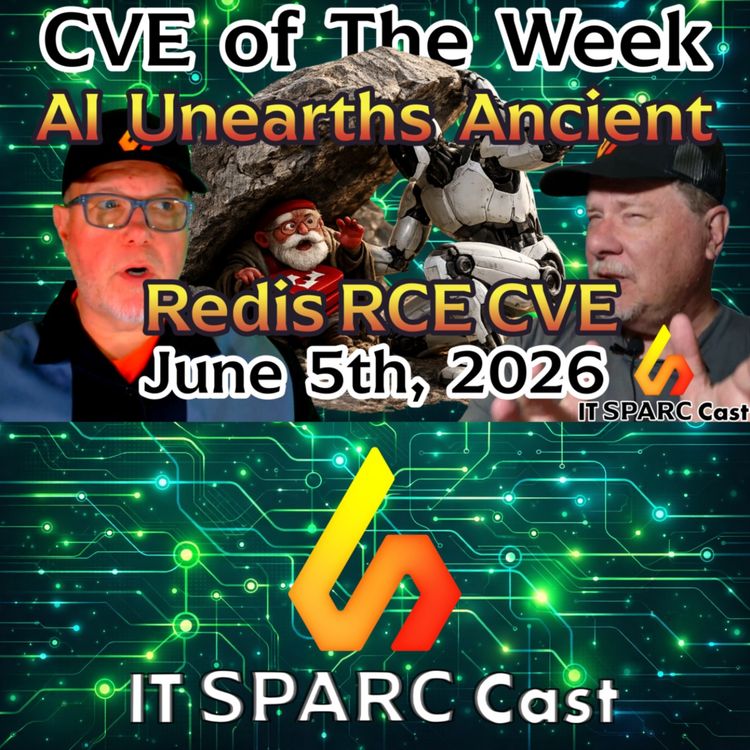
AI Finds a Redis Vulnerability Humans Missed for Two Years
An autonomous AI security tool has discovered a critical Redis remote code execution vulnerability that remained hidden for more than two years. In this episode of IT SPARC Cast – CVE of the Week, John and Lou discuss CVE-2026-23479, why Redis is such a critical part of modern cloud infrastructure, and how AI is fundamentally changing vulnerability discovery, patch management, and enterprise security operations.
⸻
📄 Show Notes
🚨 CVE of the Week: Redis Remote Code Execution (CVE-2026-23479)
This week we’re looking at CVE-2026-23479, a high-severity Redis remote code execution vulnerability discovered by an autonomous AI security tool called Xint Code.
Redis is one of the most widely deployed databases in cloud computing, meaning many organizations may be affected even if they don’t realize Redis is running somewhere in their environment.
The vulnerability stems from a use-after-free bug in Redis blocked-client handling logic introduced in Redis 7.2.
⸻
⚠️ Why This Matters
An authenticated attacker can exploit the vulnerability to achieve arbitrary operating system command execution on the Redis host.
Potential impacts include:
- Remote code execution (RCE)
- Server compromise
- Lateral movement
- Privilege escalation through exploit chaining
While no active exploitation has been reported, public exploit details are now available.
The bigger story is that AI found a serious vulnerability that human review missed for over two years.
⸻
🛠️ Mitigation Steps for CVE-2026-23479
✅ Patch Redis Immediately
Upgrade to a fixed version:
- Redis 7.2.14
- Redis 7.4.9
- Redis 8.2.6
- Redis 8.4.3
- Redis 8.6.3
or later versions as available.
✅ Restrict Redis Access
- Limit authenticated users
- Remove unnecessary privileges
- Restrict network exposure
- Block direct internet access whenever possible
✅ Review Authentication Controls
Because exploitation requires authentication:
- Rotate credentials
- Review user permissions
- Implement least-privilege access
✅ Monitor for Suspicious Activity
Watch for:
- Unexpected Redis commands
- Unusual process creation
- Unauthorized shell execution
- Privilege escalation attempts
⸻
🤖 The Real Story: AI vs. AI Security
The vulnerability itself is serious.
The larger trend may be even more important.
AI tools are now:
- Finding vulnerabilities faster
- Analyzing source code at scale
- Discovering flaws humans miss
This means organizations must rethink patch management.
Traditional “Patch Tuesday” approaches may no longer be sufficient.
John and Lou discuss a future where:
- AI finds vulnerabilities
- AI develops fixes
- AI monitors infrastructure
- AI defends against AI-driven attacks
⸻
🔧 Enterprise Recommendations
- Assign dedicated personnel to vulnerability monitoring
- Deploy automated alerting systems
- Use AI-assisted security analysis
- Review hot-patching capabilities
- Reevaluate maintenance window policies
The era of weekly patch cycles may be ending.
⸻
💬 Listener Feedback
Thanks to listener Alex for pointing out that the Microsoft Exchange vulnerability discussed in a previous episode remains unpatched.
It’s a reminder that even when vulnerabilities are publicly disclosed, vendor response times can vary dramatically.
⸻
📣 Wrap Up
Are your current patch management processes fast enough to keep up with AI-driven vulnerability discovery?
📧 feedback@itsparccast.com
🐦 @itsparccast on X
⸻
🔗 Social Links
IT SPARC Cast
@ITSPARCCast on X
https://www.linkedin.com/company/sparc-sales/ on LinkedIn
John Barger
@john_Video on X
https://www.linkedin.com/in/johnbarger/ on LinkedIn
Lou Schmidt
@loudoggeek on X
https://www.linkedin.com/in/louis-schmidt-b102446/ on LinkedIn
More episodes
View all episodes

42. 40,000 Workloads Leaving VMware?! Bezos Says AI Won’t Kill Jobs
17:35||Season 2, Ep. 42In this episode of IT SPARC Cast - News Bytes, John & Lou explore three major stories shaping enterprise IT. Jeff Bezos argues that AI will create labor shortages rather than eliminate jobs, Tesco begins one of the largest VMware migration projects ever announced, and Accenture doubles down on cybersecurity through a series of strategic investments and acquisitions.The discussion focuses on the practical realities behind AI-driven productivity, the growing backlash against VMware licensing changes, and why cybersecurity is becoming a core business function rather than simply an IT responsibility. If you work in enterprise IT, cloud, virtualization, or security, this episode highlights trends that could reshape the industry over the next several years. ⸻📌 Show Notes00:00 – IntroThis week’s episode covers AI’s impact on the workforce, one of the largest VMware migrations ever attempted, and why cybersecurity is becoming central to business strategy.⸻📰 News Bytes00:47 – AI Will Lead to Labor Shortages, Says an Optimistic Jeff BezosJeff Bezos argues that AI will increase productivity and create new categories of work rather than permanently eliminate jobs. Drawing parallels to earlier waves of automation, he suggests AI will remove bottlenecks and allow people to focus on higher-value tasks.John & Lou discuss the difference between using AI as a growth engine versus a cost-cutting tool, and why leadership decisions may ultimately determine whether organizations thrive or stagnate.Key takeaways:AI may create new opportunities rather than eliminate workProductivity gains can fuel growth instead of downsizingOrganizations that embrace expansion may outperform competitorshttps://www.reuters.com/business/world-at-work/ai-will-lead-labour-shortages-jeff-bezos-says-vivatech-2026-06-17/⸻04:49 – Tesco Moving 40,000 Workloads Off VMwareTesco is migrating approximately 40,000 workloads away from VMware, making it one of the largest publicly disclosed VMware exit projects to date. The move comes amid ongoing concerns around licensing, support, and long-term costs following Broadcom’s acquisition of VMware.The migration highlights how even major enterprises are willing to undertake massive infrastructure changes when economics shift dramatically.Key considerations:40,000 workloads represent a significant migration effortKVM-based alternatives continue gaining tractionVirtualization competition is entering a new phasehttps://arstechnica.com/information-technology/2026/06/tesco-moving-40000-server-workloads-off-vmware-amid-broadcoms-abusive-conduct/⸻11:03 – Accenture Takes Majority Stake in Cybersecurity FirmsAccenture announced major investments and acquisitions in cybersecurity, reinforcing the growing importance of security services across every industry.Rather than treating security as a standalone IT function, organizations increasingly view it as a business-wide requirement. Accenture’s move signals that demand for AI-enabled security expertise is expected to accelerate significantly.Key takeaways:Security spending continues to grow rapidlyAI adoption creates new security requirementsConsulting firms see cybersecurity as a long-term growth markethttps://www.reuters.com/legal/transactional/accenture-take-majority-stake-acquire-cybersecurity-firms-418-billion-deal-2026-06-18/⸻📬 15:25 – Mail BagListener Steve weighs in on Ubiquiti’s new Enterprise Firewall Core, agreeing that it’s a strong first step into enterprise security. The discussion expands into Ubiquiti’s new Enterprise NAS platform, ZFS-based storage, and how the company continues pushing deeper into enterprise infrastructure.⸻🔚 16:49 – Wrap Up⸻🌐 Social LinksIT SPARC Cast@ITSPARCCast on Xhttps://www.linkedin.com/company/sparc-sales/ on LinkedInJohn Barger@john_Video on Xhttps://www.linkedin.com/in/johnbarger/ on LinkedInLou Schmidt@loudoggeek on Xhttps://www.linkedin.com/in/louis-schmidt-b102446/ on LinkedIn
41. FortiGate Firewalls Compromised: Why Patching Didn’t Fix the Problem
07:28||Season 2, Ep. 41Thousands of Fortinet FortiGate devices have been compromised—even in organizations that already applied security patches. In this episode of IT SPARC Cast – CVE of the Week, John and Lou explain how attackers maintained persistence after earlier breaches, why patching alone wasn’t enough, and what every organization running FortiGate firewalls must do immediately to verify they haven’t already been compromised.⸻📄 Show Notes🚨 CVE of the Week (Special Security Alert): FortiGate CompromisesThis week we’re covering a major Fortinet security incident affecting organizations around the world.Unlike most episodes, this isn’t focused on a single CVE. Instead, attackers are leveraging previously exploited FortiGate vulnerabilities and maintaining persistent access even after organizations patched the original flaws.The key lesson:👉 Patching does not remove an attacker who is already inside.⸻⚠️ What Happened?Large organizations across multiple industries have reported compromises involving FortiGate firewalls and VPN infrastructure.Attackers reportedly:Exploited previously disclosed Fortinet vulnerabilitiesEstablished persistence mechanismsMaintained access after patches were installedContinued accessing networks through compromised devicesPotential impacts include:Network visibilityCredential theftTraffic interceptionLong-term unauthorized access⸻🛠️ Immediate Mitigation Steps✅ Audit All FortiGate DevicesIf your FortiGate was internet-facing before patching:Assume compromise until proven otherwise.Review:Administrative accountsVPN configurationsFirewall rulesConfiguration changesScheduled tasks and scripts⸻✅ Upgrade Firmware and SoftwareInstall:Latest supported FortiOS versionLatest firmware updatesAny recommended security updatesDon’t stop at operating system updates—verify firmware integrity as well.⸻✅ Rotate CredentialsImmediately rotate:Administrative passwordsVPN credentialsService accountsShared secretsAPI keysAssume previously exposed credentials may be compromised.⸻✅ Verify Multi-Factor Authentication (MFA)MFA should be enabled for:Firewall administrationVPN accessRemote administrationCritical infrastructure systemsIf MFA is not enabled, prioritize it immediately.⸻✅ Hunt for PersistenceLook for:Unknown accountsSuspicious scriptsUnexpected configuration changesUnauthorized VPN usersUnrecognized scheduled tasksIf something looks unfamiliar, investigate it.⸻🔒 Why This MattersOne of the biggest takeaways from this incident is that perimeter security is no longer enough.If a firewall compromise can expose the entire organization, the network architecture needs work.John and Lou emphasize:Zero Trust architecturesNetwork segmentationLeast privilege accessMFA everywhereContinuous security auditingA firewall should be your first line of defense—not your only line of defense.⸻💡 Key TakeawayThe real danger isn’t the original vulnerability.It’s the persistence left behind after the vulnerability was patched.Organizations that only patch—but don’t investigate for compromise—may still have attackers inside their environments.⸻📣 Wrap UpHave you audited your firewall infrastructure recently? Are you confident patching alone is enough?📧 feedback@itsparccast.com🐦 @itsparccast on X⸻🔗 Social LinksIT SPARC Cast@ITSPARCCast on Xhttps://www.linkedin.com/company/sparc-sales/ on LinkedInJohn Barger@john_Video on Xhttps://www.linkedin.com/in/johnbarger/ on LinkedInLou Schmidt@loudoggeek on Xhttps://www.linkedin.com/in/louis-schmidt-b102446/ on LinkedIn
41. 200 Microsoft Patches?! RoguePlanet Zero-Day & Ubiquiti’s Enterprise Firewall
24:27||Season 2, Ep. 41In this episode of IT SPARC Cast - News Bytes, John & Lou tackle a security-heavy week featuring a new Microsoft Defender zero-day, the largest Patch Tuesday release in Microsoft’s history, and a growing debate around how vulnerability disclosures should be handled in the AI era. As AI accelerates bug discovery, the industry is struggling to keep pace with validation, patching, and deployment.The discussion also covers Ubiquiti’s entry into the enterprise firewall market and OpenAI’s report on coordinated influence campaigns targeting public perception around AI infrastructure and data centers. If you work in enterprise IT, cybersecurity, cloud, or networking, this episode highlights several trends that will directly impact security operations and infrastructure planning. ⸻📌 Show Notes00:00 – IntroThis week’s episode focuses on security, patch management, enterprise networking, and the growing role AI plays in both finding vulnerabilities and shaping public narratives.⸻📰 News Bytes01:48 – Microsoft Defender “RoguePlanet” Zero-DaySecurity researcher Chaotic Eclipse revealed a new Microsoft Defender vulnerability dubbed “RoguePlanet” that allows local privilege escalation to SYSTEM-level access on Windows 10 and 11.The flaw joins a growing list of publicly disclosed Defender vulnerabilities and highlights ongoing tensions between researchers and Microsoft regarding vulnerability disclosure and patch response times.https://www.bleepingcomputer.com/news/microsoft/microsoft-defender-rogueplanet-zero-day-grants-system-privileges/⸻04:47 – Microsoft Smashes Record for Biggest Ever Patch Tuesday UpdateMicrosoft released more than 200 security fixes in a single Patch Tuesday, setting a new record. The update included dozens of critical vulnerabilities spanning Windows, Office, Azure, Exchange, Active Directory, Hyper-V, BitLocker, and Copilot services.John & Lou discuss why traditional patch cycles may no longer be sufficient as AI dramatically accelerates vulnerability discovery and exploit creation.https://www.computerweekly.com/news/366644117/Microsoft-smashes-record-for-biggest-ever-Patch-Tuesday-update⸻11:40 – Ubiquiti Releases Enterprise FirewallsUbiquiti announced its new Enterprise Firewall Core (EFC), expanding beyond networking into full next-generation firewall capabilities. The platform includes deep packet inspection, IDS/IPS, SSL inspection, AI-assisted threat analysis, and integration with the broader UniFi ecosystem.The aggressive pricing and subscription-light model could make it attractive for SMBs, education, MSPs, and mid-market enterprises.https://blog.ui.com/article/introducing-enterprise-firewall-core⸻17:46 – OpenAI Calls Out Anti-Data Center Influence OperationsOpenAI reported disrupting multiple coordinated campaigns that used AI-generated content, fake personas, and automated translations to influence online discussions around AI infrastructure and data centers.The report found AI significantly increased content generation volume but provided limited evidence that it improved persuasion or effectiveness.https://openai.com/index/prc-linked-influence-operations-ai-debates/⸻📬 21:44 – Mail BagLongtime listener Dennis weighs in on RTX Spark, Microsoft’s AI strategy, AMD’s role in the next Xbox, and the future of gaming platforms. The discussion explores what happens when AI agents become the primary interface and whether future gaming experiences could include Holodecks hosted by Sydney Sweeney.The conversation also raises larger questions about operating systems, platform ecosystems, and whether AI assistants eventually become more important than the devices they run on.⸻🔚 23:21 – Wrap Up⸻🌐 Social LinksIT SPARC Cast@ITSPARCCast on Xhttps://www.linkedin.com/company/sparc-sales/ on LinkedInJohn Barger@john_Video on Xhttps://www.linkedin.com/in/johnbarger/ on LinkedInLou Schmidt@loudoggeek on Xhttps://www.linkedin.com/in/louis-schmidt-b102446/ on LinkedIn
40. One Character Broke Linux Security: CVE-2026-23111 Explained
11:17||Season 2, Ep. 40A single-character coding mistake in the Linux kernel created a privilege escalation vulnerability that could allow attackers to gain root access, escape containers, and compromise systems. In this episode of IT SPARC Cast – CVE of the Week, John and Lou break down CVE-2026-23111, discuss why container escapes are so dangerous, and explore how AI-powered code analysis may become essential for finding bugs before attackers do.⸻📄 Show Notes🚨 CVE of the Week: Linux Kernel Privilege Escalation (CVE-2026-23111)This week we’re covering CVE-2026-23111, a Linux kernel vulnerability that demonstrates how a tiny coding error can create a major security risk.The vulnerability:CVSS Score: 7.8Allows local privilege escalation to rootCan enable container escapesImpacts systems using nftables and user namespacesWas caused by a single-character logic errorResearchers demonstrated successful exploitation against major Linux distributions, including Debian and Ubuntu.⸻⚠️ Why This MattersWhile technically a local privilege escalation vulnerability, the real danger comes from exploit chaining.Attackers can:Gain limited access through another vulnerabilityUse CVE-2026-23111 to escalate privilegesEscape containersTake control of the host systemThis is why John and Lou argue that modern vulnerability scoring needs to better account for attack chains rather than evaluating each flaw in isolation.⸻🛠️ Mitigation Steps✅ Verify Your Linux Kernel Is PatchedThe vulnerability was patched in February 2026.Ensure your systems are running updated kernels provided by your Linux distribution.✅ Update Embedded Linux DevicesMany embedded systems:IoT devicesHVAC controllersSecurity appliancesSmart sensorsmay not receive patches automatically.Audit these devices and verify firmware versions.✅ Implement Zero TrustLimit lateral movement through:Zero Trust architecturesLeast-privilege accessNetwork segmentationStrong authentication controls✅ Use Micro-SegmentationRestrict devices to only the resources they require.IoT and embedded systems should never have broad access to:Financial systemsHR systemsCritical infrastructureAdministrative networks✅ Add AI-Assisted Code ReviewThis vulnerability existed because of a one-character mistake.Modern AI tools can:Review codeIdentify logic errorsDetect privilege escalation risksFind issues before deployment⸻🤖 AI: The Defender and the AttackerOne of the biggest themes of this episode is how AI is changing cybersecurity.The same technologies being used to:Find vulnerabilitiesReview codeImprove software qualitycan also be used by attackers to:Discover exploit chainsGenerate exploitsAutomate attacksThe future of security will require organizations to use AI defensively just to keep pace.⸻💬 Listener FeedbackThanks to listener Xavier-Nostromo for highlighting the growing need for AI-powered security defenses.As vulnerability discovery accelerates, organizations can no longer rely solely on traditional patch cycles and manual response processes.The future may require continuous monitoring, continuous validation, and continuous patching.⸻📣 Wrap UpDo you think AI-assisted code review should become mandatory for critical infrastructure and open-source projects?📧 feedback@itsparccast.com🐦 @itsparccast on X⸻🔗 Social LinksIT SPARC Cast@ITSPARCCast on Xhttps://www.linkedin.com/company/sparc-sales/ on LinkedInJohn Barger@john_Video on Xhttps://www.linkedin.com/in/johnbarger/ on LinkedInLou Schmidt@loudoggeek on Xhttps://www.linkedin.com/in/louis-schmidt-b102446/ on LinkedIn
40. Microsoft vs Security Researchers | RTX Spark & Why Linux Won
24:21||Season 2, Ep. 40In this episode of IT SPARC Cast - News Bytes, John & Lou take a deep dive into a Microsoft-heavy week that touches nearly every corner of enterprise IT. From a growing controversy around vulnerability disclosure practices to Microsoft’s new AI-native device strategy and NVIDIA’s RTX Spark platform, the discussion explores how AI is reshaping operating systems, endpoints, and enterprise workflows.The episode also examines a surprising announcement that may signal a major shift in the desktop computing landscape: Microsoft bringing Linux CoreUtils directly into Windows. Combined with AI agents, local inference, and cross-platform development, the lines between operating systems are blurring faster than ever. If you work in enterprise IT, cloud, AI, or cybersecurity, this episode is packed with insights into where the industry is heading next. 📌 Show Notes00:00 – IntroThis week’s episode focuses on Microsoft’s evolving AI strategy, security challenges, AI-native devices, and the growing convergence between Windows and Linux. News Bytes00:46 – Microsoft’s Coordinated Vulnerability Disclosure (CVD) ControversyMicrosoft defended its coordinated vulnerability disclosure process after several high-profile Windows vulnerabilities were publicly disclosed before fixes were available. Researchers argue Microsoft has become increasingly difficult to work with and too slow to patch critical issues.John & Lou discuss both sides of the debate and why faster vulnerability discovery driven by AI is putting pressure on traditional disclosure models.Key takeaways:Vulnerability disclosure requires cooperation between researchers and vendorsPatch timelines are becoming increasingly importantAI is accelerating vulnerability discovery faster than everhttps://www.microsoft.com/en-us/msrc/blog/2026/05/a-shared-responsibility-protecting-customers-through-coordinated-vulnerability-disclosure07:20 – Inside Microsoft’s Project SolaraMicrosoft unveiled Project Solara, an AI-native platform designed around agents rather than traditional applications. Running on Android-based hardware, Solara aims to provide AI-first devices that handle workflows, context, and automation without requiring users to jump between apps.The platform includes wearable and desktop reference designs and reflects Microsoft’s vision of AI assistants becoming a core part of everyday work.https://www.geekwire.com/2026/inside-microsofts-project-solara-a-new-platform-for-devices-that-run-ai-agents-instead-of-apps/11:36 – NVIDIA & Microsoft Reinvent Windows PCs with RTX SparkNVIDIA and Microsoft announced RTX Spark, a new AI-focused platform designed to run large AI models, local agents, and advanced inference workloads directly on PCs and workstations.The platform combines NVIDIA Blackwell GPUs with AI-optimized software to reduce cloud dependency and improve data privacy while enabling powerful local AI experiences.https://www.theverge.com/tech/940589/nvidia-rtx-spark-n1-n1x-laptop-desktop-pc-cpu-gpu-ai-release-date17:43 – Microsoft Adds CoreUtils to Windows. So What? Linux Won.Microsoft is bringing native Linux CoreUtils commands directly into Windows, allowing cross-platform scripting without relying on WSL. Commands like grep, cat, find, sort, head, tail, and cut will become first-class Windows citizens.The bigger story isn’t the tools themselves—it’s what they represent: the operating system matters less than the applications, services, and workflows running on top of it.https://blogs.windows.com/windowsdeveloper/2026/06/02/build-2026-furthering-windows-as-the-trusted-platform-for-development/⸻🔚 23:22 – Wrap Up⸻🌐 Social LinksIT SPARC Cast@ITSPARCCast on Xhttps://www.linkedin.com/company/sparc-sales/ on LinkedInJohn Barger@john_Video on Xhttps://www.linkedin.com/in/johnbarger/ on LinkedInLou Schmidt@loudoggeek on Xhttps://www.linkedin.com/in/louis-schmidt-b102446/ on LinkedIn
39. AI Needs Managers Now? | Smart Glasses Return & Mythos Finds 23,000 Bugs
21:42||Season 2, Ep. 39In this episode of IT SPARC Cast - News Bytes, John & Lou explore how AI is rapidly evolving from simple assistants into autonomous workers that require management, oversight, and governance. Google introduces an open-source Agent Executor framework designed to supervise AI agents in production environments, while smart glasses may finally be approaching the point where they become practical for mainstream use.The episode also dives into the growing impact of AI-driven cybersecurity. Anthropic’s Mythos platform identified more than 23,000 potential vulnerabilities across open-source projects, raising important questions about how the industry will keep pace with validation, patching, and deployment. If you work in enterprise IT, cloud, cybersecurity, or AI, this episode offers a glimpse into where the next wave of operational challenges is headed. ⸻📌 Show Notes00:00 – IntroThis week’s episode covers AI agent management, the future of smart glasses, and the growing challenge of handling AI-discovered software vulnerabilities.⸻📰 News Bytes00:48 – Google Adds Open Source Agent ExecutorGoogle announced an open-source Agent Executor framework designed to help organizations safely run AI agents in production. The platform provides orchestration, task management, state tracking, auditing, and recovery workflows for fleets of AI agents.John & Lou compare the concept to middle management for AI—providing oversight, accountability, and guardrails that help prevent autonomous systems from making costly mistakes.Key takeaways:AI agents require supervision and governanceEnterprises need auditing and recovery mechanismsAgent fleets will require dedicated management infrastructurehttps://www.computerworld.com/article/4176809/google-adds-open-source-agent-executor-to-support-ai-agents-in-production-3.html⸻07:19 – Smart Glasses: Are They Getting Real?XREAL and Google continue pushing augmented reality forward with new Android XR initiatives and lightweight smart glasses designs. Improvements in AI assistants, displays, optics, and battery technology are bringing wearable computing closer to practical adoption.The discussion explores whether smart glasses are finally approaching an inflection point where they move beyond niche devices and become a true successor—or companion—to smartphones.Key considerations:AI assistants significantly increase utilityWearables face challenges around battery life and social acceptanceAR development platforms may become the next major ecosystem battlehttps://techcrunch.com/2026/05/24/xreal-googles-smartglasses-partner-thinks-it-has-finally-mastered-this-notoriously-tricky-industry/⸻14:31 – Mythos Detected 23,000 Potential VulnerabilitiesAnthropic revealed that its Mythos platform identified more than 23,000 potential vulnerabilities across approximately 1,000 open-source projects during limited testing. Over 1,700 findings were independently validated, including more than 1,000 high or critical severity issues.While AI is dramatically accelerating vulnerability discovery, the larger challenge may now be validation, patching, distribution, and deployment. Finding the bugs is no longer the bottleneck.Key takeaways:AI is transforming vulnerability researchPatching and deployment remain major obstaclesOpen-source communities may need new funding and workflow modelshttps://www.securityweek.com/anthropic-mythos-detected-23000-potential-vulnerabilities-across-1000-oss-projects/⸻🔚 20:49 – Wrap UpAs AI systems become more autonomous, organizations must rethink how they manage software development, cybersecurity, and operational governance. The future may belong not just to AI tools, but to the frameworks that supervise them safely and effectively.⸻🌐 Social LinksIT SPARC Cast@ITSPARCCast on Xhttps://www.linkedin.com/company/sparc-sales/ on LinkedInJohn Barger@john_Video on Xhttps://www.linkedin.com/in/johnbarger/ on LinkedInLou Schmidt@loudoggeek on Xhttps://www.linkedin.com/in/louis-schmidt-b102446/ on LinkedIn
38. Underminr Explained: The CDN Attack That Hides Malware Behind Trusted Traffic
11:38||Season 2, Ep. 38A newly disclosed attack technique called “Underminr” allows malicious traffic to hide behind trusted CDN infrastructure, potentially bypassing DNS filtering, zero trust policies, and traditional security controls. In this episode of IT SPARC Cast – CVE of the Week, John and Lou explain how attackers abuse TLS routing and CDN tenant behavior to disguise command-and-control traffic as legitimate web traffic — and why AI-driven behavioral analysis may become the only effective defense.⸻📄 Show Notes🚨 CVE of the Week: UnderminrThis week’s episode focuses on Underminr, a stealthy attack technique that allows malicious traffic to hide behind trusted CDN infrastructure.The attack abuses:CDN tenant routingTLS SNI mismatchesHTTP host header manipulationDNS resolution inconsistenciesThe result:Malicious command-and-control traffic can appear to originate from trusted services such as CDN providers.⸻⚠️ Why This Is DangerousTraditional security controls often trust:Well-known domainsCDN trafficTLS-encrypted connectionsUnderminr exploits that trust model.Potential impacts include:Bypassing DNS filteringEvading protective DNS systemsHiding malware communicationsConcealing data exfiltrationCircumventing outbound filtering policiesBecause CDNs naturally move large volumes of traffic, malicious transfers can blend into legitimate content distribution activity.⸻🛠️ Mitigation Steps for Underminr✅ Validate TLS and Routing ConsistencyVerify that:DNS resolutionTLS SNI fieldsHTTP host headersCDN routing destinations…all match expected destinations.This is one of the most important defenses.⸻✅ Implement Deep Packet Inspection (DPI)Traditional DNS filtering alone is no longer enough.Use:TLS inspectionDeep packet inspectionProxy inspectionBehavioral traffic analysisto identify suspicious traffic patterns.⸻✅ Deploy Behavioral Network AnalyticsMonitor for:Unusual CDN usageUnexpected outbound transfersOff-hours synchronization activityAbnormal traffic pathsExample:A large CDN upload occurring at 3AM outside normal workflows should trigger investigation.⸻✅ Enforce Zero Trust Outbound PoliciesInstead of trusting domains:Validate applications and processesRestrict outbound communication permissionsUse application-aware filteringLimit which services can communicate externally⸻✅ Improve CDN Isolation PoliciesCDN providers should:Tighten tenant routing validationPrevent cross-tenant hostname abuseRestrict mismatched origin routing⸻🤖 AI and the Future of Network SecurityJohn and Lou discuss how AI-assisted security analytics may become essential against attacks like Underminr.Traditional rule-based systems struggle with:Correlating multiple protocol layersDetecting subtle routing anomaliesIdentifying behavioral inconsistencies in real timeAI-driven network analysis could help identify:Suspicious traffic pathsOut-of-sequence synchronizationUnusual CDN behaviorHidden command-and-control channels⸻💬 Listener FeedbackThanks to listeners Ahmed and Dennis for the feedback on last week’s Exchange vulnerability episode.One major takeaway:Organizations continuing to run on-prem email infrastructure are increasingly carrying significant operational and security risk.⸻📣 Wrap UpDo you think traditional network trust models are finally breaking down, or can modern AI-driven security tools adapt quickly enough?📧 feedback@itsparccast.com🐦 @itsparccast on X⸻🔗 Social LinksIT SPARC Cast@ITSPARCCast on Xhttps://www.linkedin.com/company/sparc-sales/ on LinkedInJohn Barger@john_Video on Xhttps://www.linkedin.com/in/johnbarger/ on LinkedInLou Schmidt@loudoggeek on Xhttps://www.linkedin.com/in/louis-schmidt-b102446/ on LinkedIn
38. AI Data Centers, Vibe-Coded Android Apps, and the Coming Security Flood
27:12||Season 2, Ep. 38In this episode of IT SPARC Cast - News Bytes, John & Lou break down the growing AI infrastructure arms race, Google’s push toward AI-generated mobile apps, and Cloudflare’s latest findings on frontier AI security models. As AI compute demand explodes, the conversation explores how power generation, cloud scaling, and automation are rapidly reshaping enterprise IT.They also dive into Google’s new AI Studio tools that let users build Android apps in minutes and discuss how AI-driven vulnerability research is changing software security forever. From multi-agent bug hunting systems to the future of software development itself, this episode looks at how AI is transforming both how software is built—and how it’s secured.⸻📌 Show Notes00:00 – Intro⸻📰 News Bytes00:49 – xAI Power, Anthropic WorkloadsAnthropic signed a massive compute deal with SpaceX/xAI worth potentially tens of billions of dollars, highlighting how compute capacity has become the primary bottleneck in AI growth.The discussion explores the rise of “Neo Cloud” providers, AI-driven data center expansion, and the enormous power requirements driving demand for natural gas, nuclear energy, and eventually orbital data centers.Key takeaways:AI revenue is increasingly tied directly to compute availabilityData center power generation is becoming a strategic industrySpaceX and xAI are positioning themselves as major AI infrastructure providershttps://techcrunch.com/2026/05/20/anthropic-will-pay-xai-1-25-billion-per-month-for-compute/https://techcrunch.com/2026/05/20/musks-xai-is-being-sued-over-its-data-center-generators-now-its-buying-2-8b-more/⸻06:48 – Google’s AI Studio Lets Anyone Build Android AppsGoogle announced major upgrades to AI Studio that allow users to generate Android apps directly from text prompts using AI.The tools support hardware integrations like GPS, Bluetooth, and NFC while enabling users to preview and export apps quickly. John & Lou discuss how this may shift app development away from traditional coding and toward personalized automation and workflow control.Key considerations:AI-assisted development dramatically lowers barriers to entryApp development may become more task-oriented than platform-orientedSecurity and app validation remain major concernshttps://techcrunch.com/2026/05/19/googles-ai-studio-now-lets-anyone-build-android-apps-in-minutes/⸻12:11 – Cloudflare Reports on Frontier AI Models & SecurityCloudflare published findings from Project Glasswing and Anthropic’s Mythos model, revealing major advances in AI-driven vulnerability discovery.The report shows how specialized AI models can now identify exploit chains, generate proofs of concept, and assist with patch validation far beyond traditional coding agents. However, false positives, prompt bypasses, and scaling issues remain significant challenges.Key takeaways:AI vulnerability hunting is advancing rapidlyGeneric coding agents struggle with deep security analysisSoftware architecture and patching workflows must evolve for the AI erahttps://blog.cloudflare.com/cyber-frontier-models/⸻📬 25:16 – Mail BagListener feedback highlights growing excitement around the show’s AI coverage and sparks additional discussion around the future of security operations, AI-assisted coding, and enterprise infrastructure strategy.🔚 26:02 – Wrap UpAs AI accelerates software development and vulnerability discovery simultaneously, enterprise IT teams will need stronger architecture, better automation, and tighter security discipline than ever before. The future isn’t just AI-powered—it’s AI-amplified.⸻🌐 Social LinksIT SPARC Cast@ITSPARCCast on Xhttps://www.linkedin.com/company/sparc-sales/ on LinkedInJohn Barger@john_Video on Xhttps://www.linkedin.com/in/johnbarger/ on LinkedInLou Schmidt@loudoggeek on Xhttps://www.linkedin.com/in/louis-schmidt-b102446/ on LinkedIn