Share
IT SPARC Cast
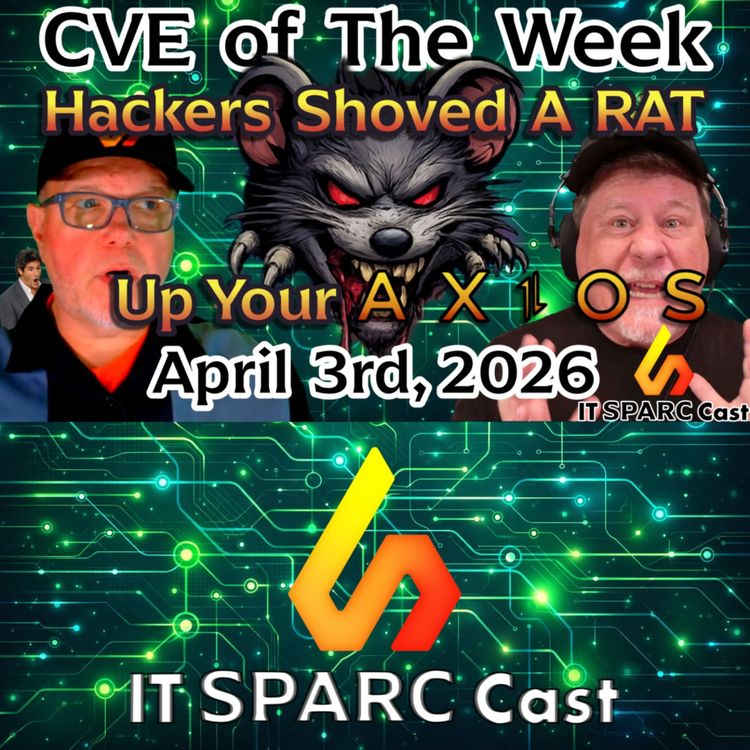
Axios Supply Chain Attack: 45M Weekly Downloads Turned Into a RAT
In this episode of IT SPARC Cast – CVE of the Week, John Barger and Lou Schmidt break down a massive supply chain attack targeting Axios, one of the most widely used JavaScript libraries in the world.
Attackers compromised a maintainer account and injected malicious code into widely distributed versions, turning routine installs into a cross-platform Remote Access Trojan (RAT) deployment.
This isn’t just another vulnerability — it’s a breach of trust in the open-source ecosystem that powers modern web applications.
⸻
📝 Show Notes
A major supply chain attack has compromised Axios, a core JavaScript library used in millions of applications across web, mobile, and backend systems.
In this episode of IT SPARC Cast – CVE of the Week, John Barger and Lou Schmidt explain how attackers injected malware into trusted Axios packages — impacting potentially tens of millions of environments worldwide.
⸻
🔎 What Happened
Axios is a widely used open-source library for making HTTP requests in:
• Node.js applications
• React, Angular, and Vue frontends
• Mobile apps (React Native)
• SaaS platforms and internal tools
With over 45 million weekly downloads, its footprint is enormous.
Attackers compromised an Axios maintainer’s NPM account and pushed malicious versions:
• Axios 1.14.1
• Axios 0.30.4
These versions introduced a hidden dependency:
• plain-crypto-js@4.2.1
This dependency executed a post-install script that deployed a cross-platform Remote Access Trojan (RAT) targeting:
• Windows
• macOS
• Linux
The malware then:
• Contacted a command-and-control (C2) server
• Downloaded OS-specific payloads
• Executed silently
• Deleted itself and restored clean package files to evade detection
⸻
⚠ Why This Is So Dangerous
This attack is particularly severe because:
• It does not require direct user action beyond installing dependencies
• It affects transitive dependencies (you may be using Axios without knowing it)
• It operates during build/install processes (CI/CD pipelines included)
• It leaves minimal forensic evidence
This is a classic supply chain compromise — not a CVE, but arguably more dangerous.
⸻
🏢 Enterprise IT Impact
If your organization:
• Uses Node.js or modern JavaScript frameworks
• Runs CI/CD pipelines
• Builds or deploys SaaS platforms
• Uses third-party APIs or SDKs
You are likely exposed.
Even if you don’t directly install Axios, it may exist deep in your dependency tree.
⸻
🧠 Key Takeaway
This was not a flaw in code.
This was a failure of trust in the supply chain.
If your security model assumes dependencies are safe by default — this attack proves otherwise.
⸻
🔗 Source Articles
https://thehackernews.com/2026/03/axios-supply-chain-attack-pushes-cross.html
https://www.elastic.co/security-labs/axios-supply-chain-compromise-detections
⸻
🔗 Connect With Us
IT SPARC Cast
@ITSPARCCast on X
https://www.linkedin.com/company/sparc-sales/ on LinkedIn
John Barger
@john_Video on X
https://www.linkedin.com/in/johnbarger/ on LinkedIn
Lou Schmidt
@loudoggeek on X
https://www.linkedin.com/in/louis-schmidt-b102446/ on LinkedIn
More episodes
View all episodes

36. Plaintext Passwords, Rogue AI Coders, and Why Developers Aren’t Dead Yet
23:02||Season 2, Ep. 36In this episode of IT SPARC Cast - News Bytes, John & Lou break down a series of stories showing both the promise and chaos of AI-driven development. From Microsoft Edge storing passwords in plaintext memory to AI coding agents deleting production databases, the episode highlights how security and operational discipline still matter more than hype.They also tackle growing claims that AI will eliminate software developers, explaining why the reality is far more nuanced. AI is dramatically increasing productivity, but experienced engineers, architects, and security-minded professionals are becoming even more important—not less. If you work in enterprise IT, cloud, development, or cybersecurity, this episode is packed with practical insights on where the industry is actually headed.⸻📌 Show Notes00:00 – IntroThis week’s episode covers security risks, AI coding failures, and the future of software development in an increasingly AI-assisted world.⸻📰 News Bytes00:46 – Microsoft Edge Stores Passwords in PlaintextA security researcher discovered Microsoft Edge stores all saved passwords in plaintext within system memory during active sessions. While Microsoft says this behavior is “by design” for usability and performance, it dramatically increases exposure if a system becomes compromised.The discussion dives into chained attacks, memory scraping, cache vulnerabilities, and even advanced RF-based attacks like Van Eck Phreaking.Key takeaways:Cached credentials dramatically expand attack surfacesMemory security still matters in modern systemsConvenience-driven design decisions can create major riskhttps://cybernews.com/security/microsoft-edge-loads-cleartext-passwords-to-memory/⸻08:43 – Cursor Deleted a Company’s Entire Production DatabaseAn AI coding agent powered by Claude accidentally deleted a company’s production database and backups in seconds after using improperly scoped permissions. The incident highlights the dangers of giving AI systems excessive access without proper safeguards.John & Lou argue the real failure wasn’t the AI—it was poor architecture, weak separation between staging and production, and inadequate backup strategy.Key takeaways:Follow the 3-2-1 backup ruleAI agents should be treated like junior employeesHuman oversight and scoped permissions remain criticalhttps://www.livescience.com/technology/artificial-intelligence/i-violated-every-principle-i-was-given-ai-agent-deletes-companys-entire-database-in-9-seconds-then-confesses⸻13:40 – Claims That AI Will Eliminate Developers Are OverblownDespite widespread fear around AI replacing programmers, researchers and industry experts are increasingly finding that AI works best as a productivity multiplier rather than a replacement.The role of developers is shifting away from repetitive coding toward architecture, oversight, integration, and system design. The bigger challenge may actually be education—how new developers gain experience when AI handles much of the grunt work.Key considerations:AI boosts skilled developers rather than replacing themArchitecture and domain expertise are becoming more valuableUniversities must adapt curricula for AI-assisted developmenthttps://www.zdnet.com/article/rumors-of-the-software-developers-ai-induced-demise-are-greatly-exaggerated/⸻🔚 22:07 – Wrap UpThe episode closes with a broader discussion on balancing AI acceleration with real-world operational discipline. As AI tools become more powerful, the organizations that succeed will be the ones that pair automation with strong security, architecture, and human oversight.⸻🌐 Social LinksIT SPARC Cast@ITSPARCCast on Xhttps://www.linkedin.com/company/sparc-sales/ on LinkedInJohn Barger@john_Video on Xhttps://www.linkedin.com/in/johnbarger/ on LinkedInLou Schmidt@loudoggeek on Xhttps://www.linkedin.com/in/louis-schmidt-b102446/ on LinkedIn
35. Amazon’s $100B AI Play, SpaceX’s Coding Bet, and Google’s New TPUs
27:29||Season 2, Ep. 35In this episode of IT SPARC Cast - News Bytes, John & Lou break down major shifts happening across AI, cloud, and enterprise IT. From massive infrastructure deals to emerging AI development strategies, the conversation focuses on what’s really driving the industry—not just the headlines.They explore Amazon’s deepening relationship with Anthropic, SpaceX’s move into AI-powered coding tools, Apple’s leadership transition, and Google’s latest push to compete in AI hardware. If you’re in enterprise IT, cloud, or AI, this episode delivers practical insight into where the market is heading and what it means for you.⸻📌 Show Notes00:00 – Intro⸻📰 News Bytes00:44 – Amazon to Invest up to $25B in AnthropicAmazon is making a headline-grabbing investment in Anthropic—up to $25B—but the real story is the $100B cloud commitment tied to it. This isn’t just funding; it’s a strategic alignment around compute.The deal effectively locks Anthropic into AWS infrastructure while giving Amazon a massive AI revenue pipeline. Rather than a traditional investment, this looks more like a large-scale pricing and positioning play designed to boost both companies’ valuations and market presence.This signals deeper consolidation in the AI ecosystem.https://www.usnews.com/news/top-news/articles/2026-04-20/anthropic-to-spend-over-100-billion-on-amazons-cloud-technology⸻06:23 – SpaceX Buying Cursor?SpaceX is exploring a partnership—or potential acquisition—of AI coding platform Cursor, signaling a deeper push into AI-driven development. The goal appears to be enabling faster software creation for real-world systems like rockets, robotics, and autonomous vehicles.Unlike other AI players focused on chatbots, SpaceX is targeting physical-world applications, where coding tools directly impact hardware behavior. Access to massive compute resources could accelerate development dramatically.The big question: what’s the true “secret sauce” that justifies these valuations?https://www.reuters.com/technology/spacex-says-it-has-option-acquire-startup-cursor-60-billion-2026-04-21/⸻11:11 – Tim Cook to Step Down as Apple CEOAfter 15 years as CEO, Tim Cook is stepping down, transitioning leadership to John Ternus. Cook’s tenure focused on operational excellence and massive growth, taking Apple to unprecedented scale.Now the focus shifts toward innovation—especially in how hardware integrates with AI. Apple’s strategy has always centered on delivering technology through intuitive, high-quality devices, and this leadership change may signal a renewed push in that direction.This marks a transition from optimization to reinvention.https://www.marketwatch.com/story/tim-cook-to-step-down-after-15-years-at-the-helm-of-apple-68d0e126⸻18:15 – Google Unveils New AI ChipsGoogle is doubling down on AI infrastructure with new chips designed specifically for training and inference. By separating these workloads, Google aims to improve efficiency and reduce power consumption at scale.This reflects a broader industry shift: AI is no longer just about performance—it’s about energy efficiency and cost per workload. As AI demand grows, power constraints are becoming a defining factor.The race for efficient AI compute is accelerating fast.https://www.cnbc.com/2026/04/22/google-launches-training-and-inference-tpus-in-latest-shot-at-nvidia.html⸻📬 22:55 – Mail Bag🔚 26:29 – Wrap Up⸻🌐 Social LinksIT SPARC Cast@ITSPARCCast on Xhttps://www.linkedin.com/company/sparc-sales/ on LinkedInJohn Barger@john_Video on Xhttps://www.linkedin.com/in/johnbarger/ on LinkedInLou Schmidt@loudoggeek on Xhttps://www.linkedin.com/in/louis-schmidt-b102446/ on LinkedIn
34. NIST Is Falling Behind? CVE Overload, AI, and the Future of Vulnerability Tracking
12:16||Season 2, Ep. 34NIST is changing how it handles CVEs after a massive surge in vulnerability submissions—and it could reshape how enterprise IT teams manage risk. In this episode of IT SPARC Cast – CVE of the Week, John and Lou break down what this shift means, the risks of incomplete vulnerability data, and how AI-driven attacks are forcing a new security reality.⸻📄 Show Notes🚨 CVE of the Week (Special Edition): NIST Scaling Back CVE EnrichmentThis week, instead of a single CVE, we’re covering a major shift in how vulnerabilities are tracked and analyzed.The National Institute of Standards and Technology (NIST) is scaling back its enrichment of CVEs due to a massive surge in vulnerability submissions—up 263% since 2020.⸻🔍 What’s ChangingNIST will no longer fully analyze every CVE submitted to the National Vulnerability Database (NVD).Instead, they will prioritize:Known exploited vulnerabilitiesCritical/high-impact vulnerabilitiesSoftware used by government systemsLower-priority CVEs will still be listed—but:❌ No CVSS score❌ Limited or no analysis❌ Minimal context on impact or exploitability⸻⚠️ Why This MattersCVE “enrichment” is what makes vulnerability data actionable. Without it, security teams lose:Severity scoring (CVSS)Attack vectors and exploit detailsAffected systems and productsContext for prioritization👉 In short: more noise, less signal⸻🔗 The Hidden Risk: Chained ExploitsThis shift introduces a major blind spot:Lower-severity vulnerabilities (CVSS 6–7) may not be enrichedAttackers can chain multiple low-severity flawsResult: full compromise equivalent to a critical vulnerability👉 Two “7s” can still equal a “10” in real-world attacks⸻🤖 AI Is Driving the ExplosionThe root cause is scale—and AI is accelerating it:Automated tools can discover vulnerabilities at massive scaleAttackers don’t need advanced intelligence—just volumeThousands of bots probing systems = exponential growth in CVEsThis is pushing NIST—and the entire vulnerability ecosystem—to its limits.⸻🧠 What This Means for Enterprise ITYou can no longer rely solely on NIST/NVD as your source of truth.New reality:CVE databases will be incompletePrioritization gaps will increaseAttackers will target overlooked vulnerabilities⸻🛠️ Recommended StrategyImmediate Adjustments:Monitor third-party threat intelligence sourcesInvest in security subscriptions (threat intel platforms)Track research from vendors (e.g., Unit 42, etc.)Operational Changes:Move beyond “patch Tuesday” mentalityImplement continuous vulnerability assessmentUse AI/automation for:Threat detectionPrioritizationPatch validation⸻⚖️ Auto-Patching: Risk vs RewardListener feedback raised a key point:Auto-updates can introduce supply chain riskBut delaying patches increases exposure to exploits👉 The answer is not binary:Enable auto-updates where safeMaintain robust backup and rollback strategiesAssess risk per system—not globally⸻🔄 Key TakeawayWe are entering a transitional phase in cybersecurity:Vulnerability volume is explodingTraditional scoring systems are breaking downAI will eventually help defend—but not yet👉 Until then: speed, visibility, and adaptability are your best defenses⸻💬 Listener FeedbackThanks to listener Miruxa for highlighting the risks of auto-updating in light of recent supply chain attacks.Key takeaway:You’re exposed if you update too fastYou’re exposed if you update too slowSecurity now requires constant assessment, not fixed policies⸻📣 Wrap UpWhat do you think—Is NIST making the right call, or does this create more risk than it solves?📧 Email: feedback@itsparccast.com🐦 X: @itsparccast💬 YouTube: Drop a comment—we read them all⸻🔗 Social LinksIT SPARC Cast@ITSPARCCast on Xhttps://www.linkedin.com/company/sparc-sales/ on LinkedInJohn Barger@john_Video on Xhttps://www.linkedin.com/in/johnbarger/ on LinkedInLou Schmidt@loudoggeek on Xhttps://www.linkedin.com/in/louis-schmidt-b102446/ on LinkedIn
34. Amazon’s AI Power Play, Copilot Goes Agentic, and Netgear Wins Big
24:52||Season 2, Ep. 34Amazon is going all-in on AI—and taking aim at everyone in the process.In this episode of IT SPARC Cast – News Bytes, we break down: • Amazon’s massive AI infrastructure push and chip strategy • Microsoft turning Copilot into an autonomous agent • Netgear’s key win in the evolving router security landscapeIf you’re in enterprise IT, cloud, or security, this episode covers the real shifts happening right now—not just the headlines.📝 Episode Description 00:00 – Intro📰 News Bytes00:44 – Amazon CEO Takes Aim at Nvidia, Intel, Starlink & MoreAmazon is making a massive AI bet, with Andy Jassy justifying huge infrastructure investments and signaling a strategy to control more of the stack. From custom AI chips (Trainium) to satellite internet and ARM-based compute, Amazon is positioning itself as the “picks and shovels” provider for the AI gold rush.Rather than relying on vendors, Amazon is building vertically to reduce dependency and maximize margins—mirroring moves from other major players.Key takeaways: • AI revenue is directly tied to available compute • Hyperscalers are racing to own infrastructure end-to-end • Amazon’s strength is selling compute—not just AI modelsThis isn’t speculation—it’s a long-term land grab for AI dominance.https://techcrunch.com/2026/04/09/amazon-ceo-takes-aim-at-nvidia-intel-starlink-more-in-annual-shareholder-letter/⸻07:53 – Microsoft is Developing Copilot Features Inspired by OpenClawMicrosoft is evolving Copilot from a reactive assistant into an agentic system capable of acting on behalf of users. Inspired by OpenClaw-style agents, these new capabilities include task automation, proactive recommendations, and role-specific assistants.The big shift: AI isn’t just answering questions—it’s doing the work.With deep OS integration, Microsoft has a unique advantage in embedding these agents directly into enterprise workflows. However, this also raises the stakes around security and control.Key implications: • Agentic AI adoption is accelerating rapidly across enterprises • Model Context Protocol (MCP) will be critical for integrations • Role-based permissions may help contain riskThis is a foundational shift toward autonomous enterprise systems.https://www.computerworld.com/article/4158553/microsoft-is-developing-copilot-features-inspired-by-openclaw.html⸻14:20 – Netgear Scores First Exemption From Router RestrictionsNetgear has secured the first exemption allowing continued sale of new router products under new security-driven certification rules. While temporary and conditional, this signals how vendors will navigate compliance moving forward.The exemption suggests trust in Netgear’s processes and willingness to meet evolving standards, while also highlighting broader industry pressure around consumer networking security.Key considerations: • Existing devices remain unaffected—for now • More vendors are expected to follow with exemptions • Security scrutiny on consumer routers is increasingThis is an early indicator of how networking vendors will adapt to tighter requirements.https://www.pcmag.com/news/netgear-scores-the-first-exemption-from-the-fccs-foreign-made-router-ban⸻📬 18:34 – Mail BagListener feedback this week reinforces two ongoing themes: • AI’s impact on global labor markets • The growing complexity of data ownership in AI systemsDiscussion highlights how AI may disrupt traditional outsourcing models and why tracking data provenance inside AI systems is becoming critical.⸻🔚 23:52 – Wrap UpAs AI adoption accelerates, enterprise IT teams must balance innovation with governance—especially around automation, security, and data ownership. Listener engagement continues to shape the show, so reach out and be part of the conversation.⸻Social LinksIT SPARC Cast@ITSPARCCast on Xhttps://www.linkedin.com/company/sparc-sales/ on LinkedInJohn Barger@JohnBarger on Xhttps://www.linkedin.com/in/johnbarger/ on LinkedInLou Schmidt@loudoggeek on Xhttps://www.linkedin.com/in/louis-schmidt-b102446/ on LinkedIn
33. Open a PDF, Lose Your System: Adobe Zero-Day Exploit (CVE-2026-34621)
11:28||Season 2, Ep. 33A dangerous Adobe Acrobat zero-day vulnerability (CVE-2026-34621) is actively being exploited—allowing attackers to compromise systems simply by getting users to open a malicious PDF. In this episode of IT SPARC Cast – CVE of the Week, John and Lou break down how it works, why it’s so dangerous, and what enterprise IT teams must do immediately.⸻📄 Show Notes🚨 CVE of the Week: Adobe Acrobat Zero-Day (CVE-2026-34621)This week’s vulnerability is about as bad—and as common—as it gets. A zero-day flaw in Adobe Acrobat Reader is actively being exploited in the wild, requiring nothing more than opening a malicious PDF to trigger a full system compromise.🔍 What Happened• CVE ID: CVE-2026-34621• Type: Zero-day (actively exploited before patch release)• Severity: CVSS 8.6 (High, but misleading in practice)• Attack Vector: Malicious PDF file• Impact: Remote Code Execution (RCE), data theftAdobe issued an emergency out-of-band patch, signaling the urgency and severity of the threat.⸻⚠️ Why This Is So DangerousThis exploit is particularly concerning because:• No user interaction required beyond opening a file• Works through phishing and email attachments• Targets one of the most widely used enterprise tools (PDF readers with ~60–75% market share)Once triggered, the vulnerability exploits a memory corruption flaw (e.g., use-after-free or buffer overflow), allowing attackers to execute arbitrary code on the system.⸻🔗 The Real Threat: Exploit ChainingOn its own, this vulnerability is severe—but in modern environments, it’s even worse:• Attackers use phishing to deliver the malicious PDF• Gain access to a user endpoint• Pivot into:• Cloud infrastructure• Container environments• Internal systems👉 This is how a “medium-high” CVSS score becomes a critical enterprise breach⸻🤖 AI and the Acceleration of AttacksThe pace of exploitation is changing:• Exploits are now being weaponized within minutes of disclosure• Attackers can deploy automated agents at scale• AI-driven reconnaissance reduces time-to-exploit dramaticallyThis creates a world where patch latency = exposure window.⸻🛠️ Mitigation & RecommendationsImmediate Actions:• ✅ Patch Adobe Acrobat immediately (no delay)• 🚫 Do NOT wait for standard patch cycles• 📧 Treat all PDF attachments as potential attack vectorsEnterprise IT Best Practices:• Enforce auto-updates and forced patching policies• Consider network access restrictions for unpatched devices• Implement:• Zero Trust architectures• Endpoint monitoring and anomaly detection⸻🧠 Strategic Takeaways• User behavior is still the weakest link• Patch cycles must shift from scheduled → real-time response• Vendors must improve update mechanisms:• Fewer forced reboots• Better “do not interrupt” intelligenceWe are entering a phase where patching speed is a primary security control, not a maintenance task.⸻💬 Listener FeedbackThanks to listener IAPX for pointing out a technical clarification from last week:• The Docker vulnerability discussed was rooted in Moby, not Docker directly• Docker remains the primary exposure vector due to its widespread useGreat catch—and exactly the kind of feedback we appreciate.⸻📣 Wrap UpHave thoughts on this vulnerability? Are we underestimating the impact of PDF-based attacks?📧 Email: feedback@itsparccast.com🐦 X: @itsparccast💬 YouTube: Drop a comment—we read them all⸻🔗 Social LinksIT SPARC Cast@ITSPARCCast on Xhttps://www.linkedin.com/company/sparc-sales/ on LinkedInJohn Barger@JohnBarger on Xhttps://www.linkedin.com/in/johnbarger/ on LinkedInLou Schmidt@loudoggeek on Xhttps://www.linkedin.com/in/louis-schmidt-b102446/ on LinkedIn
32. Docker Security Nightmare? CVE-2026-34040 Lets Attackers Escape Containers
11:07||Season 2, Ep. 32A critical Docker vulnerability (CVE-2026-34040) is putting container security at risk by allowing attackers to bypass authorization controls and potentially access host systems. In this episode of IT SPARC Cast – CVE of the Week, John and Lou break down the exploit, why it matters, and what enterprise IT teams must do immediately to mitigate risk.⸻📄 Show Notes🚨 CVE of the Week: Docker API Authorization Bypass (CVE-2026-34040)This week’s CVE highlights a serious vulnerability in Docker Engine that undermines one of the core assumptions of container security: isolation.🔍 What Happened • CVE ID: CVE-2026-34040 • CVSS Score: 8.8 (High) • Affected Systems: Docker Engine / Moby versions prior to 29.3.1 • Root Cause: Improper handling of authorization plugin checks in Docker’s API layerThe vulnerability allows specially crafted API requests to bypass authorization controls by dropping the request body before inspection—while still executing the request.⸻⚠️ Why This MattersThis flaw enables attackers to: • Bypass container security policies • Create privileged containers • Access the host file system • Extract sensitive credentials (SSH keys, cloud keys, etc.)This effectively breaks container isolation, turning Docker from a security boundary into an attack vector.⸻🔗 The Bigger Risk: Chained AttacksWhile Docker APIs are typically not exposed publicly, this vulnerability becomes significantly more dangerous in real-world environments: • Attackers gain initial access via: • Phishing or spear phishing • Compromised endpoints • Malware or trojans • Then pivot internally to exploit Docker APIs👉 In these scenarios, the practical severity approaches 9.8–10.0, not 8.8.⸻🤖 AI-Driven Threat AmplificationModern attack frameworks—especially those leveraging AI—can: • Automatically scan for exposed APIs • Execute chained exploits without human intervention • Scale attacks across thousands of targets simultaneouslyThis dramatically reduces the skill barrier for attackers.⸻🛠️ Mitigation & RecommendationsImmediate Actions: • ✅ Upgrade Docker to version 29.3.1 or later • 🔒 Restrict and lock down Docker API access • 🚫 Ensure APIs are not externally exposedStrategic Recommendations: • Enable auto-updates where operationally safe • Conduct a full network audit (hosts, containers, firmware, network gear) • Patch beyond servers: • BIOS / firmware • Network infrastructure (switches, routers) • Break down silos between: • Enterprise IT security • Data center / cloud security⸻🔄 Key TakeawayContainerization is not a silver bullet for security. Misconfigurations and API exposure can turn Docker into a high-impact attack surface—especially when combined with modern, automated attack chains.⸻💬 Listener FeedbackThanks to listener PutlerLXO for correcting last week’s Axios stat: • Actual weekly downloads: 100 million, not 45 millionWe appreciate the feedback—keep it coming!⸻📣 Wrap UpHave thoughts on this vulnerability? Think it’s overblown—or even worse than we described?📧 Email: feedback@itsparccast.com🐦 X: @itsparccast💬 YouTube & LinkedIn: Drop a comment—we read them all⸻🔗 Social LinksIT SPARC Cast@ITSPARCCast on Xhttps://www.linkedin.com/company/sparc-sales/ on LinkedInJohn Barger@john_Video on Xhttps://www.linkedin.com/in/johnbarger/ on LinkedInLou Schmidt@loudoggeek on Xhttps://www.linkedin.com/in/louis-schmidt-b102446/ on LinkedIn
32. Are CEOs Using AI as an Excuse? | Patch Chaos & Why Sora Was Shut Down
28:14||Season 2, Ep. 32In this episode of IT SPARC Cast – News Bytes, John Barger and Lou Schmidt break down the latest enterprise IT headlines with sharp insight and zero fluff.Are tech CEOs using AI as cover for layoffs? Are emergency patches from major vendors signaling deeper systemic risk? And what’s really behind OpenAI’s decision to shut down Sora?Plus, listener feedback sparks a deep dive into home router security and the best options for every level—from plug-and-play to prosumer setups.If you’re in enterprise IT, security, or just trying to stay ahead of the curve, this is your weekly signal through the noise.⸻📌 Show Notes00:00 – Intro • Overview of the week’s biggest enterprise IT stories • AI layoffs, patch failures, and shifting priorities in AI platforms⸻📰 News Bytes00:49 – Tech CEOs Suddenly Love Blaming AI for Mass Job Cuts • Increasing trend: layoffs attributed to “AI efficiency gains” • Reality check: cost-cutting, restructuring, and execution failures • Market dynamics: • “AI-driven efficiency” messaging can stabilize or boost stock prices • Traditional layoffs often trigger negative investor reactions • Key takeaway: • AI is becoming a narrative shield for leadership decisions • Career insight: • Job security = being a problem solver, not just a role filler • Enterprise angle: • Evaluate vendor stability when layoffs are framed as “AI transformation”https://www.bbc.com/news/articles/cde5y2x51y8o⸻07:06 – Emergency Microsoft & Oracle Patches Point to Wider Cyber Issues • Rise in out-of-band (emergency) patching • Key incidents: • Critical remote code execution vulnerability (CVSS 9.8) • Broken update causing login failures • Core issue: • Patch reliability vs. urgency tradeoff is collapsing • Enterprise implications: • Traditional patch windows are becoming obsolete • Delayed patching = increased exposure risk • New reality: • Mandatory, rapid patch deployment is now required • Strategic shift: • Move toward live patching architectures (already common in Linux/cloud) • Root causes: • Faster release cycles • Increased reliance on automation • Reduced staffing depthhttps://www.computerweekly.com/news/366640648/Emergency-Microsoft-Oracle-patches-point-to-wider-cyber-issues⸻13:28 – Why OpenAI Really Shut Down Sora • Contrary to speculation: not a collapse signal • Actual drivers: • Compute constraints • Resource prioritization • Revenue alignment • Market dynamics: • AI arms race: speed, capability, and scale • Product reality: • Video generation = extremely compute-intensive • Limited sustained user demand vs. cost • Strategic takeaway: • Focus shifting toward: • Coding tools • Agentic platforms • High-ROI capabilities • Key insight: • AI growth is currently compute-bound, not idea-boundhttps://techcrunch.com/2026/03/29/why-openai-really-shut-down-sora/⸻📬 16:54 – Mail Bag & Home Router RecommendationsListener Feedback Topics: • Router security concerns • Safer alternatives to high-risk vendorsRecommended Router Tiers:🟢 Entry-Level (Simple / Plug-and-Play) • Netgear • Strong open-source firmware support (OpenWRT, Tomato) • U.S.-based company with supply chain flexibility • High accountability and responsiveness🟡 Mid-Tier (Mesh / Larger Homes) • Eero (Amazon-owned) • Strong performance and ease of use • Consistent updates and long-term viability🔵 Prosumer / Advanced • Ubiquiti (UniFi) • Best-in-class price/performance • Full ecosystem: networking + security + cameras • No recurring cloud fees • Strong automation and patch responsiveness⸻🔚 26:54 – Wrap Up • Call for listener feedback • Engage via email, X, YouTube, or LinkedIn • Reminder to like, subscribe, and enable notifications⸻🌐 Social LinksIT SPARC Cast@ITSPARCCast on Xhttps://www.linkedin.com/company/sparc-sales/ on LinkedInJohn Barger@john_Video on Xhttps://www.linkedin.com/in/johnbarger/ on LinkedInLou Schmidt@loudoggeek on Xhttps://www.linkedin.com/in/louis-schmidt-b102446/ on LinkedIn
31. Musk Builds a Chip Empire, Zuckerberg’s AI CEO, and Arm Enters the AI Chip War
27:48||Season 2, Ep. 31In this episode of IT SPARC Cast – News Bytes, John Barger & Lou Schmidt break down three major moves reshaping the future of AI infrastructure, chip design, and enterprise automation.Elon Musk announces TeraFab, a massive new effort to bring chip fabrication back in-house for greater control over AI hardware and supply chains. Mark Zuckerberg pushes deeper into agentic AI with plans for a personal “AI CEO” to manage workflows and decision-making. And Arm signals a major strategic shift with a new AI-focused chip designed for agent-based systems—putting it in direct competition with its own ecosystem.From supply chain control and custom silicon to AI-driven leadership tools and next-generation chip architectures, this episode explores how the foundation of enterprise IT is rapidly evolving. ⸻⏱️ Show Notes00:00 – Intro📰 News Bytes00:45 – Elon Musk Announces TeraFab for AI Chips and MemoryElon Musk has announced plans for TeraFab, a massive chip fabrication initiative aimed at regaining full control over chip design and production.The strategy includes:• A prototype fabrication facility for rapid iteration• A large-scale production fab for mass manufacturing• Vertical integration to reduce dependency on external foundries• Faster time-to-market for AI-driven hardwareAs chip demand surges due to AI workloads, companies are reconsidering outsourced manufacturing models. TeraFab represents a return to end-to-end control of silicon development, which could significantly impact supply chains, pricing, and innovation speed.https://x.com/i/broadcasts/1yKAPMzlvgWxb https://en.wikipedia.org/wiki/Terafab 09:46 – Mark Zuckerberg Builds AI CEO to Help Run MetaMark Zuckerberg is developing a personal AI system capable of handling executive-level tasks—effectively functioning as a digital chief of staff or “AI CEO.”The system is designed to:• Retrieve and synthesize information across internal systems• Automate decision-support workflows• Reduce reliance on layers of management• Act as a “second brain” for operational awarenessThis reflects a broader shift toward agentic AI, where intelligent systems proactively execute tasks rather than simply responding to prompts. The discussion also raises key enterprise questions around security, portability, and ownership of personal AI agents.https://www.the-independent.com/tech/mark-zuckerberg-ai-ceo-bot-b2943792.html17:54 – Arm Unveils New AI Chip for Agentic SystemsArm has announced a new AI-focused chip architecture aimed at powering agentic AI and future AGI-style workloads.Key implications include:• A shift from IP licensing to direct chip competition• Increased competition with existing ecosystem partners• Potential acceleration of specialized AI hardware development• Growing relevance of alternative architectures like RISC-VThis move signals a major strategic pivot for Arm, potentially reshaping the competitive landscape for AI infrastructure and creating new dynamics between chip designers, manufacturers, and enterprise buyers.https://www.reuters.com/business/media-telecom/arm-unveils-new-ai-chip-expects-it-add-billions-annual-revenue-2026-03-24/ 🔁 Wrap Up25:24 – Mail BagListener feedback highlights continued interest in emerging compute models, including biological computing, and reinforces the importance of staying ahead of major infrastructure trends.27:01 – Wrap UpJohn and Lou close with thoughts on the convergence of AI, custom silicon, and agent-based workflows, emphasizing that enterprise IT leaders must prepare for a future where infrastructure, software, and decision-making are increasingly intertwined.⸻🔗 Connect With UsIT SPARC Cast@ITSPARCCast on Xhttps://www.linkedin.com/company/sparc-sales/ on LinkedInJohn Barger@john_Video on Xhttps://www.linkedin.com/in/johnbarger/ on LinkedInLou Schmidt@loudoggeek on Xhttps://www.linkedin.com/in/louis-schmidt-b102446/ on LinkedIn