Share
IT SPARC Cast
Microsoft Disables RC4: Why This Legacy Cipher Had to Die
In this episode of IT SPARC Cast – CVE of the Week, John Barger and Lou Schmidt break down a long-overdue security move from Microsoft: disabling the RC4 cipher by default across Windows authentication infrastructure. After more than two decades of known cryptographic weaknesses, RC4 is finally being deprecated in favor of modern encryption standards like AES.
The discussion covers why RC4 persisted for so long, how legacy Active Directory and Kerberos environments kept it alive, and why attackers have continued to exploit it through techniques like Kerberoasting. The hosts also highlight the new logging, auditing, and PowerShell tools Microsoft released to help enterprises identify and eliminate lingering RC4 dependencies—without breaking production systems.
⸻
📋 Show Notes
🔐 Main Topic: Microsoft Disables RC4 by Default
• Microsoft is removing RC4 (Rivest Cipher 4) as a default cipher in Windows authentication after more than 25 years.
• RC4 has been known to be cryptographically broken for decades and has been actively exploited in real-world attacks.
• The change impacts Kerberos authentication across Windows Server 2008 and later.
• RC4 will still function only if explicitly re-enabled—which is strongly discouraged.
⚠️ Why RC4 Is Dangerous
• RC4 has been abused in Kerberoasting attacks against Active Directory environments.
• Weak encryption allows attackers to extract service account credentials offline.
• Keeping RC4 enabled significantly increases the blast radius of a compromised domain.
🛠️ What Microsoft Did Right This Time
• Added enhanced Kerberos logging (Event IDs 4768 and 4769) to identify RC4 usage.
• Released PowerShell scripts to audit domain controllers for RC4 dependencies.
• Published clear migration guidance to move environments to AES-SHA1 and stronger encryption.
• Provided visibility before enforcing the change, helping admins avoid outages.
🎧 Listener Feedback Highlight
• A YouTube listener praised the CVE of the Week format as being highly valuable from an ops and security standpoint.
• Strong validation that actionable vulnerability analysis resonates with enterprise IT teams.
⭐ Community Call-Out: Abdullah’s React Audit Tool
A special shout-out to Abdullah ( https://x.com/ozkayabd ) who responded on X after a previous React CVE episode and shared an open-source tool to help teams audit their environments:
👉 React Audit Scanner
http://rsc-auditor.vercel.app
This tool allows teams to quickly check whether they may be impacted by recent React vulnerabilities. As always, review and validate any third-party tool before using it in production.
⸻
🔚 Wrap Up & Social Links
IT SPARC Cast
@ITSPARCCast on X
https://www.linkedin.com/company/sparc-sales/ on LinkedIn
John Barger
@john_Video on X
https://www.linkedin.com/in/johnbarger/ on LinkedIn
Lou Schmidt
@loudoggeek on X
https://www.linkedin.com/in/louis-schmidt-b102446/ on LinkedIn
More episodes
View all episodes
20. CES Brings New CPUs, AI Agents, and Deep OS-Level Copilot Integration
23:27||Season 2, Ep. 20CES may be a consumer show, but this week it sent shockwaves through enterprise IT. In this episode of IT SPARC Cast – News Bytes, John Barger and Lou Schmidt break down why nearly every major chip vendor chose CES to unveil next-generation CPUs, what Lenovo’s new agentic AI strategy means for IT teams, and why Microsoft embedding Copilot deep into Windows could fundamentally change how operating systems work.From Intel’s attempt at a comeback, to AMD and Qualcomm’s positioning against NVIDIA, to growing concerns about trust, security, and AI agents living inside your OS, this episode separates meaningful signals from CES noise—and explains why power efficiency, autonomy, and control are becoming the real battlegrounds.⸻⏱️ Show Notes00:00 – IntroJohn and Lou frame CES as the unexpected epicenter of enterprise IT announcements, explaining why CPUs, AI, and robotics dominated the show—and why IT teams should care.⸻📰 News Bytes00:54 – New CPUs AnnouncedCES saw major CPU launches from Intel, AMD, Qualcomm, and NVIDIA—signaling a shift toward mainstream AI hardware announcements. Intel launched Panther Lake, AMD expanded Ryzen AI, Qualcomm pushed Snapdragon X2 for AI agents, and NVIDIA moved Rubin into full production.⸻09:45 – Lenovo’s New AI AgentLenovo unveiled Qira, an agentic AI designed to work across PCs, phones, wearables, and enterprise systems alongside Microsoft Copilot. The move highlights a growing push toward cross-device AI coordination—and raises questions about Apple’s closed ecosystem.⸻12:40 – Microsoft Integrates Copilot Deep into WindowsMicrosoft is embedding AI agent launchers directly into Windows, allowing third-party applications to register system-wide AI agents. While this may keep operating systems relevant, it introduces serious trust and security concerns around deep OS-level access.https://blogs.windows.com/windows-insider/2025/12/19/announcing-windows-11-insider-preview-build-26220-7522-dev-beta-channels/⸻🔁 Wrap Up19:03 – Mail BagListener feedback sparks a discussion on cloud outages, cost structures, and whether on-prem alternatives are becoming viable again for certain businesses.22:15 – Wrap UpJohn and Lou emphasize that resilience in the cloud is still possible—but only if organizations are willing to pay for it—and invite listeners to share what CES announcements stood out to them.IT SPARC Cast@ITSPARCCast on Xhttps://www.linkedin.com/company/sparc-sales/ on LinkedInJohn Barger@john_Video on Xhttps://www.linkedin.com/in/johnbarger/Lou Schmidt@loudoggeek on Xhttps://www.linkedin.com/in/louis-schmidt-b102446/
19. Ni8mare in n8n: CVSS 10 Workflow RCE Hitting Automation Platforms
08:18||Season 2, Ep. 19In the first regular IT SPARC Cast - CVE of the Week episode of 2026, John & Lou dive into a critical, actively exploitable vulnerability shaking the automation world. CVE-2026-21858—dubbed Ni8mare—targets the popular workflow automation platform n8n, earning a full CVSS 10.0 due to unauthenticated remote code execution.They break down how a content-type confusion bug inside n8n’s webhook processing engine allows attackers to fully compromise systems, why automation platforms are uniquely dangerous when breached, and what this means for enterprises running self-hosted or lightly governed internal tooling. The episode also highlights listener feedback and calls out a community-built React security tool worth checking out.⸻Show NotesCVE of the Week: n8n “Ni8mare” (CVE-2026-21858) • What is n8n?An open-source, self-hosted workflow automation platform similar to Zapier or Make, widely used in enterprise and regulated environments for visual API-driven automation. • Severity & ScopeCVE-2026-21858 carries a CVSS 10.0, joining multiple recent n8n vulnerabilities rated 9.9–10.0. n8n has over 200,000 deployments across cloud and on-prem environments. • Technical Root CauseA content-type confusion flaw in webhook form-data handling allows attackers to bypass file validation and execute arbitrary code. • Why This Is DangerousWorkflow engines often touch identity systems, APIs, credentials, and business logic—making them high-value targets with blast radii far beyond a single server. • Enterprise TakeawayShadow IT, internally built automation, and lightly governed enablement tools must be continuously audited. Patch known systems—and actively hunt for unknown ones.https://thehackernews.com/2026/01/critical-n8n-vulnerability-cvss-100.htmlListener HighlightDennis called out the Ingram Micro ransomware outage, noting that he hadn’t realized just how disruptive that incident was. And he’s absolutely right—Ingram Micro going offline for roughly 9–10 days created a nightmare scenario for VARs, system integrators, and build shops that rely on Ingram for ordering, RMAs, and emergency drop-ship replacements.To put the scale in perspective, Ingram Micro processes an estimated $30–40 million per day in transactions. Even if some revenue was recovered later, the operational disruption, reputational damage, and downstream impact across the supply chain were massive. This is exactly why incidents like this belong in the conversation when we talk about real-world IT security failures.Thanks for the thoughtful comment, Dennis—we genuinely appreciate the feedback and the conversation it sparked.Wrap Up & Community EngagementThis episode reinforces a core theme: automation without security oversight becomes an enterprise liability. IT teams must partner with business units—not just say “no”—while enforcing continuous audits and rapid patching.Follow & ConnectIT SPARC Cast@ITSPARCCast on Xhttps://www.linkedin.com/company/sparc-sales/John Barger@john_Video on Xhttps://www.linkedin.com/in/johnbarger/Lou Schmidt@loudoggeek on Xhttps://www.linkedin.com/in/louis-schmidt-b102446/
19. 2026 Predictions: AI Reality Check, Quantum Breakthroughs, and the Next Cloud Reckoning
13:18||Season 2, Ep. 19In this special predictions episode of IT SPARC Cast – News Bytes, John Barger and Lou Schmidt kick off 2026 by trading bold, unfiltered forecasts for enterprise IT, AI, cloud, energy, and geopolitics. With five predictions each—and no prior coordination—they round-robin through what they believe will define the next year in technology.From the deflation of the AI hype cycle and Apple’s inevitable AI acquisition, to quantum computing entering nation-state playbooks, nuclear power reshaping data centers, and lawsuits finally challenging cloud provider accountability, this episode puts both hosts on the record. At the end of the year, they’ll revisit every prediction and grade themselves—so these takes are meant to age in public.⸻⏱️ Show Notes00:00 – IntroJohn and Lou explain the format: ten total predictions for 2026, five each, shared live without coordination—and revisited at the end of the year for accountability.⸻🔮 2026 Predictions01:09 – Lou: The AI Bubble DeflatesAI investment cools as rationalization sets in—money keeps flowing, but weaker players and inflated expectations begin to fall away instead of a full collapse.01:29 – John: Apple Acquires an AI / LLM CompanyApple makes a major AI acquisition to avoid long-term dependence on competitors’ models and regain control over its AI strategy.02:53 – Lou: AI Starts to Get Really UsefulAI shifts from hype to practical value, quietly improving everyday workflows and real-world systems rather than flashy demos.04:11 – John: Nation States Use Quantum ComputingEvidence emerges that a nation-state is actively using quantum computing for espionage or cyber operations, even if never formally acknowledged.04:45 – Lou: AI Sneaks Into Places We Never ExpectedAI embeds itself into overlooked products and environments—especially AR, wearables, and location-aware systems—delivering small but meaningful gains.05:50 – John: Negative Reaction to OpenAI HardwareOpenAI’s hardware announcement is initially panned by the press and competitors, only to be vindicated later as its purpose becomes clear. 06:51 – Lou: Power Gets Real for Data CentersEnergy—not chips—becomes the primary constraint for cloud and enterprise infrastructure, forcing new generation strategies into production.08:00 – John: Small Modular Nuclear Reactors Explode (In a Good Way)SMRs rapidly gain funding, deployments, and valuations as they become the only scalable answer to data center power demand.08:36 – Lou: The Privacy Environment Gets WeirdGeopolitics, AI agents, and shifting borders create inconsistent and unpredictable privacy regimes across regions.10:11 – John: Lawsuits Over Cloud OutagesMajor lawsuits—possibly class actions—emerge after cloud outages cause real-world harm, forcing legal accountability for uptime failures.⸻🔁 Wrap Up11:58 – Wrap UpJohn and Lou invite listeners to submit their own 2026 predictions and commit to revisiting all forecasts at year’s end to see who was right.IT SPARC Cast@ITSPARCCast on Xhttps://www.linkedin.com/company/sparc-sales/ on LinkedInJohn Barger@john_Video on Xhttps://www.linkedin.com/in/johnbarger/Lou Schmidt@loudoggeek on Xhttps://www.linkedin.com/in/louis-schmidt-b102446/
18. The 5 Biggest IT Security Failures of 2025 (Cloud, Ransomware, RCEs)
18:40||Season 2, Ep. 18n this special CVE Year in Review episode of IT SPARC Cast, John Barger and Lou Schmidt break from the usual single-CVE format to count down the five worst IT security failures of 2025.From long-lived remote code execution flaws in enterprise networking gear, to a ransomware attack that shut down a global distributor, to systemic cloud outages that shattered the concept of “five nines” availability, this episode looks at what really went wrong—and why it matters heading into 2026.These weren’t theoretical risks. They were real-world failures that disrupted supply chains, exposed critical infrastructure, and forced the industry to rethink assumptions about resilience, cloud reliability, and operational security.⸻📋 Show Notes🔥 Top 5 IT Security Fails of 202501:39 - #5 – Ruckus NetworksRuckus suffered from multiple long-lived remote code execution and authentication bypass vulnerabilities that persisted across 2024 and 2025. Impacted products included SmartZone, ZoneDirector, Cloudpath, and ICX switch management interfaces. Several flaws allowed unauthenticated access to management planes, enabling attackers to take over wireless controllers, push malicious firmware, and pivot deeper into enterprise networks. The lack of timely patches and limited communication made remediation especially painful for customers.04:32 - #4 – Ingram MicroA ransomware attack forced one of the world’s largest technology distributors to effectively shut down operations for days. Ordering systems went offline, patch access was disrupted, and thousands of downstream partners and customers were impacted. While it remains unclear whether ransom was paid, the incident highlighted how a single distributor outage can cascade across the IT supply chain, delaying hardware replacements, breaking SLAs, and costing millions in lost revenue.07:21 - #3 – SAP NetWeaverCVE-2025-31324 exposed a critical unauthenticated remote code execution flaw in SAP NetWeaver’s Visual Composer. Actively exploited in the wild before many organizations were aware of its existence, the vulnerability gave attackers potential access to finance, HR, procurement, and supply-chain data. For enterprises running SAP at the core of operations, successful exploitation meant full application takeover and deep visibility into business processes.10:26 - #2 – ReactA severe remote code execution issue in React sent shockwaves through the software ecosystem. With an estimated one-third of cloud applications depending on React, attackers were able to chain exploits involving dependency poisoning, build pipeline compromise, and even client-side execution. While patches were released quickly, the sheer scale of affected deployments meant many systems remained vulnerable well after disclosure—and some still are.12:23 - #1 – Cloud Outages2025 marked the year that “five nines” effectively died. Major outages across AWS, Microsoft Azure, Google Cloud, Microsoft 365, and IBM Cloud caused multi-hour disruptions affecting identity systems, collaboration tools, healthcare platforms, and public-safety infrastructure. Many incidents were caused not by attackers, but by control plane failures, DNS issues, NTP misconfigurations, and cascading dependencies. The result: billions in estimated financial impact and renewed concern over life-critical workloads running entirely in the cloud.Watch Cloud SLA Theater: Why 99.999% Uptime Is a Joke in 2025 - https://www.youtube.com/watch?v=ygcYoFBXdjQ⸻17:19 - Wrap UpIf you think we missed a major security failure—or disagree with our rankings—we want to hear from you. Reach out, leave a comment, or send us feedback. Your insights often shape future episodes.🔗 Connect With UsIT SPARC CastX: @ITSPARCCastLinkedIn: https://www.linkedin.com/company/sparc-sales/John BargerX: @john_VideoLinkedIn: https://www.linkedin.com/in/johnbarger/Lou SchmidtX: @loudoggeekLinkedIn: https://www.linkedin.com/in/louis-schmidt-b102446/
18. CEOs Double Down on AI, Crystal Storage Goes Mainstream, and Coursera Buys Udemy
20:40||Season 2, Ep. 18This week on IT SPARC Cast, John Barger and Lou Schmidt break down three stories shaping the future of enterprise IT—from continued AI spending despite questionable ROI, to radically new approaches to long-term data storage, and a major consolidation in the online learning market.⸻📰 News Bytes00:46 – CEOs Keep Spending on AI Despite Spotty ReturnsDespite mixed financial outcomes, a growing number of CEOs plan to increase AI investment through 2026, viewing AI as strategically unavoidable rather than immediately profitable.Key discussion points: • Fewer than half of current AI projects are delivering clear ROI • Strong gains in sales, marketing, customer service, and developer productivity • Weak performance in regulated, high-risk areas like legal, HR, compliance, and cybersecurity • Layoffs blamed on AI may result in long-term operational backlashThe hosts argue that AI should augment human expertise, not prematurely replace it—and warn against betting the company on incomplete automation strategies.https://www.msn.com/en-us/technology/artificial-intelligence/ceos-to-keep-spending-on-ai-despite-spotty-returns/ar-AA1SkMcE07:34 – 5D Glass Storage: Crystals for the EnterpriseA UK company, SPhotonix, is advancing 5D glass storage, capable of preserving data for billions of years by etching nanoscale structures into glass using femtosecond lasers.Highlights include: • 360 TB per 5-inch glass disk • Designed for permanent archival, not hot or warm storage • Potential replacement for long-term tape archives • Early write speeds are slow, but roadmap improvements are promisingThis technology positions itself as a future-proof solution for enterprises, governments, universities, and cultural institutions facing long-term data retention challenges.https://www.tomshardware.com/pc-components/storage/sphotonix-pushes-5d-glass-storage-toward-data-center-pilots15:00 – Coursera Acquires Udemy for $930 MillionOnline education giant Coursera is acquiring Udemy in a deal valued at approximately $930 million, creating a dominant force in enterprise and consumer e-learning.Discussion points: • Udemy’s strong practitioner-led course model • Coursera’s academic and credentialing reach • Expanded use of AI for assessments, personalization, and skills validation • Potential shift toward a “market-driven university” modelThe hosts see this consolidation as a net positive for enterprise IT teams responsible for compliance training, upskilling, and leadership development.https://techcrunch.com/2025/12/17/coursera-and-udemy-enter-a-merger-agreement-valued-at-around-2-5b/🔁 Wrap Up20:00 – Listener Feedback⭐ Community Call-Out: Abdullah’s React Audit ToolA special shout-out to Abdullah ( https://x.com/ozkayabd ) who responded on X after a previous React CVE episode and shared an open-source tool to help teams audit their environments:👉 React Audit Scannerhttp://rsc-auditor.vercel.appThis tool allows teams to quickly check whether they may be impacted by recent React vulnerabilities. As always, review and validate any third-party tool before using it in production.A special shout-out to Megan, who reached out after the episode with thoughtful feedback—and who’s doing important work to tackle a problem far too many people experience: ghosting of job applicants by recruiters and HR teams.Megan is actively pushing for better communication, transparency, and basic professionalism in the hiring process. It’s a reminder that while we talk a lot about AI, automation, and efficiency, the human side of tech and hiring still matters. Follow her on LinkedIn:https://www.linkedin.com/in/megan-julianoConnect with the hosts and the show:IT SPARC Cast@ITSPARCCast on Xhttps://www.linkedin.com/company/sparc-sales/John Barger@john_Video on Xhttps://www.linkedin.com/in/johnbarger/Lou Schmidt@loudoggeek on Xhttps://www.linkedin.com/in/louis-schmidt-b102446/
17. AI Layoffs, Data Centers in Space, Jet Engines for Power, and Google’s MCP Play
23:18||Season 2, Ep. 17In this episode of IT SPARC Cast – News Bytes, John and Lou tackle one of the most emotionally charged weeks in enterprise IT. Google CEO Sundar Pichai openly acknowledges that AI-driven layoffs will cause real pain before progress—a statement that sparks a candid Hot Take on disruption, job loss, and opportunity.From there, the show dives deep into the mounting backlash against U.S. data centers, with over 200 environmental groups demanding a halt to new builds—ironically accelerating plans for orbital data centers. The conversation then turns optimistic as the inventor of the Super Soaker unveils a breakthrough technology that converts waste heat directly into electricity, potentially reshaping geothermal and data center power economics.Finally, the guys explore Boom Supersonic’s unexpected pivot—using jet engines as grid-scale power generators for data centers—and Google’s launch of managed MCP servers that allow AI agents to plug directly into core Google services with minimal integration effort.⸻⏱️ Show Notes00:00 – IntroThis week: Google admits AI pain is coming, environmentalists push data centers toward orbit, waste heat becomes power, and AI agents get a universal plug.⸻HOT TAKE00:55 – Google CEO on AI Layoffs: “We’re All Going to Have to Suffer Through It” • Sundar Pichai acknowledges widespread layoffs and economic strain tied to AI adoption. • John and Lou discuss why AI-driven efficiency gains are being used as justification for premature workforce cuts. • Key argument: AI doesn’t replace people—it amplifies small teams and enables entrepreneurship.https://www.msn.com/en-us/money/companies/google-ceo-says-we-re-all-going-to-have-to-suffer-through-it-as-ai-puts-society-through-the-woodchipper/ar-AA1S5Pzx ⸻NEWS BYTES06:11 – More Than 200 Environmental Groups Demand Halt to New U.S. Data Centers • Greenpeace and others cite water usage, power demand, and CO₂ emissions. • ~$64 billion in data center projects already delayed or halted. • Lou explains why this pressure is accelerating interest in orbital data centers—one FCC license vs. hundreds of local permits.https://www.theguardian.com/us-news/2025/dec/08/us-data-centers ⸻10:26 – Super Soaker Inventor Wants to Turn Waste Heat into Electricity • Lonnie Johnson (inventor of the Super Soaker) unveils the Johnson Thermal Electrochemical Converter (JTEC). • Works with small temperature differentials—no turbines, no moving parts. • Could dramatically change how data centers source supplemental power.https://www.ajc.com/business/2025/11/earth-needs-more-energy-atlantas-super-soaker-creator-may-have-a-solution/ ⸻13:08 – Boom Supersonic Uses Jet Engines to Power Data Centers • Boom Supersonic repurposes its jet engine designs into natural gas turbines for data centers. • Each turbine outputs ~42 MW; initial orders exceed 1.2 GW and are rapidly increasing. • First deliveries expected in 2027; turbine factory opening next year. • John and Lou connect this to job creation across manufacturing, operations, and IT management.https://techcrunch.com/2025/12/10/google-is-going-all-in-on-mcp-servers-agent-ready-by-design/ ⸻16:44 – Google Launches Managed MCP Servers for AI Agents • Google introduces managed Model Context Protocol (MCP) servers on GCP. • MCP creates a universal “language” for AI agents to interact with tools and services. • Reduces API complexity—ask questions, get results, take action. • Free during public preview for enterprise customers. • Lou calls this a major step toward AI-native enterprise workflows.https://techcrunch.com/2025/12/10/google-is-going-all-in-on-mcp-servers-agent-ready-by-design/ ⸻Wrap Up20:38 – Mail Bag & Wrap Up • Listener feedback highlights interest in portable and containerized data centers.IT SPARC Cast@ITSPARCCast on Xhttps://www.linkedin.com/company/sparc-sales/ on LinkedInJohn Barger@john_Video on Xhttps://www.linkedin.com/in/johnbarger/ on LinkedInLou Schmidt@loudoggeek on Xhttps://www.linkedin.com/in/louis-schmidt-b102446/ on LinkedIn
16. React Server Components Under Active Exploit: CVE-2025-55182 Goes Code Red
09:21||Season 2, Ep. 16This week on IT SPARC Cast – CVE of the Week, John Barger and Lou Schmidt break down a code-red security situation affecting a massive portion of the modern web. CVE-2025-55182 is a critical, actively exploited vulnerability in React Server Components (RSC) that enables unauthenticated remote code execution, even in applications that don’t explicitly use server functions.With an estimated 33–35% of cloud-based services running React, attackers are already leveraging automated tooling to deploy cryptominers, Linux backdoors, and persistent malware across vulnerable systems. If you run React, Next.js, or containerized web workloads, this episode outlines exactly why this exploit is so dangerous, how attackers are weaponizing it, and what you must do right now to mitigate risk—from emergency patching to Zero Trust and micro-segmentation strategies.⸻Show Notes🔴 CVE of the Week: CVE-2025-55182 (React Server Components RCE)In this episode, John and Lou sound the alarm on a critical vulnerability in React Server Components that has escalated from disclosure to active, automated exploitation in the wild.Key points covered: • CVE-2025-55182 allows unauthenticated remote code execution via unsafe serialization and deserialization in React Server Component endpoints • Vulnerable components include: • react-server-dom-webpack • react-server-dom-parcel • react-server-dom-turbopack • A related issue impacts Next.js App Router deployments, tracked separately as CVE-2025-66478 • Even applications that do not explicitly use server functions may still be exploitable if RSC support exists🚨 Active Exploitation ConfirmedLou shares real-time intelligence showing attackers using automated tooling dubbed “React-to-Shell”, delivering: • Cryptocurrency miners • Linux backdoors (PeerBlight) • Reverse proxy tooling (CowTunnel) • Go-based post-exploitation implants (ZinFoq)This is no longer theoretical—production systems are being compromised right now.🛡️ Immediate Mitigation GuidanceIf you run React or Next.js workloads: • Patch immediately to fixed versions • Disable or strictly isolate RSC server function endpoints if not required • Place RSC behind WAFs and strict network controls • Harden container and OS permissions • Implement payload anomaly detection • Move toward micro-segmentation and Zero Trust architectures to limit blast radiusJohn and Lou emphasize that patching alone is no longer enough in an era of AI-accelerated exploitation.⸻Wrap Up & Community FeedbackThe episode closes with listener feedback from LinkedIn discussing CXL memory pooling and how it is changing enterprise infrastructure economics—plus a recommendation to check out deep-dive demos from Serve The Home.As always, the team invites listener input on whether future episodes should focus on individual CVEs or broader security themes.⸻Follow & ConnectIT SPARC Cast@ITSPARCCast on Xhttps://www.linkedin.com/company/sparc-sales/John Barger@john_Video on Xhttps://www.linkedin.com/in/johnbarger/Lou Schmidt@loudoggeek on Xhttps://www.linkedin.com/in/louis-schmidt-b102446/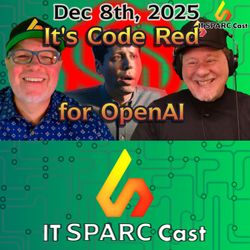
16. Apple’s AI Shakeup, India’s Surveillance App, OpenAI Code Red, and Multi-Cloud Peace Treaty
24:27||Season 2, Ep. 16In this episode of IT SPARC Cast – News Bytes, John and Lou cover a packed week in tech policy, AI disruption, and cloud infrastructure. Apple loses its AI chief as the company struggles to keep pace with rivals. India orders smartphone makers to preload a government surveillance app—then backpedals after Apple pushes back. Sam Altman declares a “Code Red” inside OpenAI as pressure mounts from Google, Anthropic, and the entire LLM ecosystem. And finally, Amazon and Google partner on a new high-speed multi-cloud interconnect—an unexpected alliance triggered in part by AWS’ recent outages.This episode blends politics, enterprise IT strategy, security concerns, and cloud architecture trends—delivered with classic SPARC Cast sarcasm.⏱️ Show Notes00:00 – IntroThis week: Apple says goodbye to its AI chief, India tests mandatory surveillance apps, OpenAI hits the panic button, and Amazon+Google become “friends with benefits.”NEWS BYTES00:46 – Apple AI Chief ExitsApple confirms that John Giannandrea, SVP of Machine Learning & AI Strategy, will step down in Spring 2026. • He was Apple’s “big hire from Google” and led AI initiatives for eight years. • His replacement: Amar Subramanya, reporting to Craig Federighi. • John & Lou discuss Apple’s AI struggles:– Apple Intelligence is “not what was promised”—delayed, underwhelming, and widely criticized.https://www.apple.com/newsroom/2025/12/john-giannandrea-to-retire-from-apple/ 06:43 – India Orders Smartphone Makers to Preload State-Owned Cyber Safety AppIndia announces a mandate requiring all new smartphones to include a government-built, undeletable cybersecurity app. • Goal: combat rising cybercrime, IMEI cloning, stolen-device fraud. • Users cannot remove or disable the app. • Lou and John highlight the risk.https://www.reuters.com/sustainability/boards-policy-regulation/india-orders-mobile-phones-preloaded-with-government-app-ensure-cyber-safety-2025-12-01/ 11:51 – Sam Altman Declares ‘Code Red’ for ChatGPTOpenAI CEO Sam Altman declares an internal “Code Red” tied to ChatGPT 5.2. • All nonessential projects—including the Pulse personalized assistant—paused. • Focus is entirely on improving 5.2 performance, reliability, and user experience. • Why now?– Gemini just jumped ahead in accuracy.– Claude leads in coding tasks.– Competition is moving at blistering speed.https://www.macrumors.com/2025/12/02/openai-delays-ad-plans/ 16:55 – Amazon and Google Launch Multicloud Service for Faster ConnectivityAmazon Web Services & Google Cloud jointly launch a multi-cloud private interconnect for rapid cross-cloud connectivity. • High-speed AWS ↔ Google Cloud links provisioned in minutes, not weeks. • Early adopter: Salesforce. • Why this matters:– After the major AWS East-1 outage, enterprises need cloud failover options fast.– This partnership essentially creates a safety net: if one cloud fails, the other can pick up load.https://www.reuters.com/business/retail-consumer/amazon-google-launch-multicloud-service-faster-connectivity-2025-12-01/ 20:32 – Mail Bag & Wrap UpSocial Links:IT SPARC Cast@ITSPARCCast on Xhttps://www.linkedin.com/company/sparc-sales/John Barger@john_Video on Xhttps://www.linkedin.com/in/johnbarger/Lou Schmidt@loudoggeek on Xhttps://www.linkedin.com/in/louis-schmidt-b102446/