Share
ISESA Podcast
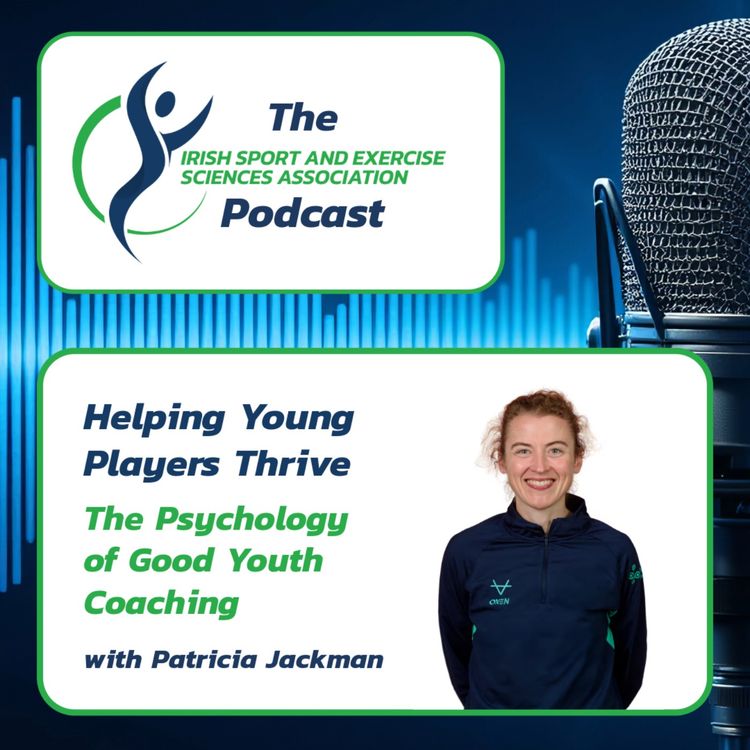
Helping Young Players Thrive: The Psychology of Good Coaching
What does good coaching actually look like when working with children and young people?
In this episode, Bruce is joined by Patricia Jackman from the University of Lincoln to explore how psychology can help coaches create positive, engaging and developmentally appropriate environments for young athletes. Patricia is one of the researchers behind SÍOL na nÓige, a psychologically informed coaching framework developed in the context of Gaelic games, but with principles that can be applied across youth sport. They discuss why good youth coaching should extend beyond winning and performance, and explore practical ways coaches can support fun and enjoyment, motivation, autonomy, strong coach-player relationships, belonging, personal development and long-term participation. The conversation also gets very practical: how should a coach respond when a player is losing confidence? What do you do with a talented player who dominates a session? How should you respond after a heavy defeat? And what small changes could coaches make at their very next training session? A useful episode for coaches, parents, coach educators, sport scientists and anyone involved in youth sport.
Topics include:
- What good youth coaching should actually achieve
- The SÍOL na nÓige framework
- Why fun and challenge are not opposites
- Giving young athletes autonomy
- Building coach-player relationships through small interactions
- Creating intrinsic motivation and a mastery climate
- Belonging, playing time and inclusion
- Managing parents and wider club expectations
- Practical responses to common coaching situations
Patricia's central message is simple: psychologically informed coaching does not necessarily mean doing more — it means being more deliberate about the environment and interactions we create for young people.
Resources:
https://www.tandfonline.com/doi/full/10.1080/21520704.2024.2441849
https://www.rte.ie/brainstorm/2025/0613/1495965-gaa-underage-players-coaching-psychology/
https://www.gaa.ie/article/siol-na-noige-how-we-can-best-grow-our-young-gaelic-games-players
Chapters:
00:00 Introduction
01:06 What does good youth coaching look like?
08:42 What do great youth coaches do differently?
11:15 Introducing SÍOL na nÓige
17:39 Fun, challenge and avoiding overcoaching
23:20 Autonomy and player voice
29:06 Building strong coach-player relationships
36:26 Motivation: being your best, not the best
39:53 Belonging and inclusion
42:57 Playing time and participation
45:37 Parents, clubs and the wider environment
48:47 Practical coaching scenarios
55:25 One change for your next training session
57:24 Closing thoughts
More episodes
View all episodes
1. Beyond Steroids: iPED Use in Ireland
58:43||Season 4, Ep. 1Image and performance enhancing drug use is changing rapidly and it is no longer confined to elite sport or competitive bodybuilding. In today's, Bruce speaks with Dr David Nolan about his new research examining iPED use in Ireland. They discuss what people are taking, why they are taking it, the growing prominence of peptides, the influence of GLP-1 drugs and testosterone replacement therapy, and the increasingly blurred line between treatment, enhancement and aesthetics. The conversation also explores health monitoring, the limits of blood testing, barriers to engaging with healthcare professionals, the challenges of coming off iPEDs, and why this is not exclusively a male issue. David’s study provides an important first snapshot of a poorly characterised area of health and performance in Ireland, with plans to repeat the research over time and build a clearer picture of how the landscape is evolving.Chapters00:00 Introduction01:15 The Enhanced Games and the changing PED landscape05:00 What are iPEDs – and who is using them?08:45 The first Irish iPED study13:15 What are people taking?18:15 Peptides, GLP-1s and the changing drug landscape29:15 Testosterone replacement therapy and enhancement33:45 Health monitoring, harm reduction and healthcare39:00 Coming off iPEDs: exit strategies and identity46:45 Women and the changing iPED population50:10 Who actually identifies as an iPED user?53:50 Where does the research go next?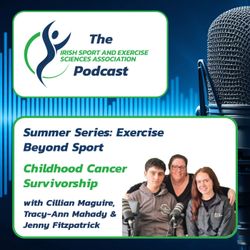
17. Childhood Cancer, Recovery and Exercise
37:12||Season 3, Ep. 17Childhood cancer survival continues to improve, but what happens after treatment ends?In this final episode of the Summer Series, Bruce travels to Navan to meet Cillian Maguire, his mum Tracey-Ann, and researcher Jenny Fitzpatrick to discuss the CHAMPS programme - an innovative exercise intervention supporting young people after childhood cancer treatment.Together they explore recovery beyond the hospital, the challenges of fatigue and returning to everyday life, and the growing role of exercise oncology in improving health and quality of life.A powerful conversation about resilience, recovery and how exercise can help people reclaim their lives.This episode forms part of the ISESA Podcast Summer Series: Exercise Beyond Sport - three conversations exploring the growing role of sport and exercise science within healthcare.
16. Understanding Obesity in the GLP-1 Era
47:50||Season 3, Ep. 16Few areas of healthcare have changed as rapidly over the past three years as obesity medicine.With medications such as semaglutide and tirzepatide transforming the conversation around obesity, Bruce revisits this insightful discussion with Professor Donal O'Shea and dietitian Aoife Hearne.Rather than focusing solely on medication, this episode explores the biology of obesity, the importance of compassion in clinical practice, and why understanding obesity as a chronic disease changes how we think about prevention, treatment and long-term support.The treatments may have evolved, but the need for evidence-based, person-centred care has not.This episode forms part of the ISESA Podcast Summer Series: Exercise Beyond Sport - three conversations exploring the growing role of sport and exercise science within healthcare.
15. Stroke, Recovery and Independence
42:27||Season 3, Ep. 15When this conversation was first recorded in 2023, structured exercise programmes for people living with long-term health conditions were only beginning to gain momentum. Today, the role of exercise professionals within healthcare has never been more important.In this episode, Bruce is joined by Annalouise Muldoon and Marie O'Connor, who shares her remarkable journey of recovering from an atypical stroke. Together they explore how structured exercise can help people regain confidence, independence and quality of life long after they leave hospital.As Ireland continues to develop new educational pathways for exercise professionals working in healthcare, this conversation feels more relevant than ever.This episode forms part of the ISESA Podcast Summer Series: Exercise Beyond Sport - three conversations exploring the growing role of sport and exercise science within healthcare.
14. Summer Series Trailer
02:50||Season 3, Ep. 14Over the next few weeks, we're revisiting three episodes from the first season of the ISESA Podcast that have become even more relevant today than when they were originally recorded.Together, these episodes explore how sport and exercise science is increasingly moving beyond performance and into healthcare—helping people regain independence after stroke, supporting people living with obesity, and improving quality of life after childhood cancer.Whether you're discovering these conversations for the first time or listening back with fresh ears, I hope they offer a new perspective on the evolving role of exercise professionals within healthcare.
13. The Sport & Exercise Nutrition Group (SENG)
29:50||Season 3, Ep. 13Nora Ní Fhlannagáin and Julia Gruszczynska from the Sport & Exercise Nutrition Group (SENG) join Bruce to discuss what this means for a registered dietician or sport and exercise nutritionist to be a member of the SENG in Ireland. Going forward, SENG members will be guests on the podcast to bring new content to our audience focussing on applied sport and exercise nutrition practice and research. The SENG are also running an event in parallel to this year's ISESA conference - they will host a business breakfast aimed at all self employed practitioners - a place to learn, meet and eat!
12. Machine Learning & AI in Rugby: Safe Tackle Biomechanics with Will Connors
49:08||Season 3, Ep. 12Irish Rugby's Will Connors explains how he uses AI, Machine Learning and Biomechanics to decode tackle safety.In this episode of the ISESA Podcast, Bruce Wardrop sits down with Irish international rugby player and sport science researcher, Will Connors.Widely regarded as one of the most effective tacklers on the pitch thanks to his mastery of the "chop tackle," Will operates at the exact intersection of elite athletic performance and cutting-edge science. After nine highly successful years with Leinster, Will discusses his upcoming move to Connacht, reuniting with Head Coach Stuart Lancaster, and the tactical evolutions he hopes to bring out West. Beyond the pitch, Will is a PhD researcher at Trinity College Dublin. We dive into his fascinating work using computer science, machine learning, and artificial intelligence to map the biomechanics of the tackle. Will explains the massive challenge of teaching an algorithm to identify safe tackle execution amidst the chaos of a professional match, and how this data can ultimately be used to improve player welfare and reduce concussion risks.
11. Summiting Everest: Adam Sweeney is Aiming to be the Youngest Irish Person to 8,848m
47:34||Season 3, Ep. 11In this super episode podcast, Bruce speaks with Adam Sweeney, a 22-year-old adventurer from Waterford. Adam is preparing to begin a two-month expedition with the objective of becoming the youngest Irish person to summit Mount Everest.The discussion tracks his progression through increasingly demanding high-altitude environments, analyzing his experiences on Aconcagua in Argentina (6,961m) and the technically formidable Ama Dablam in Nepal (6,812m). We detail the physiological realities of acclimatization, the acute effects of hypoxia, and his specific strategies for managing nutrition and hydration when performing at altitude. Plus Bruce and Adam discuss the the psychological resilience required to navigate objective hazards like the Khumbu Icefall and the physiological breakdown that occurs within the "Death Zone" above 8,000m.You can follow Adam's progress via his social media channels:Adam on InstagramAdam on TikTok