Share
Ipse Dixit
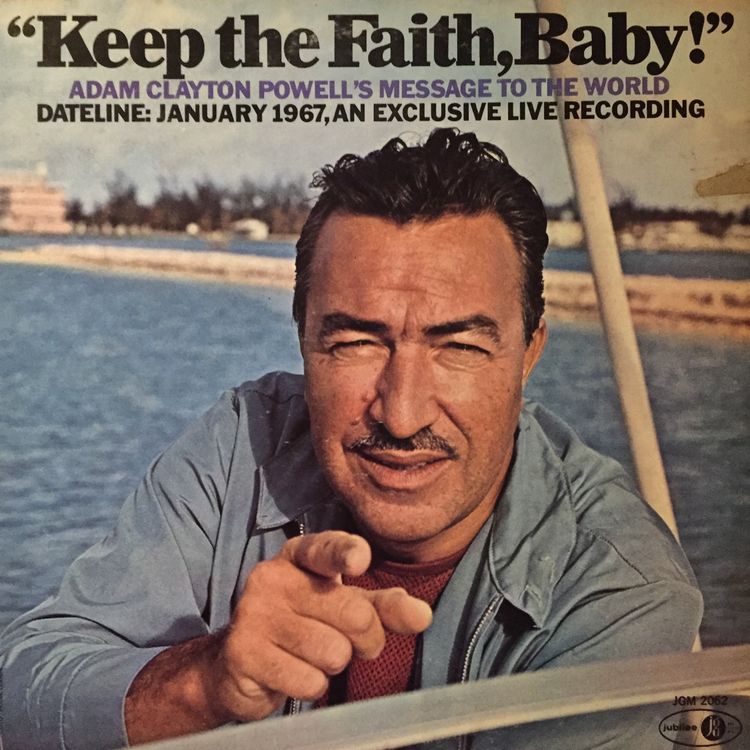
From the Archives 19: Adam Clayton Powell, "Keep the Faith, Baby!" (1967)
Adam Clayton Powell Jr. (November 29, 1908 to April 4, 1972) was an American politician, who represented Harlem in the United States House of Representatives from 1945-71. He was the first African-American to represent New York in Congress, and the fourth African-American elected to Congress in the 20th century. He was also a Baptist pastor.
Powell became a prominent leader in the civil rights movement in the 1930s, leading picket lines and boycotts. In 1941, he became the first African-American elected to the New York City Council. In 1944, he was elected to Congress on a civil rights platform. In the 1950s, he became well-known for introducing "Powell Amendments" to legislation, which would deny federal funds to segregated jurisdictions.
In January 1967, the House Democratic Caucus, dominated by southern whites, voted 307 to 116 to exclude Powell from the House, on the basis of corruption allegations. In response, Powell asked his constituents to "Keep the Faith, Baby." He won the special election to fill his seat, and in June 1969, the Supreme Court held in Powell v. McCormack that the House's exclusion of Powell was unconstitutional. However, in 1970, Powell lost his seat to Charles Rangel.
In January 1967, Powell released this LP, responding to his critics. The album is titled, "'Keep the Faith, Baby!", Adam Clayton Powell's Message to the World, Dateline: January 1967, An Exclusive Live Recording."
Side 1:
- Keep the Faith, Baby
- My Dear Colleagues
- Handwriting on the Wall
Side 2:
- Burn, Baby, Burn
- Death of Any Man
- One Day
The album was produced by Jerry and Steve Blaine, and released by Jubilee Records.
More episodes
View all episodes

834. Jon Lee on Sanctioning Lawyers Who Commit Crimes
49:56||Season 1, Ep. 834In this episode, Jon J. Lee, Associate Dean for Faculty Development and Research and Frank Elkouri and Edna Asper Elkouri Professor in Law at the University of Oklahoma College of Law, discusses his article "Sanctioning Lawyer-Criminals," which is published in the Washington and Lee Law Review. Lee begins by explaining how the legal profession regulates itself and disciplines lawyers. He describes the history of how the legal profession has disciplined lawyers who commit crimes, including which crimes it has considered worthy of discipline and why. He presents an empirical study of how different jurisdictions currently discipline lawyers for criminal activity. And he reflects on how the legal profession ought to address criminality. Lee is on Twitter and Bluesky.This episode was hosted by Brian L. Frye, Spears-Gilbert Professor of Law at the University of Kentucky College of Law. Frye is on Twitter at @brianlfrye and on Bluesky at @brianlfrye.bsky.social.833. Davies & Ellis on Brakhage & Sartre
47:25||Season 1, Ep. 833In this episode, Byron Davies, a Marie Skłodowska-Curie fellowship with the Aresmur research group in aesthetics and art theory at the University of Murcia in Spain, and Addison Ellis, Assistant Professor of Philosophy at the American University in Cairo, discuss their article "Stan Brakhage, Jean-Paul Sartre and Existentialism: Cinema De Trop," which will be published in the journal Film-Philosophy. Davies and Ellis begin by explaining who Stan Brakhage was and describing his films and writings. They discuss how Brakhage was commissioned to make a film version of Jean-Paul Sartre's Nausea, his approach to Sartre's philosophical positions, and why he might have found a particular passage from Nausea especially compelling. They then discuss how studying Brakhage and Sartre in relation to each other can illuminate the work of both thinkers. This episode was hosted by Brian L. Frye, Spears-Gilbert Professor of Law at the University of Kentucky College of Law. Frye is on Twitter at @brianlfrye and on Bluesky at @brianlfrye.bsky.social.832. Philip Hackney on Arts Tax Policy
42:37||Season 1, Ep. 832In this episode, Philip Hackney, Professor of Law at the University of Pittsburgh School of Law, discusses his draft article, "Arts Tax Policy: Democracy or Plutocracy?," which will be published in the Loyola L.A. Law Review. Hackney begins by explaining how the tax code conceptualizes art. Then he explains how the tax code conceptualizes charitable organizations and treats them differently from non-charitable organizations. He reflects on the justifications for tax exemption and deduction, especially in relation to the arts sector, focusing on the equitably of subsidizing organizations that primarily benefit and are controlled by the wealthy. And he explains how tax policy could be more equitable and progressive in relation to the arts sector. Hackney is on Twitter and Bluesky.This episode was hosted by Brian L. Frye, Spears-Gilbert Professor of Law at the University of Kentucky College of Law. Frye is on Twitter at @brianlfrye and on Bluesky at @brianlfrye.bsky.social.831. Daniel Schwarcz on AI and Human Legal Reasoning
41:18||Season 1, Ep. 831In this episode, Daniel Schwarcz, Fredrikson & Byron Professor of Law and a Distinguished University Teaching Professor at the University of Minnesota Law School, discusses his draft article "Artificial Intelligence and Human Legal Reasoning," which he co-authored with Nicholas Bednar, David R. Cleveland, and Allan Erbsen. Schwarcz explains that he and his co-authors wanted to test the conventional wisdom that using artificial intelligence models to answer legal questions will inhibit the ability of law students and lawyers to learn how to answer those questions on their own. He describes their empirical study designed to test that hypothesis and its unexpected results. And he reflects on what we can learn from the study. Schwarcz is on Twitter and Bluesky.This episode was hosted by Brian L. Frye, Spears-Gilbert Professor of Law at the University of Kentucky College of Law. Frye is on Twitter at @brianlfrye and on Bluesky at @brianlfrye.bsky.social.830. Bearer-Friend & Polcz on Taxing AI
39:53||Season 1, Ep. 830In this episode, Jeremy Bearer-Friend, Associate Professor of Law at George Washington University Law School, and Sarah Polcz, Acting Professor of Law at UC Davis School of Law, discuss their article "Sharing the Algorithm: The Tax Solution to Generative AI," which is published in the Columbia Journal of Tax Law. Bearer-Friend and Polcz begin by outlining some of the social problems associated with generative AI and explaining why existing proposals to address those problems are inadequate. They then propose an alternative model, consisting of an equity tax on AI companies, and explain why it would be both effective and preferable to alternative approaches. Bearer-Friend is on Twitter and Bluesky. Polcz is also on Twitter and Bluesky.This episode was hosted by Brian L. Frye, Spears-Gilbert Professor of Law at the University of Kentucky College of Law. Frye is on Twitter at @brianlfrye and on Bluesky at @brianlfrye.bsky.social.829. Aman Gebru on Truthmarks
36:44||Season 1, Ep. 829In this episode, Aman Gebru, Assistant Professor of Law at the University of Houston Law Center, discusses his draft article "Truthmarks," which will be published in the American University Law Review. Gebru begins by explaining the purpose of trademark law and how it protects trademarks. He describes three uses of trademarks that are inconsistent with the policy goals of trademark law of conveying truth information to consumers: masking marks, zombie marks, and nonsense marks. And he reflects on how trademark law could mitigate the harms associated with those uses. Gebru is on Twitter.This episode was hosted by Brian L. Frye, Spears-Gilbert Professor of Law at the University of Kentucky College of Law. Frye is on Twitter at @brianlfrye and on Bluesky at @brianlfrye.bsky.social.828. Urice & Frankel on Art Law
36:27||Season 1, Ep. 828In this episode, Stephen K. Urice and Simon J. Frankel discuss their book Law, Ethics, and the Visual Arts, the sixth edition of which was just published by Cambridge University Press. Urice and Frankel describe the creation of the book and the academic study of art law by John Henry Merryman, and discuss their own respective background in art law. They explain how the study and practice of art law fits into the study and practice of law more generally. And the reflect on how they expanded and amended the book for this new edition. Urice and Frankel are on LinkedIn.This episode was hosted by Brian L. Frye, Spears-Gilbert Professor of Law at the University of Kentucky College of Law. Frye is on Twitter at @brianlfrye and on Bluesky at @brianlfrye.bsky.social.827. Sam Williams on the Jokerfication of Law
58:56||Season 1, Ep. 827In this episode, Sam Williams, Associate Professor of Law and Reference and Instruction Librarian at the University of Idaho College of Law discusses several of his articles, including “The Law is Weirder than AI,” which was published in 2024 with the Hofstra Law Review, and “The Jokerfication of Law,” which was published with Hedgehogs and Foxes. Williams discusses how these pieces shed light on the nature of the weird and the eerie in law and legal scholarship, and how professors should think of their roles in an increasingly chaotic world. He also shares his thoughts on weird and silly legal scholarship, the place for such scholarship in the broader legal academic literature, and inspirations for his work—including Ipse Dixit’s very own Brian Frye. Williams is on Bluesky at @sawilliams.bsky.social. This episode was guest hosted by Michael Smith, Associate Professor of Law at the University of Oklahoma College of Law. Michael Smith is on Bluesky at @msmith750.bsky.social826. Christopher Brooks on Appellate Judicial Section
26:28||Season 1, Ep. 826In this episode, Christopher T. Brooks, Professor of History at East Stroudsburg University, discusses his work on appellate judicial selection. He explains that state appellate judges are usually either elected or appointed with the advice of nominating committees. He argues that both methods are flawed, and that it would be better for judges to be appointed by elected nominating committees. Brooks is on LinkedIn.This episode was hosted by Brian L. Frye, Spears-Gilbert Professor of Law at the University of Kentucky College of Law. Frye is on Twitter at @brianlfrye and on Bluesky at @brianlfrye.bsky.social.