Share
Ipse Dixit
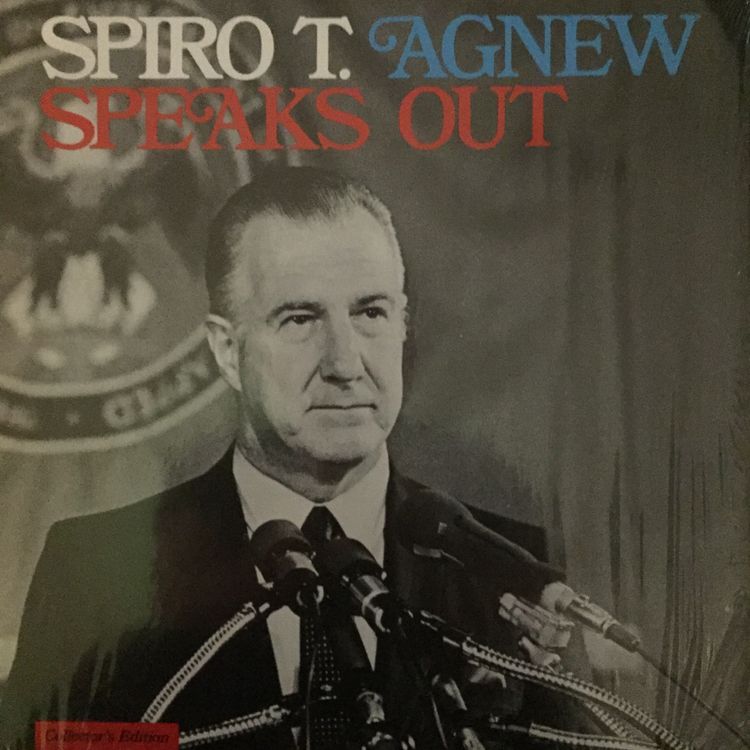
From the Archives 13: Spiro T. Agnew Speaks Out
In 1972, the Republican National Committee released an LP of excerpts from speeches by Vice President Spiro T. Agnew on RCA/Victor. The album was produced by Joseph Habig and William Mulligan. It featured the following subjects
Side 1:
- The Greatest Issue in America Today
- A Word to Law Abiding Americans
- Challenge to the Hippies
- "Effete Corps of Impudent Snobs"
- In Defense of the Courts of the Land
- Some Thoughts on the Democratic Party
- A Word to America's Detractors
Side 2:
- Some Examples of the Vice President's Wit
- The Vice President Explains Our Asian Policy
- In Answer to Critics of This Asian Policy
- The Future of the Republican Party
- The Responsibilities of Television
- Confidence in America's Future
Agnew graduated from the University of Baltimore School of law in 1947, and first ran for political office in 1956. In 1962, he was elected Baltimore County Executive, in 1966 he was elected Governor of Maryland, and in 1968, he became Richard Nixon's running mate, and was elected Vice President.
In early 1973, the United States Attorney for the District of Maryland began investigating Agnew on suspicion of conspiracy, bribery, extortion and tax fraud, beginning when he was Baltimore County Executive and Governor of Maryland. On October 10, 1973, Agnew pleaded no contest to a single felony charge of tax evasion and resigned from office. He was replaced by House Minority Leader Gerald Ford.
In 1974, Agnew was disbarred by the Maryland Court of Appeals. Unable to practice law, he founded Pathlite, Inc., a business consultancy. In 1976, he published The Canfield Decision, a novel about an American Vice President. The novel was commercially successful, but Agnew was criticized for the protagonist's explicit anti-semitism.
More episodes
View all episodes

828. Urice & Frankel on Art Law
36:27||Season 1, Ep. 828In this episode, Stephen K. Urice and Simon J. Frankel discuss their book Law, Ethics, and the Visual Arts, the sixth edition of which was just published by Cambridge University Press. Urice and Frankel describe the creation of the book and the academic study of art law by John Henry Merryman, and discuss their own respective background in art law. They explain how the study and practice of art law fits into the study and practice of law more generally. And the reflect on how they expanded and amended the book for this new edition. Urice and Frankel are on LinkedIn.This episode was hosted by Brian L. Frye, Spears-Gilbert Professor of Law at the University of Kentucky College of Law. Frye is on Twitter at @brianlfrye and on Bluesky at @brianlfrye.bsky.social.827. Sam Williams on the Jokerfication of Law
58:56||Season 1, Ep. 827In this episode, Sam Williams, Associate Professor of Law and Reference and Instruction Librarian at the University of Idaho College of Law discusses several of his articles, including “The Law is Weirder than AI,” which was published in 2024 with the Hofstra Law Review, and “The Jokerfication of Law,” which was published with Hedgehogs and Foxes. Williams discusses how these pieces shed light on the nature of the weird and the eerie in law and legal scholarship, and how professors should think of their roles in an increasingly chaotic world. He also shares his thoughts on weird and silly legal scholarship, the place for such scholarship in the broader legal academic literature, and inspirations for his work—including Ipse Dixit’s very own Brian Frye. Williams is on Bluesky at @sawilliams.bsky.social. This episode was guest hosted by Michael Smith, Associate Professor of Law at the University of Oklahoma College of Law. Michael Smith is on Bluesky at @msmith750.bsky.social826. Christopher Brooks on Appellate Judicial Section
26:28||Season 1, Ep. 826In this episode, Christopher T. Brooks, Professor of History at East Stroudsburg University, discusses his work on appellate judicial selection. He explains that state appellate judges are usually either elected or appointed with the advice of nominating committees. He argues that both methods are flawed, and that it would be better for judges to be appointed by elected nominating committees. Brooks is on LinkedIn.This episode was hosted by Brian L. Frye, Spears-Gilbert Professor of Law at the University of Kentucky College of Law. Frye is on Twitter at @brianlfrye and on Bluesky at @brianlfrye.bsky.social.825. Valentin Jeutner on Conceptual Legal Writing
43:34||Season 1, Ep. 825In this episode, Valentin Jeutner, Associate Professor of Law at Lund University and Retained Lecturer in Law at Pembroke College, Oxford University, discusses his book "[l]ex machina: unlikely encounters of international law and technology," which is published by Lund University. Jeutner begins by introducing listeners to conceptual legal writing, describing its relationship to conceptual art and conceptual writing. He provides a preliminary taxonomy of conceptual legal writing and explains his own practice of conceptual legal writing. In particular, he reflects on how conceptual legal writing can help readers see legal texts in a new and different light. He also reads a short text composed using a conceptual legal writing method. You can read Jeutner's "Fragmentary Catalogue of Conceptual Legal Writing" here, and his book "The Aesthetic Authority of Law: Experiments with Legal Form" here. Jeutner is on Bluesky.This episode was hosted by Brian L. Frye, Spears-Gilbert Professor of Law at the University of Kentucky College of Law. Frye is on Twitter at @brianlfrye and on Bluesky at @brianlfrye.bsky.social.824. Sharon Yadin on the Nature of Regulation
42:10||Season 1, Ep. 824In this episode, Sharon Yadin, Senior Lecturer of Law and Regulation at the Yezreel Valley College School of Public Administration and Public Policy, discusses her draft article "The Hidden Nature of Regulation," which will be published in the Harvard Negotiation Law Review. Yadin begins by describing the conventional bifurcation of regulation into "hard" and "soft" approaches. She observes that in practice, regulation is always negotiated between regulators and regulated parties. And she explains how this alternative perspective on the nature of regulation should inflect our approach to it. Yadin is on Twitter and Bluesky.This episode was hosted by Brian L. Frye, Spears-Gilbert Professor of Law at the University of Kentucky College of Law. Frye is on Twitter at @brianlfrye and on Bluesky at @brianlfrye.bsky.social.823. Jorge Contreras on Silly Patents
42:43||Ep. 823In this episode, Jorge L. Contreras, Distinguished University Professor, James T. Jensen Endowed Professor for Transactional Law, and Director of the Program on Intellectual Property and Technology Law at the University of Utah S.J. Quinney College of Law, discusses his draft article "Silly Patents." Contreras begins by describing why patents exist and how the patent system works. He observes that some patents are unusually "silly," because it doesn't seem like they should exist. He explains why the Patent Office issues silly patents and reflects on what they can tell us about the patent system. Contreras is on Twitter and Bluesky.This episode was hosted by Brian L. Frye, Spears-Gilbert Professor of Law at the University of Kentucky College of Law. Frye is on Twitter at @brianlfrye and on Bluesky at @brianlfrye.bsky.social.822. Nikola Datzov on AI Judges
46:03||Season 1, Ep. 822In this episode, Nikola Datzov, Associate Professor of Law at the University of North Dakota School of Law, discusses his article "AI Jurisprudence: Toward Automated Justice," which will be published in the Northwestern Journal of Technology and Intellectual Property. Datzov begins by briefly explaining how AI models works and why judicial systems are primed to use them in certain ways. He provides a taxonomy of how judges could use AI models. And he reflects on benefits and risks associated with the judiciary's use of AI.This episode was hosted by Brian L. Frye, Spears-Gilbert Professor of Law at the University of Kentucky College of Law. Frye is on Twitter at @brianlfrye and on Bluesky at @brianlfrye.bsky.social.821. Mark Blankenship on the "Aesthetic Nondiscrimination" Doctrine
41:41||Season 1, Ep. 821In this episode, Mark Edward Blankenship, Jr., Assistant Professor of Law at St. Thomas University College of Law, discusses his article "Reconsidering the 'Aesthetic Nondiscrimination' Doctrine in American Copyright Law," which is published in the Berkeley Journal of Entertainment and Sports Law. Blankenship begins by describing the origin of copyright's so-called "aesthetic nondiscrimination" doctrine. He explains how scholars have characterized its purpose of problems. And he analyzes the doctrine in light of discrimination law.This episode was hosted by Brian L. Frye, Spears-Gilbert Professor of Law at the University of Kentucky College of Law. Frye is on Twitter at @brianlfrye and on Bluesky at @brianlfrye.bsky.social.830. John Tehranian on Copyright & Inequality
43:42||Season 1, Ep. 830In this episode, John Tehranian, Paul W. Wildman Chair and Professor of Law at Southwestern Law School and a founding partner of One LLP, discusses his new book, "The Secret Life of Copyright: Intellectual Property and Inequality in the Age of AI," which is published by Cambridge University Press. Tehranian begins by describing the critical IP theory movement and how his work fits into that movement. Then he explains how copyright doctrine creates systemic inequality in the allocation and use of copyright, through its definition of ownership, joint authorship, and derivative works, as well as the relationship between copyright and the First Amendment. Tehranian is on Twitter. This episode was hosted by Brian L. Frye, Spears-Gilbert Professor of Law at the University of Kentucky College of Law. Frye is on Twitter at @brianlfrye and on Bluesky at @brianlfrye.bsky.social.