Share
In The Paddock
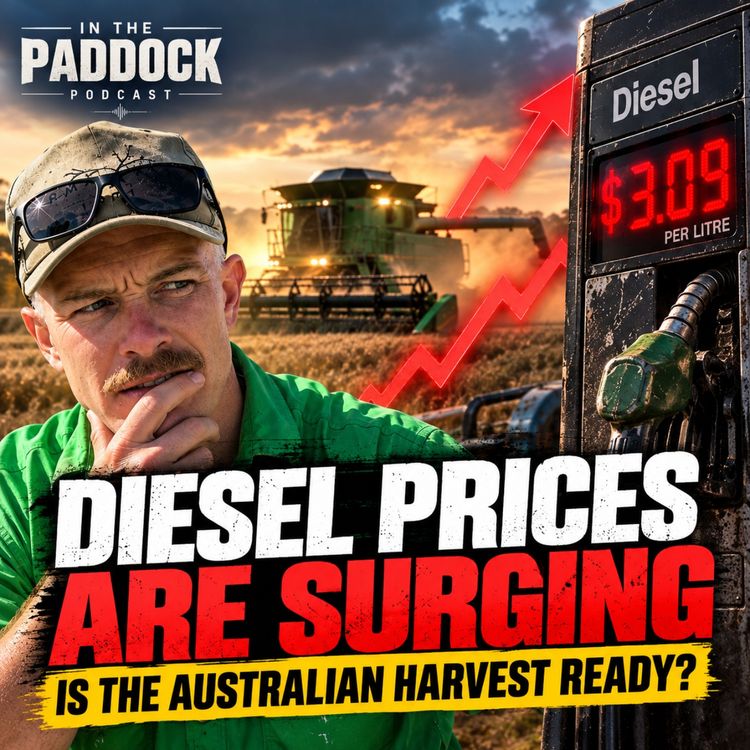
Diesel Prices Are Surging, What Will It Mean For Harvest?
Diesel prices are surging just as Australian growers prepare for harvest.
In this episode of In The Paddock, we look at what is happening in global diesel markets, why refined fuel is under more pressure than crude oil alone, and what that means for Australian agriculture heading into one of the most fuel-intensive periods of the year.
We cover Australia’s reliance on imported fuel, the impact of refinery disruptions and geopolitical tensions, what higher diesel prices could do to farm margins, and why harvest creates a unique fuel-security risk.
Most importantly, this isn’t just about identifying the problem. We also look at what growers can do now to improve their position — from calculating likely harvest fuel demand and reviewing storage, to speaking with suppliers, planning contingencies and reducing avoidable fuel use.
The bigger question is whether Australian agriculture can become less vulnerable to global diesel shocks in the future.
Because a header doesn’t burn crude oil.
It burns diesel.
And when refining gets tight, agriculture feels it quickly.
More episodes
View all episodes
Field Notes: Could These Crops Save You Nitrogen?
17:56|Could crops protect their own nitrogen—and help lower your fertiliser bill? Biological nitrification inhibition (BNI) is an emerging area of crop research that could offer new ways to improve nitrogen use efficiency in Australian agriculture.In this episode of In The Paddock — Field Notes, farmer and agronomist Martin Murray explores how plant roots could release natural nitrification inhibitors, helping retain nitrogen for crop uptake.First, we follow nitrogen from fertiliser application to the plant: how urea becomes ammonium and nitrate, where losses occur, and why different inhibitors protect different stages.You’ll hear:• How ammonia volatilisation, nitrate leaching and denitrification affect nitrogen availability.• How roots absorb ammonium and nitrate.• The difference between urease inhibitors such as NBPT and nitrification inhibitors such as DMPP.• What biological nitrification inhibition could offer wheat, sorghum and canola.• What Australia’s $10 million, four-year GRDC investment led by CSIRO is investigating.• Why promising overseas wheat results are not yet an Australian fertiliser-rate recommendation.BNI conserves existing nitrogen—it does not fix nitrogen from the atmosphere. The practical test is whether the trait delivers reliable benefits in yield, grain quality or fertiliser savings across Australian soils and seasons.💬 What would convince you to choose a nitrogen-protecting variety: lower fertiliser costs, more reliable yield, or better performance in wet seasons? Leave a comment on the companion article or join the discussion wherever your podcast player supports it.READ THE COMPANION ARTICLEExplore the nitrogen-loss graphics, inhibitor comparison and deeper research discussion. Scheduled for 6 am AEDT, Wednesday 14 October 2026:https://inthepaddock.au/?p=3805MORE FROM IN THE PADDOCKhttps://inthepaddock.au/SOURCES & FURTHER READINGGRDC GroundCover — Australian biological nitrification inhibition research:https://groundcover.grdc.com.au/grdc/announcements/new-grdc-nitrogen-research-could-deliver-future-crop-optionsCSIRO — Research into future nitrogen-efficient crop options:https://www.csiro.au/en/news/all/news/2026/july/new-grdc-nitrogen-research-could-deliver-future-crop-optionsGRDC — Nitrogen loss pathways and levers to mitigate losses:https://grdc.com.au/__data/assets/pdf_file/0026/614906/Paper-Bell-Schwenke-Grace_N-losses-Wagga-2025.pdfJIRCAS — Experimental BNI-enabled wheat results:https://www.jircas.go.jp/en/publication/research_results/2021_a04Bozal-Leorri and colleagues — BNI traits and nitrogen uptake in wheat:https://doi.org/10.3389/fpls.2022.1034219Follow In The Paddock for practical agronomy, emerging agricultural technology and research explained with Australian farmers in mind. Share this episode with someone weighing up their nitrogen-management options.General information only—not paddock-specific agronomic advice. Overseas experimental results do not establish that Australian growers can safely reduce nitrogen rates by 60%.
What Replaces Diesel on The Farm - The Future of Farm Machinery
27:33|What replaces diesel on the farm?Australian agriculture depends heavily on diesel, especially during sowing and harvest. But replacing it is not as simple as swapping a diesel engine for a battery.In this episode of In The Paddock, we look at the machinery and energy systems that could realistically power the next generation of farming — without sacrificing horsepower, endurance or productivity.We cover battery-electric tractors, battery swapping, diesel-electric hybrids, hydrogen fuel cells, biomethane, methane and HVO renewable diesel, as well as what agriculture can learn from the mining and freight industries.Machines discussed include the Honghu T150 electric tractor, Zoomlion DX7004 hybrid tractor, Zoomlion H7-600E hybrid combine, John Deere eAutoPowr, New Holland T7 Methane Power and Kubota’s hydrogen fuel-cell tractor.We also explore a bigger idea: rather than asking what single fuel replaces diesel, should farm machinery be designed around electric drivetrains that can accept different energy sources over time?From powered air carts to hybrid headers and swappable batteries, this episode looks at what might actually work in Australian broadacre agriculture — and what still has a long way to go.In this episode:Why giant battery tractors are difficultHow battery swapping could helpWhy hybrid-electric machinery may be the near-term answerWhat mining can teach agriculture about electrificationHydrogen, biomethane and renewable dieselThe future of high-horsepower sowing and harvest machineryWhy the future farm is likely to use a mix of energy sourcesRead the full companion article at InThePaddockPodcast.comIn The Paddock — practical discussion on agriculture, technology, markets and the forces shaping farming.
Field Notes - Can we Have Chemical Free Weed Control in Zero Till Farming?
10:05|Can Australian zero-till farming reduce its reliance on herbicides without going back to full-width cultivation?In this episode of In The Paddock – Field Notes, we look at emerging chemical-free weed control technologies designed to target established weeds while preserving the benefits of zero-till and conservation farming systems.We start with the Hayes Weed Chipper, an Australian-developed system that combines optical weed detection with individually controlled hydraulic tynes to physically remove weeds without cultivating the entire paddock. We then look at GRDC-backed research into other non-chemical weed control technologies, including electrical weed control, precision mechanical spot tillage, heat treatments and abrasive weed control.The key question is not whether herbicides disappear from Australian agriculture. They remain one of the most efficient weed-control tools available. The opportunity is to give growers additional modes of action for herbicide-resistant weeds, particularly survivors in fallow and low-density weed populations.Could the future sprayer or autonomous robot identify an individual weed and then choose between a herbicide nozzle, mechanical tyne, electricity or another physical treatment?That could fundamentally change how Australian growers think about herbicide resistance, zero-till weed management and precision agriculture.In this episode:Hayes Weed Chipper and optical weed detectionTargeted mechanical weed control in zero-till systemsElectrical weed control and weed electrocutionGRDC research into non-chemical weed controlPrecision agriculture and autonomous weed controlHerbicide resistance managementThe economics and limitations of physical weed destructionWhy the future may be multiple weed-kill mechanisms rather than simply new chemistryExplore the technologyHayes Weed Chipper:https://hayesspraying.com.au/weedchipper/GRDC GroundCover – autonomous and non-chemical weed control research:https://groundcover.grdc.com.au/__data/assets/pdf_file/0016/600802/Grain-Automate-and-Digital-Agronomy.pdfIn The Paddock covers Australian agriculture, agronomy, ag technology, farm business, machinery, research and the emerging technologies likely to shape farming in the years ahead.Keywords: Australian agriculture, zero till farming, no till farming, chemical free weed control, non chemical weed control, Hayes Weed Chipper, WEED-IT, GRDC, GroundCover, herbicide resistance, glyphosate resistance, electrical weed control, weed electrocution, precision agriculture, autonomous farming, robotic weed control, fallow weed control, broadacre farming, Australian grain farming, sustainable agriculture, agronomy, farm technology.
Could Australia Run out of Diesel? the 48hr Fuel Shock
16:40|Could Australia actually run out of diesel?Australia depends heavily on imported diesel to keep farms, trucks, mines and freight moving. In this episode of In The Paddock, we look at how exposed that system is — and what happens when major exporters start putting their own domestic fuel security first.We unpack China’s October fuel export suspension, Russia’s diesel restrictions, and the recent threat of a US diesel export ban. We also explain why American export policy can affect Australia even when Australia does not buy much diesel directly from the US.The episode covers:where Australia gets its dieselhow much of our fuel is importedwhy South Korea, Singapore, Malaysia and India matterhow Middle Eastern crude feeds the Asian refineries Australia relies onwhy a US diesel export ban could tighten the global markethow an export ban could even reduce US refinery outputwhy Australia exports most of its own crude while importing refinery feedstockAustralia’s strategic fuel reserves and remaining refineriesthe potential role of biodiesel, renewable diesel and Australian canolawhere farm electrification makes sensethe future potential of diesel-electric tractorsand what farmers can do on-farm to improve their own fuel securityAustralia is not currently running out of diesel. But recent events have shown how quickly international policy decisions can change global fuel flows.The bigger question is whether Australia has enough resilience when the next shock arrives.Read the full article, charts, maps and sources at inthepaddock.au.In The Paddock covers Australian agriculture, farm business, technology, markets, machinery and policy — with a focus on what global developments actually mean at farm level.#AustralianAgriculture #Diesel #FuelSecurity #Farming #FarmBusiness #Agriculture #DieselPrices #EnergySecurity #AustralianFarmers #Biodiesel #Canola #FarmMachinery #AgTech #GlobalMarkets #InThePaddock
Will Solar and Wind Destroy Our Meat Exports
09:30|Could grazing sheep and cattle around solar panels and wind turbines put Australian meat exports at risk?Claims have been circulating that livestock raised around renewable energy infrastructure could face restrictions from overseas markets. But where did the story come from — and has any country actually threatened to ban Australian beef or lamb?In this episode of In The Paddock, Martin Murray traces the rumour back through changes to Australia’s Livestock Production Assurance (LPA) program, parliamentary debate and concerns about contamination from renewable energy infrastructure.We look at what LPA actually requires, why solar panels and wind turbines were specifically mentioned in its contamination risk assessment, whether livestock grazing around solar farms need to be declared, and whether major Australian meat markets including China, Japan, South Korea, the United States, United Kingdom and European Union have introduced or proposed restrictions.There is also a bigger question: while the evidence for an overseas “solar-grazed meat ban” is lacking, could ageing or damaged renewable infrastructure create legitimate food safety, residue or market-access risks in the future?This episode separates what is documented from what appears to be speculation — and traces how a genuine LPA change evolved into a much bigger claim about Australian agricultural exports.Topics: Australian agriculture, solar farms, agrivoltaics, sheep grazing, cattle, beef exports, lamb exports, renewable energy, wind farms, LPA accreditation, food safety, contamination, agricultural policy and Australian farming.In The Paddock explores the forces shaping Australian agriculture — from agronomy and emerging technology to markets, policy and global food security.
AI in Agriculture: Beyond the Paddock
41:55|In this episode we talk with Jonathan Richetti of the CSIRO, exploring how Artificial Intelligence (AI) is transforming agriculture outside of the paddock. We explore how it is being used to enhance plant breeding, make highly accurate yield predictions and fertilizer recommendations as well as exploring the future of this technology.
Productive Sustainability
12:17|On this podcast we explore the role of productivity in sustainability, and why it's important to try and make existing farmland as productive possible in order to protect global biodiversity and lower emissions on per unit basis. We explore why measurement systems that measure emissions a total figure or on a per hectare or per acre basis distort the numbers and why concepts such as rewilding where agricultural land is removed from production and restored to a natural state may actually lead to increased emissions and less biodiversity.
Sharing the Risk with Invest in Farming
26:02|Today we're talking with Nicci from Invest in Farming Co-operative.IIF (Invest in Farming Co-operative) is revolutionizing agricultural investment by connecting consumers directly with farmers through a user-friendly app. This platform allows individuals to invest in specific agricultural assets—such as a row of grapevines, a single cow, or a basket of oysters—without the need to own a farm. By preselling a portion of their produce, farmers gain immediate access to capital, enhancing cash flow and reducing reliance on traditional banking systems. Investors, in turn, can watch their investments grow and receive returns within a few months. Operating as a member-based co-operative, IIF fosters a closer connection between those who produce food and those who consume it, benefiting both farmers and consumers alike.IIF - Invest in Farming Co-operative - A farm in your pocket