Share
The Intercept Briefing
She Exposed Government Abuse. Now She's Locked up in an El Salvador Prison.
LATE SUNDAY NIGHT, police in El Salvador arrested one of President Nayib Bukele’s sharpest critics, Ruth Eleonora López, an anti-corruption attorney who has spent years exposing government abuses. “[She] is one of the strongest voices in defense of democracy,” says Noah Bullock, her colleague and the executive director of Cristosal, a human rights group operating in northern Central America, including El Salvador.
López, a university professor and former elections official, heads Cristosal’s anti-corruption unit. She has also been an outspoken critic of Bukele’s crackdown on gang violence that has resulted in “arbitrary detentions, human rights violations,” and the imprisonment of people not connected to gangs, according to Cristosal.
The organization has documented widespread abuses in the country’s prison system. “There's a clear pattern of physical abuse, and on top of that, a clear pattern of systematic denial of basic necessities like food, water, bathrooms, medicine — medical care in general," says Bullock. “Those two factors have combined to cause the deaths of at least 380 people” in custody in recent years. That’s a prison system “that's been contracted by the U.S. government,” Bullock adds.
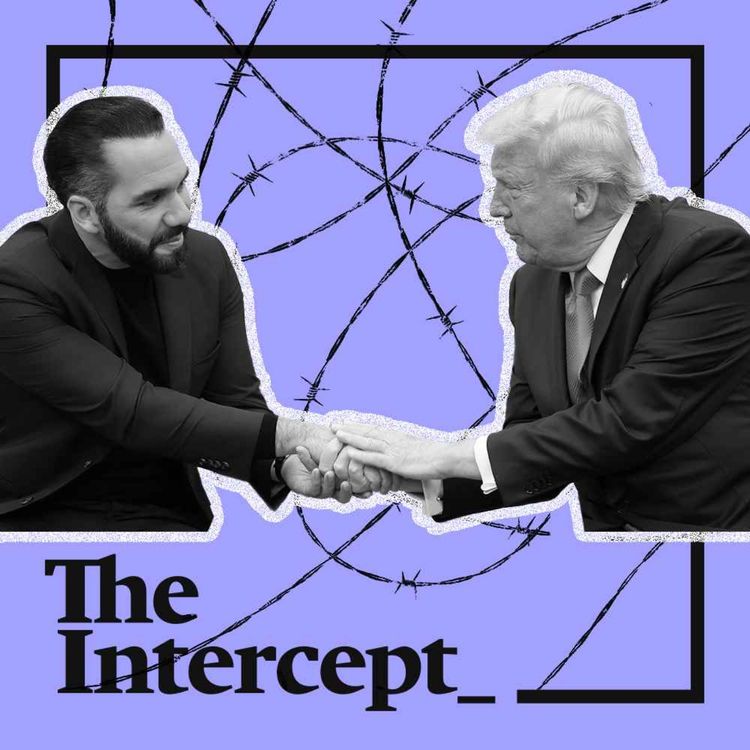
This week on The Intercept Briefing, Bullock speaks to host Jessica Washington about López’s continued imprisonment and what her work and detention reveals about the Trump administration’s interest in El Salvador’s prison system. Facing vague corruption charges, López has seen her family and lawyer but not yet a judge.
“The type of jails and the prison system that the United States has contracted is one of a dictatorship — one that operates outside of the rule of law,” says Bullock.
But El Salvador isn't the only country the U.S. is looking to partner with to outsource immigration detention. “Now in addition to El Salvador, the U.S. has reportedly explored, sought, or struck deals with at least 19 other countries,” says Nick Turse, national security fellow for The Intercept.
“Many of these countries,” says Turse, “have been excoriated by not only human rights groups and NGOs, but also the U.S. State Department.”
“ These policies did not leap fully formed from the head of Donald Trump,” says Turse. They have a legacy largely stemming from the post-9/11 counterterrorism policies of the George W. Bush administration. “The Trump administration has expanded the Bush and Obama-era terrorism paradigm to cast immigrants and refugees as terrorists and as gang members,” says Turse.
Listen to the full conversation of The Intercept Briefing on Apple Podcasts, Spotify, or wherever you listen.
More episodes
View all episodes

42. Mahmoud Khalil: “We Can’t Afford to Stay Silent”
46:50||Season 3, Ep. 42Three years into Israel’s genocide in Gaza, the U.S. government is still targeting pro-Palestine student activists.Even before federal immigration agents descended on communities around the country, killing immigrants and protesters, unmarked agents were abducting students who had voiced criticisms of Israel.Mahmoud Khalil was the first. After federal agents detained him at his alma mater, Columbia University, he spent more than 100 days in an Immigration and Customs Enforcement detention facility in Louisiana. It’s been over a year since he was released and returned to live with his family in New York City. The Trump administration is still trying to deport him.“Part of why I'm doing this right now rather than waiting 10 years or 20 years is because what's happening now in ICE detention is a stain on the U.S. conscience,” Khalil tells The Intercept Briefing. “I don't want to look back in 20 years and reckon with what's happening. I want to stop the killing now. I want to stop the disappearances now. I want to stop the cruelty now.”This week on the podcast, Khalil speaks with host Akela Lacy about what he’s learned about how he became President Donald Trump’s top target, the role Columbia University played in that campaign, and his new book, “No Land to Stand On,” which chronicles Khalil’s experience in ICE detention, missing the birth of his first child, his ongoing saga to stay in the U.S. with his family, and more.“It's been so difficult just to have that conversation with my wife Noor about what would happen,” Khalil says. “What are we doing? Is it worth the fight? Should we just leave? But to me, this fight isn't only about whether I get to stay in this country.”“It's about whether anyone — whether they are citizens or non-citizens — are able to speak out against government policies and against the support of Israel in this country. It goes down to a very basic thing: If they are able to deport someone for their views on Palestine, they would be able to deport anyone on their views, whether it is pro-Palestine or pro-Israel or anything.”For more, listen to the full conversation of The Intercept Briefing on Apple Podcasts, Spotify, YouTube, or wherever you listen.Full transcript: https://interc.pt/4ywVeOAKeep our investigations free and fearless at theintercept.com/join
41. The Blueprint for Democrats to Win Back Voters
39:47||Season 3, Ep. 41It’s the year of the democratic socialist. But the group that helped start the earthquake currently transforming the Democratic Party almost didn't make it to 2026.After suffering major losses last election cycle after a deluge of pro-Israel lobby spending, Justice Democrats, which supports progressive candidates getting elected to Congress, was on the verge of being written about in the past tense.“Everyone sort of doubted that there was a comeback to be had. I think a lot of people, AIPAC included, saw last cycle as the harbinger for what's to come: They were on the rise, JD and the left were on the decline. For the first time ever, we didn't endorse a new candidate since our founding, and because we had to focus on defending against $100 million in spending from AIPAC,” says communications director and spokesperson Usamah Andrabi. “The truth is, that moment was really — for lack of a better word — the apex of AIPAC's momentum and ability.”But Justice Democrats resurrected itself, had its most successful primary season to date, and helped put democratic socialism on the map. So what changed?The group says it won big this year, even being massively outspent, because it tapped into the brewing frustration among voters — frustration directed at Democratic Party leaders. “We understood as soon as Donald Trump won that clearly the Democratic establishment was unfit to fight back, and what voters were looking for as we've seen throughout this cycle, is this amorphous fighter that they want,” says Andrabi. “That fight doesn't just look like, as we say so often, press releases and strongly worded letters. It looks like fighting corporate establishment. It looks like fighting AIPAC. It looks like fighting crypto and AI.”This week on The Intercept Briefing, Andrabi speaks to host Akela Lacy about how the group that helped elect Reps. Alexandria Ocasio-Cortez, Ilhan Omar, and Rashida Tlaib has seen their candidates make impressive gains in the primaries, and how they're planning to leverage their wins — and what they can learn from their losses — beyond November.This primary season, Justice Democrats endorsed 15 candidates; seven won, with democratic socialists knocking out three incumbents. That includes Darializa Avila Chevalier who toppled Congressional Hispanic Caucus Chair Adriano Espaillat in New York, Melat Kiros who beat Rep. Diana DeGette in Colorado, and state Rep. Donavan McKinney who took out Rep. Shri Thanedar in Michigan. Those three are all but guaranteed to head to Congress next year, along with the four other candidates who won.“This work doesn't happen overnight. These losses don't happen overnight. It takes years and years to build this progress,” says Andrabi. “These candidates that we elected this cycle are giving you a blueprint on a silver platter on how to excite your base and how to energize your party. The Democratic Party can either listen to them or be forced to listen to them, as they have been this cycle when we beat them.”Full transcript: https://interc.pt/4rypFBtKeep our investigations free and fearless at theintercept.com/join.
40. Apocalypse Now: Naomi Klein and Astra Taylor Investigate the End-Timers Alliance
46:39||Season 3, Ep. 40The fight over the future is rapidly unfolding before our eyes. With debates roiling Washington over calls to rein in artificial intelligence before it’s too late as the U.S. continues to wage official and unofficial wars around the world, many of the world’s most powerful players are licking their chops. Yes, there’s destruction all around. But these players have carefully concocted a plan: to hasten a familiar vision that combines biblical, militant, and futuristic images of the end times so they can save themselves.This week on The Intercept Briefing, host Akela Lacy interviews award-winning authors and documentarians Naomi Klein and Astra Taylor, whose new book, "End Times Fascism and the Fight for the Living World," maps the players who want to speed up the end of the world. “We didn't feel that the old ways of understanding who Trump is, what he's trying to accomplish — even what fascism is — was fully capturing what we were seeing. Here we're thinking about invading Greenland, declaring Canada the 51st state, creating an ICE army, the relationship with El Salvador's maximum-security prisons. So we're trying to map this,” says Klein. It seemed to be “a fascism that had no vision of our world continuing. There's always an apocalyptic quality to fascism, but there is a horizon for the in-group after the cataclysm, and we weren't seeing that in this politics. It was much more about bunkering down in and taking breakdown for granted.”“End times fascism is an alliance of three main components,” says Taylor. The religious fundamentalists who helped elect Donald Trump, wanting to hasten along a violent Armageddon so Jesus will return. The tech accelerationists “exalting in the possibility that some sort of super intelligence, some sort of digital being might take over.” The ethnonationalists who view immigration as an existential threat, so they fortress the border and hoard resources. “These different prongs find a kind of uneasy alliance in their conviction that this world's going to hell and that their group will survive the wreckage,” says Taylor.It may sound bizarre. And it is. But that doesn’t mean we should ignore it, Klein says. “This is a really dangerous pattern of thought: that out of the worst things possible comes the beautiful, glorious golden city. And that's the template of all of these action films and video games, and it leads one to embrace the worst and to not fear what we should fear,” says Klein. “When Trump shares a video of a remade Gaza with a Trump Tower, he's doing a version of that story. When Sam Altman says he's summoning a digital god, and we're going to have utopia with AI, and yeah, let me cover the whole world with data centers and accelerate the climate crisis because it's going to be utopia ... he's doing the story. So we have to be able to identify it because we're all living with the consequences of this terrible story and we need better stories.”“In this moment, we're up against a fascism that is against all humans in a way. We quote Kelly Hayes, an activist based in Chicago, and she says, ‘Every fascism has its subhumans, and for techno-fascists, it's just humans in general.’ This is opening up a bigger fight beyond ‘I am a man’ to just like, this is life versus the machines, and there's something very unprecedented about that and potentially very unifying,” says Taylor, noting that the collective uprising, across the political spectrum, against data centers shows people breaking free of one so-called inevitable future.Full transcript: https://interc.pt/3V3fTuMKeep our investigations free and fearless at theintercept.com/join.
39. The AI Doomsday Future Is Not Inevitable
49:45||Season 3, Ep. 39Local police departments use Flock cameras to track license plates. ICE uses Palantir software to track and round up immigrants. Defense Secretary Pete Hegseth’s war department uses Claude to bomb Iran. The U.S. government spends billions employing private corporations to obtain mountains of data — and the surveillance space is only getting more privatized in Donald Trump’s second term. “It really has become a Wild West,” 404 Media co-founder Jason Koebler tells host Akela Lacy on The Intercept Briefing, on the state of the U.S. surveillance apparatus today. While Palantir and Flock have become household names, Koebler says, “anything that can be surveilled is being surveilled, and a lot of this is happening from companies that very few people have heard of, and companies that are willing to push the envelope on what they're willing to do, like how far they're willing to go to surveil people."“A lot of the stuff that you used to associate with the NSA or CIA or another state spy agency, those kinds of capabilities you can now just buy,” Intercept senior technology reporter Sam Biddle notes of the ease and accessibility of the tools now available to the government. “You don't need to be a top-secret government agency. You can just be a contractor in Virginia.”“It's a way to sidestep warrant requirements,” says Koebler. Surveillance contractors “are doing things that if the government were doing directly, they would need to get a warrant in order to do it.”This week, for a special recording of the podcast, independent tech outlet 404 Media and The Intercept teamed up in front of a live audience in Los Angeles to discuss how the U.S. government weaponizes private data to surveil and kill abroad and at home, the resulting backlash and potential regulations on the table, what tangible actions the average person can take to “divest from the contemporary surveillance hellscape,” and refocusing AI-ending-humanity doomerism.“When you ascribe motives and agency to AI, you're letting Sam Altman off the hook,” says Biddle. “There are human beings building this technology. It's not inevitable. This doomsday future is not inevitable,” adds Koebler. “We can't bury our heads in the sand and say, ‘This is not changing society in some way.’ But it is being driven by very rich humans, and they can be regulated. They can be held to account.”“What's been really interesting about the Flock backlash, and heartening, is that it is completely apolitical, or it's nonpartisan. It is completely — from the deepest red to the people in this room right now — the entire political spectrum hates these,” says Biddle. “There's the real potential for the first time in a while to create a pro-privacy coalition that bridges a lot of the otherwise pretty giant political gaps.”Full transcript: https://interc.pt/4hqwQrKKeep our investigations free and fearless at theintercept.com/join.
38. 25 Years After 9/11, Muslims Are Still Politicians’ Favorite Scapegoat
42:45||Season 3, Ep. 38RSVP for The Intercept and 404 Media Live Podcast, September 10 in LA: https://interc.pt/livepodcast Show Description: A quarter century after the September 11 attacks emboldened then-President George W. Bush to launch the “war on terror,” many Americans might like to think they’re wiser than the politicians and pundits who unleashed a flood of anti-Muslim hatred and eroded civil liberties through warrantless wiretaps and racist deportation campaigns.But some of the most notorious Bush-era advents — like the Department of Homeland Security and the prison colony at Guantánamo Bay — don’t appear to be going anywhere. Nor does the phenomenon of Islamophobia, which is playing a major role in the current political cycle. Michigan Democratic Senate nominee Abdul El-Sayed — who, if elected, would be the first Muslim U.S. senator — has been called a terrorist, a radical Islamist, and a threat to national security, as pro-corporate and pro-Israel super PACs spend millions on ads that paint him as a terrorist sympathizer. In New York City, meanwhile, local media has suggested that the city’s first Muslim mayor, Zohran Mamdani, should not attend the commemoration of the World Trade Center attacks, as if to do so would be an insult to the victims and their families.“Islamophobia actually becomes more rampant during election season — not necessarily after a terrorist attack, but actually during election season in the U.S.,” journalist Rozina Ali tells The Intercept Briefing. “What's happened over the last three decades is that Islamophobia has become a feature of American politics. ... When you can't actually discuss the policies, when we're not willing to engage in facts, it's really easy to throw racist rhetoric at people.”“The fight that we're seeing now is whether we are willing to accept all forms of religion in this country. And as much as I want to say this is just more of what we've seen in the past, I think what does frighten me is how quickly we are moving to a place where some governor or some local official might try to outlaw Islam altogether. And mind you, this is even a policy shift from 10 years ago when Trump called for a Muslim ban,” says Ali. “What has been happening recently is that the rhetoric ... has been shifting toward, ‘Islam is not a religion, it’s a political ideology.’ This is not a new talking point, but it is becoming institutionalized. There are efforts to make it into law, which is a frightening place to be.”This week on the podcast, host Akela Lacy speaks to Ali about how anti-Muslim rhetoric and policies are on the rise and have endured, or even worsened, in the post-9/11 world, as well as her new book, “Seasons of Fury: Four Families and the Rise of Islamophobia in America.” Ali shares the first case in which the NSA admitted to spying on a U.S. citizen, Arab American attorney Abdeen Jabara, as well as the story of imam Yassin Aref, a victim of a controversial sting operation who served 15 years in federal prison due to the ambiguous “material support” for terrorism law first passed in the ’90s. It was the same charge used to convict anti-ICE protesters at Prairieland Detention Center to decades in prison this year.“This was something lot of civil rights lawyers and activists were warning about even back then, because they recognized that this law and this war on terror can be used to attack dissidents and eventually will be used to attack a lot more people than the Muslim community. And that is what we're seeing now,” says Ali.“Because we've given so much power to the executive branch, because we've given so much power to the government over the last 25 years, the government gets to decide who they consider enemies, who they consider terrorists, and what they consider support for terrorism,” says Ali. “The Trump administration can say, ‘I now consider leftists terrorists,’ and unfortunately, there are laws in the books that allow him to do that.”Full transcript: https://interc.pt/4zPINyl
37. Right-Wing Trans Hate Comes for the WNBA
33:37||Season 3, Ep. 37The WNBA is having a moment. Viewership is up. Attendance for this year’s WNBA All-Star Game surpassed the NBA’s All-Star Game. Games and events can be viewed in a record number of places, from broadcast to cable and streaming. And just this week, Angel Reese of the Atlanta Dream set a single-game record. But the stories about the WNBA capturing national attention in recent weeks are about none of that. Instead, the focus has been on two retired NBA players, including Enes Kanter Freedom, who showed up courtside at an August 23 Chicago Sky–Indiana Fever game wearing a T-shirt that said "Woman: noun. adult human female."“I don't believe that he's being genuine in any realm, in order to create this mass hysteria of sorts for an issue that's actually simply a non-issue,” says Angela Perry, a WNBA content creator, tells The Intercept Briefing. “There are no trans women in the WNBA; there are none attempting to be in the WNBA.”This week on The Intercept Briefing podcast, host Jessica Washington speaks to Perry and journalist Katelyn Burns about how the premier women’s professional basketball league has found itself at the center of a right-wing manufactured panic.“The right has made such hay out of trans women in women's sports that they need to keep inventing controversies in order to keep this issue front of mind,” says Burns who writes for the independent newsletter Burns Notice and co-hosts the Cancel Me, Daddy podcast. “We have a midterm election coming up, and to be frank with you, the only thing that the right has done besides terrorizing immigrants is banning trans women from women's sports. It's at the center of almost all of their policies,” continues Burns. “They are inventing controversies about trans people in sports where there are no trans people involved.”“This is about women in general. They're already talking about not wanting women to have the right to vote,” says Perry. “This isn't just about sports. There's a political party trying to scale us back to what they perceive was a time where things were better. But really, it was when women were more controlled.”“The bigger issue is that the people who think that they're protected, it's always going to get to the protected class eventually,” warns Perry. “Right now, the focus is trans, and people think they're safe because ‘I'm not trans. I'm a cis woman and I'm protected.’ But it will impact you.”For more, listen to the full conversation of The Intercept Briefing on Apple Podcasts, Spotify, YouTube, or wherever you listen.Full transcript: https://interc.pt/3UXTwXsKeep our investigations free and fearless at theintercept.com/join.
36. What American Doctors Saw in Gaza
34:07||Season 3, Ep. 36It’s been nearly three years into Israel's genocidal war on Palestinians, and still no step closer to its end. Since the latest “ceasefire” began in October 2025, Israel has continued to bombard Gaza and has killed more than 1,200 people, United Nations experts reported earlier this month. Israeli Prime Minister Benjamin Netanyahu more recently rejected President Donald Trump’s Board of Peace agreement with Hamas for Israeli troops to withdraw from the Gaza Strip.“The burden has really continued to devastate the healthcare system in general. So you're hearing from colleagues every day. They don't have the materials that they need to serve their patients,” Dr. Thaer Ahmad tells The Intercept Briefing. “They don't have even the basic sort of guarantee that there is a cloak of security allowing them to operate in the traditional ways that they would like to.” This week on the podcast, Intercept reporter Jonah Valdez speaks to Ahmad, an emergency medicine physician and humanitarian who has provided medical relief in conflict zones including Gaza, and director Poh Si Teng about their new documentary “American Doctor.” It follows three U.S. physicians from three different states who volunteer to enter Gaza to provide emergency medical care as best they can, with the insufficient supplies they have, to save lives — under the threat, as healthcare workers and hospitals have repeatedly been the target of strikes, of losing theirs.The American doctors were not just targeted by the Israeli military, however. Upon returning home and trying to share the atrocities they had witnessed in Gaza, they were “pummeled,” says Teng, in interviews with mainstream media outlets and ignored by lawmakers in Congress.“There's this refusal to acknowledge what most American people are interested in — and that is money out of the Middle East in terms of military and wars, and into our communities here, into healthcare, and into some of the services that we are deprived of, that, for example, Israeli society is able to provide for their citizens: free education, free healthcare,” says Ahmad. “We don't even have that here, and yet we're still providing a significant amount of aid.”Teng says, “For everybody who's trying to do something in this moment, it's not like as individuals we have no agency. We do. But it's also important to remind people of the systems in place that make it very hard for us to do the right thing. If there was any path forward or a glimmer of inspiration, I felt, follow these doctors.”For more, listen to the full conversation of The Intercept Briefing on Apple Podcasts, Spotify, YouTube, or wherever you listen.Full transcript: https://interc.pt/4xbqfa5
35. Has the Left Really Met Its Limit?
30:31||Season 3, Ep. 35The stunning momentum of the insurgent left hit a roadblock this week when democratic socialist Francesca Hong narrowly lost her primary race for Wisconsin governor to Milwaukee County Executive David Crowley, a moderate who garnered significant support from establishment Democrats. “The collective power of that Democratic establishment in a state, where there is a Democratic governor and there is a real Democratic Party establishment machine, all of that power was required to eke out a 0.4 percent victory in the party’s own primary against a previously unknown candidate running as a Democratic socialist,” The Lever’s David Sirota tells The Intercept Briefing. This week on the podcast, host Jessica Washington speaks with Sirota, founder and editor-in-chief of The Lever, about the primaries and how the left is building power within the Democratic Party. There were bright spots for progressives on Tuesday night. In Minnesota, progressive Lt. Gov. Peggy Flanagan defeated AIPAC-backed Rep. Angie Craig, D-Minn., in the Senate primary race. Craig had previously voted for the Laken Riley Act, which requires the federal government to detain people for certain crimes, including shoplifting and burglary. Flanagan, by contrast, told supporters on election night: “We need to rip ICE apart and stop them from terrorizing our communities.” “What you’re seeing now is, and I don’t want to call it a Democratic Tea Party, but it is certainly organizing and pressuring to take back power in an adversarial way from a set of forces to the left of the Democratic establishment,” says Sirota. “That is what’s new, and that is what’s driving the political dynamic now.” Washington and Sirota also discuss the intensifying democracy crisis unfolding in the United States. According to Sirota, it “stands on two pillars: concentrated executive power and the supremacy of money.”Sirota explores this theme and more, in the new season of his show, Master Plan: The Kingmakers. The podcast is all about how a once-fringe legal theory moved into the mainstream and transformed the power of the American presidency. Full episode transcript here. Keep our investigations free and fearless at theintercept.com/join. And if you haven’t already, please subscribe to The Intercept Briefing wherever you listen to podcasts.
34. The Most Expensive Democratic Senate Primary Has a Winner
34:52||Season 3, Ep. 34Over the course of Donald Trump's second term, Democratic voters have expressed dissatisfaction with their party over what many view as an inability to stand up to the president and his broader movement. That dissatisfaction with the establishment has manifested in primaries in coastal cities across the country, where the progressive movement appears to be ascendant. On Tuesday, that test played out in Midwestern states, Michigan and Missouri.Within roughly two hours of polls closing, The Associated Press called the closely watched rematch between Cori Bush and Rep. Wesley Bell for the incumbent. In 2024, AIPAC and other outside groups spent more than $18 million to oust Bush from her Missouri district, and her defeat, along with New York Rep. Jamaal Bowman’s, has served as a warning sign for Democrats not to be too progressive or too pro-Palestine.But by Wednesday morning, Abdul El-Sayed, who ran on Medicare for All and ending military aid to Israel for its continued genocide in Gaza, narrowly defeated Rep. Haley Stevens by less than 20,000 votes. According to AdImpact, the Michigan Democratic Senate primary saw $98 million in ad spending and reservations. At least $60 million was spent boosting Stevens or attacking El-Sayed, with more than $30 million from the American Israel Public Affairs Committee’s super PAC, United Democracy Project — its largest spend in a single race ever, nearly double the then-record-breaking amount spent on Bowman's 2024 primary race.This week on The Intercept Briefing, host Jessica Washington and colleagues Akela Lacy and Jonah Valdez discuss what results from Tuesday's primaries signal for progressives and the broader left in the Democratic Party, especially in swing states and outside of coastal cities.Full transcript: https://interc.pt/4wgacXj Keep our investigations free and fearless at theintercept.com/join.