Share
Intelligence Squared
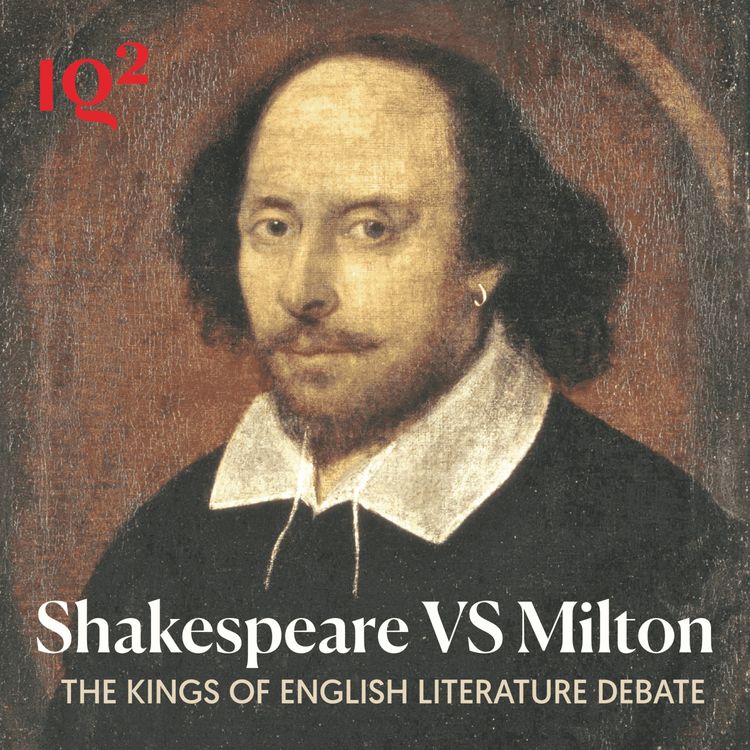
Shakespeare vs Milton: The Kings of English Literature Debate [Archive]
Nearly four centuries after his death, no writer has come close to matching Shakespeare’s understanding of the world – or his gift for dramatic poetry. It’s not just kings and queens that he captured so uniquely in his transcendent verse. Shakespeare analysed the human condition, not just for Elizabethan England, but throughout the world and for eternity. Britain may not have matched the Continent for music or art but when it comes to literature, Shakespeare sees off all international rivals, whether it’s in the spheres of comedy, tragedy or the sonnet. Even today you and I quote Shakespeare without knowing it: if you act more in sorrow than in anger, if you vanish into thin air or have ever been tongue-tied, hoodwinked or slept not one wink, you’re speaking the Bard’s English.
Milton, say his fans, works on an altogether different, higher plane. In Paradise Lost – the best poem ever written in English – Milton moved beyond the literary to address political, philosophical and religious questions in a way that still resounds strongly today. In his complex, intellectual poetry he drilled down deep into the eternal truths and sought to embody new scientific discovery in his work.
His engagement with the issues of the day – with the nature of knowledge, slavery, free will, love and creation – was unparalleled. Despite complete blindness in middle age, he was the English republic’s best known, most fervent apologist, and a key civil servant for Oliver Cromwell. In his other works, notably in Areopagitica, his attack on censorship, he showed himself as much a master of prose as poetry. He defines not only his age, but our own.
To help you decide who should be crowned king of English letters we brought together advocates to make the case for each writer, and they called on a cast of leading actors to illustrate their arguments with readings from the works.
More episodes
View all episodes
3549. Can the West Make Amends for Slavery Without Paying Reparations? [Archive]
01:04:38||Season 1, Ep. 3549As Britain and Commonwealth nations reopen discussions about the legacy of the transatlantic slave trade, the question of reparations is once again at the centre of political debate. The UK has agreed to talks on historical injustices but continues to rule out financial compensation. So what does meaningful justice for the crimes of slavery actually look like?In this episode from the Intelligence Squared archive, we revisit a debate from 2019 that feels particularly relevant today. Arguing for the motion that the West should pay reparations are Professor of Black Studies Kehinde Andrews and reparations activist Esther Stanford-Xosei. Opposing them are educator Katharine Birbalsingh and educational consultant Tony Sewell. Chaired by social historian Emma Dabiri, the debate explores whether the West has a responsibility to compensate descendants of enslaved people, how such a programme might work and whether reparations could help address historic injustices or risk deepening social divisions.
3548. Mona Chalabi on Money, Shame and the Stories We Tell Ourselves
44:13||Season 1, Ep. 3548Money shapes our choices, our relationships and our sense of who we are. Yet even when we talk about class, we often struggle to speak plainly about what we have.Why does money provoke shame across the income spectrum? How do forces beyond our control shape our chances of moving up the economic ladder? And could talking more openly about our finances help us see inequality differently?In this episode, Margherita Volpato speaks with Mona Chalabi about her book Ten Lives: How What We Have Shapes Who We Are.Chalabi followed ten people across the American income distribution, combining their stories with data and reflections on her own finances. She discusses the difference between income and wealth, the limits of individual choice and why she believes class deserves a larger place in conversations about identity. She also explores what the American dream can obscure, and how recognising our different circumstances might make collective action possible.Mona Chalabi is a Pulitzer Prize-winning writer and illustrator whose work has been exhibited at the Tate, the Smithsonian Design Museum and the Brooklyn Museum.Margherita Volpato is a Senior Producer at Intelligence Squared....If you'd like to become a Member and get access to all our full conversations, plus all of our Members-only content, just visit intelligencesquared.com/membership to find out more.For £4.99 per month you'll also receive:- Full-length and ad-free Intelligence Squared episodes, wherever you get your podcasts- Bonus Intelligence Squared podcasts, curated feeds and members exclusive series- 15% discount on livestreams and in-person tickets for all Intelligence Squared events...Or Subscribe on Apple for £4.99:- Full-length and ad-free Intelligence Squared podcasts- Bonus Intelligence Squared podcasts, curated feeds and members exclusive series…Already a subscriber? Thank you for supporting our mission to foster honest debate and compelling conversations! Visit intelligencesquared.com to explore all your benefits including ad-free podcasts, exclusive bonus content and early access.…Subscribe to our newsletter here to hear about our latest events, discounts and much more.https://www.intelligencesquared.com/newsletter-signup/Learn more about your ad choices. Visit podcastchoices.com/adchoices
3547. China's New Plan to Dominate the World Economy, with Keyu Jin
32:09||Season 1, Ep. 3547What happens when China starts exporting the know-how to build things as well as the products themselves? Economist Keyu Jin joins Intelligence Squared co-host Conor Boyle to discuss China’s long game. They explore why Chinese companies are helping other countries build their own industries, whether that creates new rivals or richer customers, and how Europe can adopt Chinese technology without becoming dependent on it. Keyu Jin is an economist and was a tenured professor at LSE for 15 years. Conor Boyle is head of programming at Intelligence Squared. -----If you'd like to become a Member and get access to all our full conversations, plus all of our Members-only content, just visit intelligencesquared.com/membership to find out more.For £4.99 per month you'll also receive:- Full-length and ad-free Intelligence Squared episodes, wherever you get your podcasts- Bonus Intelligence Squared podcasts, curated feeds and members exclusive series- 15% discount on livestreams and in-person tickets for all Intelligence Squared events ... Or Subscribe on Apple for £4.99:- Full-length and ad-free Intelligence Squared podcasts- Bonus Intelligence Squared podcasts, curated feeds and members exclusive series…Already a subscriber? Thank you for supporting our mission to foster honest debate and compelling conversations! Visit intelligencesquared.com to explore all your benefits including ad-free podcasts, exclusive bonus content and early access.…Subscribe to our newsletter here to hear about our latest events, discounts and much more.https://www.intelligencesquared.com/newsletter-signup/Learn more about your ad choices. Visit podcastchoices.com/adchoices
3546. How Pornography Invented the Attention Economy, with Patricia Nilsson
35:34||Season 1, Ep. 3546Content warning: This episode contains strong language, discussions of pornography and sexual violence, and references to self-harm.At peak times, close to a tenth of global internet traffic is devoted to streaming adult content. Across the world, as many people have instantaneous access to free pornography as to clean water.But the rise and rise of online pornography isn’t just a side effect of an increasingly connected and virtual world. Financial Times journalist Patricia Nilson makes a powerful argument that it is actually the blueprint for the modern internet itself.In this episode, Mia Sorenti speaks with Nilsson about how online pornography changed the way platforms capture our attention, and how it can help us to understand the logic of compulsion, gratification, addiction and endemic extremism that characterises so many online spaces today.Patricia Nilsson is a journalist at the Financial Times. Her book is Guilty Pleasure: The Pornification of the Internet, the Economy and Everything Else.Mia Sorenti is Senior Producer at Intelligence Squared.----f you'd like to become a Member and get access to all our full conversations, plus all of our Members-only content, just visit intelligencesquared.com/membership to find out more.For £4.99 per month you'll also receive:- Full-length and ad-free Intelligence Squared episodes, wherever you get your podcasts- Bonus Intelligence Squared podcasts, curated feeds and members exclusive series- 15% discount on livestreams and in-person tickets for all Intelligence Squared events ... Or Subscribe on Apple for £4.99:- Full-length and ad-free Intelligence Squared podcasts- Bonus Intelligence Squared podcasts, curated feeds and members exclusive series…Already a subscriber? Thank you for supporting our mission to foster honest debate and compelling conversations! Visit intelligencesquared.com to explore all your benefits including ad-free podcasts, exclusive bonus content and early access.…Subscribe to our newsletter here to hear about our latest events, discounts and much more.https://www.intelligencesquared.com/newsletter-signup/Learn more about your ad choices. Visit podcastchoices.com/adchoices
3545. Adam Grant on Why Talent Is Overrated [Archive]
01:26:01||Season 1, Ep. 3545Adam Grant is one of the most sought after organisational psychologists in the world. He has provided expert advice to many of the world’s greatest business leaders, including Bill Gates and Sheryl Sandberg, equipping them with the mental tools to find motivation and meaning, rethink assumptions, and achieve greatness in their business and personal lives.In January 2024 Grant came to the Intelligence Squared stage for a rare, exclusive London event where he shared his revolutionary framework for how we can all exceed the expectations and aspirations we have set for ourselves. Drawing on his new book Hidden Potential he explained that despite living in a world that tends to admire people who start out with innate talent, there is clear scientific evidence that we can all bridge the biology gap and improve ourselves dramatically.In conversation with economist and FT columnist Tim Harford, Grant wove together groundbreaking evidence, surprising insights, and vivid story telling to take us from the classroom to the boardroom and the playground to the Olympics. He revealed how progress depends not so much on how hard we work and more on how well we learn. Growth is not about the genius we possess – it’s about the character we develop. He explained how to build the character skills and motivational structures to realise our own potential, and how to design systems that create opportunities for those who have been underrated and overlooked.
3544. Why Science Hasn’t Displaced the Supernatural, with Malcolm Gaskill
49:49||Season 1, Ep. 3544How do we make sense of the unseen? For centuries, the supernatural has offered ways to understand misfortune, find comfort and live with uncertainty. But its history is not simply a story of superstition giving way to reason.Why did people seek evidence in witchcraft trials? Can science and supernatural belief exist alongside one another? And what might today’s encounters with frontier technologies reveal to us about the persistence of the uncanny?In this episode, Margherita Volpato speaks with Malcolm Gaskill about his new book, Worlds of Fear and Wonder: Living with the Supernatural, Past and Present.Together, they explore the emotions behind supernatural beliefs that have shaped culture. They discuss Puritans searching for signs from God, the persistence of enchantment in the modern world and the uneasy relationship between technology and the uncanny.Malcolm Gaskill is Emeritus Professor of Early Modern History at the University of East Anglia and the author of seven books, including Witchfinders, Hellish Nell, and the Sunday Times bestseller The Ruin of All Witches. He is a fellow of the Royal Historical Society and writes regularly for the London Review of Books. His new book is Worlds of Fear and Wonder: Living with the Supernatural, Past and Present.Margherita Volpato is a Senior Producer at Intelligence Squared.---If you'd like to become a Member and get access to all our full conversations, plus all of our Members-only content, just visit intelligencesquared.com/membership to find out more.For £4.99 per month you'll also receive:- Full-length and ad-free Intelligence Squared episodes, wherever you get your podcasts- Bonus Intelligence Squared podcasts, curated feeds and members exclusive series- 15% discount on livestreams and in-person tickets for all Intelligence Squared events ... Or Subscribe on Apple for £4.99:- Full-length and ad-free Intelligence Squared podcasts- Bonus Intelligence Squared podcasts, curated feeds and members exclusive series…Already a subscriber? Thank you for supporting our mission to foster honest debate and compelling conversations! Visit intelligencesquared.com to explore all your benefits including ad-free podcasts, exclusive bonus content and early access.…Subscribe to our newsletter here to hear about our latest events, discounts and much more.https://www.intelligencesquared.com/newsletter-signup/Learn more about your ad choices. Visit podcastchoices.com/adchoices
3543. Are We Addicted to Control? with Dr Anna Lembke
40:06||Season 1, Ep. 3543We live in a world designed to give us ever greater control. We can optimise our routines, monitor our bodies and manage almost every detail of our surroundings. But our pursuit of certainty may also be making us less able to face the parts of life we cannot predict.Are we becoming addicted to control? Why can uncertainty leave us feeling anxious, lonely or ashamed? And could surrender be a source of freedom rather than a sign of defeat?In this episode, Dr Güneş Taylor speaks with Stanford psychiatrist and addiction-medicine specialist Dr Anna Lembke about her new book, Radical Surrender: Letting Go in a World Addicted to Control.Drawing on neuroscience, clinical experience and her own encounter with loss, Lembke explains why accepting the limits of our control might help us find greater meaning and connection. Together, they explore what surrender means in a secular age and whether opening ourselves to uncertainty can change how we live.Dr Anna Lembke is a professor of psychiatry at Stanford University School of Medicine and Medical Director of Stanford Addiction Medicine. She is the author of Dopamine Nation and Drug Dealer, MD. Her latest book is Radical Surrender: Letting Go in a World Addicted to Control.Dr Güneş Taylor is a molecular biologist, science broadcaster and Chancellor’s Fellow at the Centre for Reproductive Health at the University of Edinburgh.If you'd like to become a Member and get access to all our full conversations, plus all of our Members-only content, just visit intelligencesquared.com/membership to find out more.---For £4.99 per month you'll also receive:- Full-length and ad-free Intelligence Squared episodes, wherever you get your podcasts- Bonus Intelligence Squared podcasts, curated feeds and members exclusive series- 15% discount on livestreams and in-person tickets for all Intelligence Squared events ... Or Subscribe on Apple for £4.99:- Full-length and ad-free Intelligence Squared podcasts- Bonus Intelligence Squared podcasts, curated feeds and members exclusive series…Already a subscriber? Thank you for supporting our mission to foster honest debate and compelling conversations! Visit intelligencesquared.com to explore all your benefits including ad-free podcasts, exclusive bonus content and early access.…Subscribe to our newsletter here to hear about our latest events, discounts and much more.https://www.intelligencesquared.com/newsletter-signup/Learn more about your ad choices. Visit podcastchoices.com/adchoices
3542. Ultra-processed Feeds: How Digital Junk Broke the Internet
27:54||Season 1, Ep. 3542Is it time to rethink our information diet? Technology lawyer and author Seb Butcher joins Intelligence Squared host Conor Boyle to discuss his book Distorted and how our online feeds serve up outrage, falsehood and distraction. They explore how algorithms and generative AI shape our sense of reality, why digital junk can be as hard to resist as ultra-processed food, and practical ways to build healthier information habits.If you'd like to become a Member and get access to all our full conversations, plus all of our Members-only content, just visit intelligencesquared.com/membership to find out more.For £4.99 per month you'll also receive:- Full-length and ad-free Intelligence Squared episodes, wherever you get your podcasts- Bonus Intelligence Squared podcasts, curated feeds and members exclusive series- 15% discount on livestreams and in-person tickets for all Intelligence Squared events ... Or Subscribe on Apple for £4.99:- Full-length and ad-free Intelligence Squared podcasts- Bonus Intelligence Squared podcasts, curated feeds and members exclusive series…Already a subscriber? Thank you for supporting our mission to foster honest debate and compelling conversations! Visit intelligencesquared.com to explore all your benefits including ad-free podcasts, exclusive bonus content and early access.…Subscribe to our newsletter here to hear about our latest events, discounts and much more.https://www.intelligencesquared.com/newsletter-signup/Learn more about your ad choices. Visit podcastchoices.com/adchoices
3541. The Many Lives of David Hockney, with Paul Morley
44:33||Season 1, Ep. 3541David Hockney created some of the most recognisable art pieces in the modern world. Everyone knows his evocative California swimming pools and Yorkshire landscapes; but this familiarity can obscure the restless reinvention that powered the artist behind them.In this episode, Mia Sorenti speaks with writer and cultural commentator Paul Morley about Hockney’s life through the places that shaped him: postwar Bradford, swinging London, Los Angeles, Paris, Yorkshire and Normandy. How did changing landscapes make Hockney the artist he was? How did he carry his northern identity into the wider world? And what does his life reveal about class, sexuality, technology and the changing character of Britain?Paul Morley is a writer and cultural commentator whose books include The North (And Almost Everything in It), From Manchester with Love and The Age of Bowie. His new biography is David Hockney: An Artist for Life.Mia Sorenti is Senior Producer at Intelligence Squared.