Share
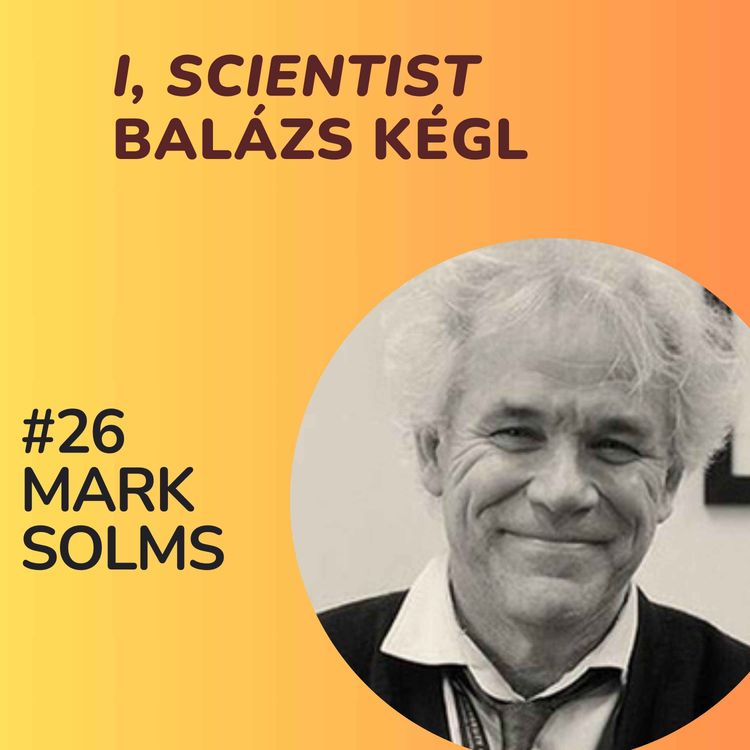
I, scientist with Balazs Kegl
Mark Solms
Another mind-blowing conversation, this time with Mark Solms, the neuropsychoanalist from the University of Cape Town, about his feeling-based theory of consciousness, how competing homeostatic needs lead to prioritization of responding to feelings, expressing these needs internally. At about the one hour mark, we go beyond and discuss how feelings can be understood as messages between hierarchical levels of conscious nested organisms.
Mark's book: https://www.amazon.com/Hidden-Spring-Journey-Source-Consciousness/dp/0393542017
A nine-episode conversation about the book: https://www.youtube.com/playlist?list=PLMxiNrgE29RIKY3hzQQlFZzkH85xsB4Vr
Related episodes:
Kevin Mitchell: https://youtu.be/nqxq-BiCr-M
Michael Levin: https://youtu.be/0nMXYdayQIU
Embodied AI: https://youtu.be/JZ8GTucClpM
Alexander Ororbia: https://youtu.be/N83vBfz7_BI
Yogi Jaeger: https://youtu.be/5UJ4y2L2qpk
Baudouin Saintyves: https://youtu.be/NmvzEpz9R84
Laura Desiree Di Paolo: https://youtu.be/9txUwVtAOBk
Anna Riedl: https://youtu.be/w2ZiSWZNQsg
Anna Ciaunica: https://youtu.be/x1QHwhlCn-8
Giuseppe Paolo: https://youtu.be/R7tEd65e2i8
00:00:00 Intro
00:04:35 Feeling-based consciousness. Anatomy: brain-stem vs cortical models.
00:20:43 The free energy principle and active inference. Do membranes exist?
00:41:00 The mechanisms of consciousness and the role of feeling. Prioritization of needs, voluntary actions, choice. Categorically different needs lead to qualia.
01:00:19 Hierarchical levels of nested organisms and feelings as messages.
01:27:46 Engineering consciousness. Is autopoiesis necessary?
I, scientist blog: https://balazskegl.substack.com
Twitter: https://twitter.com/balazskegl
Artwork: DALL-E
Music: Bea Palya https://www.youtube.com/channel/UCBDp3qcFZdU1yoWIRpMSaZw
More episodes
View all episodes
2. Glen Reuschling
01:25:52||Season 3, Ep. 2One of the conversations I enjoyed the most, where we explored AI, hardware, Platonic patterns, and nested agency in a free flow, and got somewhere together, with Glen Reuschling, a retired electronics engineer with whom I often converse here on X. Related episodes:Michael Levin: https://youtu.be/3zqI0iG428cMark Solms: Mark Solms: https://youtu.be/Rltfm-vWvgMKevin Mitchell: https://youtu.be/nqxq-BiCr-MMichael Levin: https://youtu.be/0nMXYdayQIUEmbodied AI: https://youtu.be/JZ8GTucClpMAlexander Ororbia: https://youtu.be/N83vBfz7_BIYogi Jaeger: https://youtu.be/5UJ4y2L2qpkBaudouin Saintyves: https://youtu.be/NmvzEpz9R84Laura Desiree Di Paolo: https://youtu.be/9txUwVtAOBkAnna Riedl: https://youtu.be/w2ZiSWZNQsgAnna Ciaunica: https://youtu.be/x1QHwhlCn-8Giuseppe Paolo: https://youtu.be/R7tEd65e2i800:00:00 Intro: Glen's electronics engineer background and his interest in embodied AI.00:07:11 Why Embodied AI is not mainstream? The anxiety of the pure Platonist AI researcher.00:08:31 Michael Levin and his Platonic turn. Jonathan Pageau's fractal ontology. Idealism vs transjectivity. Static top-down fractals vs dynamic bottom-up cellular automata. Had patterns existed before the world was born? Or they transjectively realized each other?00:17:47 Molecular and quantum agency. Randomness, determinacy, and free choice. What if what looks like random from the outside is in fact a conscious decision of an agent, from the inside.00:33:00 Omnipotence or finite attention and information bottleneck all the way up? Conway's caution of free will. Nondeterministic universe.00:44:10 Is God eternal or emerges as everything else? Are patters eternal or they also emerge? Do they have agency? 00:51:04 Symbols and hardware. Logical gates and binary logic are abstractions, what really happens is a flow of electrons.00:54:54 Is ChatGPT conscious? If not, what's the fundamental difference between me and ChatGPT. Integrated vs isolated layers of abstractions.00:59:23 Computation = physical process in which a language acquires agency?01:06:11 Herding randomness in living bodies vs eliminating randomness by error correction in machines. Hardware is more capable than we're using it for. Agricultural robots. Nested languages. Conversational computation. The role of feelings.01:19:36 For AGI, we will need to rethink the whole computer science stack, not only the top software layer.01:22:35 Glen's programmable pacemaker.I, scientist blog: https://balazskegl.substack.comTwitter: https://twitter.com/balazskeglArtwork: DALL-EMusic: Bea Palya https://www.youtube.com/channel/UCBDp3qcFZdU1yoWIRpMSaZwhttps://youtu.be/gjlLnvci30w
1. Michael Levin part 2
59:09||Season 3, Ep. 1My second conversation with Mike Levin, the developmental biologist from Tufts University, where we explore his ontology, the structure of the world. Are we biological interfaces to Platonic minds, or bodies and minds co-create or realize each other? Is ChatGPT conscious? Are machines more organismic than we thought? How should we get ready to communicate with minds who are very different from us?Related episodes:Mark Solms: Mark Solms: https://youtu.be/Rltfm-vWvgMKevin Mitchell: https://youtu.be/nqxq-BiCr-MMichael Levin: https://youtu.be/0nMXYdayQIUEmbodied AI: https://youtu.be/JZ8GTucClpMAlexander Ororbia: https://youtu.be/N83vBfz7_BIYogi Jaeger: https://youtu.be/5UJ4y2L2qpkBaudouin Saintyves: https://youtu.be/NmvzEpz9R84Laura Desiree Di Paolo: https://youtu.be/9txUwVtAOBkAnna Riedl: https://youtu.be/w2ZiSWZNQsgAnna Ciaunica: https://youtu.be/x1QHwhlCn-8Giuseppe Paolo: https://youtu.be/R7tEd65e2i800:00:00 Intro00:02:22 Mike's Platonic turn. Patterns are calling the shots. Prime numbers and cicadas. Anthrobots. Let's study the structure of emergence.00:14:55 Why not the Platonic and the "real" (Bard calls it pathic) realize each other rather than one creating the other? Towards more Darwinian forms? The engineering view: who controls what.00:21:15 Do patterns have agency? Do they feel? Patterns are agents. Lot of "free" computation is happening in the Platonic space.00:27:44 Can Platonic patterns die? Some patterns can survive the death of their physical instantiation. What is the ultimate drive if not persistence/survival? Similarity to Pageau's fractal ontology.00:36:26 Is ChatGPT conscious? If they are, it's not because they talk but because they might have intrinsic motivation. It's not that we are machines, rather machines are also organismic. The free spurious modes in the structure space: the mystery of bubble sort and other structuralist arguments. The organicist argument of integration of the nested agents. Computer levels are separated, organismic layers are integrated.00:52:49 How did your views changed your life? The urgency to communicate to minds that are very different from us.I, scientist blog: https://balazskegl.substack.comTwitter: https://twitter.com/balazskeglArtwork: DALL-EMusic: Bea Palya https://www.youtube.com/channel/UCBDp3qcFZdU1yoWIRpMSaZw
8. Alexander Bard part 4
01:21:25||Season 2, Ep. 8My fourth conversation with the philosopher Alexander Bard, on his new book project on mysticism, bliss, the importance of phenomenology, the philosophy of time, transcendence, and transformation.Related episodes:https://youtu.be/Y8cuqy6y0fo Alexander Bard part 1: sex, Zoroastrianism, embodied philosophyhttps://youtu.be/eASbv9WA-TQ Alexander Bard part 2: tantric sex, sex and spirituality, men's workhttps://youtu.be/3eAwktR3S3s Alexander Bard part 3: anthropology and AIBard on Sweeney, discussing the book project on mysticismhttps://www.youtube.com/watch?v=gFU0ot5daoghttps://www.youtube.com/watch?v=VtaDAqbAE3Ahttps://www.youtube.com/watch?v=XxlQyzDwTfo00:00:00 Intro: making philosophy.00:03:33 Why mysticism? Transcendence and transformation. The philosophy of time.00:14:53 The right order: phenomenology -> epistemology -> ontology of mysticism. Pathos-mythos-logos and subconscious/conscious. Only present exists. The past subsists and the future absists. The past is determinate, the future is indeterminate, the present is transdeterminate.00:26:08 Animal philosophy.00:28:51 Phenomenology of mysticism. Dancing myself unconscious. Varayana Buddhism. The two subjectless extreme states: pure experience and the infinite now. You can't do science of consciousness. 00:37:47 The historical and sociological context: pillar saints and boy pharaohs, sutra/tantra. The infinite now and orgasm. 00:49:41 Pure experience and the other-world dualism. The psychoanalytical view: neurosis and psychosis. Mamilla and embodiment.01:01:24 Mysticism is minimalism. The job of philosophy to kill axioms. Mysticism is practiced philosophy. Mysticism kills fantasies about how the world works. The importance of integration.01:09:42 The problem with western existentialism is that it assumes the subject is constant.01:10:17 Why go mystic? Why you? Why now? How? The birth of a child: instant bliss. Go deeper?01:14:22 The first thing the mystic says: there is no purpose to this. The phenomenology-epistemology loop has been ignored by philosophers.I, scientist blog: https://balazskegl.substack.comTwitter: https://twitter.com/balazskeglArtwork: DALL-EMusic: Bea Palya https://www.youtube.com/channel/UCBDp3qcFZdU1yoWIRpMSaZw
7. Kevin Mithcell
01:25:07||Season 2, Ep. 7My conversation with Kevin Mitchell, neuroscientist and geneticist at Trinity College Dublin, on free agency and randomness, nested selves, mental causation and the tension between free choice and control, and artificial agents.Kevin's books:Free Agents: https://www.amazon.com/Free-Agents-Evolution-Gave-Will/dp/0691226237/Innate: https://www.amazon.com/Innate-How-Wiring-Brains-Shapes/dp/0691204152/Related episodes:Michael Levin: https://youtu.be/0nMXYdayQIUEmbodied AI: https://youtu.be/JZ8GTucClpMAlexander Ororbia: https://youtu.be/N83vBfz7_BIYogi Jaeger: https://youtu.be/5UJ4y2L2qpkBaudouin Saintyves: https://youtu.be/NmvzEpz9R84Laura Desiree Di Paolo: https://youtu.be/9txUwVtAOBkAnna Riedl: https://youtu.be/w2ZiSWZNQsgAnna Ciaunica: https://youtu.be/x1QHwhlCn-8Giuseppe Paolo: https://youtu.be/R7tEd65e2i800:00:00 Intro: the psychological angle of theories of consciousness.00:05:00 Free agency and randomness. The world is nondeterministic, but where the possibility of control comes from? Causal slack + selection.00:15:14 The tension of randomness: its harmful but it also needs to be nurtured and amplified. From particle decay to neural "noise".00:21:38 Nested agency and cognition. Vertical dynamics of hierarchical distributed control. Multicellularity. 00:34:58 What looks random from outside may be what the 1st person system experiences as free agency. Psychopathologies.00:40:58 Selves and fuzzy boundaries. Dyads and collectives. Couples' therapy, ant colonies, lineages.00:55:58 Spirituality. Being part of a bigger organism. Rituals. Game theory and incentive design.01:08:30 AI. AGI vs _an_ AGI. Agency in Minecraft.01:18:58 What's next for Kevin? The tension of choice and control. Mental causation. Genetic decoding. I, scientist blog: https://balazskegl.substack.comTwitter: https://twitter.com/balazskeglArtwork: DALL-EMusic: Bea Palya https://www.youtube.com/channel/UCBDp3qcFZdU1yoWIRpMSaZw
6. Michael Levin part 1
01:01:31||Season 4, Ep. 6My first conversation with Michael Levin, a developmental biologist revolutionizing how we think about cellular collective, agency, and life in general. One of those conversations where I feel we dive deep and only scratch the surface, at the same time: nested agents, birth, aging, and death, third person and first person science. Related episodes:Embodied AI: https://youtu.be/JZ8GTucClpMAlexander Ororbia: https://youtu.be/N83vBfz7_BIBaudouin Saintyves: https://youtu.be/NmvzEpz9R84Laura Desiree Di Paolo: https://youtu.be/9txUwVtAOBkAnna Riedl: https://youtu.be/w2ZiSWZNQsgAnna Ciaunica: https://youtu.be/x1QHwhlCn-8Giuseppe Paolo: https://youtu.be/R7tEd65e2i800:00 Intro.04:11 Agency. Cellular cognition. How to prompt cells?18:45 Nested agency. Interpenetrating ecosystems, vertical and horizontal. The life of persistent patterns.23:46 Nested cognitive light cones: how do goals grow in collective agents?31:34 What do the parts think about the whole? How does higher level meaning manifests itself at lower levels? The shamanistic method of first-person "science".38:33 Why do we die? Layered ontology and Bard's process and event: the dynamics of nested agents. Birth, death, self-transformation. Psychological theory of aging. Vervaeke's reciprocal narrowing.I, scientist blog: https://balazskegl.substack.comTwitter: https://twitter.com/balazskeglArtwork: DALL-EMusic: Bea Palya https://www.youtube.com/channel/UCBDp3qcFZdU1yoWIRpMSaZw
5. Embodied AI with Giuseppe Paolo and Jonas Gonzalez
01:34:50||Season 2, Ep. 5Meet my two wonderful colleagues with whom we wrote a position paper last year "A Call for Embodied AI". We talk about the limits of the current "internet AI" paradigm. We agree that singularity, if even a thing, is very far, LLMs will not lead there, but that social media AI is already an embodied AI that is seamlessly rewiring us.Paper: https://proceedings.mlr.press/v235/paolo24a.htmlRelated episodes: Yogi Jaeger: https://youtu.be/5UJ4y2L2qpkAnna Riedl: https://youtu.be/w2ZiSWZNQsgAnna Ciaunica: https://youtu.be/x1QHwhlCn-8Alexander Ororbia: https://youtu.be/N83vBfz7_BILaura Desire di Paolo: https://youtu.be/9txUwVtAOBk00:00:00 Intro.00:02:54 Why are we interested in embodied AI? Robotics and philosophy.00:12:10 The ingredients of embodied AI.00:15:30 Affordances. Seeing the world as a set of meanings rather than a set of objects. Who is setting the goals?00:28:29 Karl Friston's Free Energy Principle and Active Inference. Open and closed worlds. The hardware challenge. Filtering and relevance realization. Jaeger's non-computationality argument.00:39:36 Lecun's JEPA and our criticism: representation is not objective, it is transjective. Babies learn interactively. The importance of love (binding) and self-sacrifice. Levin's TAME. Multi-agent emergence.00:52:23 AGI. What do we want from AGI to be? Life? Slaves? Asimov's I, Robot, and the impossibility of propositional alignment.01:01:50 The issue with optimization: timescale. Levin's cognitive cones. The only answer is love.01:07:44 Social media AI. The Algorithm, feed, companies, advertisement. The subconscious of internet. The danger. How are they embodied? They are spirits. I want access to the Algorithm at an intermediate level. I, scientist blog: https://balazskegl.substack.comTwitter: https://twitter.com/balazskeglArtwork: DALL-EMusic: Bea Palya https://www.youtube.com/channel/UCBDp3qcFZdU1yoWIRpMSaZw
4. Alexander Bard part 3
01:23:17||Season 2, Ep. 4This is the brainiest of my three episodes with Alexander Bard.The deepest analysis I know of the US election, from a centrist/neutral point of view, from the psychoanalytical to the anthropological.A look at AI from an anthropological angle. AI cannot do abduction, lacks emotional intelligence thus creativity. Hallucinations, Wikipedia, and the St Tropez nude beach. Dreams and the psychoanalysis of AI. Netocracy and consumariat. The first part of our conversation: https://youtu.be/Y8cuqy6y0foThe second part of our conversation: https://youtu.be/eASbv9WA-TQProcess and Event seminar series on Parallax: https://www.youtube.com/playlist?list=PLSc7jFP5VeNHTwj4vzq7Tv6UIhAPCC4vpAlexander Bard is a philosopher and futurist specializing in the relationship between humanity and technology, with a profound interest in psychoanalysis and anthropology to understand the impact of technological change on interpersonal relationships.00:00:00 Intro.00:03:32 Bard's anoject: the anonymous subject with which we like to identify. It takes off our responsibility for our acts and beliefs. Kristeva's abject: the scapegoat who we blame. Psychoanalysis meets society.00:24:41 The hyperject: Moses the hero who leads us out of our misery, or Jesus, the scapegoat turned messiah who saves us by his existence. Anoject and hyperject are the ultimate extremes of subjectivity. The test: is the power player heroic, or playing into my resentment.00:31:15 How do we know that when we talk about Man (as an anthropologist), we don't fall into anojectification? Democracy is about the king not getting killed when losing power, not about the will of the people.00:39:14 AI. How the mechanisms of fear, resentment, ano- and abject and hyperjectification, shape our technological world. Social media creates lynch mobs. 00:58:16 AI cannot do abduction, lacks emotional intelligence thus creativity. Make AIs compete. Hallucinations, Wikipedia, and the St Tropez nude beach. Dreams and the psychoanalysis of AI. Netocracy and consumariat.I, scientist blog: https://balazskegl.substack.comTwitter: https://twitter.com/balazskeglArtwork: DALL-EMusic: Bea Palya https://www.youtube.com/channel/UCBDp3qcFZdU1yoWIRpMSaZw
3. Alexander Ororbia
01:20:24||Season 2, Ep. 3We get deep into identity and death. If you are fascinated by Michael Levin and Jonathan Pageau, this conversation is for you.Fascinating discussion where we go beyond the Free Energy Principle, and even Levin's cognitive cones, and postulate that crucial internal structures, a subset of me, are what define identity. If they get damaged, I lose my identity. Deep self-transformation may also rupture my continuity. When does it happen, when do I die, as opposed to my subsystems dying? Very much a sequel to my conversation with Yogi Jaeger (https://youtu.be/5UJ4y2L2qpk). The paradox of self-preservation vs self-sacrifice. Maverick computing and organoids.Alexander is an Assistant Professor of Computer Science at Rochester Institute of Technology. He directs the Neural Adaptive Computing (NAC) Laboratory where they work on developing new learning procedures and computational architectures that embody various properties of biological neurocircuitry and are guided by theories of mind and brain functionality. His research focuses on predictive processing, active inference, spiking neural networks, competitive neural learning, neural-based cognitive modeling, and metaheuristic optimization.Alexander's webpage: https://www.rit.edu/directory/agovcs-alexander-ororbiaPaper link: https://arxiv.org/abs/2311.09589Biological learning survey: https://arxiv.org/abs/2312.0925700:00:00 Intro00:01:37 Geoff Hinton's "mortal computation" idea: what if software and hardware were inseparable? Cybernetics, thermodynamics, 4e cognitive science, basal cognition.00:11:20 Hinton's energy consumption argument.00:21:01 The self-preservation directive is the source of intelligence. The free energy principle. The non-equilibrium steady state is your identity.00:32:21 The paradox of the membrane: a permeable separation of inside and outside. The nestedness of inside and outside: fractal structure. Beyond FEP: identity-defining internal structures. Subsystemic death. Bottom-up and top-down causation.00:52:12 Why mortal (as opposed to living) computation? The crucial role of finite time horizon.01:01:49 The paradox of self-preservation vs self-sacrifice. Life drive vs death drive. Is death a must? Maverick computing and organoids.01:15:38 My take on embodiment and mortality.I, scientist blog: https://balazskegl.substack.comTwitter: https://twitter.com/balazskeglArtwork: DALL-EMusic: Bea Palya https://www.youtube.com/channel/UCBDp3qcFZdU1yoWIRpMSaZw