Share
I Can't Believe That Happened History Podcast for Kids
Emperor Norton
Emperor Norton the King of America
Did you know America had a king? This is one of my favorite stories in history and it happened in San Francisco California in the late 1880’s. The reason this is one of my favorite tales from history is that usually when someone decides they are going to grab for power they are usually doing it for POWER. There is a fight of varying degrees of awful for everyone involved. This is not that story. Emperor Norton was a visionary and you will see his vision for this country and the state of California was ahead of its’ time. This is a story of a fortune lost, some very good ideas, a two VERY good dogs, and a dear friend named Mark Twain
Joshua Norton was born in 1818 or 1819 in Britain migrating to San Francisco for the gold rush in 1849. He invested heavily in real estate growing a $40,000 investment into a quarter of a million dollars. Due to a bad deal in rice he became bankrupted and disappeared for a small while.
When he came back he came bak in a big way. On September 17, 1859, a most unusual decree appeared in the San Francisco Bulletin newspaper. In grandiloquent fashion, the message stated, “At the peremptory request and desire of a large majority of the citizens…I, Joshua Norton…declare and proclaim myself Emperor of these United States.” It went on to command representatives from all the states to convene in the Bay Area, “to make such alterations in the existing laws of the Union as may ameliorate the evils under which the country is laboring.” The edict was signed, “NORTON I, Emperor of the United States.”
Mr. Norton was usually dressed in an epaulette-adorned Navy coat, an ostrich feather-plumed hat and occasionally carrying a military saber, the delightfully eccentric “Emperor Norton I”
He lived by the kindest of restaurants that would take the currency he made. Many of the citizens would bow and tourists would collect his currency as a keepsake. There were Emperor Norton dolls. Theatre owners would save him a seat for opening nights. San Francisco’s directory listed his occupation as Emperor.
The San Francisco newspapers knew they had found gold and would print each of the emperor’s proclamations with great fanfare. . When an overzealous police officer once dared to arrest the Emperor on charges of vagrancy, the city’s newspapers responded with outrage. One writer defended him as a local institution, arguing, “since he has worn the Imperial purple [he] has shed no blood, robbed nobody, and despoiled the country of no one, which is more than can be said for his fellows in that line.” The Emperor was quickly released, and from then on, the city’s lawmen saluted whenever they encountered him on the street.
In October 1859, declared, “fraud and corruption prevent a fair and proper expression of the public voice…in consequence of which, we do hereby abolish Congress.”
"He's talking about how African-Americans should have the right to attend public schools, ride public streetcars. How the Chinese should be able to have their testimony heard in court," Lumea says. Norton also argued for the rights of Native Americans and against political corruption. (KQED)
In the 1870’s he asked for funds to build a bridge between San Francisco and Oakland. The Bay Bridge was built in 1936.
During Edward Norton’s reign Mark Twain worked as a journalist for the San Francisco papers. Mr. Twain was inspired by the emperor modeling the “king” in The Adventures of Huckleberry Finn after him.
The emperor was said to spend his days in the library, playing chess, at religious services , or going for walks with the cities most famous dogs: Bummer and Lazarus. If you hav not yet heard I Can’t Believe That Happened episode on Bummer and Lazarus go to our show notes and click on the link.
When Emperor Norton dies in 1880 he was hailed as far as The New York Times as The great emperor of America for more then 20 years. The headline of his obituary in the San Francisco Chronicle read, "Le roi est mort." More than 10,000 people attended his funeral.
Resources
https://www.history.com/news/the-strange-case-of-emperor-norton-i-of-the-united-states
Emperor Norton’s Decrees
http://www.sfmuseum.org/hist1/norton.html
Bay Curious Podcast: America's Emperor, San Francisco's Treasure: Who Was Emperor Norton?
https://www.kqed.org/news/11652705/americas-emperor-san-franciscos-treasure-who-was-emperor-norton
More episodes
View all episodes

The Christmas Truce of 1914
07:44|Title: The Christmas Truce of 1914: A Remarkable Moment of Humanity Amidst WarIntroduction: In the midst of World War I, a remarkable event unfolded that would transcend the boundaries of conflict and bring soldiers together in an unexpected display of humanity. The Christmas Truce of 1914 not only showcased the power of music and camaraderie but also provided a poignant reminder of our shared human experience, even in the darkest of times.Main Content:Understanding the Context of the Christmas TruceThe Christmas Truce did not occur in isolation; it was deeply rooted in the context of World War I, which had been raging for five months by December 1914. Soldiers found themselves entrenched in a brutal and unprecedented war, characterized by the horrific conditions of trench warfare. The call for peace from the newly appointed Pope on December 7th, who urged leaders to allow a moment of silence on Christmas Eve, set the stage for what was to come.Spontaneous Acts of HumanityContrary to common belief, the Christmas Truce was not a singular event but a series of spontaneous acts of goodwill that spread across the Western Front. Soldiers from both sides, filled with the spirit of Christmas, began exchanging songs and greetings. It all started when soldiers from the German trenches began singing "Silent Night," a moment that was heard by British soldiers, leading them to respond with their own carols.The Power of MusicThe shared experience of singing bridged the gap between the two sides, reminding them of their common humanity. As one soldier recalled, the voices carried across the desolation of no man's land, creating a momentary reprieve from the horrors of war. This beautiful exchange was not limited to singing; it evolved into friendly interactions, with soldiers exchanging gifts, sharing stories, and even playing football.A Day of Peace and ConnectionOn Christmas Day, soldiers ventured into no man's land, where they repaired trenches and shared camaraderie. The fog allowed them to step out of their trenches, leading to a remarkable encounter where they exchanged gifts and engaged in conversation. Colonel Scott Shepherd described this extraordinary state of affairs, where soldiers became friends, not enemies, if only for a day. A German officer recounted a football match that took place, where they marked their goals with caps, showcasing the light-heartedness that emerged from the chaos of war.A Reflection on HumanityThe Christmas Truce serves as an enduring example of the innate desire for peace and connection that exists even in the most challenging circumstances. For a fleeting moment, soldiers saw each other as fathers, brothers, and sons, yearning to return home rather than face faceless enemies. Many expressed their discontent with the war, sharing stories of their lives and experiences beyond the battlefield.Conclusion: The Christmas Truce of 1914 is not just a historical footnote; it is a powerful testament to the resilience of the human spirit. In the face of conflict, we can still find common ground and moments of joy. As we reflect on this extraordinary event, let us remember the importance of kindness, compassion, and understanding toward one another, no matter the situation.Key Takeaways:1. The Christmas Truce was a spontaneous act of humanity amidst the horrors of World War I.2. Music served as a powerful tool for connection, bridging divides between soldiers.3. For a brief moment, soldiers on both sides found commonality and camaraderie, reminding us of our shared humanity.Tags: Christmas Truce, World War I, humanity, peace, music, historical events, kindness, compassion, soldiers' stories.technologyhistorychildren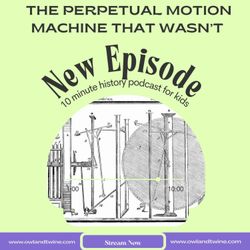
The Perpetual Motion Machine That Wasn’t
07:51|Keywordsperpetual motion, technological fraud, Charles Redheffer, engineering, history of technology, inventions, scientific advancements, robotics, historical frauds, innovationSummaryThis conversation explores the historical case of Charles Redheffer and his fraudulent perpetual motion machine in the early 19th century. It delves into the implications of questioning established scientific principles and the role of engineers in exposing technological frauds. The narrative highlights the absurdity of Redheffer's claims and the eventual unraveling of his deception, emphasizing the importance of skepticism in scientific advancement.TakeawaysQuestioning established rules can lead to scientific advancements.Charles Redheffer's perpetual motion machine was a fraud.The public was fascinated by the idea of unlimited power.Redheffer charged different prices for men and women.Engineers played a crucial role in exposing frauds.The story illustrates the absurdity of technological deception.Historical figures like Robert Fulton challenged fraudulent claims.The narrative highlights the importance of skepticism.Redheffer's disappearance from history is notable.The series will focus on technological frauds in history.TitlesThe Illusion of Perpetual MotionUnmasking the Fraud: Charles Redheffer's TaleSound bites"Have you ever seen a rule and wanted to break it?""What could you do with unlimited power source?""Thank you for returning with me after our hiatus."Chapters00:00 The Quest for Perpetual Motion02:44 The Rise and Fall of Charles Redheffer05:28 Exposing the Fraud: The Role of Engineers
Roosevelt's Zoo: Presidential Pets
06:05|🎙️ Hey there, history buffs! Did you know Teddy Roosevelt and his six kiddos were practically running a zoo in the White House? 🐻🐍 With over 40 pets, including a badger and even a bear 🦡, their adventures are bound to blow your mind! Tune in to our kids history podcast #WildWhiteHouse 🏰🐾 #PodcastFunIf you enjoyed please pass along to friends and your online community.If you found the mistake I hid in the episode please head over to www.owlandtwine.com and email me the correct answer so I can share your name on our next episode.Sources:https://www.nps.gov/thrb/learn/historyculture/roosevelt-assorted.htmhttps://www.cbsnews.com/news/presidential-pets-the-roosevelts-menagerie/https://www.presidentialpetmuseum.com/theodore-roosevelts-bears/https://www.presidentialpetmuseum.com/presidents/26tr/https://kids.nationalgeographic.com/history/article/presidential-petshttps://www.whitehousehistory.org/questions/what-are-some-unusual-animals-that-have-lived-in-and-around-the-white-househttps://www.cnn.com/interactive/2021/02/politics/white-house-pets/https://www.smithsonianmag.com/blogs/national-museum-of-natural-history/2023/02/20/in-1904-theodore-roosevelt-won-a-presidential-electionand-a-pair-of-ostriches/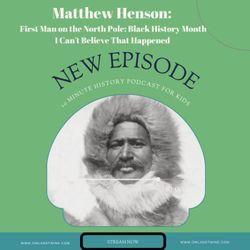
Matthew Henson: First Man on the North Pole: Black History Month I Can't Believe That Happened
10:06|Mathew Henson ExplorerI think I am going to do a series of PLEASE SOMEONE IN HOLLYWOOD MAKE A MOVIE ABOUT THIS PERSONTell me at the end if you would not sit and binge an entire series about Mathew Henson one of the first people to go to the NorthPole in our Black History month for I Can’t Believe That Happened.Born August 8 1866 on a farm in MarylandHe was the middle child with an older and a younger sisterHis parents were free sharecroppers who escaped to Georgetown after the KKK made southern Maryland too violent to stay.Mathew was orphaned at a young age and raised by his uncle in Washington DC.He earned money by washing dishes in a restaurant.During the speeches of 1863 Mathew was deeply inspired by Fredrick Douglas.At the age of 12 he became a cabin boy on the Katie Hines traveling to ports in China, Japan, Africa, and the Russian Arctic. During his time on the Hines he was educated by the ship’s captainWhen he returned to land he worked in a clothing store where he met Commander Robert E Peary. Once Robert learned of Mathew’s sea experience eh recruited him for a surveying tour of Nicaragua. Mathew impresses Peary on the voyage and became first man on all upcoming trips.For twenty years the expeditions centered around the arctic where they traded heavily with the Inuit. Mathew learned their language and was said to be the only non Inuit who became skilled in driving the sled dogs and training the dogs in the Inuit way.He was a skilled craftsman who learned to build igloos from snow and other mobile housing.In 1909 Peary mounted an expedition to reach the North Pole. He and Mathew boarded the Roosevelt leaving Greenland along with four Inuit assistants, Four Inuit guides named Egingwah, Ooqueah, Ootah, and Seeglo, and were the first people to set foot on the North Pole.Mathew was one of six chosen to make the final leg of the journey. Reports have it that Henson was no longer able to continue by foot and used the dog sled to scout ahead of the group.Henson was the one to plant the American flag.There was much controversy about the story but their accounts are backed up by the National Geographic association as well as the Naval Affairs Subcommitee of the U.S. House of Representatives.In 1912 he wrote a book about his experiences traveling widely to give speeches about his experiences. Though Henson was a very important part of the expedition it was Peary who received most of the fame and focus. Henson spent years working as a clerk.Long overdue in 1937 Henson was given membership to the New York Explorers Club.Congress awarded him the Peary Polar Expedition Medal in 1944He was honored by President Truman and President Eisenhower before he died in 1955Bibliographyhttps://www.arlingtoncemetery.mil/explore/notable-graves/explorers/matthew-hensonhttps://www.theguardian.com/travel/2020/may/24/matthew-henson-arctic-explorer-first-man-to-north-pole
One Ring To Rule Them All: The Ring That InspireD J.R.R. Tolkien's Lord of the Rings
07:45|Welcome to I Can’t Believe That Happened and our first episode on the History of Cursed Jewels.A quick reminder I always throw in one wrong fact. If you find it send me and email and let me know what the right fact is and what your source is.Let’s start with the Ring of Dwarf Hill that inspired The Lord of the Rings author J.R.R. Tolkien What if I told you that some of his epic fantasy came from actual history?Let’s talk about:The One ring to rule them all. The ring that had all of middle earth in a massive power struggle.
The Surprising History of Cursed Jewels, Jewelry, and Gemstones
05:06|What is it about minerals and gemstones that we find so amazing even beyond their beauty? We give them a supernatural power from healing crystals, to purifications, to remembering our dead with memento mori, to of course curses of long-dead powerful rulers wishing to keep their riches in to the eternity of the afterlife. We have told stories about cursed gems. There have been books and movies. You will certainly have heard of a few of the stories before or you might find out your favorite tale comes from one of these histories. When studying history we find often that the most frightening part of the tale is not the supernatural but in the way that people can set aside kindness and treat others in a way that they themselves would not wish to be treated in obtaining a symbol of power and beauty. As you might imagine the history of jewels is full of these tales. While this is meant to be a fun romp through history I want to leave you with this, never forget those in the margins of your history books and whenever you can choose kindness. Now lets go far back into a world where stones are so much more than a decoration.............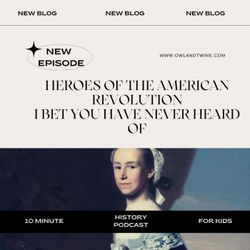
Mercy Otis Warren: Playwright, Historian, and Whistleblower July 4
08:57|Mercy Otis Warren: Revolutionary Playwright, Historian, and Whistleblower July 4 EpisodeIn researching the revolution so many names came up that even with my decades of love of history I had never heard. Mercy Otis is one. Which is surprising given how much she did during and after the revolution and the president’s who held her views in high regard. She not only wrote to presidents )who wrote back) but she published plays, pamphlets, and the first history of the revolution published by and American. Though the presidents admired (or mostly admired) her work she did have some critiques on them. She was anti slavery believing that such horrors were undermining to what the country was based on. She was angry at the treatments of the First Nations people and as you may expect was angered that there was no place for women in the new laws.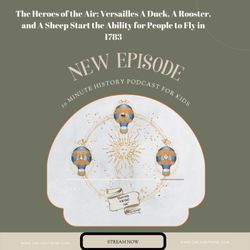
The Heroes of the Air: Versailles A Duck, A Rooster, and A Sheep
09:18|A duck, a Rooster, and a sheep wander into a wicker basket. This is not a joke it is the start of our podcast and the beginning of the ability for humans to fly. 19 September 1783 at 1 PM a cannon blasts and our Heroes of the air walk and waddle their way into history in the courtyard of Versailles in front of 130,000 people including the Queen, Marie Antoinette and King Louis.Joseph and Étienne Montgolfier had spent the years earlier experimenting with hot air and in the beginning, laundry to develop their hot air balloon.Take a listen and find out how we began flying.
Beatrix Potter Children's Book Author, Scientist, and Farmer A Ten Minute Children's History Podcast
08:38|Beatrix Potter is beloved by so many of us for her darling illustrated children's books but did you know she was a scientist who changed the English landscape? It's time to learn all about this amazing woman, her love for animals, her brilliant scientific mind, and her love of nature.