Share
How To Love Lit Podcast
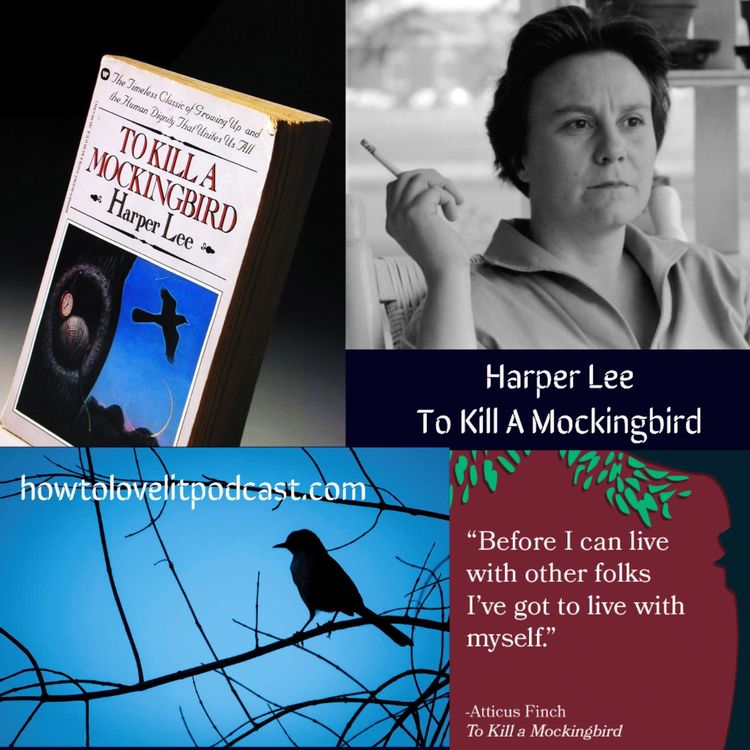
Harper Lee - To Kill A Mockingbird - Episode 1 - So Many Mysteries About The Author - And The Book!
Hi, I’m Christy Shriver and we’re here to discuss books that have changed the world and have changed us.
And I’m Garry Shriver, and this is the How to Love Lit Podcast. Today we begin our discussion on a deeply beloved book by many but at the same time one of the most censored books ever written on the American continent. When it was published in 1960 it was an immediate hit with the public. Critics called it melodramatic and over-simplistic but that hasn’t stopped people from reading it and loving it. Harper Collins boasts almost 50 million copies sold, by latest count, in over 40 languages. It won the coveted Pulitzer Prize. In 1962, it was adapted by Horton Foote into an Academy Award-winning film, admittedly diminishing the role of Scout and the story of the children but drawing considerable attention and acclaim for many reasons, one being the memorable and Oscar-winning performance of Gregory Peck as Atticus Finch. The focus of the movie is, of course, the trial of a wrongly convicted and clearly innocent African-American gentleman by the name of Tom Robinson. The film is considered one of the greatest American films of all time and even Harper Lee liked it. After viewing she had this to say, “"I can only say that I am a happy author. They have made my story into a beautiful and moving motion picture.”
Of course, it’s the racial element of the book that has always kept this book at the center of controversy- from both sides of the political aisle. It has been held in contempt for its language which is extremely raw, and obviously, and for that reason alone, it’s been censored in many circles. But that’s not the only problematic issue. Many have drawn attention to the idealized characterization of Atticus Finch as a paragon of respectability and champion of for the oppressed. Toni Morrison labeled him a “white savior”. More recently, social advocates have challenged Lee’s characterization of the Ewells as feral animals depicting them basically as sub-human. There is no doubt the setting is the segregated South of the 1930s; there is no doubt; Maycomb is a broken town; there is no doubt that the child Scout looks at her father in that way we hope all 9 year old daughters are afforded the opportunity to look at their fathers. So, is this a dated sociological study or timeless classic? Lee’s ability to stir so many emotions and raise so many questions is freakishly genius. Through the eyes of a child, she questions our ability as humans to even understand of the role of time in our world, the place of human judgement, our ability to give and receive social acceptance, the causes of human cruelty and human kindness. She goes a lot of directins- but what do all these things mean when presented as a whole? How do they connect us to each other? What did these things mean to the most provincial of people possible in 1935, what did they mean to a cosmopolitan American in 1960 and what do they mean to a world-wide interconnected globe today?
I know you like to talk about timeless themes and universal truths and so do I, don’t get me wrong, but historically speaking there’s a lot here I think is important to discuss as well. This book is not just regarded as sensitive because of its language and racial issues; it’s also considered one of the most revealing portraits of the American South to come out of that generation- and beyond issues of race there is a lot more to see. The book is important historically. Lee was born an insider to a very specific and closed cultural group, but she pulled out of her culture and tried to examine it critically in some ways as an outsider, but an outsider who understood the inside.
More episodes
View all episodes
286. Washington Irving || The Legend of Sleepy Hollow || Episode 1
50:11||Season 1, Ep. 286Washington Irving || The Legend of Sleepy Hollow || Episode 1
303. James Joyce || Dubliners || Episode 5
50:27||Season 1, Ep. 303James Joyce || Dubliners || Episode 5
302. James Joyce || Dubliners || Episode 4
46:13||Season 1, Ep. 302James Joyce || Dubliners || Episode 4
301. James Joyce || Dubliners || Episode 3
54:31||Season 1, Ep. 301James Joyce || Dubliners || Episode 3
162. Dolly Parton || The Ultimate Local Color Songwriter!
47:10||Season 1, Ep. 162Dolly Parton || The Ultimate Local Color Songwriter!
300. James Joyce || Dubliners || Episode 2
51:18||Season 1, Ep. 300James Joyce || Dubliners || Episode 2
299. James Joyce || Dubliners || Episode 1
48:55||Season 1, Ep. 299James Joyce || Dubliners || Episode 1
146. Homer || The Odyssey || Episode 5 || Homer And Penelope Reunited!
40:57||Season 1, Ep. 146Homer || The Odyssey || Episode 5 || Homer And Penelope Reunited!
145. Homer || The Odyssey || Episode 4 || The Importance Of ”Oikos” And Why Odysseus Pursues It!
43:29||Season 1, Ep. 145Homer || The Odyssey || Episode 4 || The Importance Of ”Oikos” And Why Odysseus Pursues It!