Share

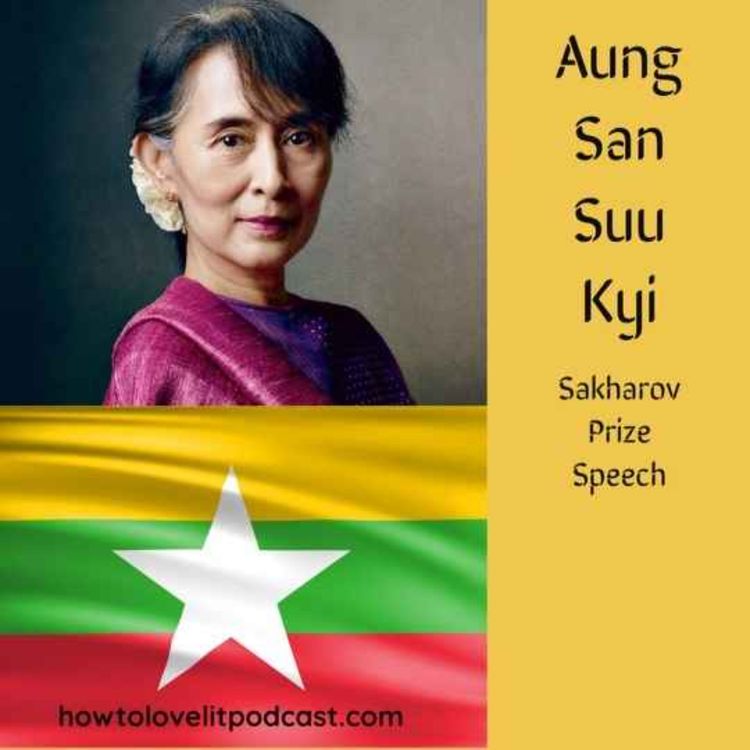
cover art for Aung San Suu Kyi || Fear Creates Corruption|| Sakharov Prize Speech!

How To Love Lit Podcast

Aung San Suu Kyi || Fear Creates Corruption|| Sakharov Prize Speech!

Season 1, Ep. 206

Aung San Suu Kyi - Fear Creates Corruption - Nobel Acceptance Speech! Hi, I’m Christy Shriver and we’re here to discuss books that have changed the world and have changed us.   


And I’m Garry Shriver, and this is the How to Love Lit Podcast.  This week, we want to turn our attention to the words and ideas of peace advocate and Nobel Laureate, Aung San Suu Kyi.  Her story is set in Southeast Asia.  A region that includes the nations of Brunei, Myanmar, Cambodia, Indonesia, Laos, Malaysia, The Philippines, Singapore, Thailand and Vietnam.  It is the most diverse region of Asia and includes hundreds of different cultures, religions, racial make ups and languages.  Just politically there are nine different kinds of regimes represented in this region of the world, ranging from military juntas, like Myanmar to monarchies like Brunei to democracies like the Philippines. Freedom House, a non-profit that monitors democracies and indexes freedoms around the world, does not rate a single country in the region as “free”.  Countries such as The Philippines, Indonesia, and Malaysia are rated as partly free, but Myanmar, Thailand, Cambodia, Laos and Vietnam are not.  Of course, there are many variables that create barriers to freedom in the region, and each country has its own unique story.  This week, we want to explore the story of Myanmar and of a woman who has devoted her life to its survival.   


Many people may know Myanmar by its other name, Burma.   


Yes, and that is confusing.  Up until 1989, it was called Burma, but in 1989, the military dictatorship changed the name of the country claiming it was more historically accurate to call it Myanmar instead of the British-derived Burma.  However, there was no public referendum on that, and many opposed the change, including Aung San Suu Kyi.  She, along with many others continue to refer to the country as Burma.  This is just one indication of the many political problems that plague this nation.   


The country is large, over 55 million people life there.  It’s natural beauty ranges from pristine beaches to the Himalayan mountains where many tribal groups live in relative seclusion.  Myanmar has cool wildlife like tigers and leopards and elephants.   It’s full of of buddhist temples, in fact, there are thousands pagodas in Myanmar earning the country the nickname, the land of pagodas, just the ancient Bagan city has over 2000 still standing.   Almost any landscape picture of Myanmar will showcase the glittery golden pagodas that dot the landscape, reminding us that this is a with a deep and rich history. 


But before we get too far into politics or religion, let’s situate it geographically.   It is bordered by India to the West, and by Western China, Thailand and Laos to the east.  It is also the largest nation in continental Southeast Asia. Remember India is considered Southern Asia, and China is considered Eastern Asia, so Mynamar is between the two.  

More episodes

View all episodes
  • 120. William Butler Yeats || The Second Coming || Apocalyptic Poetry At Its Best!

    37:00||Season 1, Ep. 120
    William Butler Yeats || The Second Coming || Apocalyptic Poetry At Its Best!  
  • 119. William Butler Yeats || Easter,1916 || The Poetry That Inspired Things Fall Apart

    46:32||Season 1, Ep. 119
    William Butler Yeats || Easter,1916 || The Poetry That Inspired Things Fall Apart
  • 297. The Short Stories of Katherine Mansfield || Episode 3 || The Garden Party Part 2

    50:08||Season 1, Ep. 297
    The Short Stories of Katherine Mansfield || Episode 3 || The Garden Party Part 2
  • 296. The Short Stories of Katherine Mansfield || Episode 2 || The Garden Party Part 1

    41:34||Season 1, Ep. 296
    The Short Stories of Katherine Mansfield || Episode 2 || The Garden Party Part 1
  • 295. The Short Stories of Katherine Mansfield || Episode 1 || Miss Brill

    41:59||Season 1, Ep. 295
    The Short Stories of Katherine Mansfield || Episode 1|| Miss Brill
  • 97. Julia de Burgos || Meet Puerto Rico's Most Famous Poet!

    39:48||Season 1, Ep. 97
    Julia de Burgos || Meet Puerto Rico's Most Famous Poet!
  • 39. The Crucible || Arthur Miller || Episode 4 || My Name! The Disintegration And Reintegration Of John Proctor!

    40:41||Season 1, Ep. 39
    The Crucible || Arthur Miller || Episode 4 || My Name! The Disintegration And Reintegration Of John Proctor!
  • 38. The Crucible || Arthur Miller || Episode 3 || Allegories Galore! || How To Incite Hysteria And Create a Bogeyman!

    40:56||Season 1, Ep. 38
    The Crucible || Arthur Miller || Episode 3 || Allegories Galore! || How To Incite Hysteria And Create a Bogeyman!
  • 200. Aldous Huxley - Brave New World - Episode 4 - The Struggle Between Meaning And Happiness!

    48:06||Season 1, Ep. 200
    Hi, I’m Christy Shriver and we’re here to discuss books that have changed the world and have changed us.  I’m Garry Shriver, and this is the How to Love Lit Podcast.  Today we conclude our four-part series on Aldous Huxley’s Brave New World; the world Huxley creates may be New but certainly it is not brave. Michel Houellebecq in his 1998 novel The Elementary Particles references Brave New World in an unusual way.  Instead of seeing it as a warning of an evil to be avoided, he, or at least his characters find it a world to aspire to.   Let me quote him, “everyone says BNW is supposed to be a totalitarian nightmare, a vicious indictment on our society, but that’s just hypocritical bullshit.  BNW is our idea of heaven: genetic manipulation, sexual liberation, the war against aging, the leisure society.”    It’s a conversation, Huxley thought we should have as a society: what constitutes a real human world?  What is human society? Are we individuals living together; or are cells in a single organism called society with a small collection of men as braintrusts running it all?  In BNW Revisited, he says this, “In spite of the Id and the Unconscious, in spite of endemic neurosis and the prevalence of low IQ's most men and women are probably decent enough and sensible enough to be trusted with the direction of their own destinies. “  The World Controllers in BNW disagree., Mond, in part 4, describes a world where men and women are NOT to be trusted with the direction of their own destinies. And as we reach the end of the book, we listen to Mustafa Mond explain why.  And in a nutshell the answer is instability.  “Independence was not made for man. God isn’t compatible with machinery and scientific medicine and universal happiness.  “It would upset the whole social order if men started doing things on their own.”  These are the arguments we read at the end of the book, but their meanings are illustrated  throughout starting in chapter one.    After reading the dialogue between John and Mond, so much of what we’ve seen illustrated makes more sense.  Really, this is a book that needs to be read twice because when you read those first chapters, you’re overwhelmed and confused.  In episode 1, we tour with our omniscient narrator that Central London Hatchery and Conditioning Center in the year of stability AF 632.  We learn that vivaparous reproduction (or birth as we know it) has been replaced by the assembly line; babies are manufactured in bottles.  The director explains to us that world is divided into castes, and everyone is conditioned to believe they are equal and equally valuable- albeit, they certainly are not equal in the way we think of equality today. We are introduced to a new set of values and the value that prevails is happiness.  The World State has solved man’s happiness problem, and we are shown how this is achieved.  The way the director describes makes it seem flawless.   Caitrin Nicol in her famous essay “Brave New World at 75” describes it a different way, “there is an unholy alliance of industrial capitalist, fascist, communist, psycho- analytic, and pseudo-scientific ideologies has brought about the end of history. The past is taboo - "History is bunk," as "Our Ford" so eloquently said - and there is no future, because history's ends have been accomplished. There is no pain, deformity, crime, anguish, or social discontent. Even death has no more sting: Children are acclimatized to the death palaces from the age of eighteen months, encouraged to poke around and eat chocolate creams while the dying are ushered into oblivion on soma, watching sports and pornography on television.”