Holistic History Pod
All Episodes
Trailer
01:20|History isn't just about dates and dead kings.It's about the decisions, ideas, triumphs and disasters that shaped the world we live in today.Welcome to Holistic History, I’m Russell Myrie.Once a month, ill delve into a fascinating topic or event from the past, exploring the people, conflicts and turning points that changed the course of history. From political conspiracies and social upheaval to war, revolution and the stories that are often overlooked, I’ll examine the past in its full context.Discover the events that shaped the world—for better or worse—and gain the most powerful tool you could ever hope for: hindsight.Because when we understand where we've been, we see the present a little more clearly.And for the first month, you lucky lot get two topics instead of one.So join us as we take a holistic look at history and uncover the stories that still echo through our world today.Subscribe now at: shows.acast.com/holistic-history for the third and final episode of every season.
1. The Nazi Inspired Plot To Overthrow President Franklin Roosevelt: The Prelude To The Plot
35:12||Season 1, Ep. 1When The Great Depression follows the Wall Street Crash and the rise of fascism in Europe, the seeds are sown for an immoral and unlawful plot to overthrow President Roosevelt, the person whose job it is to steer the United States through the extremely difficult times.
1. The Lancashire Cotton Famine: Is Cotton King?
28:24||Season 2, Ep. 1How did the outbreak of the civil war in the United States affect aspects of the Industrial Revolution in Britain? What happened when the cotton stopped arriving in Britain after the hostilities began?
2. The Nazi Inspired Plot To Overthrow President Franklin Roosevelt: The Plot Thickens
31:08||Season 1, Ep. 2As President Roosevelt's New Deal is introduced across America, powerful forces organise in order to overthrow the President who they feel has forgotten what class he comes from.
2. The Lancashire Cotton Famine: The Hardship Hits
33:18||Season 2, Ep. 2As the civil war intensifies, the lack of cotton causes Lancashire's cotton mills to grind to a halt. How do the people who relied on the cotton for their livelihoods cope?
1. Convict Leasing & The Chain Gangs: The 13th Amendment
40:08||Season 3, Ep. 1The American Civil War may have ended slavery, but one crucial clause in the 13th Amendment left the door open to a new form of exploitation. This episode explores how that loophole shaped the decades that followed, tracing the origins of convict leasing and asking whether slavery truly ended—or simply evolved.
2. Convict Leasing & The Chain Gang: The Chain Remains
30:15||Season 3, Ep. 2Reconstruction briefly offered hope for genuine freedom and equality, but that hope was systematically dismantled. From the rise of the Ku Klux Klan and the Black Codes to the writings of George Washington Cable and the tragedy of President James Garfield's assassination, this episode examines how opportunity gave way to oppression and how convict leasing became embedded across the American South.
1. The Paris Peace Conference & The Pan African Congress: Was It The Most Important Event Of The 20th Century?
43:22||Season 4, Ep. 1In 1919, the victors of the First World War gathered in Paris with an extraordinary task: to redraw borders, dismantle empires and create a new international order that they hoped would prevent another global war. The consequences would reach far beyond Versailles.In this episode, I examine the Paris Peace Conference and ask whether the decisions made there helped shape more of the twentieth century than any other single event — from the rise of fascism and the Second World War to the creation of new states, the decline of empires and conflicts that continue into the present day. But another gathering was taking place in Paris. W. E. B. Du Bois and delegates to the 1919 Pan-African Congress sought to challenge the contradiction at the heart of the new world order: European and American leaders were talking about self-determination while millions of people across Africa, Asia and the Caribbean remained under colonial rule. From Woodrow Wilson, David Lloyd George and Georges Clemenceau to Du Bois, Blaise Diagne and Ida Gibbs, this episode explores who was allowed a seat at the table, who wasn't — and how decisions made in Paris in 1919 helped create the world we live in today.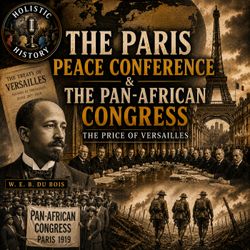
2. The Paris Peace Conference & The Pan African Congress: The Price Of Versailles
28:11||Season 4, Ep. 2What happened when the victors of the First World War finally decided what peace would look like?This episode examines the decisions made at the Paris Peace Conference and the consequences of excluding the defeated powers from the negotiations. Germany faced the War Guilt Clause, severe military restrictions and enormous reparations, while Georges Clemenceau fought to ensure that France would never again face a powerful German threat. The episode asks whether the Allies went too far — and whether the settlement created precisely the resentment and instability that its architects hoped to prevent.It also explores the enormous advantage Clemenceau gained from hosting the conference in Paris, the influence of the French and international press, and Woodrow Wilson's increasingly difficult attempt to reconcile his promise of open diplomacy with the secretive reality of great-power negotiations.David Lloyd George provides a striking counterpoint. His Fontainebleau Memorandum warned that treating Germany unjustly could ultimately produce demands for retribution, even as Britain pursued its own imperial interests and acquired territory from the defeated German and Ottoman empires.And behind these negotiations was another struggle. What did the decisions of the world's most powerful states mean for the Pan-African Congress and its demands for a different future? Could the principle of self-determination ever be reconciled with the victorious powers' determination to preserve and expand their empires? This episode sets up that question before the series turns directly to its consequences in the finale.
loading...